HFFS Pouching Machines Market Size and Growth
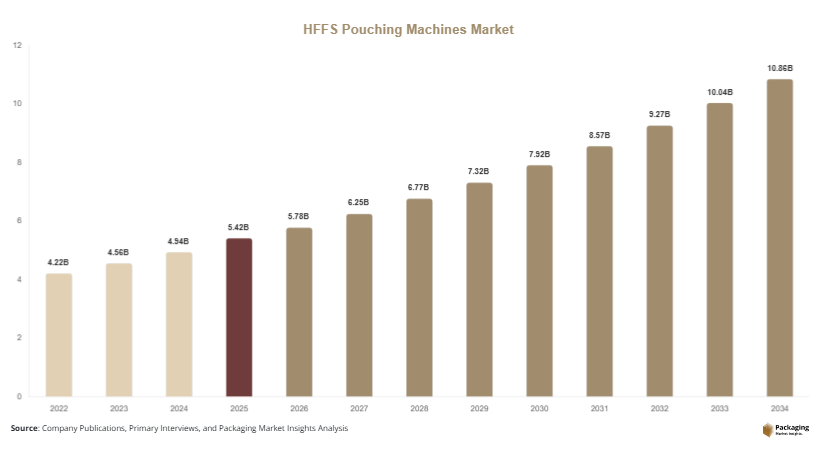
The global HFFS Pouching Machines Market size is estimated at approximately USD 5.42 billion in 2025, and it is projected to reach USD 5.78 billion in 2026. By 2034, the market is expected to grow significantly to around USD 10.95 billion, registering a CAGR of 8.2% during 2025–2034. This growth is supported by increasing automation in packaging lines and the shift toward flexible, lightweight, and cost-efficient pouch packaging formats. The HFFS (Horizontal Form Fill Seal) Pouching Machines Market is experiencing steady expansion due to rising demand for automated, high-speed flexible packaging solutions across food, pharmaceuticals, personal care, and industrial sectors.
One of the major growth factors is the rising consumption of packaged food and ready-to-eat products globally, which requires high-speed pouching systems for efficient production. Another factor is the increasing adoption of automation and Industry 4.0 technologies in manufacturing facilities, enabling better productivity and reduced operational downtime. Additionally, demand for sustainable packaging formats such as recyclable and mono-material pouches is pushing manufacturers to invest in advanced HFFS systems capable of handling eco-friendly materials.
Key Highlights
- Europe dominated the market with a 36.8% share in 2025.
- Asia Pacific is projected to grow at the fastest CAGR of 8.6% (2025–2034).
- Continuous motion HFFS pouching machines led the machine type segment with a 58.4% share in 2024.
- Food and beverage application dominated the market with a 46.7% share in 2024.
- FMCG end-use industry accounted for a 49.2% share in 2024.
- The US market reached USD 1.35 billion in 2025 and USD 1.46 billion in 2026
Explore more data points, trends and opportunities Download Free Sample Report
Market Trends
Integration of Smart Automation and IoT-Enabled HFFS Machines
The integration of smart automation and IoT-based monitoring systems is transforming the HFFS pouching machines market. Manufacturers are increasingly adopting machines equipped with real-time diagnostics, predictive maintenance features, and AI-based quality control systems. These advancements reduce downtime and improve production efficiency. IoT-enabled HFFS machines allow operators to monitor temperature, sealing strength, and filling accuracy remotely, enhancing production reliability. This trend is particularly strong in large-scale food and pharmaceutical packaging plants where operational consistency and compliance are critical. The shift toward smart factories is further encouraging investment in digitally connected pouching systems.
Rising Demand for Sustainable and Mono-Material Packaging Compatibility
Sustainability is becoming a core trend shaping machine design in the HFFS pouching machines market. Packaging manufacturers are moving toward recyclable and mono-material films, requiring machines capable of handling complex sealing conditions. HFFS systems are being upgraded with improved sealing technologies that ensure compatibility with biodegradable and eco-friendly materials. This trend is driven by regulatory pressures in Europe and North America, where packaging waste reduction targets are strict. Brands are also focusing on reducing carbon footprint across packaging lines, which is accelerating demand for energy-efficient and low-waste pouching machines.
Market Drivers
Expansion of Processed Food and Beverage Industry
The rapid growth of the processed food and beverage industry is a key driver of the HFFS pouching machines market. Urbanization, changing lifestyles, and increasing demand for convenient food options are pushing manufacturers toward flexible pouch packaging formats. HFFS machines are widely used for packaging snacks, sauces, frozen foods, and dairy products due to their high-speed capabilities and sealing accuracy. The shift toward portion-controlled packaging is also increasing machine utilization across global production facilities. Additionally, food safety regulations are encouraging manufacturers to adopt hygienic, automated packaging systems, further boosting demand for HFFS pouching machines.
Increasing Adoption of Automation in Packaging Lines
Automation in packaging operations is another strong driver supporting market growth. Manufacturers are investing heavily in fully automated production lines to improve efficiency and reduce labor dependency. HFFS pouching machines play a critical role in this transformation by enabling continuous, high-speed packaging with minimal human intervention. Integration with robotics, vision inspection systems, and digital monitoring tools enhances productivity and reduces errors. Industries such as pharmaceuticals and personal care are increasingly adopting automated HFFS systems to maintain consistency and comply with strict regulatory requirements.
Market Restraint
High Initial Investment and Maintenance Costs
One of the major restraints in the HFFS pouching machines market is the high initial capital investment required for advanced machinery. Small and medium-sized packaging companies often find it difficult to adopt fully automated HFFS systems due to cost constraints. In addition to purchase costs, maintenance, spare parts replacement, and skilled operator requirements increase overall operational expenses. This creates a barrier to adoption in price-sensitive markets, particularly in developing regions. Moreover, frequent technological upgrades and integration of smart systems further add to long-term cost burdens, slowing down market penetration among smaller manufacturers.
Market Opportunities
Growth in E-Commerce Packaging Demand
The expansion of global e-commerce is creating strong opportunities for HFFS pouching machines. Online retail requires durable, lightweight, and tamper-resistant packaging, which is efficiently achieved through flexible pouch formats. HFFS machines are increasingly being used for packaging cosmetics, supplements, and food items sold through e-commerce platforms. The rise in direct-to-consumer brands is further increasing demand for customized pouch sizes and branding-friendly packaging solutions. This shift is encouraging manufacturers to invest in flexible and high-speed pouching systems.
Advancements in Multi-Lane and High-Speed Machines
Technological advancements in multi-lane and high-speed HFFS machines are opening new growth opportunities. These systems allow simultaneous production of multiple pouch lines, significantly improving output efficiency. Manufacturers are focusing on reducing cycle time and increasing production flexibility to meet diverse packaging demands. High-speed machines are particularly beneficial for large-scale FMCG and pharmaceutical companies. Continuous innovation in servo-driven systems and precision control mechanisms is expected to enhance machine efficiency further, creating strong market expansion opportunities.
Report Scope
| Report Metric | Details |
|---|---|
| Market Size in 2025 | USD 5.42 Billion |
| Market Size in 2026 | USD 5.78 Billion |
| Market Size in 2034 | USD 10.95 Billion |
| CAGR | 8.2% (2026-2034) |
| Base Year for Estimation | 2025 |
| Historical Data | 2022-2024 |
| Forecast Period | 2026-2034 |
| Report Coverage | Revenue Forecast, Competitive Landscape, Supply Chain Disruption, Growth Factors, Environment & Regulatory Landscape and Trends |
| Geographies Covered | North America, Europe, APAC, Middle East and Africa, LATAM |
| Countries Covered | U.S., Canada, U.K., Germany, France, Spain, Italy, Russia, Nordic, Benelux, Rest of Europe, China, South Korea, Japan, India, Australia, Singapore, Taiwan, South East Asia, Rest of Asia-Pacific, UAE, Turky, Saudi Arabia, South Africa, Egypt, Nigeria, Rest of MEA, Brazil, Mexico, Argentina, Chile, Colombia, Rest of LATAM |
Explore more data points, trends and opportunities Download Free Sample Report
Segmental Analysis
By Machine Type
The machine type segment of the HFFS pouching machines market includes intermittent motion machines and continuous motion machines, both playing a crucial role in determining production speed, efficiency, and application suitability. Among these, continuous motion HFFS pouching machines dominated the market with approximately 58.4% share in 2024. This dominance is primarily due to their ability to deliver uninterrupted production cycles, higher throughput, and reduced downtime, making them highly suitable for large-scale manufacturing environments. Industries such as food and beverage, pharmaceuticals, and household products prefer continuous motion systems because they offer consistent sealing quality and improved operational efficiency across long production runs.
The demand for continuous motion systems is further supported by increasing automation in packaging lines and the rising need for high-speed output in mass production facilities. Manufacturers are increasingly integrating servo-driven mechanisms and advanced control systems into these machines to enhance precision and reduce material wastage. Additionally, continuous motion machines are well-suited for handling a wide variety of flexible packaging materials, including multilayer films and recyclable laminates, which are becoming more common due to sustainability regulations.
On the other hand, intermittent motion HFFS pouching machines are expected to witness the fastest growth, expanding at a CAGR of around 9.3% during 2025–2034. These machines are gaining traction among small and medium-sized enterprises due to their lower initial investment cost, ease of operation, and flexibility in handling short production runs. Intermittent systems are particularly popular in niche applications such as specialty foods, organic products, and pharmaceutical sampling packs where batch sizes are smaller and customization is higher.
Growth in this subsegment is also driven by increasing demand for flexible production systems that can switch between different pouch formats quickly. As consumer preferences shift toward personalized and smaller packaging sizes, intermittent motion machines are becoming more relevant. Technological upgrades such as digital controls and modular machine designs are further enhancing their adoption across emerging markets.
By Application
The application segment of the HFFS pouching machines market is broadly categorized into food and beverage, pharmaceuticals, personal care and cosmetics, chemicals, and others. Among these, the food and beverage segment dominated the market with a share of approximately 46.7% in 2024. This dominance is attributed to the massive global demand for packaged food products such as snacks, sauces, frozen meals, dairy products, and ready-to-eat items. HFFS machines are widely used in this sector due to their ability to provide hygienic, leak-proof, and cost-efficient packaging solutions.
The food industry heavily relies on flexible pouch formats that offer convenience, longer shelf life, and portability. HFFS pouching machines support high-speed production while maintaining product safety standards, making them an essential component in modern food packaging lines. Increasing urbanization, busy lifestyles, and rising demand for convenience foods are further strengthening this segment’s position in the market.
The pharmaceutical application segment is projected to be the fastest-growing, expanding at a CAGR of approximately 9.8% during the forecast period. The demand is being driven by the increasing need for unit-dose packaging, blister alternatives, and sterile pouch formats for tablets, powders, and liquid medicines. HFFS machines offer high precision sealing and contamination-free packaging, which is critical for pharmaceutical compliance standards.
Growth in this segment is also supported by the expansion of the global healthcare industry and rising consumption of over-the-counter (OTC) drugs. In addition, increasing adoption of single-dose packaging for patient convenience and medication adherence is accelerating demand. Pharmaceutical companies are investing in advanced HFFS systems equipped with validation and traceability features to comply with stringent regulatory requirements.
By End-Use Industry
The end-use industry segment includes FMCG, healthcare, industrial chemicals, agriculture, and others. Among these, the FMCG (Fast-Moving Consumer Goods) industry held the dominant share of approximately 49.2% in 2024. This strong position is driven by the extensive use of flexible packaging for consumer goods such as snacks, beverages, detergents, personal care products, and household essentials.
FMCG manufacturers prioritize high-speed, cost-efficient, and visually appealing packaging solutions, which makes HFFS pouching machines highly suitable for this sector. The growing retail penetration of branded consumer goods and expansion of supermarket and e-commerce distribution channels are further boosting demand. FMCG companies are also increasingly focusing on sustainable packaging formats, encouraging the adoption of machines capable of handling recyclable and biodegradable films.
The healthcare and pharmaceutical end-use segment is expected to register the fastest growth, with a CAGR of around 9.6% during 2025–2034. This growth is primarily driven by rising healthcare expenditure, increasing demand for sterile packaging, and growing adoption of single-dose medication formats. HFFS machines are increasingly being used to produce hygienic and tamper-proof packaging solutions for medical supplies and pharmaceutical products.
The expansion of healthcare infrastructure in emerging economies and rising awareness regarding patient safety are further accelerating this segment. Pharmaceutical manufacturers are investing in advanced HFFS systems that offer high precision dosing, contamination control, and compliance with international regulatory standards. Additionally, the growing trend of personalized medicine and home-based healthcare is contributing to increased demand for small-format pouch packaging solutions.
HFFS Pouching Machines Market Segmentations
By Machine Type
- Continuous Motion HFFS Machines
- Intermittent Motion HFFS Machines
- Servo-Driven HFFS Systems
- Multi-Lane Pouching Machines
By Application
- Food & Beverage
- Pharmaceuticals
- Personal Care & Cosmetics
- Chemicals
- FMCG Packaging
By End-Use Industry
- FMCG
- Healthcare & Pharmaceuticals
- Industrial Packaging
- Agriculture
- Others
Regional Analysis
North America
North America accounted for approximately 28.4% share of the HFFS pouching machines market in 2025 and is projected to grow at a CAGR of around 7.9% during 2025–2034. The region benefits from advanced packaging infrastructure, high automation penetration, and strong demand from the processed food and pharmaceutical industries. The United States dominates regional demand due to large-scale manufacturing facilities and early adoption of smart packaging technologies.
The U.S. market growth is primarily driven by increasing investment in high-speed packaging lines and rising demand for convenience food products. The presence of leading packaging machinery manufacturers and continuous technological innovation in servo-driven HFFS systems further strengthens market expansion in the region.
Europe
Europe held around 25.6% market share in 2025 and is expected to grow at a CAGR of 7.4% through 2034. The region shows strong demand due to strict packaging regulations, sustainability initiatives, and high adoption of recyclable packaging solutions. Countries such as Germany, Italy, and France play a significant role in machinery production and export.
Germany dominates the European market due to its strong industrial base and advanced engineering capabilities. The country’s focus on energy-efficient packaging machinery and automation in manufacturing plants is a key growth factor supporting regional expansion.
Asia Pacific
Asia Pacific dominated the global market with a 34.2% share in 2025 and is projected to grow at the fastest CAGR of 9.8% from 2025 to 2034. Rapid industrialization, expanding food processing industries, and increasing demand for packaged consumer goods are driving strong adoption of HFFS pouching machines in the region.
China leads the Asia Pacific market due to its massive manufacturing sector and large-scale packaging production facilities. Rising investments in automation and the expansion of domestic packaging machinery manufacturers are significantly boosting market growth.
Middle East & Africa
The Middle East & Africa region accounted for approximately 6.5% market share in 2025 and is projected to grow at a CAGR of 7.1% during 2025–2034. Growth in the region is supported by expanding food processing industries, increasing urbanization, and rising demand for packaged consumer goods.
Saudi Arabia dominates the regional market due to its growing food manufacturing sector and increasing investments in industrial diversification under economic transformation programs. Adoption of automated packaging systems is gradually increasing across large-scale production facilities.
Latin America
Latin America held around 5.3% share in 2025 and is expected to grow at a CAGR of 7.6% during the forecast period. The region is experiencing steady growth driven by rising packaged food consumption and expansion of retail distribution networks.
Brazil is the leading market in the region due to its strong food processing industry and increasing investments in packaging automation. The growing presence of multinational FMCG companies is further supporting adoption of HFFS pouching machines.
Latin America
Latin America held 6% share in 2025 and is expected to grow at a CAGR of 6.8% through 2034. Growth is supported by expanding food processing industries.
Brazil dominates the region due to strong FMCG production. A key growth factor is increasing investment in automated packaging equipment to improve export competitiveness.
Competitive Landscape
The HFFS pouching machines market is highly competitive with several global machinery manufacturers focusing on automation, speed, and sustainability. Key players include Bosch Packaging Technology, IMA Group, Syntegon Technology, KHS GmbH, and Matrix Packaging Machinery. These companies are investing heavily in R&D to enhance machine efficiency and integrate digital technologies.
Syntegon Technology is considered a leading player due to its strong global presence and advanced automated packaging solutions. Recently, the company introduced next-generation servo-driven HFFS machines designed for high-speed flexible packaging with improved energy efficiency and reduced material waste.
Key Players List
- Bosch Packaging Technology
- Syntegon Technology
- IMA Group
- KHS GmbH
- Matrix Packaging Machinery
- ULMA Packaging
- Scholle IPN
- ProMach Inc.
- Mespack
- Harpak-ULMA
- Accutek Packaging Equipment
- Volpak
- Mespack
- Reepack S.r.l.
- SN Maschinenbau