Disposable Tea Flask Market Size
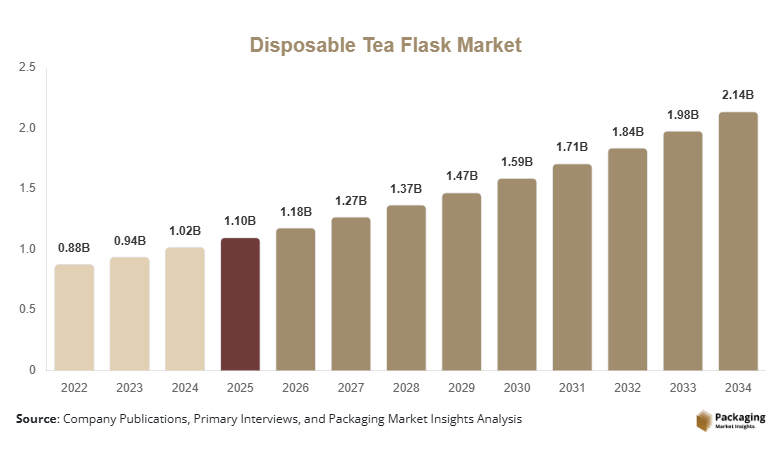
The disposable tea flask market size is projected at USD 1.18 billion in 2026 and is expected to hit USD 2.14 billion by 2034 with a CAGR of 7.7%.
The disposable tea flask market report provides a detailed evaluation of market performance, segmentation trends, regional developments, production capacity, and the competitive landscape. Growing consumption of ready-to-drink beverages, increasing takeaway food services, and demand for convenient beverage packaging solutions are accelerating adoption across food service and retail sectors. The study analyzes market opportunities through quantitative insights covering product innovations, material preferences, application demand, and industry expansion.
The disposable tea flask market includes single-use insulated containers designed for tea, hot beverages, and portable beverage consumption. These products provide thermal retention, lightweight handling, and hygienic packaging solutions for restaurants, cafes, street beverage vendors, and institutional facilities. Global production exceeded 6.5 billion disposable tea flask units in 2025, with plastic-based flasks contributing approximately 48% share, followed by paper-based products at 32% and biodegradable alternatives at 20%, supporting overall disposable tea flask market development.
Explore more data points, trends and opportunities Download Free Sample Report
Disposable Tea Flask Market Trends
Increasing Shift Toward Sustainable Disposable Beverage Containers
The disposable tea flask market trend is strongly influenced by growing environmental concerns and adoption of sustainable packaging materials. Manufacturers are introducing biodegradable and recyclable tea flasks using plant-based polymers and paper composites. In 2025, more than 1.3 billion eco-friendly disposable beverage containers were produced globally, representing nearly 22% of total disposable tea flask production. Food service operators adopting sustainable packaging increased by approximately 35% across urban markets, strengthening the transition toward environmentally responsible disposable tea flask market solutions.
Growth of Convenience Beverage Consumption and Premium Designs
The disposable tea flask market trend is supported by rising demand for portable beverage packaging among consumers. More than 7 billion takeaway beverage servings are estimated to utilize disposable packaging annually, creating opportunities for insulated flask manufacturers. Advanced designs featuring leak resistance, improved thermal insulation, and customized branding capabilities have achieved adoption rates of nearly 45% among premium cafes and beverage chains. These developments continue to expand disposable tea flask market demand across commercial applications.
Disposable Tea Flask Market Drivers
Expansion of Food Service and Takeaway Beverage Culture
The disposable tea flask market growth is driven by the rapid expansion of cafes, restaurants, online food delivery, and takeaway beverage services. The global food service industry generated more than USD 3 trillion in revenue in 2025, increasing demand for convenient beverage packaging. Approximately 55% of disposable tea flask consumption originates from commercial food outlets, while urban beverage vendors contribute nearly 25%. Growing consumer preference for portable tea consumption and hygienic packaging solutions is supporting consistent disposable tea flask market expansion.
Disposable Tea Flask Market Restraints
Environmental Concerns Related to Single-Use Packaging Waste
The disposable tea flask market faces restraints due to increasing regulations against single-use plastics and packaging waste. Plastic-based disposable flasks account for nearly 48% of production but face restrictions in multiple regions due to environmental concerns. Recycling rates for conventional disposable beverage packaging remain below 40% in several developing economies. Compliance costs, alternative material adoption, and waste management requirements increasing by 15%–20% annually create challenges for disposable tea flask market manufacturers.
Disposable Tea Flask Market Opportunities
Rising Adoption of Biodegradable and Compostable Materials
The disposable tea flask market opportunities are expanding due to increasing investments in sustainable packaging technologies. Demand for biodegradable beverage containers has grown by more than 30% since 2024, supported by consumer awareness and corporate sustainability initiatives. Manufacturers developing compostable materials, including paper composites and bio-based polymers, are targeting markets representing more than USD 50 billion in sustainable packaging demand. These innovations are expected to create significant opportunities for the disposable tea flask market.
Challenges in Disposable Tea Flask Market
Raw Material Price Volatility and Supply Chain Limitations
The disposable tea flask market faces challenges due to fluctuations in raw material costs and supply chain disruptions. Plastic resin prices account for nearly 35% of manufacturing expenses, while paper-based material costs contribute approximately 25%. Global supply chain variations affecting more than 20% of packaging manufacturers create production uncertainties. Maintaining cost efficiency while transitioning toward sustainable materials remains a key challenge for disposable tea flask market participants.
Report Scope
| Report Metric | Details |
|---|---|
| Market Size in 2025 | USD 1.10 Billion |
| Market Size in 2026 | USD 1.18 Billion |
| Market Size in 2034 | USD 2.14 Billion |
| CAGR | 7.7% (2026-2034) |
| Base Year for Estimation | 2025 |
| Historical Data | 2022-2024 |
| Forecast Period | 2026-2034 |
| Report Coverage | Revenue Forecast, Competitive Landscape, Supply Chain Disruption, Growth Factors, Environment & Regulatory Landscape and Trends |
| Geographies Covered | North America, Europe, APAC, Middle East and Africa, LATAM |
| Countries Covered | U.S., Canada, U.K., Germany, France, Spain, Italy, Russia, Nordic, Benelux, Rest of Europe, China, South Korea, Japan, India, Australia, Singapore, Taiwan, South East Asia, Rest of Asia-Pacific, UAE, Turkey, Saudi Arabia, South Africa, Egypt, Nigeria, Rest of MEA, Brazil, Mexico, Argentina, Chile, Colombia, Rest of LATAM |
Explore more data points, trends and opportunities Download Free Sample Report
Disposable Tea Flask Market Segmentation
The disposable tea flask market segmentation is categorized by material type and application. Plastic disposable tea flasks dominate with approximately 48% share due to affordability and large-scale availability, while food service applications represent nearly 55% of total consumption. Increasing adoption of sustainable alternatives is reshaping segmentation patterns as businesses seek environmentally responsible beverage packaging options.
By Material Type
Plastic disposable tea flasks represent the largest segment with approximately 48% market share. Global production exceeds 3 billion units annually due to cost efficiency, lightweight properties, and strong availability. These flasks typically use polypropylene or polyethylene materials with heat resistance capabilities ranging between 70°C and 100°C. They are widely used by beverage vendors, cafes, and quick-service restaurants requiring economical packaging solutions.
Paper-based tea flasks account for nearly 32% share, supported by increasing sustainability initiatives. Annual production exceeds 2 billion units globally. These products feature coated paper layers, moisture barriers, and improved insulation structures. Growing adoption among premium cafes and corporate food services is increasing demand for paper-based disposable tea flask market products.
Biodegradable tea flasks contribute approximately 20% of the market share, with production exceeding 1.3 billion units annually. These products utilize materials such as PLA, bagasse, and compostable polymers. Their environmentally friendly characteristics and compliance with sustainability standards are increasing adoption across developed markets.
By Application
Food service applications dominate the disposable tea flask market with nearly a 55% share. Restaurants, cafes, tea shops, and quick-service outlets consume more than 3.5 billion units annually. Increasing online food delivery penetration exceeding 60% in major urban markets is creating strong demand for disposable beverage packaging solutions.
Retail applications contribute approximately 28% share, with annual consumption exceeding 1.8 billion units. Supermarkets, convenience stores, and beverage retailers use disposable tea flasks for ready-to-consume beverages. Improved product branding and consumer convenience are supporting market adoption.
Institutional Use
Institutional users represent nearly 17% share, consuming over 1 billion units annually. Offices, educational institutions, hospitals, and event organizers utilize disposable tea flasks for large-scale beverage distribution. Increasing workplace beverage services are improving penetration across institutional segments.
Disposable Tea Flask Market Segmentations
Material Type
- Paper-Based Disposable Tea Flasks
- Plastic Disposable Tea Flasks
- Biodegradable & Compostable Tea Flasks
- Aluminum & Laminated Tea Flasks
Capacity
- Small Capacity Flasks (Below 250 ml)
- Medium Capacity Flasks (250 ml–500 ml)
- Large Capacity Flasks (Above 500 ml)
Application
- Foodservice & Restaurants
- Cafes & Beverage Chains
- Retail & Convenience Stores
- Travel, Events & Outdoor Activities
Distribution Channel
- Online Retail
- Supermarkets & Hypermarkets
- Specialty Packaging Stores
- Direct Sales & Bulk Distribution
Disposable Tea Flask Market Regional Outlook
North America
North America accounts for approximately 28% of the disposable tea flask market share, supported by strong cafe culture and food delivery expansion. The United States contributes nearly 80% of regional demand, consuming more than 1.4 billion units annually. Sustainable paper-based and biodegradable products represent nearly 45% of regional adoption due to environmental regulations.
Europe
Europe holds around 26% share, driven by sustainability-focused packaging policies. Germany, the United Kingdom, and France collectively account for more than 1 billion units annually. Biodegradable disposable tea flasks represent approximately 35% of regional demand due to strict environmental standards.
Asia Pacific
Asia Pacific is the fastest-growing region, representing nearly 34% market share. China, India, and Japan contribute more than 2 billion units annually due to increasing tea consumption and expanding food delivery networks. The region demonstrates strong demand from retail and street beverage applications.
Latin America and Middle East & Africa
These regions collectively account for approximately 12% share. Growing urbanization, increasing cafe establishments, and expanding hospitality sectors are supporting market growth. Brazil, Mexico, the UAE, and South Africa are emerging contributors with increasing disposable beverage packaging adoption.
Top Players In The Disposable Tea Flask Market
- Huhtamaki Oyj
- International Paper Company
- Amcor Plc
- Mondi plc
- WestRock Company
- Berry Global Inc.
- Sonoco Products Company
- Dart Container Corporation
- Genpak LLC
- Graphic Packaging Holding Company
Huhtamaki Oyj maintains a strong position in the disposable tea flask market through its extensive sustainable food packaging portfolio. The company holds an estimated 10%–12% market presence across disposable beverage packaging solutions. Its focus on recyclable materials, paper-based containers, and customized food service packaging strengthens its competitive position. The company serves global food service operators with millions of packaging units annually. Amcor Plc. Amcor Plc. represents a significant participant with approximately 8%–10% share in the disposable tea flask market. The company focuses on advanced packaging materials, lightweight designs, and sustainable solutions. Its global manufacturing network supports beverage packaging demand across multiple regions. Investments in recyclable and environmentally improved materials enhance its positioning in the evolving disposable tea flask industry.