Liquid Carton Packaging Market Size and Growth
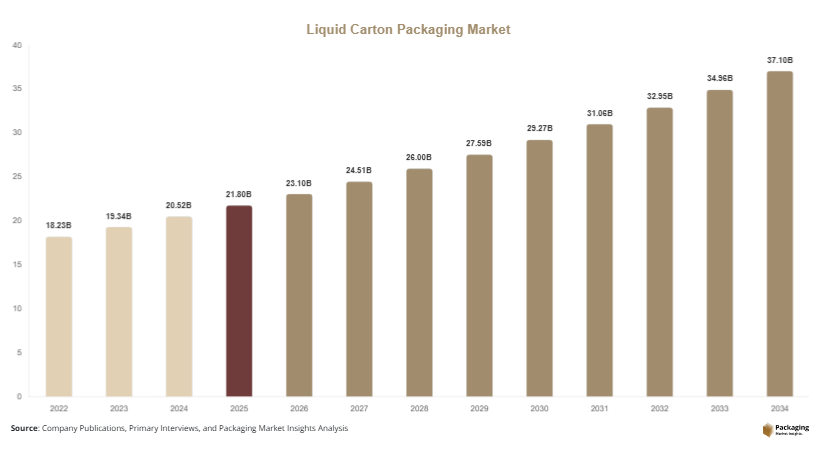
The global liquid carton packaging market was valued at approximately USD 21.8 billion in 2025 and is projected to reach USD 23.1 billion in 2026. The market is expected to grow at a CAGR of 6.1% during 2025–2034, reaching nearly USD 39.8 billion by 2034. Growing demand for sustainable beverage packaging, increasing consumption of dairy and plant-based drinks, and rising adoption of aseptic packaging technologies are supporting the expansion of the market across developed and emerging economies.
Liquid carton packaging is widely used for packaging milk, juice, flavored beverages, liquid food products, soups, and ready-to-drink nutritional beverages. These cartons are generally manufactured using paperboard combined with polyethylene and aluminum barrier layers that provide product protection, longer shelf life, lightweight transportation, and improved storage efficiency. The market continues to benefit from growing consumer preference for convenient, portable, and recyclable packaging solutions.
Key Highlights
- Asia Pacific dominated the market with a 39.2% share in 2025.
- Latin America is projected to grow at the fastest CAGR of 6.8%.
- Aseptic cartons led the type segment with a 46.5% share.
- Paperboard materials dominated with a 61.3% share.
- Dairy beverages led the end-use segment with 44.8% share.
- The US remained the dominant country with a market size of USD 4.3 billion in 2025 and USD 4.6 billion in 2026.
Explore more data points, trends and opportunities Download Free Sample Report
Market Trends
Increasing Adoption of Renewable and Recyclable Carton Materials
The growing adoption of renewable and recyclable materials is becoming one of the most important trends in the liquid carton packaging market. Beverage manufacturers are increasingly shifting toward paper-based cartons made from certified renewable forestry sources to reduce dependence on fossil fuel-based plastic packaging. Packaging companies are also developing recyclable multilayer structures and plant-based caps designed to improve circular economy performance.
For example, dairy and juice manufacturers are increasingly introducing cartons made with bio-based polymers and renewable paperboard materials to strengthen sustainability commitments. Retailers are also supporting recyclable packaging adoption as consumers increasingly prefer environmentally responsible beverage packaging. This trend is expected to accelerate as governments implement stricter packaging waste regulations and beverage companies increase investments in low-carbon packaging technologies.
Rising Demand for Aseptic and Shelf-Stable Beverage Packaging
The growing demand for aseptic and shelf-stable beverage packaging is another major trend shaping the liquid carton packaging market. Aseptic cartons allow liquid food and beverage products to remain fresh for extended periods without refrigeration, making them highly attractive for dairy products, juices, soups, and nutritional beverages.
Beverage manufacturers are increasingly adopting aseptic filling technologies to improve product distribution efficiency and reduce cold-chain transportation costs. For instance, plant-based beverage producers are expanding the use of aseptic cartons for almond milk, oat milk, and protein drinks because these products require longer shelf stability across retail channels. Future growth of aseptic carton packaging is expected to be supported by increasing urbanization, rising demand for convenience beverages, and expanding retail distribution networks in developing economies.
Market Drivers
Growing Consumption of Dairy and Plant-Based Beverages
The rapid growth in dairy and plant-based beverage consumption is a major factor driving the liquid carton packaging market. Consumers are increasingly purchasing flavored milk, yogurt drinks, protein beverages, fruit juices, oat milk, almond milk, and soy beverages due to changing dietary preferences and rising health awareness.
Liquid cartons provide effective protection against moisture, oxygen, and light exposure while maintaining beverage freshness and nutritional quality. Beverage manufacturers are increasingly using aseptic cartons to improve shelf life and expand product distribution without refrigeration requirements. For example, several international dairy brands have expanded production of single-serve flavored milk cartons and family-size plant-based beverage cartons to meet growing consumer demand. The continued expansion of health-focused beverage categories is expected to support strong long-term packaging demand.
Expansion of Sustainable Packaging Regulations
Increasing government regulations related to sustainable packaging and plastic waste reduction are strongly supporting the liquid carton packaging market. Regulatory authorities across Europe, North America, and Asia Pacific are encouraging the use of recyclable and renewable packaging materials while restricting certain single-use plastics.
Liquid cartons are increasingly viewed as environmentally preferable packaging formats because of their lightweight structure and renewable paperboard content. Beverage companies are responding by replacing plastic bottles with recyclable carton packaging for milk, juice, and ready-to-drink beverages. Several global beverage producers are also introducing plant-based caps and renewable polymer coatings to improve sustainability performance. As environmental regulations continue to strengthen, demand for recyclable liquid carton packaging is expected to increase steadily across food and beverage industries.
Market Restraint
Complex Recycling Infrastructure for Multilayer Cartons
One of the major restraints affecting the liquid carton packaging market is the complexity associated with recycling multilayer carton structures. Liquid cartons often consist of paperboard, plastic polymer layers, and aluminum barrier materials that require specialized recycling processes to separate and recover materials effectively.
Many developing countries lack sufficient recycling infrastructure capable of processing multilayer beverage cartons at large scale. Limited collection systems and low consumer awareness regarding carton recycling can reduce recycling rates and increase landfill disposal. In some regions, municipalities prioritize recycling of PET bottles and aluminum cans because of established recovery systems.
For example, beverage carton recycling facilities require advanced pulping and material separation technologies that may involve high capital investments. Smaller recycling operators may struggle to process multilayer packaging economically, especially in regions with lower packaging waste volumes. These infrastructure limitations could slow adoption of liquid carton packaging in certain emerging economies despite rising sustainability awareness.
Market Opportunities
Expansion of Plant-Based Beverage Packaging Applications
The rapid growth of plant-based beverages presents significant opportunities for the liquid carton packaging market. Rising consumer preference for vegan diets, lactose-free products, and functional beverages is increasing demand for oat milk, soy milk, almond milk, coconut milk, and nutritional protein drinks.
Plant-based beverage producers increasingly prefer aseptic cartons because they provide long shelf life, lightweight transportation, and attractive branding opportunities. Packaging companies are developing premium carton formats with improved pouring convenience and recyclable barrier structures specifically designed for dairy alternatives. Future opportunities are expected to emerge from personalized nutrition beverages, fortified drinks, and single-serve functional beverage applications.
Development of Smart and Digitally Printed Cartons
The increasing use of smart labeling and digital printing technologies is creating strong growth opportunities across the liquid carton packaging market. Beverage companies are increasingly using QR codes, connected packaging, and personalized graphics to improve consumer engagement and product traceability.
Digital printing technologies allow beverage brands to produce customized packaging designs for promotional campaigns and regional marketing strategies. Smart packaging features can also provide consumers with information regarding product origin, recycling instructions, and sustainability certifications. Future developments in interactive packaging and connected retail systems are expected to strengthen the role of liquid cartons in modern beverage marketing and supply chain management.
Report Scope
| Report Metric | Details |
|---|---|
| Market Size in 2025 | USD 21.8 Billion |
| Market Size in 2026 | USD 23.1 Billion |
| Market Size in 2034 | USD 39.8 Billion |
| CAGR | 6.1% (2026-2034) |
| Base Year for Estimation | 2025 |
| Historical Data | 2022-2024 |
| Forecast Period | 2026-2034 |
| Report Coverage | Revenue Forecast, Competitive Landscape, Supply Chain Disruption, Growth Factors, Environment & Regulatory Landscape and Trends |
| Geographies Covered | North America, Europe, APAC, Middle East and Africa, LATAM |
| Countries Covered | U.S., Canada, U.K., Germany, France, Spain, Italy, Russia, Nordic, Benelux, Rest of Europe, China, South Korea, Japan, India, Australia, Singapore, Taiwan, South East Asia, Rest of Asia-Pacific, UAE, Turky, Saudi Arabia, South Africa, Egypt, Nigeria, Rest of MEA, Brazil, Mexico, Argentina, Chile, Colombia, Rest of LATAM |
Explore more data points, trends and opportunities Download Free Sample Report
Segmental Analysis
By Type
Aseptic cartons dominated the liquid carton packaging market with approximately 46.5% of the global market share in 2024. These cartons are widely used for packaging milk, juices, soups, nutritional beverages, and plant-based drinks because they provide long shelf life without refrigeration. Aseptic packaging technologies help maintain product freshness and nutritional quality while reducing transportation and storage costs. Beverage manufacturers increasingly prefer aseptic cartons for large-scale retail distribution, particularly in regions with limited cold-chain infrastructure. Several dairy companies are expanding investments in aseptic filling systems to improve operational efficiency and product availability across rural and urban markets. The growth of ready-to-drink beverages and functional nutrition products is further strengthening demand for aseptic liquid carton packaging.
Gable top cartons are projected to register the fastest CAGR of 6.9% during the forecast period due to increasing consumer preference for fresh dairy products and convenient pouring designs. Gable top cartons are widely used for refrigerated milk, flavored dairy drinks, and fresh juice products because they provide user-friendly handling and attractive shelf presentation. Beverage brands are increasingly introducing recyclable gable top cartons with tethered caps and plant-based polymer coatings to improve sustainability performance. Future growth is expected to be driven by premium dairy beverage applications, customized packaging graphics, and increasing retail demand for fresh refrigerated products.
By Material
Paperboard dominated the liquid carton packaging market with a 61.3% share in 2024 because it serves as the primary structural component for most beverage cartons. Paperboard materials provide lightweight performance, printability, stacking efficiency, and renewable sourcing advantages. Beverage companies increasingly prefer paperboard cartons because they support sustainability goals and improve transportation efficiency compared to glass or rigid plastic packaging. Manufacturers are investing in certified renewable forestry sourcing and recyclable multilayer paperboard technologies to strengthen environmental performance. Several beverage brands are also promoting cartons with high renewable content to attract environmentally conscious consumers. Continued innovation in barrier coatings and moisture-resistant paperboard structures is expected to support future market growth.
Bio-based polymer layers are expected to witness the fastest CAGR of 7.2% through 2034 due to increasing demand for renewable and low-carbon packaging materials. Packaging manufacturers are developing plant-based polymer coatings and sugarcane-derived plastics designed to replace conventional fossil fuel-based polyethylene layers. Beverage companies are increasingly adopting bio-based materials to reduce carbon emissions and comply with environmental regulations. Future developments in recyclable barrier structures and biodegradable polymer technologies are expected to strengthen the adoption of sustainable carton packaging materials.
By End-Use
Dairy beverages accounted for nearly 44.8% of the global liquid carton packaging market in 2024, making it the dominant end-use segment. Milk, flavored dairy drinks, yogurt beverages, and cream products generate significant demand for carton packaging because these products require effective barrier protection and convenient storage. Dairy manufacturers increasingly prefer liquid cartons because they provide lightweight handling, extended shelf life, and efficient retail stacking. Several global dairy brands are expanding production of single-serve milk cartons and family-size aseptic beverage packs to meet growing consumer demand. Rising urbanization and increasing consumption of packaged dairy products continue to support strong demand across the segment.
Plant-based beverages are projected to register the fastest CAGR of 8.1% during the forecast period because of rising demand for vegan, lactose-free, and health-focused drinks. Oat milk, almond milk, soy beverages, and protein nutrition products are increasingly packaged in aseptic cartons to improve product shelf life and transportation efficiency. Beverage companies are introducing premium carton packaging designs and recyclable materials targeted at environmentally conscious consumers. Future growth opportunities are expected to emerge from personalized nutrition products, fortified beverages, and functional wellness drinks packaged in convenient carton formats.
Liquid Carton Packaging Market Segmentations
By Type
- Aseptic Cartons
- Gable Top Cartons
- Brick Cartons
- Shaped Cartons
- Pouch Cartons
By Material
- Paperboard
- Polyethylene
- Aluminum Layers
- Bio-Based Polymer Layers
- Recycled Fiber Materials
By End-User
- Dairy Beverages
- Plant-Based Beverages
- Fruit Juices
- Liquid Food Products
- Ready-to-Drink Beverages
Regional Analysis
North America
North America accounted for approximately 25.7% of the global liquid carton packaging market in 2025 and is expected to register a CAGR of 5.8% through 2034. The region benefits from strong demand for packaged dairy products, ready-to-drink beverages, and shelf-stable nutritional drinks. Beverage companies are increasingly shifting toward recyclable carton packaging formats to align with sustainability goals and consumer preferences for eco-friendly products. Rising demand for plant-based beverages and flavored milk products is also supporting market growth across the United States and Canada.
The United States remains the dominant country within the regional market due to its advanced beverage manufacturing sector and strong retail distribution infrastructure. One unique growth driver is the increasing demand for premium nutritional beverages and protein drinks packaged in aseptic cartons. Beverage companies are investing in convenient single-serve packaging formats targeted at health-conscious consumers and busy urban lifestyles. Retail chains are also promoting recyclable carton packaging to support corporate sustainability initiatives.
Europe
Europe represented nearly 23.8% of the global liquid carton packaging market in 2025 and is anticipated to grow at a CAGR of 6.0% during the forecast period. Strict environmental regulations and strong consumer preference for sustainable packaging are major factors supporting market expansion across the region. Beverage companies are increasingly replacing rigid plastic packaging with recyclable paperboard cartons for milk, juices, soups, and liquid nutritional products.
Germany remains the leading country in the European market because of its advanced recycling systems and strong dairy processing industry. One important growth driver is the implementation of circular economy policies encouraging recyclable packaging adoption. Beverage manufacturers are increasingly introducing cartons with renewable paperboard content and plant-based closures to improve environmental performance. Several European retailers are also prioritizing shelf-stable carton beverages to reduce refrigeration energy consumption and logistics costs.
Asia Pacific
Asia Pacific dominated the global liquid carton packaging market with a 39.2% share in 2025 and is projected to expand at a CAGR of 6.4% through 2034. Rapid urbanization, increasing consumption of packaged beverages, and growing retail modernization are supporting strong market growth across China, India, Japan, and Southeast Asia. Rising demand for milk products, fruit juices, tea beverages, and ready-to-drink nutritional products continues to strengthen the adoption of carton packaging solutions.
China remains the dominant country within the regional market due to its large beverage manufacturing industry and growing middle-class population. One unique growth driver is the expansion of shelf-stable dairy distribution in regions with limited cold-chain infrastructure. Beverage companies are increasingly adopting aseptic cartons to improve transportation efficiency and product shelf life. India is also witnessing rapid growth in packaged milk and fruit beverage consumption, creating significant opportunities for carton packaging manufacturers.
Middle East & Africa
The Middle East & Africa accounted for approximately 6.1% of the global liquid carton packaging market in 2025 and is expected to register a CAGR of 6.2% through 2034. Rising urban populations, increasing packaged food consumption, and expanding retail infrastructure are contributing to regional market growth. Liquid carton packaging is increasingly used for juices, flavored milk products, and shelf-stable dairy beverages because of its suitability for warm climate conditions.
Saudi Arabia remains the dominant country in the regional market due to its growing dairy processing industry and rising consumption of packaged beverages. One major growth driver is the increasing demand for long shelf-life dairy products suitable for large-scale retail distribution. Beverage producers are expanding investments in aseptic carton packaging to reduce refrigeration requirements and improve product transportation efficiency. The tourism and hospitality sectors are also contributing to rising demand for portable beverage packaging formats.
Latin America
Latin America held approximately 5.2% of the global liquid carton packaging market in 2025 and is forecast to witness the fastest CAGR of 6.8% during the forecast period. Increasing demand for packaged juices, dairy beverages, and affordable shelf-stable food products is supporting market expansion across the region. Beverage companies are increasingly adopting carton packaging because of its lightweight transportation benefits and lower storage costs.
Brazil remains the leading country in the regional market because of its large dairy and fruit beverage industries. One unique growth driver is the strong availability of renewable forestry resources used in paperboard carton manufacturing. Beverage companies are increasingly introducing recyclable cartons for fruit juices and milk products targeted at urban retail consumers. Mexico is also experiencing increasing demand for ready-to-drink beverages packaged in convenient single-serve carton formats.
Competitive Landscape
The liquid carton packaging market is highly competitive, with major packaging companies focusing on recyclable materials, aseptic filling technologies, and renewable packaging innovations to strengthen market position. Manufacturers are increasing investments in lightweight carton structures, plant-based polymers, and advanced barrier coatings to improve sustainability performance and product protection.
Tetra Pak International S.A. remains the leading company in the market because of its strong global distribution network, advanced aseptic packaging technologies, and extensive beverage packaging portfolio. The company continues investing in recyclable carton solutions, tethered caps, and renewable material innovations to meet evolving environmental requirements.
SIG Group AG, Elopak ASA, Greatview Aseptic Packaging Co. Ltd., and Evergreen Packaging LLC are also major participants in the market. These companies are focusing on strategic partnerships with beverage manufacturers, production expansion, and sustainable material development to improve competitiveness.
Packaging suppliers are increasingly collaborating with dairy and plant-based beverage companies to develop customized carton packaging formats designed for premium retail applications. Regional manufacturers in Asia Pacific and Latin America are also increasing investments in local carton production facilities to support growing beverage consumption.
Key Players List
- Tetra Pak International S.A.
- SIG Group AG
- Elopak ASA
- Evergreen Packaging LLC
- Greatview Aseptic Packaging Co. Ltd.
- Nippon Paper Industries Co. Ltd.
- Stora Enso Oyj
- WestRock Company
- Mondi Group
- Amcor plc
- Refresco Group
- Billerud AB
- Smurfit Kappa Group
- UFlex Ltd.
- Pactiv Evergreen Inc.
- Nipak Inc.
- Lamipak Group