Liquid Packaging Carton Market Size and Growth
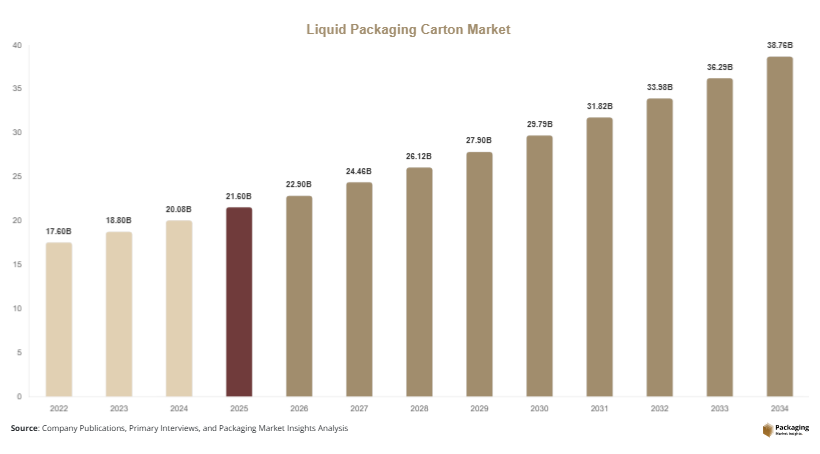
The global liquid packaging carton market was valued at approximately USD 21.6 billion in 2025 and is projected to reach around USD 22.9 billion in 2026. By 2034, the market is expected to reach nearly USD 38.7 billion, registering a CAGR of 6.8% during 2025–2034. Liquid packaging cartons are widely used for milk, juices, flavored beverages, plant-based drinks, soups, and liquid food products because they provide lightweight handling, extended shelf life, and improved transportation efficiency. The liquid packaging carton market is experiencing steady growth due to increasing demand for sustainable beverage packaging, expanding dairy consumption, and rising adoption of convenient packaging solutions across food and beverage industries.
One of the major growth factors driving the market is the rising preference for eco-friendly and recyclable packaging materials. Consumers and regulatory authorities are increasingly encouraging the use of paper-based packaging alternatives to reduce plastic waste and improve sustainability performance. Another important growth factor is the increasing global demand for packaged dairy products and ready-to-drink beverages. Urbanization, changing dietary habits, and growing retail penetration are supporting demand for liquid packaging cartons across developed and developing economies.
Key Highlights
- Asia Pacific dominated the market with a 39.7% share in 2025.
- Latin America is projected to grow at the fastest CAGR of 7.4%.
- Aseptic cartons led the carton type segment with a 44.2% share.
- Dairy applications dominated with a 47.6% share.
- Paperboard materials accounted for 53.8% share.
- The US remained the dominant country with a market size of USD 4.2 billion in 2025 and USD 4.5 billion in 2026.
Explore more data points, trends and opportunities Download Free Sample Report
Market Trends
Rising Adoption of Sustainable and Recyclable Carton Packaging
Sustainability is becoming a central trend in the liquid packaging carton market as consumers and governments push for environmentally responsible packaging alternatives. Beverage manufacturers are increasingly replacing rigid plastic containers with paper-based cartons that offer improved recyclability and reduced carbon emissions. Packaging companies are also investing in bio-based coatings and renewable raw materials to improve carton sustainability. Lightweight carton structures reduce transportation emissions and support circular economy initiatives. Major beverage brands are introducing recyclable carton packaging for milk, juices, and plant-based drinks to strengthen environmental commitments. This trend is expected to accelerate further as global regulations regarding single-use plastics continue to tighten.
Growth of Aseptic Packaging Technologies
Aseptic packaging technologies are gaining significant traction within the liquid packaging carton market. Manufacturers are increasingly using aseptic cartons for dairy products, juices, soups, and nutritional beverages because they extend shelf life without requiring refrigeration. This packaging technology helps maintain product quality and reduces food waste during transportation and storage. The rising demand for ready-to-drink beverages and convenient food products is supporting wider adoption of aseptic carton systems globally. Packaging companies are also introducing advanced filling and sealing technologies that improve operational efficiency and product safety. Growing demand for shelf-stable beverages in emerging markets continues to strengthen this trend.
Market Drivers
Increasing Demand for Packaged Dairy and Beverage Products
The growing global consumption of packaged dairy products and beverages is one of the major drivers supporting the liquid packaging carton market. Consumers increasingly prefer packaged milk, juices, flavored drinks, and nutritional beverages due to convenience, hygiene, and longer shelf life. Expanding urban populations and changing dietary habits are accelerating demand for portable and easy-to-store packaging solutions. Beverage manufacturers are adopting carton packaging because it offers lightweight transportation, efficient storage, and attractive branding opportunities. Rising retail penetration and supermarket expansion are also supporting higher sales of packaged beverages, contributing significantly to market growth.
Rising Environmental Concerns and Plastic Reduction Initiatives
Environmental concerns regarding plastic waste are driving increased adoption of paper-based liquid packaging cartons. Governments across multiple regions are implementing stricter regulations aimed at reducing single-use plastic packaging and encouraging recyclable materials. Consumers are also becoming more environmentally conscious and are actively choosing sustainable packaging alternatives. Carton packaging manufacturers are responding by developing recyclable and renewable packaging solutions with reduced environmental impact. The ability of liquid cartons to support recycling programs and lower carbon emissions compared to certain plastic packaging formats is expected to continue driving strong market demand.
Market Restraint
Complex Recycling Processes for Multilayer Cartons
One of the major restraints affecting the liquid packaging carton market is the complexity associated with recycling multilayer carton structures. Many liquid cartons contain combinations of paperboard, aluminum, and plastic layers that help preserve product freshness and prevent contamination. However, separating these materials during recycling requires specialized infrastructure and processing technologies, which may not be widely available in all regions.
For example, smaller municipalities and developing economies may face difficulties in collecting and processing used cartons efficiently due to limited recycling facilities. This can reduce overall recycling rates and create waste management challenges. In addition, companies may incur higher operational costs when adopting advanced recyclable coating technologies or redesigning packaging structures to improve sustainability compliance. Regulatory pressure regarding packaging waste reduction may further increase manufacturing costs for carton producers. These recycling and infrastructure limitations could restrict market growth in certain regions during the forecast period.
Market Opportunities
Expansion of Plant-Based Beverage Packaging
The rapid growth of plant-based beverages presents significant opportunities for the liquid packaging carton market. Products such as almond milk, oat milk, soy beverages, and nutritional drinks increasingly use carton packaging because it offers strong barrier protection and extended shelf life. Health-conscious consumers are driving demand for dairy alternatives and functional beverages worldwide. Beverage companies are introducing innovative carton formats with improved convenience, resealable closures, and attractive printing capabilities to strengthen product differentiation. As the plant-based food industry expands, demand for liquid carton packaging solutions is expected to rise substantially.
Development of Bio-Based and Renewable Coatings
The development of bio-based coatings and renewable barrier materials creates major opportunities for carton packaging manufacturers. Companies are investing in sustainable alternatives to traditional plastic and aluminum layers used in liquid cartons. Bio-based coatings improve recyclability and reduce environmental impact while maintaining packaging performance and product safety. Increasing consumer preference for renewable packaging materials is encouraging manufacturers to commercialize advanced eco-friendly carton technologies. Governments and retailers are also supporting sustainable packaging initiatives, creating favorable conditions for innovation in renewable liquid carton packaging solutions.
Report Scope
| Report Metric | Details |
|---|---|
| Market Size in 2025 | USD 21.6 Billion |
| Market Size in 2026 | USD 22.9 Billion |
| Market Size in 2034 | USD 38.7 Billion |
| CAGR | 6.8% (2026-2034) |
| Base Year for Estimation | 2025 |
| Historical Data | 2022-2024 |
| Forecast Period | 2026-2034 |
| Report Coverage | Revenue Forecast, Competitive Landscape, Supply Chain Disruption, Growth Factors, Environment & Regulatory Landscape and Trends |
| Geographies Covered | North America, Europe, APAC, Middle East and Africa, LATAM |
| Countries Covered | U.S., Canada, U.K., Germany, France, Spain, Italy, Russia, Nordic, Benelux, Rest of Europe, China, South Korea, Japan, India, Australia, Singapore, Taiwan, South East Asia, Rest of Asia-Pacific, UAE, Turky, Saudi Arabia, South Africa, Egypt, Nigeria, Rest of MEA, Brazil, Mexico, Argentina, Chile, Colombia, Rest of LATAM |
Explore more data points, trends and opportunities Download Free Sample Report
Segmental Analysis
By Carton Type
Aseptic cartons dominated the liquid packaging carton market in 2024, accounting for approximately 44.2% of total market share. These cartons are widely used for milk, juices, soups, and nutritional beverages because they provide extended shelf life without refrigeration. Aseptic packaging technologies help preserve product quality and reduce transportation costs by enabling ambient storage conditions. Beverage manufacturers increasingly prefer aseptic cartons for large-scale distribution and export operations. Rising demand for shelf-stable food and beverage products, particularly in developing economies, continues to support strong growth of this segment globally.
Chilled cartons are projected to register the fastest CAGR of 6.9% during the forecast period. Chilled cartons are commonly used for fresh dairy products, flavored milk, smoothies, and refrigerated beverages that require cold-chain storage. Consumers increasingly prefer fresh and minimally processed beverages, driving demand for chilled carton packaging formats. Manufacturers are introducing resealable closures and improved carton designs to enhance convenience and product differentiation. Growing demand for premium dairy beverages and refrigerated nutritional drinks is expected to support long-term segment expansion.
By Application
Dairy applications held the dominant market share of 47.6% in 2024 due to increasing global consumption of milk, yogurt drinks, cream products, and flavored dairy beverages. Liquid cartons provide excellent barrier protection, product safety, and convenient transportation for dairy packaging. Expanding urban populations and rising demand for hygienic packaged milk products continue to support market growth. Dairy companies are also investing in attractive carton printing and sustainable packaging technologies to strengthen brand visibility and consumer engagement.
Plant-based beverages are expected to witness the fastest growth, registering a CAGR of 8.1% during the forecast period. Products such as almond milk, oat beverages, soy drinks, and protein-based nutritional beverages are increasingly packaged in liquid cartons due to their shelf-life advantages and sustainability appeal. Consumers are adopting plant-based diets because of health and environmental concerns, creating strong demand for dairy alternatives globally. Beverage manufacturers are launching innovative packaging designs and convenient portion sizes to target health-conscious consumers and expand market penetration.
By Material Type
Paperboard materials accounted for approximately 53.8% of total market share in 2024 because they provide lightweight structure, printability, and recyclability advantages for liquid carton packaging. Paperboard-based cartons are widely used across dairy, juice, and beverage industries due to their cost efficiency and environmental performance. Manufacturers are increasingly sourcing renewable paperboard materials from certified forestry operations to strengthen sustainability initiatives. Rising consumer awareness regarding environmentally responsible packaging is expected to continue supporting demand for paperboard liquid cartons.
Bio-based barrier coatings are projected to grow at the fastest CAGR of 8.4% during the forecast period. These coatings are being developed as sustainable alternatives to traditional plastic and aluminum layers used in multilayer cartons. Bio-based materials improve carton recyclability while maintaining moisture resistance and product protection capabilities. Packaging companies are investing heavily in renewable coating technologies to comply with evolving environmental regulations and retailer sustainability requirements. Increasing adoption of eco-friendly beverage packaging solutions is expected to drive strong segment growth throughout the forecast period.
Liquid Packaging Carton Market Segmentations
By Carton Type
- Brick Cartons
- Gable Top Cartons
- Shaped Cartons
- Stand-Up Cartons
By Material Type
- Paperboard
- Aluminum Layered Cartons
- Polyethylene Coated Cartons
- Bio-Based Cartons
By End-Use Industry
- Dairy Products
- Juices & Soft Drinks
- Alcoholic Beverages
- Liquid Food Products
- Pharmaceutical Liquids
By Distribution Channel
- Direct Supply Agreements
- Packaging Distributors
- Online B2B Platforms
- Retail Packaging Suppliers
Regional Analysis
North America
North America accounted for approximately 24.8% of the global liquid packaging carton market share in 2025 and is projected to grow at a CAGR of 6.1% during the forecast period. Strong demand for packaged dairy products, juices, and plant-based beverages is supporting market growth across the region. Consumers increasingly prefer recyclable and lightweight packaging solutions, encouraging beverage manufacturers to adopt paper-based cartons. Expanding retail distribution and rising consumption of shelf-stable beverages are also contributing to regional market expansion.
The United States dominates the North American market due to its large beverage industry and advanced packaging infrastructure. A unique growth factor is the increasing popularity of plant-based milk alternatives packaged in aseptic cartons. Growing consumer focus on health-conscious beverage consumption continues to support strong demand for liquid packaging cartons in the country.
Europe
Europe held approximately 29.3% of the global market share in 2025 and is expected to grow at a CAGR of 6.4% during the forecast period. Strict environmental regulations and strong consumer awareness regarding sustainable packaging are driving market growth in the region. Beverage companies are increasingly shifting toward recyclable paper-based cartons to reduce plastic packaging waste. Advanced recycling systems and government sustainability initiatives further support widespread adoption of liquid carton packaging solutions.
Germany remains the dominant market within Europe due to its strong dairy processing industry and advanced packaging technology sector. A unique growth factor is the country’s well-developed recycling infrastructure, which supports efficient collection and processing of used beverage cartons and strengthens circular economy initiatives.
Asia Pacific
Asia Pacific dominated the global liquid packaging carton market with a 39.7% share in 2025 and is expected to register substantial growth during the forecast period. Rising urbanization, increasing disposable incomes, and growing demand for packaged beverages are driving regional market expansion. Rapid growth in dairy consumption and expanding supermarket penetration are also supporting strong demand for liquid packaging cartons throughout the region.
China dominates the Asia Pacific market due to its large population base and rapidly growing packaged beverage industry. A unique growth factor is the increasing consumption of shelf-stable dairy products and ready-to-drink teas in urban areas, which continues to accelerate demand for aseptic carton packaging solutions.
Middle East & Africa
The Middle East & Africa region accounted for approximately 3.9% of the global market share in 2025 and is projected to grow at a CAGR of 5.8% during the forecast period. Rising demand for packaged juices, dairy products, and nutritional beverages is contributing to regional market development. Increasing urban populations and changing consumer lifestyles are encouraging adoption of convenient liquid packaging formats across retail and foodservice industries.
Saudi Arabia dominates the regional market due to strong demand for long shelf-life dairy products and juices. A unique growth factor is the region’s hot climate conditions, which increase demand for aseptic beverage packaging solutions capable of preserving product quality without continuous refrigeration.
Latin America
Latin America represented approximately 2.3% of the global liquid packaging carton market share in 2025 and is expected to grow at the fastest CAGR of 7.4% during the forecast period. Growing consumption of packaged beverages and expanding retail infrastructure are supporting regional market growth. Beverage companies are increasingly introducing affordable carton packaging formats to meet rising consumer demand in urban and semi-urban areas.
Brazil remains the dominant country in Latin America due to its expanding dairy and juice industries. A unique growth factor is the increasing demand for affordable shelf-stable beverage products distributed through large supermarket chains and convenience retail stores across the country.
Competitive Landscape
The liquid packaging carton market is highly competitive, with major companies focusing on sustainable packaging innovation, aseptic technology advancements, and strategic partnerships with beverage manufacturers. Packaging companies are investing in recyclable materials, renewable coatings, and lightweight carton designs to strengthen environmental performance and meet changing regulatory requirements. Technological innovation in filling equipment and barrier protection systems also remains a key competitive strategy.
Tetra Pak International S.A. remains one of the leading companies in the market due to its extensive aseptic carton portfolio and strong global distribution network. In 2024, the company introduced a new bio-based barrier carton solution designed to improve recyclability and reduce dependence on fossil-based materials in beverage packaging applications.
Other major players operating in the market include SIG Combibloc Group, Elopak AS, Greatview Aseptic Packaging, and Evergreen Packaging LLC. These companies continue investing in advanced carton technologies and regional manufacturing expansion strategies to strengthen market position.
Key Players List
- Tetra Pak International S.A.
- SIG Combibloc Group
- Elopak AS
- Greatview Aseptic Packaging
- Evergreen Packaging LLC
- Nippon Paper Industries Co., Ltd.
- Refresco Group
- WestRock Company
- Stora Enso Oyj
- Mondi Group
- Smurfit Kappa Group
- Uflex Limited
- Liquibox Corporation
- Billerud AB
- Adam Pack S.A.