Beverage Carton Packaging Machinery Market Size and Growth
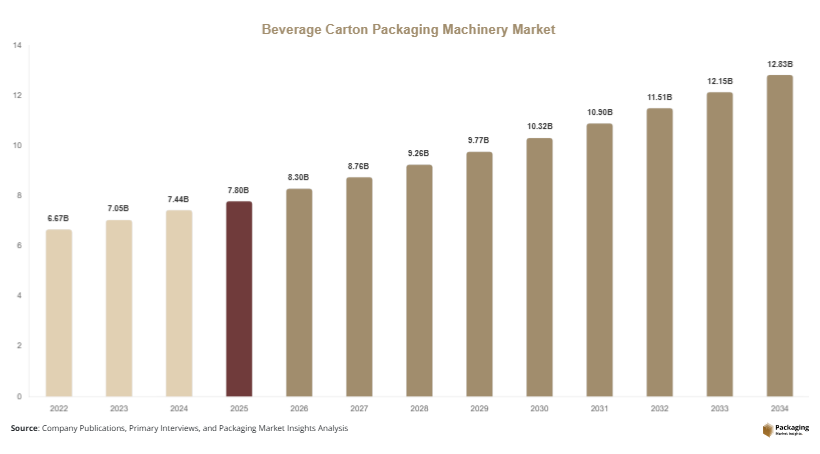
The global beverage carton packaging machinery market size reached approximately USD 7.8 billion in 2025 and is estimated to grow to USD 8.3 billion in 2026. Over the long term, the market is projected to achieve USD 13.6 billion by 2034, registering a CAGR of 5.6% from 2025 to 2034. This growth reflects increasing consumption of packaged beverages and the transition toward environmentally responsible packaging formats. The beverage carton packaging machinery market continues to expand steadily as beverage producers adopt efficient and sustainable packaging technologies.
A major factor contributing to this expansion is the rising preference for eco-friendly packaging solutions. Beverage cartons, made primarily from renewable paperboard, are gaining strong acceptance as companies reduce reliance on plastics. Machinery manufacturers are therefore developing systems that support recyclable materials while maintaining high production efficiency. Another key factor is the integration of automation technologies. Advanced packaging machinery equipped with sensors, data analytics, and real-time monitoring systems is improving operational productivity and reducing downtime.
Key Highlights:
- Asia Pacific dominated the market with a 38.2% share in 2025, while Latin America is projected to grow at the fastest CAGR of 6.4%.
- Aseptic carton packaging machinery led the type segment with a 41.5% share, while form-fill-seal machinery is expected to grow at a CAGR of 6.1%.
- Fully automatic machinery dominated with a 57.8% share, while semi-automatic systems are forecasted to grow at a CAGR of 5.8%.
- Dairy beverage applications led the segment with 46.3% share, while plant-based beverages are expected to grow at a CAGR of 6.6%.
- China remained the dominant country with a market size of USD 1.9 billion in 2025 and USD 2.1 billion in 2026.
Explore more data points, trends and opportunities Download Free Sample Report
Market Trends
Growing emphasis on sustainable packaging machinery
Sustainability has become a central theme across the beverage carton packaging machinery market, influencing both product development and purchasing decisions. Manufacturers are increasingly designing machinery that can efficiently process renewable and recyclable materials such as paperboard-based cartons. This shift is supported by rising environmental awareness among consumers and stricter regulatory requirements aimed at reducing plastic waste. Packaging machinery is being engineered to minimize material usage and energy consumption, improving overall environmental performance. In addition, companies are investing in closed-loop systems that enable recycling and reuse, supporting circular economy goals while maintaining operational efficiency.
Increasing integration of automation and digital technologies
The adoption of automation and smart technologies is transforming packaging operations across the beverage industry. Modern carton packaging machinery incorporates advanced features such as real-time monitoring, predictive maintenance, and data analytics. These technologies help reduce machine downtime, improve output quality, and enhance production efficiency. Automated systems also reduce reliance on manual labor, which is particularly beneficial in high-volume production environments. As beverage manufacturers aim to scale operations and maintain consistent product quality, the demand for intelligent and connected packaging machinery continues to rise, supporting long-term market growth.
Market Drivers
Rising consumption of packaged beverages globally
The growing demand for packaged beverages is a major factor driving the beverage carton packaging machinery market. Rapid urbanization, changing lifestyles, and increasing disposable incomes are encouraging consumers to choose ready-to-drink and convenient beverage options. This trend is particularly strong in emerging economies where consumption of dairy products, juices, and functional beverages is increasing. As beverage producers expand production capacity to meet rising demand, they require efficient and high-speed packaging machinery. Carton packaging offers advantages such as portability, durability, and extended shelf life, making it a preferred choice and boosting machinery adoption.
Strong regulatory focus on food safety and hygiene
Stringent food safety and hygiene regulations are playing a significant role in shaping the market. Governments and regulatory authorities are enforcing strict standards to ensure the quality and safety of packaged beverages. This has increased the demand for advanced packaging machinery, especially aseptic systems that prevent contamination during processing. Such systems help extend shelf life without the need for preservatives, making them ideal for dairy and plant-based beverages. Manufacturers are investing in modern machinery that meets regulatory requirements while maintaining efficiency, contributing to steady market growth.
Market Restraint
High capital investment and operational costs
The high cost associated with advanced packaging machinery remains a key challenge in the beverage carton packaging machinery market. Fully automated and aseptic systems require substantial initial investment, which can limit adoption among small and medium-sized enterprises. In addition to purchase costs, maintenance and operational expenses can be significant due to the complexity of these machines. Upgrading existing production lines to incorporate modern technologies often involves additional infrastructure investments and workforce training. These financial barriers can slow down adoption rates, particularly in price-sensitive markets, and may impact overall market expansion.
Market Opportunities
Expansion of beverage manufacturing in emerging economies
Emerging markets offer strong growth potential for the beverage carton packaging machinery market. Rapid urbanization, population growth, and increasing income levels are driving demand for packaged beverages in regions such as Asia Pacific, Latin America, and Africa. Governments are also promoting sustainable packaging practices, creating favorable conditions for carton packaging adoption. Beverage companies are investing in new production facilities to meet local demand, which is generating opportunities for machinery manufacturers to provide scalable and cost-effective solutions tailored to regional requirements.
Rising demand for plant-based and functional beverages
The growing popularity of plant-based and functional beverages is opening new avenues for market growth. Consumers are increasingly focusing on health and sustainability, leading to higher demand for alternatives such as almond milk, soy milk, and fortified drinks. These products require specialized packaging to maintain quality and nutritional value. As a result, beverage manufacturers are investing in advanced carton packaging machinery capable of handling diverse formulations and packaging formats. Companies that can deliver flexible and efficient solutions are well-positioned to benefit from this evolving demand landscape.
Report Scope
| Report Metric | Details |
|---|---|
| Market Size in 2025 | USD 7.8 Billion |
| Market Size in 2026 | USD 8.3 Billion |
| Market Size in 2034 | USD 13.6 Billion |
| CAGR | 5.6% (2026-2034) |
| Base Year for Estimation | 2025 |
| Historical Data | 2022-2024 |
| Forecast Period | 2026-2034 |
| Report Coverage | Revenue Forecast, Competitive Landscape, Supply Chain Disruption, Growth Factors, Environment & Regulatory Landscape and Trends |
| Geographies Covered | North America, Europe, APAC, Middle East and Africa, LATAM |
| Countries Covered | U.S., Canada, U.K., Germany, France, Spain, Italy, Russia, Nordic, Benelux, Rest of Europe, China, South Korea, Japan, India, Australia, Singapore, Taiwan, South East Asia, Rest of Asia-Pacific, UAE, Turky, Saudi Arabia, South Africa, Egypt, Nigeria, Rest of MEA, Brazil, Mexico, Argentina, Chile, Colombia, Rest of LATAM |
Explore more data points, trends and opportunities Download Free Sample Report
Segmental Analysis
By Type
Aseptic carton packaging machinery accounted for the largest share of approximately 41.5% in 2024. This segment is widely adopted due to its ability to maintain product sterility and extend shelf life without preservatives. It is particularly important for dairy and juice products, where maintaining freshness and safety is essential. The growing emphasis on food safety regulations is further supporting the adoption of aseptic systems across the beverage industry.
Form-fill-seal machinery is projected to grow at a CAGR of 6.1% during the forecast period. This segment is gaining traction due to its efficiency and ability to streamline packaging operations. By integrating forming, filling, and sealing processes into a single system, manufacturers can reduce production time and operational complexity. The demand for flexible and cost-effective packaging solutions is a key factor driving growth in this segment.
By Automation Level
Fully automatic machinery dominated the market with a share of 57.8% in 2024. These systems offer high-speed operation, precision, and reduced labor dependency, making them suitable for large-scale production. Advanced features such as real-time monitoring and predictive maintenance enhance operational efficiency and minimize downtime, supporting their widespread adoption.
Semi-automatic machinery is expected to grow at a CAGR of 5.8% during the forecast period. These systems provide a balance between cost and efficiency, making them attractive for small and medium-sized enterprises. Their flexibility and lower investment requirements are driving adoption, particularly in emerging markets where budget constraints are a key consideration.
By Application
Dairy beverages accounted for the largest market share of 46.3% in 2024. Carton packaging is widely used in this segment due to its ability to preserve freshness and extend shelf life. The high consumption of milk and dairy products globally is a major factor supporting demand for packaging machinery in this segment.
Plant-based beverages are expected to grow at a CAGR of 6.6% over the forecast period. The increasing popularity of plant-based diets and demand for alternative beverages are key drivers of this segment. Packaging requirements for these products are more complex, encouraging manufacturers to invest in advanced machinery capable of maintaining quality and nutritional value.
Beverage Carton Packaging Machinery Market Segmentations
By Type
- Aseptic Carton Packaging Machinery
- Form-Fill-Seal Machinery
- Filling Machinery
- Sealing Machinery
By Automation Level
- Fully Automatic
- Semi-Automatic
By Application
- Dairy Beverages
- Non-Carbonated Soft Drinks
- Plant-Based Beverages
- Alcoholic Beverages
Regional Analysis
North America
North America accounted for approximately 24.6% of the global beverage carton packaging machinery market share in 2025 and is expected to grow at a CAGR of 4.8% over the forecast period. The region benefits from a well-established beverage industry and high adoption of automation technologies. Companies in the region are focusing on improving production efficiency and sustainability, which is supporting the demand for advanced carton packaging machinery.
The United States leads the regional market due to strong consumption of packaged beverages and continuous technological innovation. A key growth factor is the increasing investment in smart manufacturing solutions, including Industry 4.0 technologies. Beverage companies are upgrading existing facilities with automated and connected machinery to enhance operational performance and reduce production costs.
Europe
Europe held around 22.3% of the global market share in 2025 and is projected to expand at a CAGR of 5.1%. The region’s growth is driven by strict environmental regulations and strong consumer preference for sustainable packaging solutions. The adoption of recyclable and biodegradable materials is encouraging investment in advanced packaging machinery.
Germany dominates the European market due to its strong manufacturing base and technological expertise. A significant growth factor is the region’s focus on circular economy practices. Companies are adopting machinery that reduces material waste and supports recycling, aligning with sustainability goals and regulatory standards.
Asia Pacific
Asia Pacific emerged as the leading region with a 38.2% market share in 2025 and is expected to grow at a CAGR of 6.3%. Rapid urbanization, increasing population, and rising demand for packaged beverages are key factors driving growth. The expansion of beverage production facilities across the region is also contributing to increased demand for packaging machinery.
China leads the Asia Pacific market due to its large consumer base and expanding beverage industry. A unique growth factor is the rapid development of retail and e-commerce distribution channels. This trend is increasing demand for efficient and durable packaging solutions, encouraging investment in advanced machinery.
Middle East & Africa
The Middle East & Africa accounted for approximately 7.8% of the market share in 2025 and is expected to grow at a CAGR of 5.4%. The market is driven by increasing urbanization and rising demand for packaged beverages, particularly in urban areas. Adoption of modern packaging technologies is gradually increasing across the region.
Saudi Arabia is a key contributor to regional growth, supported by investments in the food and beverage sector. A notable growth factor is the expansion of organized retail infrastructure, including supermarkets and hypermarkets, which is boosting demand for packaged beverages and associated packaging machinery.
Latin America
Latin America held about 7.1% of the global market share in 2025 and is projected to grow at a CAGR of 6.4%, making it one of the fastest-growing regions. Increasing demand for convenient beverage products and rising awareness of sustainable packaging are supporting market growth.
Brazil dominates the regional market due to its large beverage industry and growing population. A key growth factor is the increasing focus on domestic beverage production. Manufacturers are investing in advanced packaging machinery to improve efficiency and meet rising local demand.
Competitive Landscape
The beverage carton packaging machinery market is moderately consolidated, with key players focusing on innovation and technological advancement. Companies are investing in research and development to introduce efficient and sustainable packaging solutions. Strategic collaborations, mergers, and acquisitions are also shaping the competitive environment.
Tetra Pak International S.A. remains a leading company in the market, offering a wide range of packaging machinery solutions. The company has introduced energy-efficient systems designed to reduce operational costs and environmental impact. Other players are also focusing on expanding their product portfolios and strengthening their global presence to remain competitive in the evolving market.
Key Players List
- Tetra Pak International S.A.
- SIG Combibloc Group AG
- Krones AG
- Elopak AS
- Greatview Aseptic Packaging Co., Ltd.
- IPI S.r.l.
- Coesia S.p.A.
- Bosch Packaging Technology
- GEA Group AG
- ProMach Inc.
- Barry-Wehmiller Companies Inc.
- JBT Corporation
- Nichrome India Ltd.
- Evergreen Packaging LLC
- ACG Worldwide