Vertical Form Fill Seal Machines Market Size and Growth
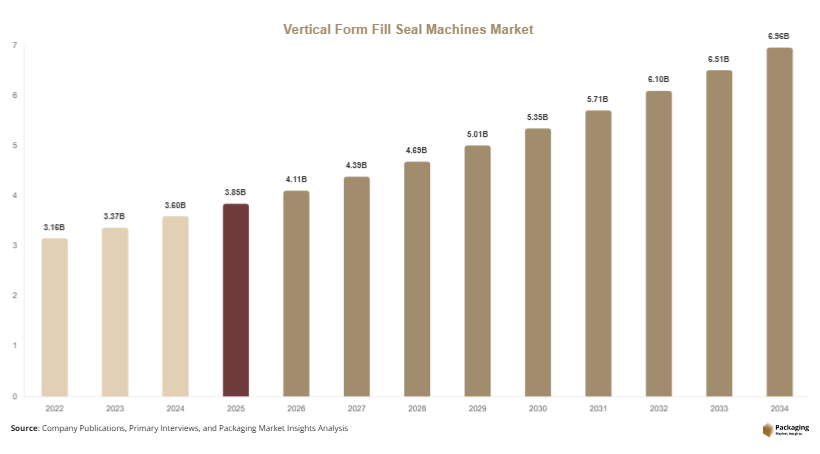
The vertical form fill seal machines market is projected to witness steady growth over the forecast period, driven by increasing demand for automated packaging solutions across multiple industries, including food, pharmaceuticals, and consumer goods. In 2025, the market size is estimated at USD 3.85 billion and is expected to reach approximately USD 6.92 billion by 2034, growing at a CAGR of 6.8% during 2025–2034. The growth is fueled by the rising adoption of automation technologies in packaging operations, the surge in e-commerce activities requiring efficient packaging solutions, and stringent regulatory standards emphasizing product safety and hygiene.
One of the critical factors contributing to market expansion is the increasing preference for flexible packaging solutions, which allow for cost-effective and space-efficient packaging while maintaining product integrity. Additionally, technological advancements such as servo-driven systems, intelligent control mechanisms, and integration with Industry 4.0 solutions are enhancing operational efficiency and reducing labor dependency, further driving market demand. Moreover, the trend toward sustainable and eco-friendly packaging materials is prompting manufacturers to invest in vertical form fill seal (VFFS) machines compatible with biodegradable and recyclable films.
Key Highlights:
- Market size projected to grow from USD 3.85 billion in 2025 to USD 6.92 billion by 2034.
- CAGR of 6.8% forecasted during 2025–2034.
- Increasing adoption of automation and flexible packaging solutions driving growth.
- Technological advancements such as servo-driven systems enhancing efficiency.
- Rising demand for sustainable packaging solutions influencing machine development.
Explore more data points, trends and opportunities Download Free Sample Report
Market Trends
Integration of Smart and IoT-Enabled Packaging Machines
The vertical form fill seal machinery segment is increasingly adopting smart and IoT-enabled solutions to enhance operational efficiency and reduce downtime. These intelligent machines offer real-time monitoring, predictive maintenance, and seamless data analytics, allowing manufacturers to optimize production workflows and reduce material waste. With IoT-enabled VFFS systems, packaging facilities can remotely monitor equipment performance, detect potential faults before they escalate, and ensure consistent product quality. The trend is particularly notable in the food and pharmaceutical sectors, where regulatory compliance, traceability, and hygiene are critical. By integrating IoT solutions, manufacturers can maintain detailed production records and adapt quickly to changing packaging requirements. This trend is expected to drive the market further, as industries increasingly embrace digitalization and automation to meet rising consumer demands.
Rising Demand for Sustainable and Flexible Packaging
Consumer awareness of environmental sustainability has led to a significant shift toward eco-friendly packaging solutions. VFFS machines capable of handling recyclable, biodegradable, and compostable films are witnessing growing adoption. Flexible packaging allows for smaller footprints, reduces material usage, and offers enhanced product protection. Manufacturers are investing in machines that can efficiently package products in pouches, sachets, and stand-up bags while minimizing energy consumption. This trend is reinforced by government regulations promoting sustainable practices, making eco-compatible VFFS machines an essential investment for modern packaging operations.
Market Drivers
Growth in the Processed Food Industry
The expanding processed food industry is one of the primary drivers of the vertical form fill seal machines market. With increasing urbanization and changing consumer lifestyles, demand for packaged and ready-to-eat food products has surged globally. VFFS machines provide an efficient solution for packaging snacks, grains, frozen foods, and liquids with minimal human intervention. These machines ensure product freshness, reduce contamination risks, and improve packaging speed, which is critical for high-volume production. Food manufacturers are leveraging VFFS machines to meet rising consumer expectations for convenience and safety. The consistent demand for packaged food products, particularly in developing regions, continues to drive the adoption of these machines across the industry.
Technological Advancements and Automation
Technological innovations in VFFS machinery, including servo-driven systems, high-speed production capabilities, and integrated weighing and filling solutions, have become key growth drivers. Automation reduces labor costs, improves operational efficiency, and ensures precise packaging, which is especially vital for the pharmaceutical and healthcare sectors. Advanced VFFS machines are now equipped with sensors, automated changeovers, and quality inspection systems, enabling manufacturers to maintain high throughput while reducing errors. The ongoing trend toward smart factories and Industry 4.0 integration further accelerates demand for sophisticated VFFS solutions, enabling predictive maintenance, improved supply chain management, and energy-efficient operations.
Market Restraint
High Initial Investment and Maintenance Costs
One of the significant restraints impacting the vertical form fill seal machines market is the high initial capital expenditure required to acquire advanced machines. Modern VFFS machines equipped with automation features, IoT capabilities, and multi-functionality often demand substantial investment, which may limit adoption among small and medium-sized enterprises (SMEs). Additionally, the ongoing maintenance costs for these machines, including regular calibration, part replacement, and technical servicing, can be high. For instance, food packaging companies in emerging markets often face budget constraints, slowing down the transition from manual or semi-automatic systems to fully automated VFFS machines. This cost factor can delay large-scale implementation, impacting overall market growth. Furthermore, machine downtime due to maintenance or technical issues can disrupt production schedules and lead to financial losses. Despite the technological benefits, manufacturers must balance operational efficiency against the high capital requirements, particularly when investing in machines compatible with diverse packaging materials and complex product formats.
Market Opportunities
Expansion in Emerging Economies
Emerging economies in Asia Pacific, Latin America, and the Middle East present significant growth opportunities for the vertical form fill seal machines market. Rapid industrialization, modernization of food processing facilities, and increasing consumer demand for packaged goods are fueling market expansion. Manufacturers are strategically entering these regions to capitalize on rising demand, offering machines tailored to local requirements such as energy-efficient operations, multi-format packaging, and compact designs. For instance, India and Brazil are witnessing heightened investment in modern food and pharmaceutical packaging facilities, creating a lucrative market for VFFS machinery. Companies providing localized after-sales services and technical support are positioned to benefit from the growing regional adoption of automated packaging systems.
Integration with Sustainable Packaging Initiatives
As governments and consumers increasingly focus on sustainability, VFFS machines compatible with eco-friendly materials such as biodegradable films and recycled plastics are gaining traction. Companies investing in R&D to develop energy-efficient machines capable of handling sustainable packaging materials have a competitive advantage. This trend offers opportunities to create specialized machines for niche applications, such as organic food, plant-based products, and eco-friendly consumer goods. Moreover, integration with renewable energy-powered facilities and energy-saving systems enhances the attractiveness of VFFS machines for companies aiming to reduce carbon footprints, creating a long-term growth pathway in the global market.
Report Scope
| Report Metric | Details |
|---|---|
| Market Size in 2025 | USD 3.85 Billion |
| Market Size in 2026 | USD 4.11 Billion |
| Market Size in 2034 | USD 6.92 Billion |
| CAGR | 6.8% (2026-2034) |
| Base Year for Estimation | 2025 |
| Historical Data | 2022-2024 |
| Forecast Period | 2026-2034 |
| Report Coverage | Revenue Forecast, Competitive Landscape, Supply Chain Disruption, Growth Factors, Environment & Regulatory Landscape and Trends |
| Geographies Covered | North America, Europe, APAC, Middle East and Africa, LATAM |
| Countries Covered | U.S., Canada, U.K., Germany, France, Spain, Italy, Russia, Nordic, Benelux, Rest of Europe, China, South Korea, Japan, India, Australia, Singapore, Taiwan, South East Asia, Rest of Asia-Pacific, UAE, Turky, Saudi Arabia, South Africa, Egypt, Nigeria, Rest of MEA, Brazil, Mexico, Argentina, Chile, Colombia, Rest of LATAM |
Explore more data points, trends and opportunities Download Free Sample Report
Segmental Analysis
Type
The vertical form fill seal machines market can be segmented based on type, including automatic, semi-automatic, and manual machines. In 2024, the automatic VFFS segment held the dominant share of approximately 62%. This segment’s leadership is attributed to its high production capacity, minimal labor requirement, and advanced features such as multi-head weighing, servo-driven sealing, and integrated quality control systems. Automatic machines are extensively adopted in high-volume operations, particularly in the food and pharmaceutical sectors. Their capability to handle various pouch formats, from pillow pouches to stand-up bags, enhances operational flexibility and efficiency. Moreover, the need for precise portioning, reduced material wastage, and improved hygiene further strengthens their market position.
The semi-automatic segment is projected to be the fastest-growing subsegment, with a CAGR of 7.2% during 2025–2034. Growth in this subsegment is driven by SMEs seeking cost-effective automation solutions without investing in fully automatic systems. Semi-automatic VFFS machines offer moderate production speed, easy maintenance, and flexibility to package multiple product types. The rising number of small-scale food and pharmaceutical manufacturers, especially in emerging economies, has created a substantial demand for semi-automatic machines that balance affordability with operational efficiency.
Application
Based on application, the VFFS market includes solid, liquid, and powder product packaging. Solid product packaging dominated in 2024, accounting for approximately 55% of the market. This dominance is due to the high prevalence of packaged snacks, grains, confectionery, and frozen food products that require efficient automated packaging solutions. Solid product packaging often demands high-speed, multi-format machines capable of accurate portioning and secure sealing. Manufacturers prioritize machines with integrated weighing and filling systems to ensure consistent quality and minimize material wastage, further reinforcing the dominance of this subsegment.
Liquid product packaging is expected to grow at the highest CAGR of 7.1% during the forecast period. Growth is fueled by increasing demand for beverages, sauces, dairy, and liquid pharmaceuticals packaged in pouches or sachets. Liquid packaging requires specialized sealing and filling technologies to prevent leakage and maintain product integrity. Innovations such as multi-lane filling systems, precise dosing, and hygienic designs compatible with food and pharmaceutical standards are driving adoption. The rising consumption of ready-to-drink beverages and liquid nutritional products in both developed and emerging regions is contributing to accelerated growth in this subsegment.
End-Use
The end-use segment includes food & beverage, pharmaceuticals, personal care, and others. The food & beverage sector held a dominant market share of approximately 58% in 2024. This is attributed to the widespread adoption of VFFS machines for packaging snacks, frozen foods, confectionery, dairy, and other processed food products. The need for high-speed production, consistent portioning, and extended shelf-life solutions has encouraged food manufacturers to invest in advanced VFFS machines. Additionally, the growing e-commerce market and demand for ready-to-eat packaged foods have further amplified the adoption in this sector.
Pharmaceuticals represent the fastest-growing end-use subsegment, with a projected CAGR of 7.3% from 2025 to 2034. Growth in this subsegment is driven by the increasing need for sterile, hygienic, and accurately dosed packaging of tablets, powders, and liquid medications. Regulatory compliance, quality assurance, and patient safety are crucial in the pharmaceutical industry, prompting manufacturers to adopt sophisticated VFFS machines with integrated inspection and automation capabilities. The expansion of pharmaceutical manufacturing in emerging markets, coupled with increasing healthcare demands, is accelerating market growth for this subsegment.
Vertical Form Fill Seal Machines Market Segmentations
Type
- Automatic
- Semi-Automatic
- Manual
Application
- Solid Product Packaging
- Liquid Product Packaging
- Powder Product Packaging
End-Use
- Food & Beverage
- Pharmaceuticals
- Personal Care
- Others
Regional Analysis
North America
In 2025, North America accounted for approximately 28% of the global vertical form fill seal machines market, with a forecasted CAGR of 5.9% during 2025–2034. The region's mature food processing industry, coupled with widespread automation adoption, has driven steady market growth. High consumer demand for packaged snacks, dairy, and frozen foods necessitates efficient, high-speed packaging solutions. Additionally, North American manufacturers increasingly prefer VFFS machines compatible with flexible packaging materials, further propelling market expansion. The growing trend of online grocery shopping has also fueled demand for machines capable of high-speed, high-volume production while maintaining product integrity.
The United States dominates the North American market due to advanced manufacturing infrastructure, high automation levels, and a strong presence of leading VFFS machine manufacturers. The growth factor unique to the U.S. is the regulatory emphasis on food safety and traceability, which has compelled manufacturers to adopt automated packaging solutions with integrated inspection systems. Investments in smart factories and Industry 4.0 initiatives have further strengthened market penetration, ensuring North America remains a key growth region for VFFS machinery.
Europe
Europe contributed approximately 24% to the global vertical form fill seal machines market in 2025 and is expected to grow at a CAGR of 5.6% during the forecast period. The region's growth is driven by increasing demand for packaged foods, dairy products, and pharmaceuticals. European manufacturers are emphasizing automation to maintain high production efficiency and comply with strict hygiene and safety standards. The rising focus on sustainable and recyclable packaging materials also promotes the adoption of VFFS machines compatible with eco-friendly films. Manufacturers are investing in advanced machines to meet evolving consumer preferences and government regulations.
Germany leads the European market, supported by its robust manufacturing ecosystem and technological expertise in automated machinery. A unique growth factor in Germany is the strong emphasis on energy-efficient and sustainable manufacturing processes, which has resulted in widespread adoption of VFFS machines equipped with energy-saving features. Additionally, the demand for flexible packaging solutions in Germany's food and pharmaceutical sectors has created opportunities for specialized VFFS machines, further consolidating the country's market dominance.
Asia Pacific
In 2025, Asia Pacific represented roughly 31% of the global vertical form fill seal machines market, reflecting the highest regional share. The market is projected to grow at a CAGR of 7.4% through 2034. Rapid industrialization, urbanization, and a growing middle-class population have spurred demand for packaged and processed food products. The expansion of modern retail channels, supermarkets, and e-commerce platforms has further fueled the need for automated packaging solutions capable of meeting high-volume production requirements. The adoption of flexible and multi-functional VFFS machines is particularly prevalent in food, confectionery, and pharmaceutical sectors across the region.
China is the dominant country in the Asia Pacific region due to its large manufacturing base, extensive consumer market, and ongoing investment in automation technologies. A unique growth factor driving China’s market is the increasing integration of VFFS machines with smart production lines and IoT-enabled monitoring systems, enhancing operational efficiency and quality control. Additionally, government initiatives promoting food safety, packaging standardization, and industrial modernization are accelerating VFFS machine adoption in both urban and semi-urban manufacturing hubs.
Middle East & Africa
The Middle East & Africa region accounted for approximately 7% of the global market in 2025, with a forecasted CAGR of 6.1% from 2025 to 2034. Growth in the region is supported by rising demand for processed food, pharmaceuticals, and consumer goods, coupled with increasing automation in packaging operations. Companies are increasingly adopting VFFS machines to meet international quality standards and streamline production efficiency. Flexible packaging solutions have gained traction due to their convenience, cost-effectiveness, and suitability for diverse products, which supports regional market growth.
Saudi Arabia dominates the Middle East segment, driven by growing investment in food processing infrastructure and modernization of pharmaceutical packaging facilities. A unique growth factor is the influx of foreign direct investment (FDI) into the food and beverage sector, which encourages manufacturers to implement state-of-the-art packaging machinery. Additionally, the government’s push toward industrial diversification and Vision 2030 initiatives is fostering demand for automated packaging technologies, making the region increasingly significant for VFFS machine manufacturers.
Latin America
Latin America held a market share of approximately 10% in 2025 and is projected to expand at a CAGR of 6.5% through 2034. Growth is primarily driven by increasing demand for packaged and processed food products, rising consumer awareness of hygiene, and growing retail infrastructure. Companies are focusing on modernizing packaging operations to improve efficiency and meet international standards. The adoption of flexible and multi-functional VFFS machines supports high-volume production, while minimizing material waste and operational costs.
Brazil is the dominant country in the Latin American region due to its large food processing industry and expanding pharmaceutical sector. A unique growth factor for Brazil is the government’s emphasis on modernizing manufacturing operations, particularly in urban hubs where retail and e-commerce growth is strong. Investments in sustainable packaging materials and energy-efficient VFFS machines further drive adoption, positioning Latin America as a promising growth market for vertical form fill seal machinery.
Competitive Landscape
The global vertical form fill seal machines market is highly competitive, with several international and regional players vying for market share. Key players include Bosch Packaging Technology, TNA Australia, Barry-Wehmiller, IMA Group, and Rovema GmbH. Bosch Packaging Technology is recognized as a market leader due to its strong portfolio of automated packaging solutions and consistent innovation in VFFS systems. The company recently launched a new servo-driven VFFS machine with IoT-enabled monitoring capabilities, enhancing operational efficiency for food and pharmaceutical manufacturers.
TNA Australia has strengthened its market position by offering customizable machines suited for high-speed production in the snack and confectionery sectors. Barry-Wehmiller focuses on scalable and energy-efficient packaging machinery, while IMA Group provides specialized VFFS solutions for pharmaceutical applications. Rovema GmbH emphasizes flexible, modular systems designed for diverse packaging formats. Companies are increasingly investing in R&D, expanding regional presence, and integrating digital solutions to maintain competitiveness and cater to evolving market requirements.
Key Players List
- Bosch Packaging Technology
- TNA Australia
- Barry-Wehmiller
- IMA Group
- Rovema GmbH
- Matrix Packaging Machinery
- Multivac
- Fuji Machinery Co., Ltd.
- Marchesini Group
- Paxiom Group
- Ilapak S.A.
- Coesia Group
- Mespack
- Shanghai Fawer Machinery Co., Ltd.
- Yamato Scale Co., Ltd.