Topical Applicators Market Size
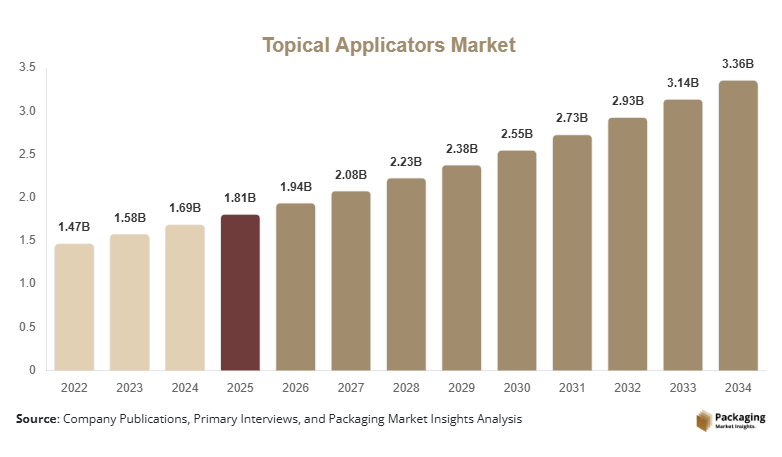
The topical applicators market size is projected at USD 1.94 billion in 2026 and is expected to hit USD 3.36 billion by 2034 with a CAGR of 7.1%. Increasing demand for precision drug delivery, expanding personal care applications, and rising adoption of hygienic dispensing systems continue to support market expansion. The report analyzes product innovation, production capacity, application trends, material developments, and the competitive landscape across major regions.
Topical applicators are dispensing devices designed to accurately apply creams, gels, lotions, ointments, liquids, and medicated formulations directly onto the skin or affected areas. Global production exceeded 5.8 billion units in 2025, while pharmaceutical applications accounted for approximately 49% of total consumption, personal care products represented 38%, and veterinary applications contributed nearly 13%. Roll-on applicators generated around 46% of production volume, while hygienic single-use applicators accounted for over 31% of new product demand, reinforcing the topical applicators market.
Explore more data points, trends and opportunities Download Free Sample Report
Topical Applicators Market Trends
Rising Adoption of Precision Dispensing and Hygienic Packaging
Manufacturers are increasingly introducing precision-dose applicators capable of reducing product wastage by approximately 18% while improving dosage consistency. Annual production of precision dispensing topical applicators exceeded 2.2 billion units during 2025, and antimicrobial applicator components were incorporated into nearly 29% of premium healthcare products. These developments continue strengthening the topical-applicator market.
Advanced injection molding, medical-grade polymers, and ergonomic applicator designs are becoming standard across pharmaceutical and cosmetic packaging. Automated manufacturing capacity exceeded 6 billion units annually, while quality inspection automation surpassed 84% across leading facilities. Growing demand for touch-free application systems and portable packaging formats continues supporting the topical applicators market.
Topical Applicators Market Drivers
Growing Demand for Topical Drug Delivery Systems
Global production of topical pharmaceutical formulations exceeded 19 billion units, while dermatology prescriptions increased by approximately 11% annually. Consumer preference for hygienic application methods grew by nearly 17%, and demand for precision dispensing devices expanded across wound care, dermatology, and cosmetic treatment applications, driving the topical applicators market.
Topical Applicators Market Restraints
High Manufacturing Costs for Medical-Grade Components
Medical-grade polymers and specialty dispensing components experienced price fluctuations between 9% and 15%, increasing production expenses. Regulatory compliance costs rose by approximately 10%, while validation requirements for pharmaceutical packaging extended product development timelines by nearly 14%, creating restraints for the topical applicators market.
Topical Applicators Market Opportunities
Expansion of Sustainable and Smart Applicator Technologies
Demand for recyclable applicator systems is increasing by over 16% annually, while smart dispensing technologies integrated with dose-control mechanisms expanded by approximately 18%. Investments exceeding USD 310 million in sustainable materials, precision molding, and advanced dispensing systems continue creating opportunities across the topical applicators market.
Challenges in Topical Applicators Market
Maintaining Sterility and Precision Across High-Volume Production
Manufacturers produce more than 5.8 billion applicators annually while maintaining dimensional tolerances within ±0.1 mm. Sterility assurance above 99.9%, leak-proof sealing, and compatibility with multiple pharmaceutical formulations remain key manufacturing challenges. Continuous automation and quality monitoring are essential for maintaining competitiveness in the topical applicators market.
Report Scope
| Report Metric | Details |
|---|---|
| Market Size in 2025 | USD 1.81 Billion |
| Market Size in 2026 | USD 1.94 Billion |
| Market Size in 2034 | USD 3.36 Billion |
| CAGR | 7.1% (2026-2034) |
| Base Year for Estimation | 2025 |
| Historical Data | 2022-2024 |
| Forecast Period | 2026-2034 |
| Report Coverage | Revenue Forecast, Competitive Landscape, Supply Chain Disruption, Growth Factors, Environment & Regulatory Landscape and Trends |
| Geographies Covered | North America, Europe, APAC, Middle East and Africa, LATAM |
| Countries Covered | U.S., Canada, U.K., Germany, France, Spain, Italy, Russia, Nordic, Benelux, Rest of Europe, China, South Korea, Japan, India, Australia, Singapore, Taiwan, South East Asia, Rest of Asia-Pacific, UAE, Turkey, Saudi Arabia, South Africa, Egypt, Nigeria, Rest of MEA, Brazil, Mexico, Argentina, Chile, Colombia, Rest of LATAM |
Explore more data points, trends and opportunities Download Free Sample Report
Topical Applicators Market Segmentation
The market is segmented by type and application according to dispensing functionality and end-use industries. Roll-on applicators account for approximately 46% of market demand, while pharmaceutical applications contribute nearly 49% of total consumption because of increasing demand for accurate topical drug administration.
By Type
Roll-on applicators represent approximately 46% of global demand, with annual production exceeding 2.7 billion units. These applicators feature rotating ball mechanisms ranging from 10 mm to 35 mm in diameter, enabling controlled dispensing for deodorants, medicated gels, and skincare products while minimizing product wastage.
Brush applicators contribute nearly 31% of total market consumption, with production surpassing 1.8 billion units annually. Manufactured using synthetic or natural bristles, these applicators provide precise product distribution for antiseptics, cosmetic serums, dermatological treatments, and specialty pharmaceutical formulations.
Foam & sponge applicators account for approximately 23% of total production, exceeding 1.3 billion units annually. Their soft, absorbent construction supports uniform application of lotions, creams, antiseptic solutions, and wound care products while improving user comfort and reducing cross-contamination.
By Application
Pharmaceutical applications account for approximately 49% of market demand, consuming over 2.8 billion applicators annually. These products are widely used for dermatology medications, antiseptics, wound care, antifungal creams, and pain relief formulations, with adoption exceeding 71% across prescription topical therapies.
Personal care & cosmetics contribute nearly 38% of total consumption, with annual usage exceeding 2.2 billion units. Applicators for skincare, facial serums, deodorants, cosmetic treatments, and beauty products emphasize hygienic dispensing, convenience, and controlled product application.
Veterinary applications represent approximately 13% of market demand, utilizing more than 760 million applicators annually. Precision dispensing systems are increasingly used for topical animal medications, wound treatments, insect repellents, and dermatological therapies to improve treatment accuracy and reduce product waste.
Topical Applicators Market Segmentations
Product Type
- Roll-On Applicators
- Brush Applicators
- Foam & Sponge Applicators
Application
- Pharmaceuticals
- Personal Care & Cosmetics
- Veterinary Products
Distribution Channel
- Direct Sales
- Medical Device Distributors
- Pharmaceutical Packaging Suppliers
- Online B2B Platforms
- Healthcare Supply Companies
Topical Applicators Regional Outlook
North America
North America accounts for approximately 33% of global market revenue, producing over 1.8 billion applicators annually. The United States contributes nearly 84% of regional demand, supported by advanced pharmaceutical manufacturing, premium skincare products, and strong healthcare infrastructure.
Europe
Europe represents approximately 27% of global demand. Germany, France, Italy, Switzerland, and the United Kingdom collectively account for over 72% of regional production. Growth is supported by pharmaceutical innovation, dermatology products, and sustainable packaging initiatives.
Asia-Pacific
Asia-Pacific holds approximately 31% of the global market and manufactures more than 1.9 billion applicators annually. China, Japan, India, and South Korea dominate production due to expanding pharmaceutical manufacturing and rapidly growing personal care industries.
Latin America
Latin America contributes approximately 5% of market revenue. Brazil and Mexico account for nearly 69% of regional consumption, driven by expanding healthcare access and increasing cosmetic product demand.
Middle East & Africa
The Middle East & Africa account for approximately 4% of global demand. Rising healthcare investments, pharmaceutical production, and personal care consumption continue supporting gradual market expansion across the region.
Top Players in Topical Applicators Market
- AptarGroup, Inc.
- Berry Global Inc.
- Silgan Dispensing Systems
- Raepak Ltd.
- Quadpack Industries
- Albéa Group
- TekniPlex, Inc.
- DWK Life Sciences
- Yonwoo Co., Ltd.
- RPC Bramlage GmbH
- Frapak Packaging B.V.
- Lumson S.p.A.
AptarGroup, Inc.
- Estimated global market share of approximately 14%.
- Leading provider of dispensing and topical application systems.
- The company develops precision dispensing applicators for pharmaceutical, healthcare, and cosmetic products with a strong emphasis on user-friendly design, sustainability, and product safety. Investments in recyclable materials, smart dispensing technologies, and automated manufacturing have strengthened its competitive position. Extensive global operations and advanced research capabilities support continuous product innovation across healthcare and personal care packaging markets.
Berry Global Inc.
- Estimated global market share of approximately 11%.
- Major manufacturer of healthcare and personal care dispensing components.
- Berry Global supplies roll-on applicators, dispensing closures, and custom topical application systems for pharmaceutical and cosmetic industries. The company emphasizes lightweight designs, recycled polymer integration, precision molding, and sustainable manufacturing processes. Ongoing investments in automation, high-volume production capacity, and customer-focused packaging solutions reinforce its leadership across the global topical applicator industry.