Pharmaceutical Packaging Equipment Market Size and Growth
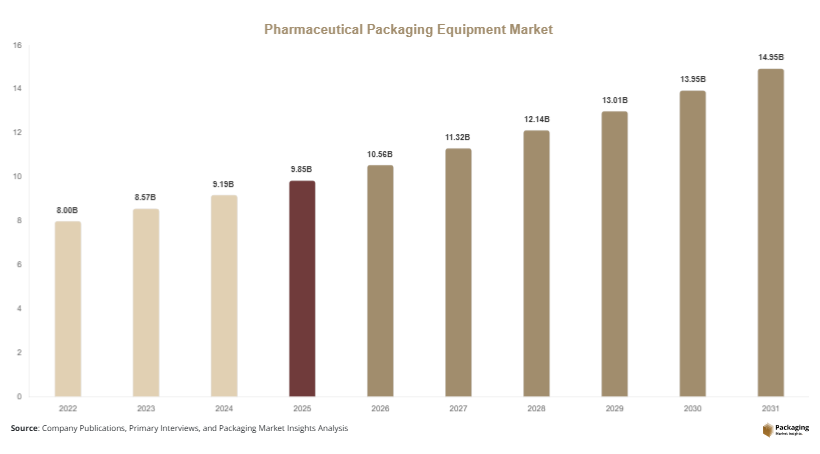
The Pharmaceutical Packaging Equipment Market size was valued at USD 9.85 billion in 2025 and is projected to reach USD 14.90 billion by 2030, expanding at a CAGR of 7.2% during 2025–2031. The market has witnessed steady growth driven by the rising demand for efficient, compliant, and automated packaging solutions across pharmaceutical manufacturing facilities worldwide.
One major global factor supporting market expansion has been the rapid increase in pharmaceutical production volumes, particularly in generics and biologics. This has necessitated advanced packaging equipment capable of ensuring product integrity, traceability, and regulatory compliance. Automation and integration of smart technologies have further enhanced operational efficiency, reducing human error and improving output quality.
The Pharmaceutical Packaging Equipment Market continues to evolve with increasing investments in flexible packaging lines and modular systems. Manufacturers are focusing on reducing downtime while improving throughput, which is shaping the adoption of high-speed packaging machinery globally.
Key Highlights:
- North America dominated the market with 36.5% share in 2025, while Asia Pacific is projected to grow at the fastest CAGR of 8.6%
- Filling equipment emerged as the leading type segment, while labeling equipment is expected to grow at a CAGR of 8.9%
- Bottles remained the dominant packaging format, whereas pre-filled syringes are projected to grow at 9.2% CAGR
- The United States led the market with USD 3.1 billion in 2025 and is estimated to reach USD 3.3 billion in 2026
Explore more data points, trends and opportunities Download Free Sample Report
Market Trends
Adoption of Smart and Connected Packaging Equipment
The Pharmaceutical Packaging Equipment Market is increasingly adopting IoT-enabled and AI-integrated machinery. Smart equipment allows real-time monitoring, predictive maintenance, and performance optimization. These technologies help manufacturers comply with stringent regulatory standards while reducing downtime. Digital twins and machine learning are also being incorporated to simulate packaging operations and enhance efficiency.
Shift Toward Flexible and Modular Packaging Systems
Pharmaceutical companies are transitioning toward flexible packaging lines that can handle multiple formats and batch sizes. This trend is driven by the need for personalized medicines and small-batch production. Modular equipment designs enable quick changeovers and reduce operational costs. As a result, manufacturers are investing in adaptable systems that support diverse packaging formats such as blister packs, vials, and syringes.
Market Drivers
Growing Pharmaceutical Production and Drug Approvals
The increasing number of drug approvals and expansion of pharmaceutical manufacturing facilities are key drivers of the Pharmaceutical Packaging Equipment Market. Rising demand for generic drugs and specialty medicines has led to higher production volumes, necessitating advanced packaging systems. Equipment capable of handling high throughput while maintaining compliance is becoming essential.
Stringent Regulatory Requirements for Packaging
Regulatory agencies worldwide mandate strict guidelines for pharmaceutical packaging to ensure product safety and traceability. Serialization, tamper-evident packaging, and labeling accuracy are critical requirements. This has accelerated the adoption of technologically advanced packaging equipment that can meet compliance standards efficiently. Manufacturers are investing in systems that integrate inspection, coding, and verification processes.
Market Restraint
High Capital Investment and Maintenance Costs
The Pharmaceutical Packaging Equipment Market faces challenges due to the high initial investment required for advanced machinery. Automated and smart packaging systems involve significant costs related to installation, integration, and training. Additionally, ongoing maintenance and upgrades add to operational expenses. Small and medium-sized pharmaceutical companies often find it difficult to adopt such equipment, limiting market penetration. The complexity of integrating new systems with existing production lines further adds to the cost burden, slowing down adoption rates in cost-sensitive regions.
Market Opportunities
Expansion of Biologics and Injectable Drugs
The increasing demand for biologics and injectable drugs presents significant opportunities for the Pharmaceutical Packaging Equipment Market. These products require specialized packaging solutions such as vials, ampoules, and pre-filled syringes. Equipment designed for sterile and precise filling processes is expected to witness strong demand. This shift toward complex drug formulations will drive innovation in packaging technologies.
Growth in Emerging Markets
Emerging economies in Asia, Latin America, and Africa are experiencing rapid growth in pharmaceutical manufacturing. Governments are investing in healthcare infrastructure and local drug production. This creates opportunities for packaging equipment manufacturers to expand their presence in these regions. Cost-effective and scalable equipment solutions are gaining traction, enabling manufacturers to cater to diverse market needs.
Report Scope
| Report Metric | Details |
|---|---|
| Market Size in 2025 | USD 9.85 Billion |
| Market Size in 2026 | USD 10.56 Billion |
| Market Size in 2031 | USD 15.97 Billion |
| CAGR | 7.2% (2026-2031) |
| Base Year for Estimation | 2025 |
| Historical Data | 2022-2024 |
| Forecast Period | 2026-2031 |
| Report Coverage | Revenue Forecast, Competitive Landscape, Supply Chain Disruption, Growth Factors, Environment & Regulatory Landscape and Trends |
| Geographies Covered | North America, Europe, APAC, Middle East and Africa, LATAM |
| Countries Covered | U.S., Canada, U.K., Germany, France, Spain, Italy, Russia, Nordic, Benelux, Rest of Europe, China, South Korea, Japan, India, Australia, Singapore, Taiwan, South East Asia, Rest of Asia-Pacific, UAE, Turky, Saudi Arabia, South Africa, Egypt, Nigeria, Rest of MEA, Brazil, Mexico, Argentina, Chile, Colombia, Rest of LATAM |
Explore more data points, trends and opportunities Download Free Sample Report
Segmental Analysis
By Equipment Type
Filling equipment held the dominant share of 32.6% in 2024 within the Pharmaceutical Packaging Equipment Market. This segment had been widely used for liquid and semi-solid drug formulations, ensuring accuracy and efficiency in packaging processes. Its ability to handle high production volumes made it essential for pharmaceutical manufacturers.
Labeling equipment is projected to be the fastest-growing subsegment, expanding at a CAGR of 8.9%. The growth will be driven by increasing regulatory requirements for accurate labeling and serialization. Advanced labeling systems with integrated inspection technologies will enhance compliance and reduce errors.
By Packaging Format
Bottles dominated the segment with a 34.2% share in 2024, as they are widely used for oral medications and liquid formulations. Their versatility and compatibility with various drug types contributed to their leading position in the Pharmaceutical Packaging Equipment Market.
Pre-filled syringes are expected to grow at a CAGR of 9.2%, driven by the rising demand for injectable drugs and biologics. These formats will require specialized packaging equipment capable of maintaining sterility and precision, supporting segment growth.
By Automation Level
Automatic equipment accounted for 58.7% of the market share in 2024, reflecting strong adoption of high-speed and efficient systems. Automation had improved production efficiency, reduced labor dependency, and ensured consistent quality.
Semi-automatic equipment will grow at a CAGR of 6.5%, supported by small and medium-sized manufacturers seeking cost-effective solutions. These systems will offer flexibility and lower investment costs, making them suitable for emerging markets.
By End-Use
Pharmaceutical manufacturing companies dominated the segment with a 61.3% share in 2024, as they are the primary users of packaging equipment. Increasing production capacities and expansion of manufacturing facilities have driven demand in this segment.
Contract packaging organizations are expected to grow at a CAGR of 8.1%, driven by outsourcing trends in pharmaceutical packaging. These organizations will benefit from increasing demand for specialized and flexible packaging services.
Pharmaceutical Packaging Equipment Market Segmentations
By Equipment Type
- Filling Equipment
- Labeling Equipment
- Cartoning Equipment
- Wrapping Equipment
- Inspection Equipment
By Packaging Format
- Bottles
- Blister Packs
- Vials & Ampoules
- Pre-filled Syringes
- Others
By Automation Level
- Automatic
- Semi-Automatic
- Manual
By End-Use
- harmaceutical Manufacturers
- Contract Packaging Organizations
Regional Analysis
North America
North America accounted for 36.5% of the Pharmaceutical Packaging Equipment Market share in 2025 and had demonstrated strong adoption of automated systems. The region will continue to expand at a CAGR of 6.5% during 2025–2033, supported by technological advancements and regulatory compliance requirements. High investments in pharmaceutical R&D and packaging innovation will sustain growth.
The United States dominated the regional market due to its advanced pharmaceutical manufacturing ecosystem. The presence of major pharmaceutical companies and contract manufacturing organizations has driven demand for high-speed and precision packaging equipment. The country’s focus on serialization and track-and-trace systems has further accelerated equipment adoption.
Europe
Europe held approximately 27.8% of the market share in 2025 and had maintained steady growth driven by strong regulatory frameworks. The region is projected to grow at a CAGR of 6.8% through 2033, supported by the presence of established pharmaceutical manufacturers and increasing demand for sustainable packaging solutions.
Germany emerged as the leading country due to its robust industrial base and focus on automation. The country’s emphasis on engineering excellence and innovation in packaging technologies has supported market expansion. Adoption of eco-friendly packaging equipment has also gained momentum in the region.
Asia Pacific
Asia Pacific captured 22.4% of the Pharmaceutical Packaging Equipment Market in 2025 and had shown rapid industrial growth. The region will grow at the fastest CAGR of 8.6% during 2025–2033, driven by expanding pharmaceutical production and rising healthcare investments.
China dominated the region due to its large-scale pharmaceutical manufacturing capacity. Government initiatives to boost domestic drug production and exports have increased demand for advanced packaging equipment. The growing generics market has further supported equipment adoption.
Middle East & Africa
The Middle East & Africa accounted for 6.3% of the market share in 2025 and had experienced gradual growth. The region is expected to expand at a CAGR of 6.9% during the forecast period, supported by improving healthcare infrastructure.
Saudi Arabia led the regional market due to government initiatives aimed at localizing pharmaceutical production. Investments in healthcare facilities and manufacturing capabilities have driven demand for packaging equipment. The country’s strategic focus on reducing import dependency has further supported growth.
Latin America
Latin America held 7.0% of the Pharmaceutical Packaging Equipment Market share in 2025 and had shown moderate growth. The region will grow at a CAGR of 7.1% through 2033, driven by increasing pharmaceutical demand and industrial expansion.
Brazil dominated the region due to its strong pharmaceutical sector. The country’s growing population and healthcare needs have increased drug production, driving demand for packaging equipment. Investments in modernization of manufacturing facilities have further contributed to market growth.
Competitive Landscape
The Pharmaceutical Packaging Equipment Market is characterized by the presence of global and regional players focusing on innovation and automation. Companies are investing in advanced technologies to enhance efficiency and comply with regulatory standards.
IMA Group is recognized as a market leader due to its comprehensive product portfolio and global presence. The company recently introduced advanced modular packaging systems designed to improve flexibility and reduce downtime.
Other key players are focusing on expanding their product offerings and strengthening distribution networks. Strategic partnerships, mergers, and acquisitions are common strategies to enhance market position. Continuous investment in research and development is enabling companies to introduce technologically advanced solutions, supporting market growth.
Key Players in the Pharmaceutical Packaging Equipment Market
- IMA Group
- Bosch Packaging Technology
- Uhlmann Group
- Marchesini Group
- Romaco Group
- Multivac Group
- Körber AG
- Coesia Group
- Bausch+Ströbel
- Syntegon Technology
- ACG Worldwide
- MG2 S.r.l.
- Optima Packaging Group
- Robert Bosch GmbH
- ProMach Inc.