Hydrogel Market Size
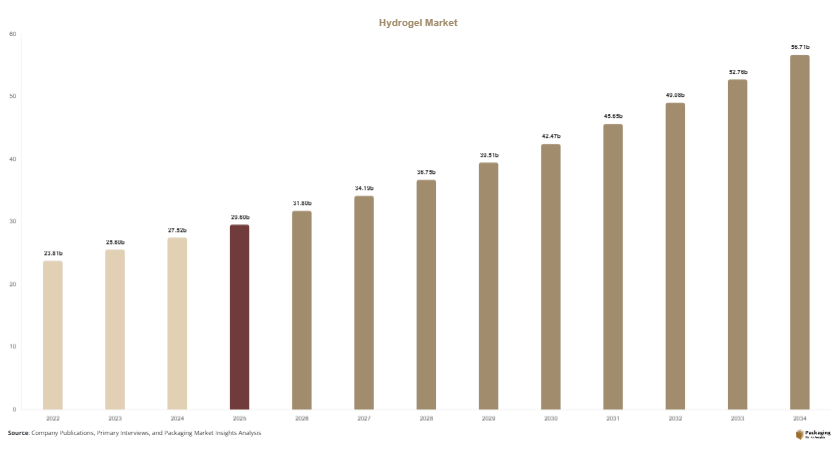
Hydrogel market size is projected at USD 31.8 billion in 2026 and is expected to hit USD 56.7 billion by 2034 with a CAGR of 7.5%. The market is supported by increasing investments in biomedical materials, rising healthcare expenditure, and growing industrial applications across pharmaceuticals, agriculture, and personal care. Comprehensive market evaluation includes detailed segmentation by type and application, competitive benchmarking of major manufacturers, production capacity analysis exceeding 9.6 million metric tons, and regional performance assessment to provide strategic insights for stakeholders.
Hydrogels are three-dimensional polymer networks capable of retaining up to 95–99% water while maintaining structural integrity. They are extensively utilized in wound management, drug delivery systems, tissue engineering, contact lenses, agriculture, and hygiene products due to their excellent biocompatibility and absorbent properties. Global production surpassed 9.2 million metric tons in 2025, while healthcare applications represented nearly 44% of total consumption and industrial applications accounted for approximately 31%. More than 68% of newly developed biomedical scaffolds incorporate hydrogel-based formulations, reinforcing the expanding Hydrogel market.
Explore more data points, trends and opportunities Download Free Sample Report
Hydrogel Market Trends
Rising Adoption of Smart and Responsive Hydrogels
The development of temperature-sensitive, pH-responsive, and injectable hydrogels is transforming advanced medical treatment. More than 37% of newly commercialized hydrogel products now include smart polymer technologies compared with 24% five years ago. Annual production of responsive hydrogels exceeded 1.8 million metric tons, driven by demand from regenerative medicine and controlled drug release applications. Increasing adoption across orthopedic implants and chronic wound treatment continues to strengthen Hydrogel market.
Growing investments exceeding USD 2.4 billion in biomaterials research have accelerated commercialization of multifunctional hydrogels. Approximately 62% of pharmaceutical companies developing sustained-release therapies are evaluating hydrogel platforms, while healthcare facilities report over 18% annual growth in hydrogel dressing utilization. Continuous technology integration with 3D bioprinting and tissue scaffolding further supports Hydrogel market.
Hydrogel Market Drivers
Growing Demand for Advanced Wound Care Solutions
The increasing incidence of chronic wounds, diabetic ulcers, and surgical procedures continues to stimulate hydrogel consumption. More than 65 million patients receive advanced wound treatment annually, while hydrogel dressings account for nearly 41% of modern moist wound care products. Healthcare spending on wound management exceeded USD 22 billion, with hydrogel utilization increasing by approximately 9% annually. Expanding hospital infrastructure and aging populations continue supporting Hydrogel market growth.
Hydrogel Market Restraints
High Manufacturing Costs and Regulatory Compliance
Production of medical-grade hydrogels requires specialized polymer synthesis, sterilization, and quality validation processes, increasing manufacturing expenses by nearly 18–24% compared with conventional polymer materials. Regulatory approvals frequently require 24–48 months, while compliance costs may exceed USD 8 million per product for advanced biomedical applications. Price sensitivity in emerging economies also limits broader commercialization, creating restraints for Hydrogel market growth.
Hydrogel Market Opportunities
Expansion Across Regenerative Medicine and Drug Delivery
Regenerative medicine investments are creating significant opportunities for hydrogel manufacturers. More than 1,600 tissue engineering clinical studies currently utilize hydrogel matrices, while injectable hydrogel demand is growing above 11% annually. Drug delivery applications account for nearly 29% of research investments, supported by rising biologics production and personalized medicine initiatives. These developments continue creating new opportunities within Hydrogel market.
Challenges in Hydrogel Market
Performance Optimization Across Multiple End-use Industries
Achieving optimal mechanical strength, biodegradability, and long-term stability remains challenging. Approximately 28% of research programs focus on improving polymer crosslinking efficiency, while nearly 17% of commercial products undergo formulation upgrades before market launch. Balancing water retention above 95% with structural durability remains technically demanding across healthcare and industrial applications, presenting ongoing challenges for Hydrogel market.
Report Scope
| Report Metric | Details |
|---|---|
| Market Size in 2025 | USD 29.6 billion |
| Market Size in 2026 | USD 31.8 billion |
| Market Size in 2034 | USD 56.7 billion |
| CAGR | 7.5% (2026-2034) |
| Base Year for Estimation | 2025 |
| Historical Data | 2022-2024 |
| Forecast Period | 2026-2034 |
| Report Coverage | Revenue Forecast, Competitive Landscape, Supply Chain Disruption, Growth Factors, Environment & Regulatory Landscape and Trends |
| Geographies Covered | North America, Europe, APAC, Middle East and Africa, LATAM |
| Countries Covered | U.S., Canada, U.K., Germany, France, Spain, Italy, Russia, Nordic, Benelux, Rest of Europe, China, South Korea, Japan, India, Australia, Singapore, Taiwan, South East Asia, Rest of Asia-Pacific, UAE, Turky, Saudi Arabia, South Africa, Egypt, Nigeria, Rest of MEA, Brazil, Mexico, Argentina, Chile, Colombia, Rest of LATAM |
Explore more data points, trends and opportunities Download Free Sample Report
Hydrogel Market Segmentation
The market is segmented according to material composition and application. Synthetic hydrogels contribute approximately 52% of global revenue, while wound care applications represent nearly 38% of total consumption owing to increasing healthcare utilization and technological advancement.
By Type
Natural Hydrogels
Natural hydrogels account for approximately 24% of production, exceeding 2.2 million metric tons annually. Derived from collagen, alginate, and chitosan, they demonstrate excellent biocompatibility with water absorption above 96%. These materials are extensively utilized in tissue regeneration and wound healing applications.
Synthetic Hydrogels
Synthetic hydrogels dominate with nearly 52% market contribution and annual production exceeding 4.8 million metric tons. Polyacrylamide, polyethylene glycol, and polyvinyl alcohol hydrogels provide improved mechanical stability, controlled swelling behavior, and consistent manufacturing quality suitable for medical and industrial uses.
Hybrid Hydrogels
Hybrid hydrogels contribute roughly 24% of global demand. Combining natural and synthetic polymers improves elasticity by approximately 22%, enhances drug-loading efficiency above 85%, and supports advanced tissue engineering and injectable biomedical formulations.
By Application
Wound Care
Wound care remains the largest application with nearly 38% share and annual consumption exceeding 3.4 million metric tons. Hydrogels maintain moist healing environments, absorb exudates efficiently, and reduce infection risk while supporting tissue regeneration across burns, ulcers, and postoperative wounds.
Drug Delivery
Drug delivery contributes approximately 34% of demand. More than 900 million hydrogel-based dosage systems are produced annually with sustained drug release efficiencies exceeding 80%. Injectable hydrogel formulations continue gaining acceptance for targeted therapeutic delivery.
Tissue Engineering
Tissue engineering accounts for nearly 28% of market utilization. Hydrogel scaffolds demonstrate cell viability above 90%, high porosity, and controlled degradation rates suitable for cartilage, bone, and soft tissue regeneration, supporting expanding regenerative medicine programs.
Hydrogel Market Segmentations
Type
- Natural Hydrogels
- Synthetic Hydrogels
- Hybrid Hydrogels
Application
- Wound Care
- Drug Delivery
- Tissue Engineering
End User
- Hospitals & Clinics
- Pharmaceutical & Biotechnology Companies
- Research & Academic Institutes
- Medical Device Manufacturers
- Agriculture & Industrial Users
Hydrogel Regional Outlook
North America
North America holds approximately 37% of global revenue with production exceeding 3.1 million metric tons annually. The United States contributes nearly 82% of regional output due to strong pharmaceutical manufacturing, advanced healthcare infrastructure, and significant biomaterials research investments. Canada continues expanding medical hydrogel manufacturing capacity.
Europe
Europe accounts for around 28% of global consumption. Germany, France, the United Kingdom, and Italy collectively represent more than 74% of regional demand. Production exceeds 2.3 million metric tons, supported by advanced biomedical research, healthcare innovation, and strict quality standards.
Asia-Pacific
Asia-Pacific represents approximately 27% of global revenue and records the fastest expansion. China contributes nearly 46% of regional production, followed by Japan, India, and South Korea. Manufacturing output exceeds 2.7 million metric tons, supported by expanding pharmaceutical industries and rising healthcare investments.
Middle East & Africa and South America
These regions jointly account for nearly 8% of global consumption. Brazil leads South American demand, while Saudi Arabia, the UAE, and South Africa continue increasing healthcare investments. Combined production exceeds 700 thousand metric tons, with increasing adoption in medical and agricultural applications.
Top players in Hydrogel Market
- 3M Company
- Cardinal Health
- Smith & Nephew plc
- Johnson & Johnson
- Coloplast A/S
- B. Braun SE
- Paul Hartmann AG
- Ashland Inc.
- BASF SE
- Dow Inc.
- Evonik Industries AG
- Kuraray Co., Ltd.
3M Company
-
Holds an estimated 9–11% global market position across advanced wound care solutions.
-
Strong portfolio of hydrogel dressings, medical adhesives, and healthcare materials.
-
Extensive global manufacturing network serving hospitals in over 70 countries.
-
Continuous investment in product innovation and advanced polymer technologies strengthens competitive positioning within the medical hydrogel sector.
Cardinal Health
-
Accounts for approximately 7–9% market participation in medical hydrogel products.
-
Broad distribution capabilities across hospitals, clinics, and long-term care facilities.
-
Offers diversified wound care solutions supported by integrated healthcare logistics.
-
Expanding partnerships with healthcare providers and continuous portfolio enhancement reinforce its position in advanced hydrogel-based medical applications.