Multi Med Adherence Packaging Market size and Growth
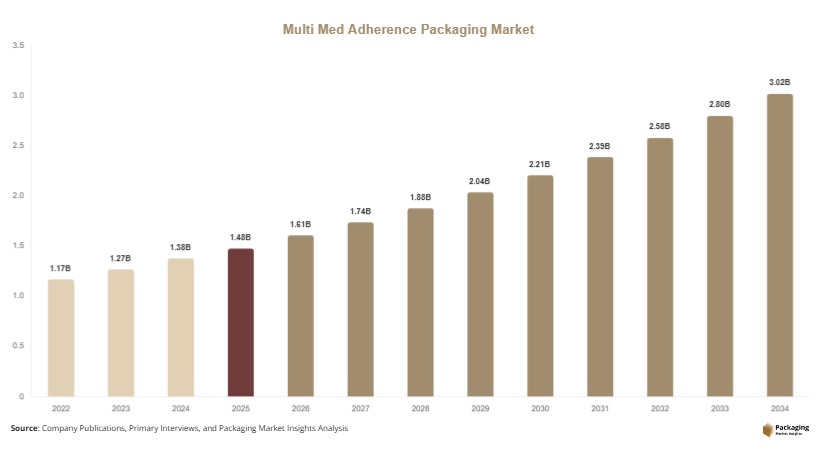
The global multi med adherence packaging market size is estimated at approximately USD 1.48 billion in 2025, reflecting strong adoption across pharmacies, hospitals, and home healthcare settings. By 2026, the market is projected to reach around USD 1.61 billion, supported by increasing automation in pharmacy operations and rising patient-centric healthcare models. Looking forward, the market is expected to attain USD 3.05 billion by 2034, expanding at a CAGR of 8.2% during 2025–2034. The multi med adherence packaging market is witnessing steady expansion driven by increasing global focus on medication compliance, rising prevalence of chronic diseases, and growing demand for organized pharmaceutical dispensing solutions.
The growth of the multi med adherence packaging market is primarily driven by three key factors. First, the increasing burden of chronic diseases such as diabetes, cardiovascular disorders, and respiratory illnesses is significantly boosting demand for structured medication management systems. Second, healthcare providers are focusing on reducing medication errors and improving patient adherence rates, especially among elderly populations requiring multiple prescriptions. Third, rising adoption of pharmacy automation systems and digital healthcare integration is improving efficiency in medication dispensing processes.
Key Highlights:
- North America dominated the market with a 36.8% share in 2025.
- Europe held a 28.4% share in 2025.
- Asia Pacific is projected to grow at the fastest CAGR of 9.1%.
- Blister-based adherence packaging led the market with a 48.2% share in 2024.
- Pharmacies dominated the end-user segment with a 54.1% share in 2024.
- Chronic disease management accounted for a 50.7% share in 2024.
- The US remained the dominant country with a market size of USD 1.62 billion in 2025 and USD 1.75 billion in 2026.
Explore more data points, trends and opportunities Download Free Sample Report
Market Trends
Increasing Adoption of Digital Medication Tracking Integration
The multi med adherence packaging market is experiencing a strong shift toward integration of digital tracking systems with packaging solutions. Pharmacies and healthcare providers are incorporating QR codes, barcode scanning, and mobile-based reminder systems into adherence packaging formats. This allows patients and caregivers to monitor medication schedules more effectively and reduce missed doses. The trend is particularly strong in North America and Europe, where digital healthcare ecosystems are highly developed. Smart adherence packaging systems are also being integrated with pharmacy management software, improving dispensing accuracy and operational efficiency. This trend is expected to significantly enhance patient compliance rates and reduce hospitalization due to medication errors.
Growth of Personalized Multi-Dose Packaging Solutions
Another major trend is the increasing demand for personalized multi-dose packaging formats tailored to individual patient medication schedules. Pharmacies are offering customized blister packs and pouch-based systems that organize multiple medications by time, day, and dosage. This trend is driven by rising geriatric populations and increasing prevalence of polypharmacy cases. Personalized packaging helps reduce confusion among patients taking multiple prescriptions and improves adherence outcomes. Healthcare providers are increasingly partnering with packaging solution providers to deliver patient-specific medication packs, especially in long-term care facilities and home healthcare environments.
Market Drivers
Rising Prevalence of Chronic Diseases
The growing global burden of chronic diseases is a key driver of the multi med adherence packaging market. Conditions such as diabetes, hypertension, cardiovascular diseases, and asthma require long-term and often complex medication schedules. Patients suffering from multiple chronic conditions are more likely to experience medication non-adherence, increasing demand for structured packaging solutions. Healthcare systems are increasingly adopting adherence packaging to improve treatment outcomes and reduce healthcare costs associated with hospital readmissions. This is particularly significant in aging populations, where multiple prescriptions are common.
Expansion of Pharmacy Automation and Healthcare Digitization
The increasing adoption of pharmacy automation systems is another major driver of market growth. Automated dispensing systems, robotic packaging machines, and digital prescription management tools are enhancing efficiency in medication packaging processes. Pharmacies are able to reduce human error while improving speed and accuracy in multi-medication packaging. Additionally, healthcare digitization is enabling better integration between electronic health records and packaging systems, allowing real-time updates of patient prescriptions. This technological advancement is significantly improving operational efficiency and driving widespread adoption of adherence packaging solutions.
Market Restraint
High Initial Cost and Operational Complexity of Adherence Packaging Systems
A key restraint in the multi med adherence packaging market is the high initial investment and operational complexity associated with advanced packaging systems. Automated blister packaging machines, multi-dose pouch systems, and digital integration tools require significant capital expenditure, which can be challenging for small and mid-sized pharmacies. Additionally, training staff to operate these systems and maintain accuracy in medication sorting adds to operational costs.
In many developing regions, healthcare facilities still rely on manual dispensing systems due to cost constraints, limiting adoption of advanced adherence packaging technologies. Furthermore, integration of digital tracking systems with existing pharmacy infrastructure can be technically complex and time-consuming. Variability in prescription formats and regulatory differences across regions also create operational challenges. As a result, despite strong demand, cost-related barriers and system complexity continue to slow down large-scale adoption in price-sensitive markets.
Market Opportunities
Expansion of Home Healthcare and Remote Patient Monitoring
The rapid growth of home healthcare services presents a major opportunity for the multi med adherence packaging market. Increasing preference for home-based treatment, especially among elderly and chronically ill patients, is driving demand for easy-to-use medication packaging systems. Adherence packaging plays a crucial role in ensuring correct dosage administration outside clinical settings. Integration with remote monitoring technologies and mobile health applications further enhances patient compliance. Healthcare providers are increasingly adopting subscription-based medication delivery systems combined with adherence packaging solutions.
Growth of Smart and Connected Packaging Solutions
The emergence of smart packaging technologies offers significant growth opportunities. Packaging systems integrated with IoT devices, NFC tags, and mobile applications are enabling real-time medication tracking and adherence monitoring. These technologies allow caregivers and healthcare providers to receive alerts on missed doses or incorrect usage. Pharmaceutical companies are investing in intelligent packaging solutions to differentiate their offerings and improve patient outcomes. As digital healthcare ecosystems expand globally, smart adherence packaging is expected to become a key innovation area.
Report Scope
| Report Metric | Details |
|---|---|
| Market Size in 2025 | USD 1.48 Billion |
| Market Size in 2026 | USD 1.61 Billion |
| Market Size in 2034 | USD 3.05 Billion |
| CAGR | 8.2% (2026-2034) |
| Base Year for Estimation | 2025 |
| Historical Data | 2022-2024 |
| Forecast Period | 2026-2034 |
| Report Coverage | Revenue Forecast, Competitive Landscape, Supply Chain Disruption, Growth Factors, Environment & Regulatory Landscape and Trends |
| Geographies Covered | North America, Europe, APAC, Middle East and Africa, LATAM |
| Countries Covered | U.S., Canada, U.K., Germany, France, Spain, Italy, Russia, Nordic, Benelux, Rest of Europe, China, South Korea, Japan, India, Australia, Singapore, Taiwan, South East Asia, Rest of Asia-Pacific, UAE, Turky, Saudi Arabia, South Africa, Egypt, Nigeria, Rest of MEA, Brazil, Mexico, Argentina, Chile, Colombia, Rest of LATAM |
Explore more data points, trends and opportunities Download Free Sample Report
Segmental Analysis
By Packaging Type
The packaging type segment of the multi med adherence packaging market is dominated by blister-based adherence packaging, accounting for approximately 48.2% share in 2024. Blister packs remain widely used due to their ability to organize medications in clearly labeled daily or weekly doses. These systems significantly reduce medication errors, improve patient compliance, and are extensively used in pharmacies, hospitals, and long-term care facilities. Their tamper-evident design and easy readability make them highly suitable for elderly patients and individuals managing multiple prescriptions.
The fastest-growing subsegment is multi-dose pouch packaging, projected to grow at a CAGR of 8.8% through 2034, driven by increasing automation in pharmacies and rising demand for home healthcare solutions. Multi-dose pouch systems allow automated sorting, packaging, and labeling of medications into clearly defined dosage packs. Integration with pharmacy automation software and barcode systems enhances accuracy and reduces human error. This format is gaining strong adoption in North America and Europe due to its efficiency in managing high-volume prescriptions and improving workflow efficiency in retail pharmacies.
By End User
The end-user segment is led by pharmacies, accounting for approximately 54.1% share in 2024. Pharmacies play a central role in preparing and dispensing adherence packaging solutions, making them the largest consumers of multi-med packaging systems. Retail and hospital pharmacies are increasingly offering value-added medication management services, including pre-sorted blister packs and pouch-based adherence solutions. Automation technologies have significantly enhanced pharmacy efficiency, allowing faster and more accurate prescription fulfillment.
The fastest-growing subsegment is home healthcare settings, projected to grow at a CAGR of 9.3% through 2034, driven by the global shift toward decentralized healthcare delivery. Patients are increasingly receiving treatment at home, especially those with chronic conditions requiring long-term medication. This has created strong demand for pre-packaged adherence solutions that simplify medication schedules. Integration of digital reminders, mobile apps, and remote monitoring tools further enhances adherence rates and reduces dependency on clinical visits, supporting strong growth in this segment.
By Application
The application segment is dominated by chronic disease management, accounting for approximately 50.7% share in 2024. Chronic diseases such as diabetes, cardiovascular disorders, and respiratory conditions require long-term and often complex medication regimens, making adherence packaging essential for improving treatment outcomes. These systems help reduce missed doses, prevent overdosing, and ensure correct medication timing, significantly improving patient safety.
The fastest-growing subsegment is polypharmacy management, projected to grow at a CAGR of 9.0% through 2034, driven by the increasing number of patients taking multiple medications simultaneously. Aging populations and rising prevalence of multiple chronic conditions are key drivers of this segment. Healthcare providers are increasingly adopting structured packaging systems that organize multiple prescriptions into single, easy-to-follow dosing schedules. This improves patient compliance and reduces healthcare costs associated with medication errors and hospital readmissions.
Multi Med Adherence Packaging Market Segmentations
By Packaging Type
- Blister-Based Adherence Packaging
- Multi-Dose Pouch Packaging
- Strip Packaging
- Calendar Packs
By End User
- Pharmacies
- Hospitals
- Home Healthcare
- Long-Term Care Facilities
By Application
- Chronic Disease Management
- Polypharmacy Management
- Elderly Care
- Post-Surgery Medication
Regional Analysis
North America
North America dominates the multi med adherence packaging market, accounting for approximately 36.8% share in 2025, and is projected to grow at a CAGR of 8.5% from 2025 to 2034. The region’s leadership is driven by advanced healthcare infrastructure, strong pharmaceutical distribution systems, and widespread adoption of pharmacy automation technologies. The United States holds the largest share due to its highly developed healthcare ecosystem, large patient base suffering from chronic diseases, and strong presence of leading pharmacy chain operators.
A major growth factor in North America is the increasing need to improve medication adherence among elderly populations. A significant portion of patients in the region suffer from multiple chronic conditions such as diabetes, cardiovascular diseases, and neurological disorders, requiring complex medication schedules. This has increased demand for blister-based multi-dose packaging, strip packs, and digitally integrated adherence systems. Pharmacies are rapidly adopting automated dispensing machines and cloud-connected medication management systems to improve accuracy and reduce human error. Canada also contributes significantly, driven by government-supported healthcare programs and strong focus on reducing hospital readmissions through better medication management solutions.
Europe
Europe holds approximately 28.4% market share in 2025, with a projected CAGR of 8.0% through 2034 in the multi med adherence packaging market. The region is characterized by strong regulatory frameworks, high healthcare spending, and increasing focus on patient safety. Countries such as Germany, the United Kingdom, France, Italy, and Spain are leading contributors, with Germany emerging as the most dominant due to its advanced pharmaceutical logistics and structured healthcare system.
A key growth driver in Europe is the rapidly aging population, which is increasing demand for organized medication management solutions. Elderly patients are more likely to experience polypharmacy, requiring multiple prescriptions per day, which increases the risk of non-adherence and medication errors. As a result, pharmacies and healthcare providers are increasingly adopting multi-dose blister packs, compliance packaging, and pharmacy-prepared adherence systems. Another important factor is strict EU regulatory pressure on medication safety and accuracy, which is encouraging the adoption of standardized packaging solutions. Additionally, Europe is witnessing strong integration of digital healthcare systems, including electronic prescriptions linked with adherence packaging workflows.
Asia Pacific
Asia Pacific accounts for approximately 25.6% market share in 2025, and is projected to grow at the fastest CAGR of 9.1% through 2034 in the multi med adherence packaging market. The region’s growth is driven by rising healthcare expenditure, large patient populations, and increasing awareness about medication adherence benefits. China, India, Japan, and South Korea are the key markets, with China leading due to its vast healthcare infrastructure and expanding pharmaceutical industry.
A major growth factor in Asia Pacific is the increasing burden of chronic diseases combined with improving healthcare access. Urbanization and lifestyle changes have led to a rise in conditions such as diabetes, hypertension, and respiratory disorders, which require long-term medication adherence. Pharmacies are increasingly adopting automated dispensing systems and pre-packaged medication solutions to reduce workload and improve accuracy. India is emerging as a high-growth market due to expansion of organized retail pharmacies and government initiatives aimed at improving healthcare delivery systems. Japan also plays a significant role due to its aging population and strong focus on precision healthcare management solutions.
Middle East & Africa
The Middle East & Africa (MEA) region holds approximately 5.2% market share in 2025, with a projected CAGR of 7.0% through 2034 in the multi med adherence packaging market. The region is experiencing gradual but steady growth due to improving healthcare infrastructure, increasing chronic disease prevalence, and rising pharmaceutical imports. Countries such as the United Arab Emirates, Saudi Arabia, South Africa, and Egypt are the major contributors to regional demand.
A key growth factor in MEA is the expansion of hospital networks and increasing government investment in healthcare modernization. Healthcare providers are increasingly focusing on improving patient safety and reducing medication errors, which is driving adoption of adherence packaging solutions. The UAE leads the region due to advanced healthcare facilities and rapid digital health adoption. South Africa is also witnessing increasing adoption due to growing awareness of chronic disease management and improved access to pharmaceutical services in urban areas. However, limited automation in smaller healthcare facilities continues to restrict faster adoption in rural areas.
Latin America
Latin America accounts for approximately 4.0% market share in 2025, with a projected CAGR of 7.6% through 2034 in the multi med adherence packaging market. The region is gradually adopting structured medication management solutions driven by expanding healthcare access and rising pharmaceutical consumption. Brazil, Mexico, Argentina, and Chile are the key contributors, with Brazil dominating due to its large population and strong pharmacy network expansion.
A key growth factor in Latin America is the increasing prevalence of chronic diseases and rising demand for cost-effective healthcare solutions. Pharmacies are increasingly offering pre-organized medication packs to improve adherence and reduce hospital readmissions. Mexico is emerging as a strong market due to growing investments in pharmacy automation and expansion of retail healthcare chains. Additionally, rising government focus on improving healthcare efficiency and reducing treatment costs is encouraging the adoption of adherence packaging systems across urban healthcare facilities.
Competitive Landscape
The market is moderately consolidated with key players focusing on automation and digital integration. Major companies include Omnicell Inc., BD (Becton Dickinson), McKesson Corporation, ARxIUM, and Jones Healthcare Group. These companies are investing in smart packaging systems and pharmacy automation tools.
Omnicell Inc. is a leading player due to its advanced medication management solutions. Recently, the company expanded its automated adherence packaging platform integrated with cloud-based medication tracking systems, improving pharmacy workflow efficiency.
Key Players List
- Omnicell Inc.
- Becton Dickinson (BD)
- McKesson Corporation
- ARxIUM Inc.
- Jones Healthcare Group
- Medicine-On-Time
- TCGRx
- Swisslog Healthcare
- Capsa Healthcare
- Parata Systems
- Manrex Limited
- PillPack (Amazon Pharmacy)
- Cardinal Health
- Avery Dennison
- WestRock Company