Compound Pharmacy Packaging Market Size and Growth
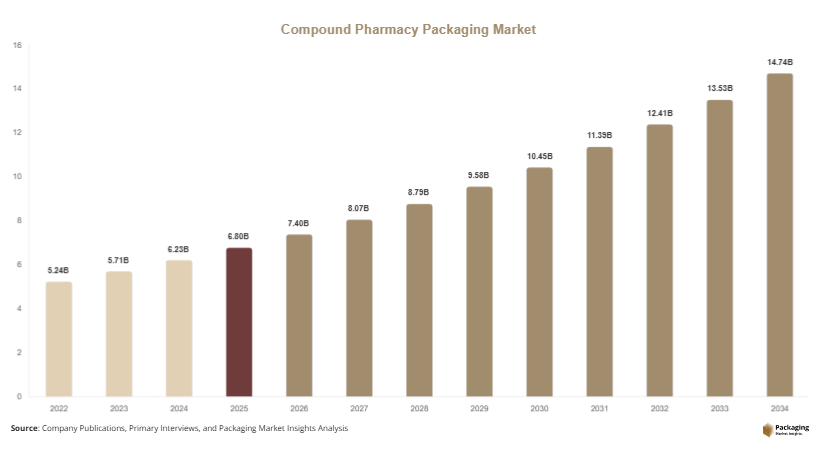
The global compound pharmacy packaging market size reached USD 6.8 billion in 2025 and is projected to grow to USD 7.4 billion in 2026. With expanding applications in customized drug formulations, the market is forecast to reach approximately USD 16.2 billion by 2034, registering a CAGR of 9.0% during the forecast period (2025–2034). The compound pharmacy packaging market is experiencing steady growth driven by the increasing demand for personalized medicines and specialized pharmaceutical formulations. Compound pharmacy packaging plays a critical role in ensuring product stability, safety, and compliance with regulatory standards.
One of the primary growth factors influencing the compound pharmacy packaging market is the rising demand for personalized medicine. As healthcare providers increasingly prescribe customized formulations tailored to individual patient needs, the requirement for specialized packaging solutions is growing. These packaging formats must ensure accurate dosing, protection from environmental factors, and ease of use.
Key Highlights:
- Market size reached USD 6.8 billion in 2025 and is projected to reach USD 16.2 billion by 2034, reflecting steady expansion supported by increasing demand for specialized pharmaceutical packaging solutions.
- The market is expected to grow at a CAGR of 9.0% during the forecast period (2025–2034), driven by advancements in packaging technologies and the growing focus on safety, compliance, and product integrity.
- Rising demand for personalized medicine and customized drug formulations is accelerating adoption, as compounding pharmacies require packaging solutions that ensure accurate dosing, stability, and protection of sensitive formulations.
- Increasing adoption of advanced and compliant pharmaceutical packaging solutions is further contributing to market growth, with innovations such as tamper-evident features, child-resistant closures, and smart labeling enhancing patient safety and regulatory adherence.
Explore more data points, trends and opportunities Download Free Sample Report
Market Trends
Increasing Integration of Smart Packaging Technologies
The integration of smart packaging technologies is emerging as a significant trend in the compound pharmacy packaging market. Pharmaceutical companies and compounding pharmacies are adopting solutions such as QR codes, RFID tags, and digital tracking systems to enhance product traceability and patient safety. These technologies enable real-time monitoring of medications and provide detailed information about dosage, storage conditions, and expiration dates. Smart packaging is also supporting regulatory compliance by ensuring accurate record-keeping and improving supply chain transparency. This trend is expected to gain momentum as digital healthcare solutions continue to expand.
Shift Toward Sustainable and Eco-Friendly Packaging
The shift toward sustainable and eco-friendly packaging is another key trend shaping the market. With increasing environmental concerns and regulatory pressure, manufacturers are focusing on developing packaging solutions that reduce environmental impact. Materials such as recyclable plastics, biodegradable polymers, and paper-based packaging are gaining popularity. Companies are also optimizing packaging designs to reduce material usage while maintaining product safety. This trend is expected to drive innovation in packaging materials and support long-term market growth.
Market Drivers
Growing Demand for Personalized Medicine
The growing demand for personalized medicine is a major driver of the compound pharmacy packaging market. Healthcare providers are increasingly prescribing customized medications tailored to individual patient needs. This trend is particularly evident in areas such as oncology, pediatrics, and dermatology. Packaging solutions must ensure accurate dosing, maintain drug stability, and provide clear labeling. The increasing adoption of personalized medicine is driving demand for specialized packaging formats, supporting market growth.
Rising Focus on Medication Safety and Compliance
The rising focus on medication safety and regulatory compliance is another key driver of the market. Regulatory authorities are implementing stringent guidelines for pharmaceutical packaging to ensure patient safety. Features such as tamper-evident seals, child-resistant closures, and clear labeling are becoming essential. These requirements are encouraging pharmaceutical companies to invest in advanced packaging solutions. The emphasis on reducing medication errors and improving patient outcomes is further supporting market growth.
Market Restraint
High Cost of Advanced Packaging Solutions
The high cost of advanced packaging solutions is a significant restraint for the compound pharmacy packaging market. Developing and implementing specialized packaging systems that meet regulatory requirements can be expensive. Small and medium-sized compounding pharmacies may face challenges in adopting these solutions due to limited budgets. Additionally, the cost of materials such as high-barrier plastics and specialized glass can increase overall packaging expenses. For example, implementing smart packaging technologies requires investment in infrastructure and equipment, which can be a barrier for smaller players. These cost challenges may limit market growth in certain regions.
Market Opportunities
Expansion of Compounding Pharmacies in Emerging Markets
The expansion of compounding pharmacies in emerging markets presents a significant opportunity for the compound pharmacy packaging market. Increasing healthcare access, rising awareness about personalized medicine, and growing demand for customized drug formulations are driving the growth of compounding pharmacies. As these facilities expand, the demand for specialized packaging solutions is expected to increase. Companies can capitalize on this opportunity by offering cost-effective and compliant packaging solutions tailored to local market needs.
Development of Innovative and Patient-Centric Packaging
The development of innovative and patient-centric packaging solutions offers another key opportunity for the market. Packaging designs that improve ease of use, enhance medication adherence, and provide clear instructions are gaining importance. Features such as easy-open containers, unit-dose packaging, and digital labeling systems are expected to drive demand. This trend is particularly relevant for elderly patients and those with chronic conditions, supporting market growth.
Report Scope
| Report Metric | Details |
|---|---|
| Market Size in 2025 | USD 6.8 Billion |
| Market Size in 2026 | USD 7.4 Billion |
| Market Size in 2034 | USD 16.2 Billion |
| CAGR | 9.0% (2026-2034) |
| Base Year for Estimation | 2025 |
| Historical Data | 2022-2024 |
| Forecast Period | 2026-2034 |
| Report Coverage | Revenue Forecast, Competitive Landscape, Supply Chain Disruption, Growth Factors, Environment & Regulatory Landscape and Trends |
| Geographies Covered | North America, Europe, APAC, Middle East and Africa, LATAM |
| Countries Covered | U.S., Canada, U.K., Germany, France, Spain, Italy, Russia, Nordic, Benelux, Rest of Europe, China, South Korea, Japan, India, Australia, Singapore, Taiwan, South East Asia, Rest of Asia-Pacific, UAE, Turky, Saudi Arabia, South Africa, Egypt, Nigeria, Rest of MEA, Brazil, Mexico, Argentina, Chile, Colombia, Rest of LATAM |
Explore more data points, trends and opportunities Download Free Sample Report
Segmental Analysis
By Material Type
The plastic packaging segment dominated the compound pharmacy packaging market in 2024, accounting for approximately 55% of the total market share. This dominance is attributed to its versatility, cost-effectiveness, and ability to provide high-barrier protection against moisture and contaminants. Plastic containers are widely used for storing liquid formulations, creams, and capsules. The increasing demand for lightweight and durable packaging solutions is driving the growth of this segment.
The glass packaging segment is expected to be the fastest-growing, with a projected CAGR of 9.6% during the forecast period. This growth is driven by its superior chemical resistance and ability to maintain drug stability. Glass containers are preferred for sensitive formulations, supporting segment growth.
By Product Type
The bottles segment held the largest market share in 2024, accounting for approximately 48% of the total revenue. Bottles are widely used in compound pharmacy packaging due to their convenience and versatility. They are suitable for a wide range of formulations, including liquids and capsules. The increasing demand for customized medications is driving the growth of this segment.
The vials segment is expected to be the fastest-growing, with a CAGR of 9.4% during the forecast period. This growth is driven by increasing demand for injectable and sterile formulations. Vials provide high protection and are widely used in healthcare settings.
By End-Use
The compounding pharmacies segment dominated the market in 2024, accounting for approximately 50% of the total share. The demand for packaging solutions in this segment is driven by the need for customized drug formulations. Packaging must ensure safety, stability, and compliance.
The hospitals segment is expected to be the fastest-growing, with a CAGR of 9.2% during the forecast period. This growth is driven by increasing demand for personalized medicine in healthcare facilities. Hospitals are adopting advanced packaging solutions to improve patient safety.
Compound Pharmacy Packaging Market Segmentations
By Product Type
- Bottles
- Vials
- Tubes
- Others
By Material Type
- Plastic
- Glass
- Others
By End-User
- Compounding Pharmacies
- Hospitals
- Others
Regional Analysis
North America
North America accounted for approximately 38% of the compound pharmacy packaging market share in 2025 and is expected to grow at a CAGR of 8.7% during the forecast period. The region’s growth is driven by the strong presence of compounding pharmacies and advanced healthcare infrastructure. Increasing demand for personalized medicine is supporting market expansion.
The United States dominates the North American market due to its well-established pharmaceutical industry. A unique growth factor is the high adoption of regulatory-compliant packaging solutions. Stringent regulations are encouraging the use of advanced packaging technologies, driving market growth.
Europe
Europe held a market share of approximately 26% in 2025 and is projected to grow at a CAGR of 8.9% during the forecast period. The region’s growth is driven by increasing demand for customized medications and strong regulatory frameworks. The focus on patient safety is supporting the adoption of advanced packaging solutions.
Germany is the dominant country in the European market, supported by its robust pharmaceutical industry. A unique growth factor is the emphasis on sustainable packaging solutions. Companies are adopting eco-friendly materials to meet regulatory requirements and consumer expectations.
Asia Pacific
Asia Pacific accounted for around 22% of the global market share in 2025 and is expected to register the highest CAGR of 10.3% during the forecast period. The region’s growth is driven by increasing healthcare expenditure and rising demand for personalized medicine. The expansion of pharmaceutical manufacturing is also contributing to market growth.
China is the leading country in the Asia Pacific market due to its large population and growing healthcare sector. A unique growth factor is the rapid expansion of compounding pharmacies. This trend is driving demand for specialized packaging solutions.
Middle East & Africa
The Middle East & Africa region held a market share of approximately 7% in 2025 and is expected to grow at a CAGR of 8.2% during the forecast period. The market is driven by improving healthcare infrastructure and increasing demand for pharmaceutical products.
The United Arab Emirates is a key market in the region, driven by its growing healthcare sector. A unique growth factor is the increasing adoption of advanced pharmaceutical packaging technologies, supporting market growth.
Latin America
Latin America accounted for around 7% of the global market share in 2025 and is projected to grow at a CAGR of 8.5% during the forecast period. The region’s growth is supported by increasing demand for customized medications and improving healthcare access.
Brazil is the dominant country in the Latin American market due to its large population. A unique growth factor is the expansion of healthcare services, driving demand for compound pharmacy packaging solutions.
Competitive Landscape
The compound pharmacy packaging market is characterized by intense competition, with key players focusing on innovation, regulatory compliance, and expansion strategies. Companies are investing in research and development to enhance packaging performance and meet evolving industry requirements. Strategic collaborations and product launches are common in the market.
Gerresheimer AG is considered a leading player in the market due to its strong presence in pharmaceutical packaging. The company recently introduced advanced glass packaging solutions designed for compound pharmacies, enhancing product safety and stability. Other major players are also focusing on sustainable packaging solutions and expanding their product portfolios to strengthen their market position.
Key Players List
- Gerresheimer AG
- Amcor plc
- Berry Global Inc.
- West Pharmaceutical Services, Inc.
- AptarGroup, Inc.
- Schott AG
- Nipro Corporation
- SGD Pharma
- DWK Life Sciences
- Bormioli Pharma
- O.Berk Company
- Comar LLC
- Alpha Packaging
- Piramal Glass
- Stevanato Group