Reusable Cold Chain Packaging Market Size and Growth
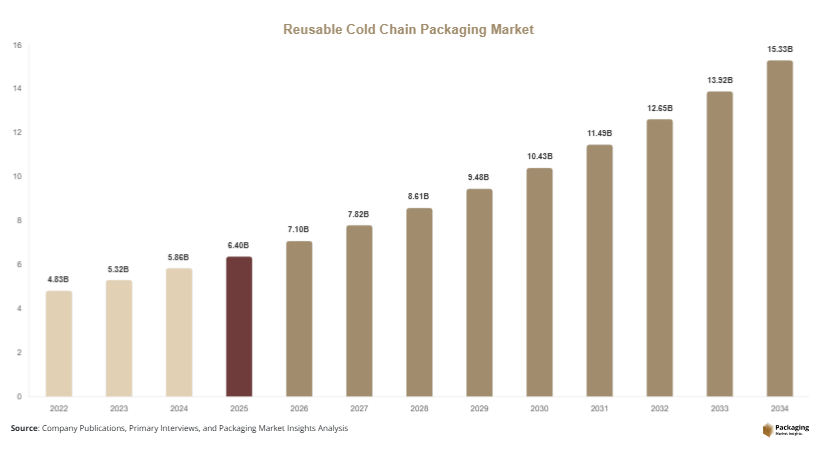
The global reusable cold chain packaging market size was valued at approximately USD 6.4 billion in 2025 and is projected to reach USD 7.1 billion in 2026. With rising global trade of perishable goods and biologics, the market is expected to reach USD 16.8 billion by 2034, growing at a CAGR of 10.1% during the forecast period (2025–2034). The Reusable Cold Chain Packaging Market is witnessing steady expansion due to the increasing demand for temperature-sensitive logistics across pharmaceutical, food, and biotechnology sectors.
One of the primary growth factors is the rapid expansion of the pharmaceutical industry, especially in biologics and vaccines that require strict temperature control. Reusable cold chain packaging solutions provide cost-effective and sustainable alternatives compared to single-use systems, making them increasingly preferred by logistics providers and manufacturers. These solutions help maintain product integrity during transit, reducing the risk of spoilage and financial losses.
Key Highlights:
- The market size reached USD 6.4 billion in 2025 and is projected to grow steadily, reaching USD 16.8 billion by 2034. This growth reflects increasing demand for efficient cold chain logistics across industries.
- The market is expected to expand at a CAGR of 10.1% during the forecast period from 2025 to 2034. This indicates consistent growth supported by rising investments in sustainable packaging solutions.
- There is increasing demand for temperature-sensitive logistics in pharmaceutical and food industries. This is driven by the need to maintain product quality, safety, and regulatory compliance during transportation.
- The rising adoption of sustainable and reusable packaging solutions is further supporting market growth. Companies are focusing on reducing environmental impact while improving cost efficiency in logistics operations.
Explore more data points, trends and opportunities Download Free Sample Report
Market Trends
Integration of Smart Monitoring Technologies in Cold Chain Packaging
A notable trend in the reusable cold chain packaging market is the integration of smart monitoring technologies such as IoT sensors and real-time tracking systems. These technologies enable continuous monitoring of temperature, humidity, and location during transportation. This ensures compliance with regulatory standards and minimizes product losses. Companies are increasingly adopting digital solutions to improve transparency and traceability across the supply chain. The use of smart packaging enhances operational efficiency and supports data-driven decision-making. As digital transformation continues to influence logistics, this trend is expected to gain further traction.
Increasing Adoption of Sustainable and Circular Packaging Models
Another key trend is the shift toward sustainable and circular packaging models. Businesses are focusing on reducing environmental impact by adopting reusable packaging solutions that can be returned, refurbished, and redeployed. This approach not only reduces waste but also lowers long-term costs. Companies are developing innovative materials and designs that enhance durability and insulation performance. The adoption of circular economy principles is becoming a strategic priority, particularly in regions with strict environmental regulations. This trend is expected to drive innovation and reshape the competitive landscape of the market.
Market Drivers
Growth of Biopharmaceutical and Vaccine Distribution
The increasing demand for biopharmaceuticals and vaccines is a major driver of the Reusable Cold Chain Packaging Market. These products require precise temperature control to maintain efficacy and safety. Reusable packaging solutions provide reliable insulation and temperature stability, making them suitable for long-distance transportation. The expansion of global vaccination programs and the rise of personalized medicine are further contributing to demand. As pharmaceutical companies continue to invest in advanced therapies, the need for efficient cold chain logistics is expected to grow.
Expansion of Online Food Delivery and Grocery Services
The rapid growth of online food delivery and grocery services is also driving market expansion. Consumers are increasingly ordering fresh and frozen products online, which requires efficient cold chain solutions. Reusable packaging helps companies maintain product quality while reducing packaging waste. The convenience of home delivery and changing consumer preferences are encouraging retailers to invest in advanced logistics systems. This driver is particularly significant in urban areas, where demand for quick and reliable delivery services is high.
Market Restraint
High Initial Investment and Reverse Logistics Challenges
One of the major restraints in the Reusable Cold Chain Packaging Market is the high initial investment required for reusable packaging systems. These systems involve higher upfront costs compared to single-use alternatives, including expenses for durable materials, tracking technologies, and cleaning processes. Additionally, managing reverse logistics—returning used packaging for reuse—can be complex and costly. Companies need to establish efficient collection, cleaning, and redistribution systems, which may not be feasible in all regions.
For example, small and medium-sized enterprises often face challenges in implementing reusable systems due to limited resources and infrastructure. Inefficient reverse logistics can lead to delays and increased operational costs, impacting overall profitability. While the long-term benefits of reusable packaging are significant, these challenges can hinder widespread adoption in certain markets.
Market Opportunities
Increasing Demand in Emerging Markets
Emerging markets present significant growth opportunities for the Reusable Cold Chain Packaging Market. Rapid urbanization, rising disposable incomes, and expanding healthcare infrastructure are driving demand for temperature-sensitive logistics. Countries in Asia Pacific, Latin America, and Africa are witnessing increased investment in cold chain infrastructure. This creates opportunities for companies to introduce reusable packaging solutions that offer cost efficiency and sustainability. As these markets continue to develop, the demand for advanced logistics solutions is expected to rise.
Technological Advancements in Insulation Materials
Technological advancements in insulation materials are creating new opportunities in the market. Innovations such as phase change materials and vacuum insulation panels are improving the performance of reusable packaging solutions. These materials offer enhanced temperature control and longer duration of thermal protection. Companies are investing in research and development to create lightweight and durable packaging solutions. This is expected to expand the application scope of reusable cold chain packaging across various industries.
Report Scope
| Report Metric | Details |
|---|---|
| Market Size in 2025 | USD 6.4 Billion |
| Market Size in 2026 | USD 7.1 Billion |
| Market Size in 2034 | USD 16.8 Billion |
| CAGR | 10.1% (2026-2034) |
| Base Year for Estimation | 2025 |
| Historical Data | 2022-2024 |
| Forecast Period | 2026-2034 |
| Report Coverage | Revenue Forecast, Competitive Landscape, Supply Chain Disruption, Growth Factors, Environment & Regulatory Landscape and Trends |
| Geographies Covered | North America, Europe, APAC, Middle East and Africa, LATAM |
| Countries Covered | U.S., Canada, U.K., Germany, France, Spain, Italy, Russia, Nordic, Benelux, Rest of Europe, China, South Korea, Japan, India, Australia, Singapore, Taiwan, South East Asia, Rest of Asia-Pacific, UAE, Turky, Saudi Arabia, South Africa, Egypt, Nigeria, Rest of MEA, Brazil, Mexico, Argentina, Chile, Colombia, Rest of LATAM |
Explore more data points, trends and opportunities Download Free Sample Report
Segmental Analysis
By Product Type
The insulated containers segment dominated the market in 2024, accounting for approximately 45% of the total share. These containers are widely used due to their durability and ability to maintain temperature stability over extended periods. They are suitable for transporting pharmaceuticals, food products, and other temperature-sensitive goods. The segment benefits from advancements in insulation materials and design, which enhance performance and reduce operational costs. Additionally, the ability to reuse these containers multiple times makes them a cost-effective solution for logistics providers.
The phase change materials segment is the fastest-growing, expected to register a CAGR of 11.5% during the forecast period. These materials provide consistent temperature control and are increasingly used in combination with insulated containers. The growing demand for efficient thermal management solutions is driving the adoption of phase change materials. Their ability to maintain specific temperature ranges makes them suitable for pharmaceutical and food applications. This segment is expected to witness significant growth due to ongoing technological advancements.
By Application
The pharmaceutical segment held the largest market share in 2024, accounting for approximately 48% of the total market. The increasing demand for temperature-sensitive drugs and biologics is driving growth in this segment. Reusable cold chain packaging solutions help maintain product integrity and comply with regulatory requirements. The segment benefits from the expansion of global healthcare infrastructure and rising investments in drug development.
The food and beverage segment is the fastest-growing, with a projected CAGR of 10.8% during the forecast period. The increasing demand for fresh and frozen food products is driving growth in this segment. The expansion of online grocery and food delivery services is further supporting market growth. Reusable packaging solutions help reduce waste and improve operational efficiency, making them an attractive option for food retailers.
By End-Use
The logistics providers segment dominated the market in 2024, accounting for approximately 50% of the total share. These providers play a critical role in the transportation of temperature-sensitive goods. The adoption of reusable packaging solutions helps them reduce costs and improve sustainability. The segment benefits from the increasing demand for efficient logistics services across various industries.
The healthcare providers segment is the fastest-growing, expected to register a CAGR of 11.2% during the forecast period. The increasing demand for home healthcare and remote patient monitoring is driving growth in this segment. Healthcare providers require reliable cold chain solutions to ensure the safe delivery of medications. This is encouraging the adoption of reusable packaging systems.
Reusable Cold Chain Packaging Market Segmentations
By Product Type
- Insulated Containers
- Phase Change Materials
- Refrigerants
By Application
- Pharmaceuticals
- Food & Beverage
- Chemicals
By End-Use
- Logistics Providers
- Healthcare Providers
- Retail & E-commerce
Regional Analysis
North America
North America accounted for approximately 32% of the global Reusable Cold Chain Packaging Market share in 2025 and is expected to register a CAGR of 9.5% during the forecast period. The region benefits from advanced healthcare infrastructure and a strong presence of pharmaceutical companies. Increasing demand for biologics and temperature-sensitive drugs is driving market growth. Additionally, the expansion of e-commerce and food delivery services is contributing to the adoption of reusable cold chain packaging solutions.
The United States dominates the regional market due to its well-established logistics network and high demand for advanced healthcare solutions. A unique growth factor is the increasing adoption of home healthcare services, which require efficient cold chain logistics for medication delivery. This is encouraging companies to invest in reusable packaging systems to ensure product safety and compliance.
Europe
Europe held around 25% of the market share in 2025 and is projected to grow at a CAGR of 9.2% through 2034. The region is characterized by strict environmental regulations and a strong focus on sustainability. Governments are promoting the use of reusable packaging solutions to reduce waste and carbon emissions. The presence of established pharmaceutical and food industries further supports market growth.
Germany leads the European market, driven by its advanced manufacturing and logistics capabilities. A unique growth factor is the increasing adoption of circular economy practices, which encourage the reuse and recycling of packaging materials. This is creating opportunities for companies to develop innovative and sustainable cold chain solutions.
Asia Pacific
Asia Pacific dominated the global market with a share of approximately 28% in 2025 and is expected to register the highest CAGR of 11.3% during the forecast period. The region is experiencing rapid growth due to increasing demand for pharmaceuticals and perishable food products. Expanding e-commerce and improving cold chain infrastructure are key factors driving market growth.
China is the dominant country in the region, supported by large-scale manufacturing and logistics operations. A key growth factor is the rapid expansion of online grocery platforms, which require efficient cold chain solutions. This is encouraging the adoption of reusable packaging systems to manage costs and ensure product quality.
Middle East & Africa
The Middle East & Africa region accounted for around 7% of the market share in 2025 and is expected to grow at a CAGR of 8.8% during the forecast period. The market is gradually expanding due to increasing investment in healthcare and logistics infrastructure. The development of cold chain networks is supporting the transportation of temperature-sensitive products.
The United Arab Emirates is a leading country in the region, driven by its focus on technological innovation and infrastructure development. A unique growth factor is the growth of pharmaceutical distribution hubs, which require efficient cold chain solutions. This is creating opportunities for reusable packaging systems in the region.
Latin America
Latin America held approximately 8% of the global market share in 2025 and is projected to grow at a CAGR of 9.0% through 2034. The region is witnessing growth due to increasing demand for pharmaceuticals and perishable food products. Governments are investing in cold chain infrastructure to support economic development.
Brazil dominates the regional market, supported by its large population and growing healthcare sector. A key growth factor is the expansion of vaccine distribution programs, which require reliable temperature-controlled logistics. This is driving demand for reusable cold chain packaging solutions in the region.
Competitive Landscape
The reusable cold chain packaging market is characterized by the presence of several key players focusing on innovation and sustainability. Companies are investing in advanced materials and technologies to enhance the performance of reusable packaging solutions. Strategic partnerships and collaborations are common, as companies aim to expand their market presence and improve service offerings.
A leading player in the market is Sonoco Products Company, which has been actively developing sustainable packaging solutions. The company recently introduced a new range of reusable insulated containers designed for pharmaceutical applications. Other major players are focusing on expanding their product portfolios and strengthening their distribution networks to meet growing demand.
Key Players List
- Sonoco Products Company
- Pelican BioThermal LLC
- Cold Chain Technologies, LLC
- Envirotainer AB
- va-Q-tec AG
- Sofrigam SA
- Intelsius Ltd.
- Tempack Packaging Solutions
- Cryopak Industries Inc.
- American Aerogel Corporation
- Inmark Packaging
- SkyCell AG
- Softbox Systems Ltd.
- Marken (UPS Healthcare)
- DHL Supply Chain