Passive Temperature Controlled Packaging Market Size and Growth
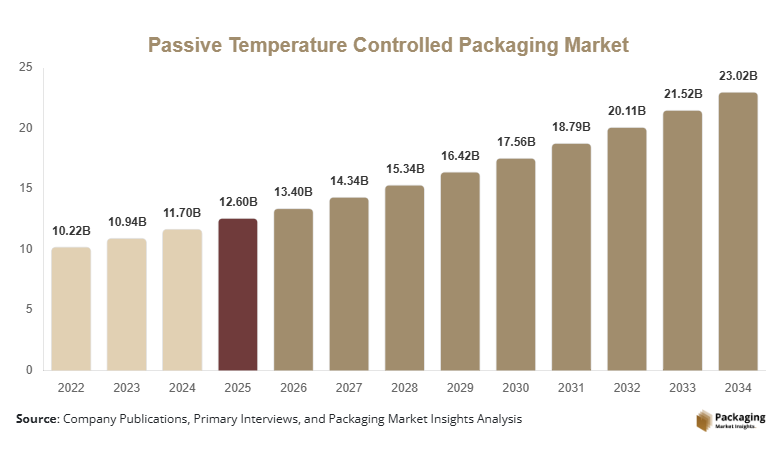
The global passive temperature controlled packaging market size is estimated at USD 12.6 billion, while the market is projected to reach approximately USD 13.4 billion in 2026. By 2034, the market is forecasted to attain nearly USD 23.1 billion, expanding at a CAGR of 7.0% during 2025–2034. The passive temperature controlled packaging market is witnessing significant growth due to the increasing need for reliable cold chain logistics across pharmaceutical, healthcare, food, and biotechnology industries. Passive temperature controlled packaging solutions maintain required temperature ranges without the use of active mechanical refrigeration systems. These packaging systems typically utilize insulated containers, phase change materials, thermal liners, and gel packs to preserve product integrity during transportation and storage.
One of the primary growth factors driving the passive temperature controlled packaging market is the increasing transportation of temperature-sensitive pharmaceuticals, vaccines, and biologics. Pharmaceutical companies require reliable packaging systems that can maintain stable temperatures for extended periods while complying with strict healthcare regulations. Another important growth factor is the expansion of global food delivery and e-commerce industries. Demand for insulated packaging solutions for frozen foods, fresh produce, and meal kits has increased significantly as online grocery services continue to expand. In addition, rising investments in cold chain infrastructure across emerging economies are strengthening market demand.
Key Highlights
- North America dominated the market with a 36.4% share in 2025.
- Asia Pacific is projected to grow at the fastest CAGR of 7.6%.
- Insulated containers led the product segment with a 32.7% share.
- Plastic-based insulated packaging dominated with a 48.6% share.
- Pharmaceutical applications led the market with a 46.1% share.
- The US remained the dominant country with a market size of USD 3.4 billion in 2025 and USD 3.7 billion in 2026.
Explore more data points, trends and opportunities Download Free Sample Report
Market Trends
Growing Adoption of Sustainable Thermal Packaging Solutions
Sustainability is becoming a major trend in the passive temperature controlled packaging market as companies focus on reducing environmental impact and meeting regulatory requirements. Packaging manufacturers are increasingly developing recyclable insulation materials, reusable shipping containers, and biodegradable thermal liners to support circular economy initiatives. Pharmaceutical and food companies are also seeking eco-friendly packaging solutions to strengthen sustainability commitments and improve brand image. Lightweight packaging structures that reduce transportation emissions are gaining popularity across logistics operations. In addition, reusable passive packaging systems are helping businesses reduce long-term operational costs. This trend is expected to drive innovation in insulation materials and sustainable thermal packaging technologies over the forecast period.
Integration of Smart Temperature Monitoring Technologies
The integration of smart monitoring technologies into passive temperature controlled packaging systems is gaining traction across healthcare and food supply chains. Companies are incorporating IoT-enabled sensors, RFID tracking systems, and temperature data loggers into packaging solutions to improve shipment visibility and compliance monitoring. These technologies allow manufacturers and distributors to track temperature conditions in real time and reduce product spoilage risks. Pharmaceutical companies are particularly adopting smart monitoring systems to comply with strict transportation regulations for vaccines and biologics. Additionally, automated monitoring technologies are improving supply chain transparency and helping logistics providers optimize delivery efficiency. This trend is expected to support market growth as digital cold chain management continues to expand globally.
Market Drivers
Rising Demand for Temperature-Sensitive Pharmaceuticals
The growing production and global distribution of temperature-sensitive pharmaceutical products is a key driver for the passive temperature controlled packaging market. Vaccines, biologics, insulin products, and specialty injectable drugs require strict temperature control during transportation to maintain efficacy and stability. Pharmaceutical manufacturers are increasingly investing in advanced passive packaging solutions to ensure regulatory compliance and minimize product losses. In addition, global immunization programs and expansion of clinical trials are creating continuous demand for reliable thermal packaging systems. The rise of personalized medicine and biologics manufacturing is further strengthening the need for insulated packaging technologies that provide extended thermal protection.
Expansion of E-commerce Food Delivery Services
The rapid growth of online grocery and meal delivery services is significantly driving demand for passive temperature controlled packaging solutions. Consumers are increasingly purchasing frozen foods, dairy products, seafood, and ready-to-eat meals through e-commerce platforms. Food retailers require insulated packaging systems that maintain freshness and prevent spoilage during transit. Passive packaging products such as thermal liners, insulated boxes, and gel packs are becoming essential components of food delivery logistics. Furthermore, rising urbanization and changing consumer lifestyles are encouraging the expansion of direct-to-consumer food delivery models, which is expected to create sustained demand for temperature-controlled packaging products.
Market Restraint
Limited Temperature Control Duration in Extreme Conditions
One of the major restraints affecting the passive temperature controlled packaging market is the limited temperature maintenance duration under extreme environmental conditions. Passive systems rely on insulation materials and cooling agents instead of active refrigeration technologies, which can reduce performance during long-distance shipments or exposure to excessive heat. In industries such as pharmaceuticals, even small temperature deviations can compromise product quality and lead to financial losses. For example, biologic medicines transported across regions with high ambient temperatures may require additional cooling materials or expedited shipping methods, increasing logistics costs. This limitation can restrict the use of passive packaging solutions for highly sensitive products requiring extended transportation periods. Additionally, companies may need to invest in advanced testing and validation processes to ensure consistent thermal performance across varying climatic conditions, creating operational and financial challenges for packaging manufacturers and logistics providers.
Market Opportunities
Expansion of Biopharmaceutical and Vaccine Supply Chains
The rapid expansion of global biopharmaceutical and vaccine supply chains presents significant growth opportunities for the passive temperature controlled packaging market. Biologic drugs and vaccines require secure thermal packaging systems capable of maintaining stable temperatures throughout transportation and storage. Pharmaceutical companies are increasing investment in cold chain infrastructure and validated packaging solutions to support international product distribution. Emerging markets are also expanding vaccination programs and healthcare access, increasing demand for reliable insulated packaging products. Furthermore, the growth of personalized medicine and advanced biologics manufacturing is expected to create long-term opportunities for passive thermal packaging suppliers across pharmaceutical logistics networks.
Development of Reusable and Lightweight Packaging Systems
The increasing focus on cost reduction and sustainability is creating strong opportunities for reusable and lightweight passive temperature controlled packaging solutions. Companies are developing durable insulated containers and thermal liners that can be reused multiple times without compromising performance. Reusable packaging systems help reduce packaging waste and lower transportation expenses, making them attractive for pharmaceutical distributors and food delivery companies. In addition, lightweight materials reduce fuel consumption and improve logistics efficiency during shipping operations. Manufacturers investing in innovative reusable packaging technologies are expected to gain competitive advantages as industries continue to prioritize sustainable and cost-effective supply chain solutions.
Report Scope
| Report Metric | Details |
|---|---|
| Market Size in 2025 | USD 12.6 Billion |
| Market Size in 2026 | USD 13.4 Billion |
| Market Size in 2034 | USD 23.1 Billion |
| CAGR | 7.0% (2026-2034) |
| Base Year for Estimation | 2025 |
| Historical Data | 2022-2024 |
| Forecast Period | 2026-2034 |
| Report Coverage | Revenue Forecast, Competitive Landscape, Supply Chain Disruption, Growth Factors, Environment & Regulatory Landscape and Trends |
| Geographies Covered | North America, Europe, APAC, Middle East and Africa, LATAM |
| Countries Covered | U.S., Canada, U.K., Germany, France, Spain, Italy, Russia, Nordic, Benelux, Rest of Europe, China, South Korea, Japan, India, Australia, Singapore, Taiwan, South East Asia, Rest of Asia-Pacific, UAE, Turky, Saudi Arabia, South Africa, Egypt, Nigeria, Rest of MEA, Brazil, Mexico, Argentina, Chile, Colombia, Rest of LATAM |
Explore more data points, trends and opportunities Download Free Sample Report
Segmental Analysis
By Product Type
Insulated containers dominated the passive temperature controlled packaging market in 2024, accounting for approximately 32.7% of the total market share. These containers are widely used across pharmaceutical, food, and biotechnology industries because they provide reliable thermal insulation and physical protection during transportation. Insulated containers are available in various sizes and configurations, making them suitable for shipping vaccines, biologics, fresh produce, and frozen foods. Manufacturers are increasingly developing lightweight and reusable insulated containers to improve operational efficiency and reduce shipping costs. Advancements in insulation technologies are also enhancing thermal retention capabilities and extending shipment duration performance across global cold chain logistics operations.
Phase change materials are expected to be the fastest-growing subsegment, registering a CAGR of 7.9% during the forecast period. These materials help maintain stable temperature ranges by absorbing and releasing thermal energy during phase transitions. Pharmaceutical companies are increasingly using phase change materials in vaccine and biologics transportation because they offer precise temperature control and improved thermal consistency. Food delivery providers are also adopting these materials to enhance freshness preservation during transit. In addition, advancements in reusable phase change technologies are supporting sustainability goals while reducing packaging waste and long-term logistics expenses.
By Material
Plastic-based insulated packaging dominated the material segment in 2024 with a market share of approximately 48.6%. Plastic materials are widely preferred due to their lightweight structure, durability, cost efficiency, and strong thermal insulation properties. Expanded polystyrene and polyurethane foams are commonly used in insulated packaging products for healthcare and food applications. Plastic-based systems are also compatible with various cooling agents such as gel packs and dry ice. Manufacturers continue to rely on plastic insulation materials because they provide reliable temperature protection while remaining easy to process and transport across large-scale logistics networks.
Biodegradable materials are projected to witness the fastest growth, expanding at a CAGR of 7.3% during the forecast period. Rising environmental concerns and stricter packaging waste regulations are encouraging companies to adopt eco-friendly insulation materials. Manufacturers are developing biodegradable thermal liners, paper-based insulated boxes, and plant-based foam materials that provide effective thermal protection while reducing environmental impact. Pharmaceutical and food companies are increasingly selecting sustainable packaging solutions to support corporate sustainability commitments and comply with environmental regulations. This trend is expected to drive innovation in biodegradable insulation technologies.
By Application
Pharmaceutical applications held the dominant share of approximately 46.1% in 2024 within the passive temperature controlled packaging market. The pharmaceutical sector relies heavily on insulated packaging systems to transport vaccines, biologics, blood samples, and specialty drugs safely across global supply chains. Strict healthcare regulations regarding temperature control and product integrity are encouraging pharmaceutical manufacturers to adopt validated passive packaging solutions. The expansion of clinical trials and biologics manufacturing is also contributing to rising demand for reliable temperature-controlled transportation systems. Additionally, pharmaceutical companies are investing in reusable packaging technologies to improve sustainability and reduce transportation costs.
Food delivery applications are expected to register the fastest CAGR of 7.5% during the forecast period. Rapid growth in online grocery shopping, restaurant delivery services, and meal kit subscriptions is driving demand for insulated food packaging systems. Consumers increasingly expect fresh and frozen food products to maintain quality during transportation, encouraging retailers to invest in advanced thermal packaging solutions. Passive packaging products such as insulated liners, coolers, and gel packs are helping food distributors maintain freshness and reduce spoilage risks. Expanding urban populations and changing consumer purchasing behavior are expected to continue supporting growth in this segment.
Passive Temperature Controlled Packaging Market Segmentations
By Product Type
- Insulated Containers
- Thermal Blankets
- Thermal Liners
- Phase Change Materials
- Gel Packs
By Material
- Plastic-Based Materials
- Paper-Based Materials
- Foam Insulation Materials
- Biodegradable Materials
By Application
- Pharmaceuticals
- Food & Beverages
- Biotechnology
- Chemicals
- Healthcare Logistics
Regional Analysis
North America
North America accounted for approximately 36.4% of the global passive temperature controlled packaging market share in 2025 and is projected to grow at a CAGR of 6.2% during the forecast period. The region benefits from advanced cold chain infrastructure, strong pharmaceutical manufacturing capabilities, and increasing demand for temperature-sensitive healthcare products. Rising adoption of biologic therapies and expanding online grocery delivery services are also contributing to market growth. Additionally, strict transportation regulations for pharmaceutical products continue to encourage the use of validated thermal packaging systems.
The United States dominates the regional market due to its extensive pharmaceutical industry and developed healthcare logistics network. One unique growth factor is the increasing adoption of home healthcare services requiring direct-to-patient delivery of temperature-sensitive medicines. This trend is encouraging pharmaceutical distributors to invest in advanced passive thermal packaging systems with extended temperature protection capabilities and improved shipment tracking technologies.
Europe
Europe held nearly 27.1% of the global market share in 2025 and is expected to register a CAGR of 6.0% through 2034. Growth in the region is supported by strong pharmaceutical exports, increasing sustainability initiatives, and strict healthcare transportation regulations. European companies are focusing on environmentally friendly insulated packaging materials and reusable shipping systems to reduce carbon emissions. Demand for temperature-controlled food transportation is also increasing as online grocery retail channels continue to expand across the region.
Germany remains the dominant country in the European market due to its advanced pharmaceutical manufacturing sector and logistics infrastructure. A unique growth factor is the increasing development of sustainable cold chain packaging technologies supported by environmental regulations. German packaging companies are investing in recyclable insulation materials and reusable shipping containers to meet regional sustainability goals while maintaining reliable thermal protection performance.
Asia Pacific
Asia Pacific represented approximately 29.3% of the global market in 2025 and is forecasted to grow at the fastest CAGR of 7.6% during the study period. Rising healthcare investments, rapid urbanization, and expanding food delivery services are key factors driving regional demand. Countries such as China, India, and Japan are increasing pharmaceutical production and improving cold chain logistics capabilities. In addition, growing middle-class populations and changing consumer preferences are supporting the expansion of e-commerce grocery delivery services requiring insulated packaging systems.
China dominates the Asia Pacific market because of its large pharmaceutical manufacturing industry and rapidly expanding logistics sector. A unique growth factor is the strong growth of domestic vaccine production and exports. Pharmaceutical manufacturers in China are increasingly adopting validated passive packaging solutions to support international shipments and comply with global healthcare transportation standards.
Middle East & Africa
The Middle East & Africa region accounted for around 4.0% of the market share in 2025 and is projected to grow at a CAGR of 6.3% during the forecast period. Rising investments in healthcare infrastructure and increasing imports of temperature-sensitive pharmaceuticals are supporting regional market growth. Governments are focusing on improving cold chain logistics systems to reduce medicine wastage and improve healthcare accessibility. Demand for insulated packaging solutions is also increasing in food distribution and agricultural export industries.
Saudi Arabia leads the regional market due to expanding pharmaceutical imports and ongoing healthcare modernization projects. One unique growth factor is the development of regional vaccine storage and distribution facilities supported by government healthcare initiatives. This has increased the need for advanced passive temperature controlled packaging products capable of maintaining product integrity during transportation across varying climatic conditions.
Latin America
Latin America captured approximately 3.2% of the global market share in 2025 and is expected to grow at a CAGR of 6.8% over the forecast period. Market growth is driven by increasing pharmaceutical consumption, expanding healthcare infrastructure, and rising demand for refrigerated food transportation. Governments in the region are investing in cold chain logistics systems to improve healthcare delivery and support agricultural exports. Growing urban populations are also encouraging the adoption of online grocery and meal delivery services.
Brazil dominates the Latin American market due to its large healthcare sector and expanding pharmaceutical distribution network. A unique growth factor is the increasing export of temperature-sensitive agricultural products and processed foods. This trend is creating strong demand for insulated shipping containers and passive thermal packaging systems that can preserve product quality during long-distance transportation.
Competitive Landscape
The passive temperature controlled packaging market is moderately competitive, with leading companies focusing on innovation, sustainability, and global expansion strategies. Major market participants are investing in advanced insulation technologies, reusable packaging solutions, and smart monitoring systems to strengthen their product portfolios and improve supply chain efficiency. Strategic partnerships with pharmaceutical and logistics companies are also becoming common as manufacturers aim to expand market reach and improve cold chain service capabilities.
Sonoco ThermoSafe remains one of the leading companies in the market due to its broad thermal packaging portfolio and strong international distribution network. In 2024, the company launched a new recyclable passive thermal packaging solution designed for pharmaceutical transportation applications. Other major players include Cold Chain Technologies, Pelican BioThermal, Sofrigam, and Envirotainer. These companies are increasingly focusing on sustainable packaging materials, automation technologies, and regional manufacturing expansion to address growing global demand.
Key Players List
- Sonoco ThermoSafe
- Cold Chain Technologies
- Pelican BioThermal
- Sofrigam
- Envirotainer
- Cryopak
- Tempack
- Intelsius
- Va-Q-Tec AG
- Softbox Systems
- Inmark Packaging
- Snyder Industries
- American Aerogel Corporation
- Insulated Products Corporation
- DGP Intelsius