Temperature Controlled Packaging Market Size and Growth
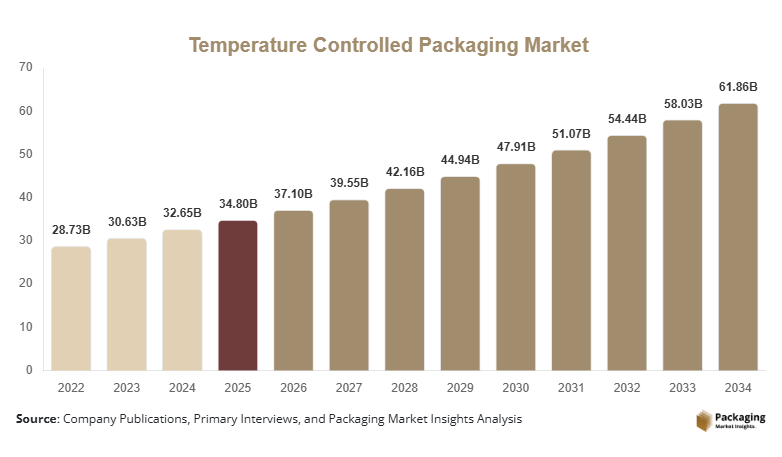
The global temperature controlled packaging market size was valued at USD 34.8 billion in 2025 and is estimated to reach USD 37.1 billion in 2026. The market is projected to grow to USD 61.9 billion by 2034, expanding at a CAGR of 6.6% during the forecast period of 2025–2034. Rising pharmaceutical exports, growth in online grocery delivery services, and increasing vaccine distribution activities are supporting market expansion across developed and emerging economies.
The temperature controlled packaging market is witnessing stable growth due to the increasing demand for safe transportation of temperature-sensitive pharmaceutical products, biologics, fresh food, dairy products, and specialty chemicals. The market has become a critical part of global cold chain logistics as industries seek efficient solutions to maintain product integrity during storage and transit. Temperature controlled packaging solutions include insulated containers, refrigerants, thermal liners, vacuum insulated panels, and phase change materials that help maintain specific temperature ranges across supply chains.
Key Highlights
- North America dominated the market with a 35.8% share in 2025.
- Asia Pacific is projected to grow at the fastest CAGR of 7.4%.
- Passive packaging solutions led the type segment with a 58.6% share.
- Plastic-based insulated packaging dominated with a 49.3% share.
- Pharmaceutical applications led the segment with 41.5% share.
- The US remained the dominant country with a market size of USD 9.7 billion in 2025 and USD 10.3 billion in 2026.
Explore more data points, trends and opportunities Download Free Sample Report
Market Trends
Growing Adoption of Sustainable Thermal Packaging Solutions
Sustainability has become a major trend in the temperature controlled packaging market as manufacturers and logistics providers focus on reducing environmental impact. Companies are increasingly replacing conventional foam and plastic-based insulation materials with recyclable paper liners, biodegradable thermal wraps, and reusable insulated containers. The demand for eco-friendly packaging is growing rapidly among food delivery companies and pharmaceutical distributors aiming to meet sustainability targets and consumer expectations. Reusable shipping containers are also helping reduce operational costs over multiple transportation cycles. This trend is encouraging innovation in plant-based insulation materials and lightweight recyclable packaging formats across global cold chain operations.
Integration of Smart Monitoring Technologies in Cold Chain Packaging
The use of smart packaging technologies is increasing significantly in the temperature controlled logistics industry. Manufacturers are integrating sensors, RFID tracking systems, and IoT-enabled monitoring devices into thermal packaging products to improve shipment visibility and product safety. These technologies help companies track real-time temperature fluctuations, humidity levels, and transit conditions during transportation. Pharmaceutical companies are adopting smart monitoring systems to comply with regulatory requirements for biologics and vaccine shipments. Food distributors are also using digital monitoring tools to reduce spoilage risks and improve inventory management. The growing importance of supply chain transparency is accelerating demand for intelligent temperature controlled packaging solutions worldwide.
Market Drivers
Expansion of Pharmaceutical Cold Chain Logistics
The rapid expansion of pharmaceutical cold chain logistics is a major driver for the temperature controlled packaging market. Biologics, vaccines, cell therapies, and specialty medicines require controlled temperature environments throughout transportation and storage processes. Pharmaceutical manufacturers are increasing investments in insulated containers, refrigerants, and thermal packaging systems to maintain product stability and regulatory compliance. Global vaccine distribution programs and rising healthcare spending are further supporting market growth. Additionally, international pharmaceutical exports have increased substantially, creating demand for reliable packaging systems that can protect sensitive products from temperature fluctuations during long-distance transportation and cross-border logistics operations.
Rising Demand for Fresh and Frozen Food Delivery
The growth of online grocery shopping and food delivery platforms is accelerating the adoption of temperature controlled packaging solutions worldwide. Consumers increasingly prefer fresh, frozen, and ready-to-eat food products delivered directly to homes, creating strong demand for insulated packaging systems. Food retailers and logistics providers are investing in advanced thermal packaging to preserve freshness and prevent spoilage during transportation. The expansion of organized retail chains and cold storage infrastructure is also supporting market demand. Furthermore, increasing international trade of seafood, dairy, meat, and processed food products is encouraging the use of efficient temperature controlled packaging across food supply chains.
Market Restraint
High Cost of Advanced Thermal Packaging Solutions
The high cost associated with advanced temperature controlled packaging systems remains a significant restraint for market growth. Premium insulated containers, vacuum insulated panels, phase change materials, and active cooling systems involve substantial manufacturing and operational expenses. Small and medium-sized logistics companies often face difficulties adopting advanced thermal packaging solutions due to budget limitations. In pharmaceutical logistics, companies must also spend additional resources on compliance testing, temperature validation, and monitoring systems, increasing overall packaging costs.
The cost challenge becomes more evident in emerging markets where cold chain infrastructure remains underdeveloped. Many local food distributors and healthcare providers continue using traditional packaging methods because advanced insulated systems may increase transportation expenses. For example, reusable active thermal containers used for biologics transportation can cost significantly more than standard passive packaging systems. This pricing gap affects adoption rates among cost-sensitive end users. Moreover, fluctuating raw material prices for plastics, insulation foams, and refrigerants continue to impact production costs, creating additional pressure on manufacturers and supply chain operators.
Market Opportunities
Growth of Direct-to-Consumer Healthcare Deliveries
The increasing adoption of direct-to-consumer healthcare delivery services is creating strong opportunities in the temperature controlled packaging market. Home delivery of specialty medicines, insulin products, diagnostic kits, and biologics has increased considerably due to digital healthcare expansion and online pharmacy platforms. These products require reliable thermal protection to maintain effectiveness during transit. Packaging manufacturers are developing compact and lightweight insulated solutions specifically for last-mile healthcare deliveries. The demand for convenient and secure temperature controlled packaging is expected to rise further as telehealth services and home-based patient care continue expanding across developed and emerging economies.
Expansion of Cold Chain Infrastructure in Emerging Economies
Emerging economies are investing heavily in cold chain infrastructure development, creating significant opportunities for temperature controlled packaging providers. Countries across Asia Pacific, Latin America, and the Middle East are expanding refrigerated transportation networks, food processing facilities, and pharmaceutical distribution systems. Rising urbanization and increasing consumption of packaged food products are driving investments in cold storage logistics. Governments are also supporting vaccine distribution and food safety initiatives, encouraging the adoption of modern thermal packaging technologies. Manufacturers that introduce cost-effective and sustainable packaging solutions tailored to regional logistics conditions are expected to gain considerable growth opportunities in these developing markets.
Report Scope
| Report Metric | Details |
|---|---|
| Market Size in 2025 | USD 34.8 Billion |
| Market Size in 2026 | USD 37.1 Billion |
| Market Size in 2034 | USD 61.9 Billion |
| CAGR | 6.6% (2026-2034) |
| Base Year for Estimation | 2025 |
| Historical Data | 2022-2024 |
| Forecast Period | 2026-2034 |
| Report Coverage | Revenue Forecast, Competitive Landscape, Supply Chain Disruption, Growth Factors, Environment & Regulatory Landscape and Trends |
| Geographies Covered | North America, Europe, APAC, Middle East and Africa, LATAM |
| Countries Covered | U.S., Canada, U.K., Germany, France, Spain, Italy, Russia, Nordic, Benelux, Rest of Europe, China, South Korea, Japan, India, Australia, Singapore, Taiwan, South East Asia, Rest of Asia-Pacific, UAE, Turky, Saudi Arabia, South Africa, Egypt, Nigeria, Rest of MEA, Brazil, Mexico, Argentina, Chile, Colombia, Rest of LATAM |
Explore more data points, trends and opportunities Download Free Sample Report
Segmental Analysis
By Type
Passive packaging solutions dominated the temperature controlled packaging market in 2024 with a market share of 58.6%. These systems are widely used because they offer cost-effective thermal protection without requiring external power sources. Passive packaging products such as insulated shippers, thermal liners, and gel packs are extensively utilized across pharmaceutical and food transportation applications. Their lightweight structure, operational simplicity, and lower maintenance requirements contribute to broad industry adoption. Pharmaceutical companies prefer passive packaging for vaccine transportation and biologics shipments due to ease of handling and regulatory compliance. Additionally, food delivery providers increasingly rely on insulated passive packaging systems to preserve freshness during short-distance and last-mile deliveries.
Active temperature controlled packaging is projected to register the fastest CAGR of 7.1% during the forecast period. Active systems utilize powered refrigeration or heating mechanisms to maintain stable temperatures during long-distance transportation. The growth of biologics, cell therapies, and specialty pharmaceutical products is increasing demand for highly precise thermal management systems. Airlines and global logistics providers are adopting active containers to support international pharmaceutical trade and reduce temperature excursion risks. Technological improvements in battery efficiency, reusable active containers, and integrated monitoring systems are further accelerating market adoption. The increasing complexity of global pharmaceutical supply chains continues to create strong growth opportunities for active thermal packaging manufacturers.
By Material
Plastic-based insulated packaging held the largest market share of 49.3% in 2024 due to its durability, moisture resistance, and strong thermal insulation performance. Expanded polystyrene, polyurethane foam, and polyethylene materials remain widely used in insulated shipping containers and thermal liners. Pharmaceutical manufacturers and food distributors prefer plastic-based packaging because it offers dependable temperature stability during transit. The material also supports lightweight packaging designs that reduce transportation costs. Furthermore, plastic insulation products are compatible with various refrigerants and phase change materials, increasing their suitability for diverse cold chain applications across healthcare and food industries.
Paper-based thermal packaging is anticipated to grow at the fastest CAGR of 6.9% during the forecast period. Sustainability concerns and regulatory pressure to reduce plastic waste are encouraging manufacturers to develop recyclable paper insulation solutions. Companies are introducing corrugated insulated boxes, molded fiber packaging, and paper thermal liners designed for temperature-sensitive shipments. Retailers and e-commerce grocery companies increasingly prefer sustainable packaging to improve brand positioning and meet environmental goals. Advancements in paper coating technologies and moisture-resistant insulation materials are improving thermal performance, making paper-based packaging a viable alternative to traditional plastic insulation products in several cold chain applications.
By Application
Pharmaceutical applications accounted for the largest share of 41.5% in 2024 due to rising demand for biologics, vaccines, and specialty medicines requiring controlled temperature transportation. Pharmaceutical manufacturers use insulated containers, thermal shippers, and active cooling systems to maintain product efficacy during storage and transit. Regulatory compliance standards for healthcare logistics are also strengthening demand for advanced temperature controlled packaging solutions. The expansion of global clinical trials and cross-border pharmaceutical trade continues to support segment growth. Additionally, increasing demand for personalized medicine and injectable therapies is creating further opportunities for thermal packaging providers across pharmaceutical supply chains.
Food delivery applications are expected to grow at the fastest CAGR of 7.3% during the forecast period. The expansion of online grocery platforms, meal kit services, and frozen food delivery businesses is increasing demand for reliable insulated packaging systems. Consumers are placing greater emphasis on food quality, freshness, and safe transportation, encouraging retailers to invest in thermal packaging technologies. Companies are introducing lightweight insulated boxes and recyclable thermal liners specifically for e-commerce food delivery operations. Growth in urban populations and changing consumer purchasing habits are expected to continue supporting strong demand for temperature controlled packaging solutions in food logistics and last-mile delivery networks.
Temperature Controlled Packaging Market Segmentations
By Type
- Passive Packaging
- Active Packaging
- Insulated Shippers
- Thermal Blankets
- Phase Change Material Packaging
By Material
- Plastic
- Paper & Paperboard
- Metal
- Foam Insulation
- Vacuum Insulated Panels
By Application
- Pharmaceuticals
- Food & Beverage
- Chemicals
- Healthcare Logistics
- Industrial Applications
Regional Analysis
North America
North America accounted for 35.8% of the global temperature controlled packaging market share in 2025 and continues to maintain a strong position due to advanced cold chain infrastructure and high pharmaceutical exports. The region is projected to expand at a CAGR of 6.2% during the forecast period. Growing biologics transportation and increasing online grocery delivery services are supporting regional market growth significantly across the United States and Canada.
The U.S. remains the dominant country in North America due to strong pharmaceutical manufacturing capabilities and expanding healthcare logistics networks. One unique growth factor in the country is the increasing adoption of home healthcare delivery services requiring insulated medical packaging. Rising investments in reusable cold chain packaging systems and smart temperature monitoring technologies are also contributing to sustained market development across pharmaceutical and food distribution industries.
Europe
Europe represented 27.6% of the global temperature controlled packaging market in 2025 and is expected to grow at a CAGR of 6.1% through 2034. Strong demand for sustainable cold chain solutions and strict pharmaceutical transportation regulations are supporting regional growth. Food safety standards and increasing exports of temperature-sensitive products continue to drive adoption of advanced insulated packaging systems across several European countries.
Germany remains the leading country in the European market due to its established pharmaceutical manufacturing sector and advanced logistics infrastructure. A key growth factor in Germany is the increasing use of recyclable thermal packaging materials to meet environmental sustainability targets. Companies are focusing on reusable insulated shipping containers and low-emission cold chain operations, supporting broader adoption of eco-friendly packaging technologies across healthcare and food industries.
Asia Pacific
Asia Pacific held 24.1% of the temperature controlled packaging market share in 2025 and is forecast to register the fastest CAGR of 7.4% during the study period. Rapid urbanization, growing pharmaceutical production, and expansion of e-commerce grocery platforms are major contributors to regional growth. Increasing cold storage investments across China, India, Japan, and Southeast Asia are strengthening demand for thermal packaging solutions.
China dominates the Asia Pacific market due to its large food processing sector and expanding pharmaceutical exports. One unique growth factor in China is the rapid modernization of domestic cold chain logistics networks supported by government investment programs. Rising demand for fresh food transportation and vaccine distribution is encouraging manufacturers to adopt advanced insulated containers, phase change materials, and reusable thermal packaging products across the country.
Middle East & Africa
The Middle East & Africa region accounted for 6.4% of the global temperature controlled packaging market in 2025 and is expected to grow at a CAGR of 5.9% through 2034. The increasing import of pharmaceutical products and expansion of food retail chains are supporting market demand. Investments in healthcare infrastructure and cold storage facilities are also contributing to the adoption of temperature controlled packaging systems.
Saudi Arabia is the dominant country in the region due to rising healthcare investments and increasing demand for imported temperature-sensitive medicines. A unique growth factor supporting the Saudi Arabian market is the expansion of pharmaceutical warehousing and refrigerated transportation networks linked to healthcare modernization initiatives. Growth in organized food retail and frozen food imports is also increasing demand for insulated packaging solutions throughout the country.
Latin America
Latin America captured 6.1% of the temperature controlled packaging market share in 2025 and is anticipated to grow at a CAGR of 6.5% over the forecast period. The growth of food exports, vaccine distribution programs, and organized retail channels is driving demand for cold chain packaging solutions. Regional companies are investing in insulated transportation systems to reduce product spoilage and improve logistics efficiency.
Brazil leads the Latin American market due to its large food processing industry and expanding pharmaceutical distribution sector. One important growth factor in Brazil is the increasing export of frozen meat and seafood products requiring reliable thermal packaging systems. Investments in cold storage logistics and temperature-sensitive transportation infrastructure are also encouraging greater adoption of advanced insulated packaging products across domestic and export supply chains.
Competitive Landscape
The temperature controlled packaging market is moderately fragmented with the presence of global packaging manufacturers, cold chain logistics providers, and specialty insulation companies. Leading participants are focusing on sustainable packaging innovation, reusable insulated systems, and smart monitoring technologies to strengthen market position. Companies are also investing in mergers, acquisitions, and regional expansion strategies to increase their cold chain distribution capabilities.
Sonoco ThermoSafe, Cold Chain Technologies, Pelican BioThermal, Sealed Air Corporation, and Sofrigam are among the major companies operating in the market. Sonoco ThermoSafe remains one of the leading players due to its broad portfolio of pharmaceutical thermal packaging products and global logistics partnerships. In 2025, the company introduced a reusable insulated shipping container with integrated IoT temperature tracking features designed for biologics transportation.
Cold Chain Technologies continues expanding its reusable packaging portfolio for pharmaceutical clients, while Pelican BioThermal focuses on durable temperature-controlled containers for international healthcare shipments. Sealed Air Corporation is strengthening its sustainable packaging offerings by developing recyclable thermal insulation materials. Competitive intensity is increasing as companies prioritize environmentally responsible packaging systems and advanced cold chain analytics solutions.
Key Players List
- Sonoco ThermoSafe
- Cold Chain Technologies
- Pelican BioThermal
- Sealed Air Corporation
- Sofrigam
- Cryopak Industries Inc.
- Envirotainer AB
- va-Q-tec AG
- CSafe Global
- Tempack Packaging Solutions
- American Aerogel Corporation
- Intelsius
- DGP Intelsius LLC
- Snyder Industries Inc.
- Inmark Packaging