Insulated Packaging Market Size and Growth
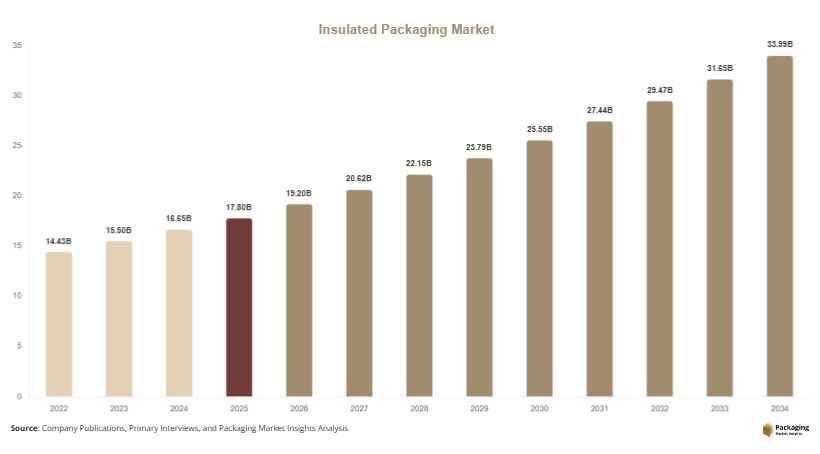
The insulated packaging market size is witnessing steady expansion driven by the growing need for temperature-controlled logistics across industries such as food, pharmaceuticals, and chemicals. In 2025, the global insulated packaging market size is estimated at USD 17.8 billion, with a projected increase to USD 19.2 billion in 2026. The market is expected to reach approximately USD 36.5 billion by 2034, expanding at a CAGR of 7.4% during the forecast period (2025–2034). This growth reflects increasing demand for efficient thermal protection solutions that maintain product integrity during storage and transportation.
One of the key growth factors is the rising demand for cold chain logistics, particularly in the pharmaceutical sector, where biologics and vaccines require strict temperature control. Additionally, the expansion of e-commerce grocery delivery services has increased the need for insulated packaging to ensure food safety and freshness. Another important driver is the growing awareness of sustainable packaging solutions, prompting manufacturers to develop recyclable and biodegradable insulated materials.
Key Highlights:
- Market size valued at USD 17.8 billion in 2025 and projected to reach USD 36.5 billion by 2034
- CAGR of 7.4% during the forecast period (2025–2034)
- Rising demand from pharmaceutical and food delivery sectors
- Technological advancements improving insulation efficiency and sustainability
Explore more data points, trends and opportunities Download Free Sample Report
Market Trends
Increasing Adoption of Sustainable Insulated Packaging Solutions
Sustainability has emerged as a central trend in the insulated packaging market as companies shift toward environmentally responsible materials. Manufacturers are focusing on developing recyclable, reusable, and biodegradable insulation materials such as paper-based liners, molded fiber, and plant-based foams. This transition is driven by regulatory pressures and consumer demand for eco-friendly packaging solutions. Businesses are also adopting circular economy models to reduce packaging waste and improve lifecycle efficiency. As a result, companies are investing in research to balance insulation performance with environmental impact, making sustainability a defining trend in the market.
Integration of Smart Packaging Technologies
The integration of smart technologies into insulated packaging is gaining traction, especially in temperature-sensitive supply chains. Smart packaging solutions incorporate sensors and tracking devices that monitor temperature, humidity, and transit conditions in real time. This enables better quality control and reduces product spoilage. Industries such as pharmaceuticals and perishable food are increasingly adopting these solutions to ensure compliance with safety standards. Additionally, digital monitoring helps companies optimize logistics operations and improve transparency across the supply chain, making smart insulated packaging a significant technological trend.
Market Drivers
Growth of Cold Chain Logistics Industry
The expansion of the cold chain logistics sector is a primary driver for the insulated packaging market. With increasing global demand for temperature-sensitive products such as vaccines, biologics, dairy, and frozen foods, the need for reliable insulated packaging solutions has grown significantly. Governments and private players are investing in cold storage infrastructure, further boosting demand. The rise in international trade of perishable goods also necessitates advanced packaging systems that maintain consistent temperatures throughout transit. This trend is particularly prominent in emerging markets, where infrastructure development is accelerating.
Rapid Expansion of E-commerce Food Delivery Services
The surge in online grocery and meal delivery services has significantly contributed to market growth. Consumers increasingly prefer home delivery of fresh and frozen food products, requiring efficient insulated packaging to preserve quality. Food delivery platforms rely heavily on thermal packaging solutions to maintain freshness during last-mile delivery. Additionally, urbanization and busy lifestyles are driving demand for ready-to-eat and packaged meals, further supporting the need for insulated packaging. This shift in consumer behavior continues to create strong growth opportunities for market players.
Market Restraint
High Cost of Advanced Insulation Materials
One of the key restraints in the insulated packaging market is the high cost associated with advanced insulation materials such as vacuum insulated panels and phase change materials. These technologies offer superior thermal performance but significantly increase packaging costs, making them less accessible for small and medium-sized enterprises. Additionally, the complexity of manufacturing and limited availability of raw materials can further drive up costs. This creates a barrier to widespread adoption, particularly in cost-sensitive markets.
The high cost also impacts industries with tight profit margins, such as food delivery services, where companies seek cost-effective packaging solutions. For example, small-scale food businesses may opt for conventional packaging methods instead of investing in premium insulated solutions. As a result, the market faces challenges in achieving universal adoption despite technological advancements.
Market Opportunities
Rising Demand in Pharmaceutical Sector
The pharmaceutical industry presents a significant growth opportunity for the insulated packaging market. The increasing production and distribution of temperature-sensitive drugs, including biologics and vaccines, require reliable thermal packaging solutions. With global healthcare infrastructure expanding and investments in drug development rising, the demand for insulated packaging is expected to grow steadily. Additionally, stringent regulatory requirements for drug transportation are encouraging pharmaceutical companies to adopt high-performance packaging systems, creating new opportunities for market players.
Expansion in Emerging Economies
Emerging economies offer substantial growth potential due to rapid urbanization, rising disposable incomes, and evolving consumer preferences. Countries in Asia Pacific, Latin America, and Africa are witnessing increased demand for packaged food and pharmaceutical products. Infrastructure development, including cold storage and transportation networks, is further supporting market growth. Local manufacturers are also entering the market, providing cost-effective solutions tailored to regional needs. This expansion is expected to create a favorable environment for insulated packaging adoption in these regions.
Report Scope
| Report Metric | Details |
|---|---|
| Market Size in 2025 | USD 17.8 Billion |
| Market Size in 2026 | USD 19.2 Billion |
| Market Size in 2034 | USD 36.5 Billion |
| CAGR | 7.4% (2026-2034) |
| Base Year for Estimation | 2025 |
| Historical Data | 2022-2024 |
| Forecast Period | 2026-2034 |
| Report Coverage | Revenue Forecast, Competitive Landscape, Supply Chain Disruption, Growth Factors, Environment & Regulatory Landscape and Trends |
| Geographies Covered | North America, Europe, APAC, Middle East and Africa, LATAM |
| Countries Covered | U.S., Canada, U.K., Germany, France, Spain, Italy, Russia, Nordic, Benelux, Rest of Europe, China, South Korea, Japan, India, Australia, Singapore, Taiwan, South East Asia, Rest of Asia-Pacific, UAE, Turky, Saudi Arabia, South Africa, Egypt, Nigeria, Rest of MEA, Brazil, Mexico, Argentina, Chile, Colombia, Rest of LATAM |
Explore more data points, trends and opportunities Download Free Sample Report
Segmental Analysis
By Type
The rigid insulated packaging segment dominated the market in 2024, accounting for approximately 58% of the total share. This segment includes materials such as expanded polystyrene and polyurethane, which offer high durability and excellent thermal insulation properties. These solutions are widely used in pharmaceutical and food industries where maintaining temperature integrity is critical. The demand for rigid packaging is driven by its ability to provide consistent performance over extended periods, making it suitable for long-distance transportation and storage.
Flexible insulated packaging is expected to be the fastest-growing segment, with a projected CAGR of 8.5% during the forecast period. This growth is attributed to its lightweight nature and cost-effectiveness compared to rigid alternatives. Flexible packaging solutions are increasingly used in e-commerce and food delivery services due to their ease of handling and reduced shipping costs. Additionally, advancements in material technology are improving the thermal performance of flexible packaging, making it a viable alternative for various applications.
By Application
The food and beverage segment held the largest market share in 2024, accounting for around 46%. The increasing demand for fresh and frozen food products has driven the adoption of insulated packaging solutions. These packaging systems help maintain product quality and extend shelf life, making them essential for food transportation and storage. The rise of online grocery platforms and meal delivery services has further strengthened demand within this segment.
The pharmaceutical segment is expected to grow at the highest CAGR of 9.0% during the forecast period. This growth is driven by the increasing demand for temperature-sensitive drugs and vaccines. Stringent regulatory requirements for drug transportation are encouraging pharmaceutical companies to invest in advanced insulated packaging solutions. Additionally, the growing focus on healthcare infrastructure in developing regions is contributing to the expansion of this segment.
By End-Use
The healthcare sector dominated the insulated packaging market in 2024, with a share of approximately 40%. The need for reliable temperature-controlled packaging for drugs, vaccines, and medical supplies has driven growth in this segment. Healthcare providers and pharmaceutical companies rely heavily on insulated packaging to ensure product safety and compliance with regulatory standards.
The e-commerce sector is projected to be the fastest-growing end-use segment, with a CAGR of 8.8%. The rapid expansion of online retail and food delivery services has increased the demand for insulated packaging solutions. Companies are focusing on developing cost-effective and sustainable packaging options to meet the growing needs of e-commerce businesses. This trend is expected to drive significant growth in the segment over the forecast period.
Insulated Packaging Market Segmentations
Type
- Rigid Insulated Packaging
- Flexible Insulated Packaging
Application
- Food & Beverage
- Pharmaceuticals
- Industrial
End-Use
- Healthcare
- E-commerce
- Food Industry
Regional Analysis
North America
North America accounted for a significant share of the insulated packaging market in 2025, holding approximately 32% of the global market. The region is expected to grow at a CAGR of 6.8% during the forecast period. Strong demand from the pharmaceutical and food industries drives market growth. Advanced cold chain infrastructure and strict regulatory standards further support the adoption of insulated packaging solutions across the region.
The United States dominates the North American market due to its well-established healthcare and food delivery sectors. A key growth factor is the increasing demand for biologics and specialty drugs, which require precise temperature control during transportation. This has led to widespread adoption of high-performance insulated packaging solutions across pharmaceutical supply chains.
Europe
Europe held around 25% of the global market share in 2025 and is projected to grow at a CAGR of 6.5%. The region’s growth is supported by strong environmental regulations promoting sustainable packaging solutions. Additionally, increasing demand for temperature-sensitive food products contributes to market expansion.
Germany is a leading country in the European market, driven by its robust manufacturing and logistics sectors. A unique growth factor is the region’s focus on sustainability, with companies investing heavily in recyclable and biodegradable insulated packaging materials. This trend is shaping the future of the market in Europe.
Asia Pacific
Asia Pacific is the fastest-growing region, accounting for approximately 28% of the market share in 2025 and expected to expand at a CAGR of 9.2%. Rapid urbanization, population growth, and increasing demand for packaged food are key drivers of market growth in the region.
China dominates the Asia Pacific market due to its large manufacturing base and growing e-commerce sector. A significant growth factor is the expansion of cold chain logistics infrastructure, supported by government initiatives. This development is accelerating the adoption of insulated packaging solutions across industries.
Middle East & Africa
The Middle East & Africa region held about 8% of the global market share in 2025 and is projected to grow at a CAGR of 7.0%. The region is witnessing increasing demand for temperature-controlled packaging due to the growing food and pharmaceutical sectors.
The United Arab Emirates is a key market within the region, driven by its role as a logistics hub. A unique growth factor is the increasing investment in cold storage facilities, which supports the transportation of perishable goods across long distances, boosting demand for insulated packaging.
Latin America
Latin America accounted for approximately 7% of the global market share in 2025 and is expected to grow at a CAGR of 7.3%. The region’s growth is driven by rising demand for packaged food and pharmaceuticals, along with improving logistics infrastructure.
Brazil leads the Latin American market, supported by its expanding food and beverage industry. A key growth factor is the increasing adoption of e-commerce platforms, which has boosted demand for insulated packaging solutions for food delivery and online retail.
Competitive Landscape
The insulated packaging market is moderately fragmented, with several global and regional players competing based on product innovation, pricing, and sustainability initiatives. Leading companies are focusing on expanding their product portfolios and investing in research and development to enhance insulation performance.
One of the leading players in the market is Sonoco Products Company, known for its diverse range of insulated packaging solutions. The company has recently introduced sustainable packaging products to meet increasing environmental regulations. Other key players are also adopting similar strategies, including mergers, acquisitions, and partnerships, to strengthen their market presence and expand their global footprint.
Key Players List
- Sonoco Products Company
- Sealed Air Corporation
- Amcor plc
- Huhtamaki Oyj
- Cold Chain Technologies
- Tempack Packaging Solutions
- Sofrigam
- Deutsche Post DHL Group
- Cryopak Industries Inc.
- Insulated Products Corporation
- Pelican BioThermal
- ACH Foam Technologies
- Thermal Packaging Solutions
- Intelsius
- Nordic Cold Chain Solutions