Pharmaceutical Temperature Controlled Packaging Solutions Market Size and Growth
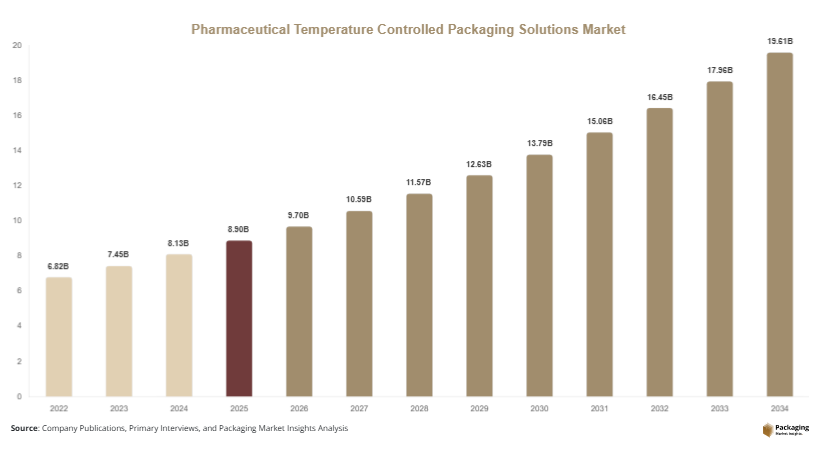
The global pharmaceutical temperature controlled packaging solutions Market size was estimated at USD 8.9 billion in 2025 and is projected to reach approximately USD 9.7 billion in 2026. With increasing global pharmaceutical trade and the expansion of biologic drug production, the market is forecast to grow significantly and reach USD 19.6 billion by 2034, registering a compound annual growth rate (CAGR) of 9.2% from 2025 to 2034.
The pharmaceutical temperature controlled packaging solutions Market is experiencing steady growth due to the increasing demand for biologics, vaccines, and temperature-sensitive pharmaceutical products across global healthcare supply chains. Temperature-controlled packaging solutions are designed to maintain specific temperature ranges during storage and transportation, ensuring product safety and efficacy. These solutions include insulated containers, refrigerants, phase-change materials, and active temperature-controlled systems used throughout pharmaceutical logistics networks.
Key Highlights
- Market size estimated at USD 8.9 billion in 2025
- Expected to reach USD 19.6 billion by 2034
- Forecast CAGR of 9.2% between 2025 and 2034
- Growth supported by expansion of biologics and vaccine distribution
- Increasing pharmaceutical cold chain logistics infrastructure worldwide
Explore more data points, trends and opportunities Download Free Sample Report
Market Trends
Increasing Adoption of Sustainable and Reusable Packaging
Sustainability has emerged as an important trend in the pharmaceutical temperature controlled packaging solutions Market. Pharmaceutical companies and logistics providers are focusing on reducing environmental impact by adopting reusable insulated containers and recyclable packaging materials. Traditional single-use packaging often generates significant waste during global pharmaceutical shipments. To address this challenge, manufacturers are introducing reusable pallet shippers, advanced insulation materials, and biodegradable refrigerants that reduce environmental footprint.
Many pharmaceutical supply chain operators now implement return-and-reuse programs where insulated containers are collected, refurbished, and redeployed in future shipments. This approach helps companies lower operational costs while meeting sustainability goals. Regulatory agencies and healthcare organizations are also encouraging environmentally responsible supply chain practices, which further supports the shift toward sustainable packaging systems.
Integration of Smart Temperature Monitoring Technologies
Another key trend shaping the market is the integration of smart monitoring and tracking technologies within temperature-controlled packaging systems. Digital sensors, IoT-based monitoring devices, and real-time temperature tracking solutions are increasingly embedded into pharmaceutical packaging systems. These technologies allow pharmaceutical companies to monitor shipment conditions continuously and detect temperature deviations during transportation.
Real-time data monitoring improves visibility across the pharmaceutical supply chain and allows logistics providers to respond quickly if temperature excursions occur. Advanced monitoring solutions also support regulatory compliance and quality assurance by providing detailed shipment records. As pharmaceutical distribution networks expand globally, the adoption of intelligent temperature monitoring technologies is expected to accelerate.
Market Drivers
Rising Demand for Biologics and Specialty Drugs
The rapid growth of biologics and specialty pharmaceuticals is a major factor driving the pharmaceutical temperature controlled packaging solutions Market. Biologic drugs, including monoclonal antibodies, cell therapies, and gene therapies, require strict temperature control throughout the supply chain. These products are highly sensitive to temperature fluctuations and may lose effectiveness if exposed to unsuitable storage conditions.
The increasing number of biologic drug approvals worldwide has expanded the need for reliable cold chain packaging solutions. Pharmaceutical companies are investing in advanced insulated containers and refrigerant technologies to protect these products during global distribution. As biologic medicines continue to gain prominence in therapeutic areas such as oncology and autoimmune diseases, demand for temperature-controlled packaging solutions is expected to rise significantly.
Expansion of Global Pharmaceutical Supply Chains
The expansion of international pharmaceutical trade has also accelerated the adoption of temperature-controlled packaging solutions. Many pharmaceutical companies now operate manufacturing facilities, research centers, and distribution networks across multiple countries. This globalization of pharmaceutical production has increased the complexity of logistics operations and strengthened the need for reliable packaging systems.
Temperature-controlled packaging solutions help maintain product integrity during long-distance shipments across diverse climatic conditions. As pharmaceutical companies expand their global distribution networks, they require packaging solutions capable of maintaining stable temperatures during extended transit periods. This demand is expected to support long-term growth in the pharmaceutical temperature-controlled packaging market.
Market Restraint
High Cost of Advanced Temperature-Controlled Packaging Systems
Despite growing demand, the high cost of advanced temperature-controlled packaging solutions remains a key restraint for the pharmaceutical temperature controlled packaging solutions Market. Active temperature-controlled containers, high-performance insulation materials, and sophisticated refrigerant systems often involve significant manufacturing and operational costs. These costs can limit adoption among small and mid-sized pharmaceutical companies with limited logistics budgets.
Active packaging systems, which rely on battery-powered refrigeration units or electronic temperature regulation technologies, are particularly expensive compared to passive packaging alternatives. While these systems provide superior temperature stability for long-distance transportation, their cost can increase overall logistics expenses for pharmaceutical companies. This challenge becomes more significant when shipping large volumes of temperature-sensitive medicines.
Additionally, the need for validation testing, regulatory compliance, and specialized packaging handling adds further operational costs. Pharmaceutical companies must ensure packaging systems meet regulatory standards for temperature stability and product protection. The cost of testing and certification may discourage smaller logistics providers from investing in advanced packaging technologies.
For example, global vaccine distribution programs often require specialized packaging capable of maintaining ultra-low temperatures. Developing and maintaining these packaging systems can increase distribution costs significantly. As a result, some pharmaceutical manufacturers may rely on simpler packaging solutions that provide lower performance but reduce costs.
While ongoing technological innovations are gradually lowering production costs, pricing challenges continue to influence purchasing decisions across pharmaceutical supply chains.
Market Opportunities
Growth of Biopharmaceutical Manufacturing
The rapid expansion of biopharmaceutical manufacturing presents a significant opportunity for the pharmaceutical temperature controlled packaging solutions Market. Biopharmaceutical production facilities are increasing worldwide, driven by rising demand for advanced therapies such as monoclonal antibodies, recombinant proteins, and gene therapies. These products require precise temperature control throughout manufacturing, storage, and transportation.
As biopharmaceutical manufacturing capacity grows, pharmaceutical companies must adopt reliable cold chain packaging systems to protect sensitive products during global distribution. This trend creates opportunities for packaging manufacturers to develop specialized insulated containers and advanced refrigerant materials designed for biologic drug transportation.
Expansion of Pharmaceutical Distribution in Emerging Markets
Emerging economies present another strong growth opportunity for the pharmaceutical temperature-controlled packaging market. Countries in Asia, Latin America, and Africa are expanding healthcare infrastructure and pharmaceutical distribution networks to meet rising demand for medicines. As pharmaceutical supply chains expand into these regions, maintaining temperature stability during transportation becomes increasingly important.
Temperature-controlled packaging solutions play a critical role in delivering vaccines and biologic medicines to remote locations where infrastructure may be limited. Packaging manufacturers are developing cost-effective and durable solutions designed for challenging transportation environments. This growing demand from emerging healthcare markets is expected to create new opportunities for industry participants.
Report Scope
| Report Metric | Details |
|---|---|
| Market Size in 2025 | USD 8.9 Billion |
| Market Size in 2026 | USD 9.7 Billion |
| Market Size in 2034 | USD 19.6 Billion |
| CAGR | 9.2% (2026-2034) |
| Base Year for Estimation | 2025 |
| Historical Data | 2022-2024 |
| Forecast Period | 2026-2034 |
| Report Coverage | Revenue Forecast, Competitive Landscape, Supply Chain Disruption, Growth Factors, Environment & Regulatory Landscape and Trends |
| Geographies Covered | North America, Europe, APAC, Middle East and Africa, LATAM |
| Countries Covered | U.S., Canada, U.K., Germany, France, Spain, Italy, Russia, Nordic, Benelux, Rest of Europe, China, South Korea, Japan, India, Australia, Singapore, Taiwan, South East Asia, Rest of Asia-Pacific, UAE, Turky, Saudi Arabia, South Africa, Egypt, Nigeria, Rest of MEA, Brazil, Mexico, Argentina, Chile, Colombia, Rest of LATAM |
Explore more data points, trends and opportunities Download Free Sample Report
Segmental Analysis
By Type
Passive packaging solutions dominated the pharmaceutical temperature controlled packaging solutions Market in 2024, accounting for approximately 62% of total market share. Passive systems rely on insulated containers combined with refrigerants such as gel packs or phase-change materials to maintain required temperature ranges during transportation. These systems are widely used due to their cost efficiency and ability to maintain stable temperatures for extended shipping durations. Passive packaging is particularly common in pharmaceutical distribution where shipments require moderate temperature control between 2°C and 8°C.
The fastest-growing subsegment within the type category is active temperature-controlled packaging, which is expected to register a CAGR of nearly 10.8% through 2034. Active systems use battery-powered refrigeration units or advanced temperature regulation technologies to maintain precise temperature conditions. These systems are particularly valuable for shipping highly sensitive biologic products or vaccines over long distances where temperature stability is critical.
By Application
Within the application segment, vaccine transportation represented the dominant subsegment in 2024, capturing approximately 41% of total market share. Vaccines often require strict temperature control throughout the supply chain to maintain potency and effectiveness. Temperature-controlled packaging solutions play a crucial role in maintaining consistent storage conditions during transportation from manufacturing facilities to healthcare providers.
The biologics transportation segment is expected to witness the fastest growth during the forecast period, with an estimated CAGR of around 11.5% through 2034. Increasing production of biologic drugs such as monoclonal antibodies and gene therapies has significantly increased demand for advanced packaging systems capable of maintaining precise temperature conditions during shipment.
By End-Use
Pharmaceutical manufacturers represented the largest end-use segment in the pharmaceutical temperature controlled packaging solutions Market, accounting for approximately 48% of total revenue in 2024. These companies require temperature-controlled packaging systems to distribute temperature-sensitive products across global supply chains. The expansion of biologics manufacturing and global pharmaceutical trade continues to strengthen demand from this segment.
The pharmaceutical logistics providers segment is expected to record the fastest growth, with a projected CAGR of approximately 10.9% during the forecast period. Logistics companies are increasingly offering specialized cold chain transportation services for pharmaceutical products. As pharmaceutical distribution networks expand globally, logistics providers are investing in advanced temperature-controlled packaging technologies to support reliable product delivery.
Pharmaceutical Temperature Controlled Packaging Solutions Market Segmentations
Type
- Passive Temperature-Controlled Packaging
- Active Temperature-Controlled Packaging
Application
- Vaccine Transportation
- Biologics Transportation
- Clinical Trial Distribution
- Insulin Transportation
End-Use
- Pharmaceutical Manufacturers
- Pharmaceutical Logistics Providers
- Hospitals and Clinics
Regional Analysis
North America
North America accounted for the largest share of the pharmaceutical temperature controlled packaging solutions Market in 2025, representing approximately 38% of global revenue. The region is expected to grow at a CAGR of around 8.5% through 2034. Growth is supported by strong pharmaceutical manufacturing capacity, advanced cold chain logistics infrastructure, and increasing biologics production. Pharmaceutical companies in the region continue to invest heavily in temperature-controlled distribution systems to maintain product quality across domestic and international markets.
The United States remains the dominant country within the regional market due to its large pharmaceutical industry and high biologics research activity. One unique growth factor in the U.S. market is the presence of extensive clinical trial networks that require reliable temperature-controlled packaging solutions for transporting investigational drugs across multiple research sites.
Europe
Europe represents another significant market for pharmaceutical temperature-controlled packaging solutions and accounted for approximately 27% of global market share in 2025. The region is projected to grow at a CAGR of nearly 8.7% through the forecast period. Strong regulatory frameworks governing pharmaceutical storage and distribution have increased the adoption of validated packaging systems across the region.
Germany is a leading country within the European market due to its advanced pharmaceutical manufacturing sector and strong logistics infrastructure. A unique growth factor in Germany is the country's focus on pharmaceutical exports, which requires reliable temperature-controlled packaging for long-distance transportation across global markets.
Asia Pacific
The Asia Pacific region is expected to record the fastest growth in the pharmaceutical temperature controlled packaging solutions Market, with a projected CAGR of around 11.2% through 2034. The region accounted for approximately 22% of global market share in 2025. Rapid expansion of pharmaceutical manufacturing and growing healthcare investments are supporting regional market growth.
China dominates the regional market due to its large pharmaceutical production capacity and increasing biologics manufacturing. A unique growth factor driving demand in China is the expansion of pharmaceutical exports, which requires advanced packaging solutions to ensure temperature stability during international shipments.
Middle East & Africa
The Middle East & Africa region represented around 7% of the global market share in 2025 and is expected to grow at a CAGR of approximately 9.1% through 2034. Market growth in this region is supported by increasing investments in healthcare infrastructure and pharmaceutical supply chains. Governments are strengthening cold chain logistics networks to improve access to temperature-sensitive medicines.
Saudi Arabia plays a leading role in the regional market due to its expanding pharmaceutical distribution infrastructure. One unique growth factor is government investment in national vaccine storage and distribution programs, which require reliable temperature-controlled packaging systems.
Latin America
Latin America accounted for approximately 6% of the global pharmaceutical temperature controlled packaging solutions Market share in 2025. The region is forecast to grow at a CAGR of about 9.4% during the forecast period. Increasing pharmaceutical imports and expanding healthcare infrastructure are contributing to regional market growth.
Brazil is the dominant country within the Latin American market due to its large pharmaceutical distribution network. A key growth factor supporting demand in Brazil is the expansion of national immunization programs that require secure temperature-controlled packaging solutions for vaccine transportation.
Competitive Landscape
The pharmaceutical temperature controlled packaging solutions Market is moderately competitive, with several global packaging manufacturers and cold chain solution providers operating across the industry. Market participants focus on product innovation, strategic partnerships, and geographic expansion to strengthen their market presence. Companies are investing in advanced insulation materials, sustainable packaging technologies, and integrated temperature monitoring systems to meet the evolving needs of pharmaceutical supply chains.
One of the leading companies in the market is Sonoco ThermoSafe, which maintains a strong presence through a broad portfolio of passive and active temperature-controlled packaging solutions. The company continues to expand its reusable packaging offerings and cold chain logistics services to support pharmaceutical manufacturers worldwide.
Other prominent companies are focusing on strategic collaborations with pharmaceutical companies and logistics providers to expand their distribution networks. Recent developments in the market include the introduction of reusable pallet shippers, smart temperature monitoring systems, and environmentally sustainable packaging materials designed to reduce supply chain waste.
As demand for temperature-sensitive pharmaceutical products continues to rise, companies operating in the pharmaceutical temperature-controlled packaging market are expected to increase investments in product innovation and cold chain infrastructure.
Key Players List
- Sonoco ThermoSafe
- Cold Chain Technologies
- Pelican BioThermal
- Softbox Systems
- va-Q-tec AG
- Envirotainer
- SkyCell AG
- Cryopak Industries
- Sofrigam
- Intelsius
- Tempack Packaging Solutions
- American Aerogel Corporation
- Inmark Packaging
- CSafe Global
- Tower Cold Chain