Product Packaging Design Market Size and Growth
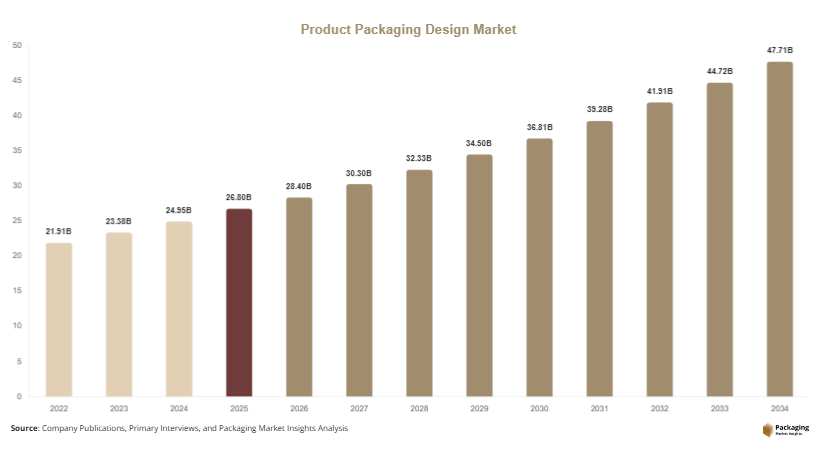
The global product packaging design market size was valued at approximately USD 26.8 billion in 2025 and is projected to reach USD 28.4 billion in 2026. By 2034, the market is forecasted to attain nearly USD 47.9 billion, growing at a CAGR of 6.7% during 2025–2034. Companies are increasingly investing in packaging design to improve brand recognition, customer engagement, and product differentiation in competitive retail and e-commerce environments. The product packaging design market is experiencing consistent expansion due to increasing demand for visually appealing, sustainable, and consumer-focused packaging solutions across industries such as food & beverages, cosmetics, pharmaceuticals, electronics, and personal care.
One of the major growth factors driving the product packaging design market is the rising influence of consumer purchasing behavior. Packaging design has become a key marketing tool, as consumers often associate attractive packaging with product quality and brand reliability. Businesses are therefore focusing on unique colors, typography, structural design, and interactive packaging formats to strengthen shelf visibility and improve customer retention.
Key Highlights
- Asia Pacific dominated the market with a 36.8% share in 2025.
- Latin America is projected to grow at the fastest CAGR of 7.1%.
- Structural packaging design led the type segment with a 33.5% share.
- Paper and paperboard packaging dominated material usage with a 41.2% share.
- Food & beverage applications led the segment with 39.6% share, while cosmetic packaging is expected to grow at a CAGR of 7.3%.
- The US remained the dominant country with a market size of USD 6.1 billion in 2025 and USD 6.5 billion in 2026.
Explore more data points, trends and opportunities Download Free Sample Report
Market Trends
Increasing Adoption of Sustainable and Minimalist Packaging Designs
Sustainability-focused packaging design is becoming a major trend in the product packaging design market as brands attempt to reduce environmental impact while maintaining strong visual appeal. Companies are replacing excessive packaging layers with minimalist structures that reduce material usage and improve recyclability. Packaging designers are increasingly using biodegradable substrates, soy-based inks, and reusable materials to align with sustainability regulations and consumer expectations. Minimalist packaging aesthetics are also gaining popularity because they communicate transparency and premium quality. This trend is especially visible in food, cosmetics, and personal care industries where environmentally conscious consumers influence purchasing decisions. Brands are using sustainability-focused design strategies to improve market positioning and strengthen customer loyalty.
Growth of Smart and Interactive Packaging Design
The integration of digital technology into packaging design is reshaping the market landscape. Brands are increasingly adopting QR codes, augmented reality experiences, NFC tags, and digital storytelling elements to create interactive consumer experiences. Smart packaging design helps companies provide product authentication, promotional content, and detailed product information directly through packaging interfaces. The rise of smartphone usage and digital marketing strategies has accelerated this trend across multiple industries. Cosmetic, beverage, and electronics brands are particularly investing in interactive packaging solutions to improve customer engagement and brand visibility. In addition, smart packaging enables companies to collect consumer behavior insights, helping businesses improve future product and marketing strategies. This trend is expected to support long-term market growth.
Market Drivers
Rising Importance of Brand Differentiation in Competitive Markets
Increasing competition across consumer goods industries is driving demand for innovative product packaging design solutions. Packaging serves as a primary communication tool between brands and consumers, particularly in retail stores and online marketplaces. Companies are investing in customized graphics, unique structures, and premium finishing techniques to improve product visibility and strengthen brand identity. Attractive packaging design also influences impulse buying behavior, especially in food, beverages, cosmetics, and luxury products. Businesses are increasingly recognizing packaging as a strategic investment rather than a secondary operational requirement. The growing number of product launches and private-label brands is further encouraging companies to develop distinctive packaging formats that can differentiate products from competitors and improve customer engagement.
Expansion of E-commerce and Direct-to-Consumer Distribution
The rapid growth of e-commerce platforms has become a significant driver for the product packaging design market. Online shopping has changed packaging requirements, as products now need to withstand transportation while maintaining strong visual presentation during delivery. Companies are designing durable yet attractive packaging that improves customer satisfaction and enhances the unboxing experience. Social media platforms have amplified the importance of visually appealing packaging because consumers frequently share product experiences online. This has encouraged brands to adopt premium packaging styles, personalized messages, and creative structural designs. Additionally, subscription box services and direct-to-consumer brands are increasingly relying on packaging design to build emotional connections with customers and improve repeat purchases.
Market Restraint
High Design and Material Development Costs
One of the major restraints affecting the product packaging design market is the high cost associated with advanced packaging design development and sustainable material integration. Companies often require significant investment in graphic design services, prototyping, digital printing technologies, and customized structural packaging solutions. Small and medium-sized enterprises may face budget limitations that restrict their ability to adopt premium packaging formats. Sustainable packaging materials such as biodegradable plastics and recycled paperboard also involve higher production and sourcing costs compared to conventional materials. These expenses can increase overall product pricing and reduce profit margins. For example, emerging cosmetic brands may struggle to compete with larger companies that can invest heavily in premium packaging design and branding strategies. Additionally, frequent packaging redesigns to match changing consumer preferences and regulatory requirements can further increase operational costs, creating challenges for manufacturers and brand owners across multiple industries.
Market Opportunities
Growth in Personalized and Limited-Edition Packaging
The increasing demand for personalized packaging solutions presents strong growth opportunities for market participants. Brands are launching customized packaging for seasonal promotions, regional campaigns, and influencer collaborations to strengthen customer engagement. Personalized packaging enhances emotional connection with consumers and improves brand recall. Beverage, confectionery, and cosmetic companies are particularly investing in limited-edition packaging designs to attract younger consumers and increase social media visibility. Advances in digital printing technology are making small-batch customized packaging more cost-effective and accessible for brands of different sizes. This opportunity is expected to expand as companies continue focusing on customer-centric marketing strategies and differentiated brand experiences.
Rising Demand for Sustainable Luxury Packaging
Luxury brands are increasingly adopting sustainable packaging designs without compromising premium aesthetics, creating significant opportunities in the market. High-end cosmetic, fashion, and electronics companies are integrating recyclable materials, refillable containers, and eco-friendly finishes into luxury packaging solutions. Consumers are becoming more conscious about environmental impact while still expecting premium product presentation. This shift is encouraging designers to combine sustainability with elegant structural and graphic elements. The demand for sustainable luxury packaging is also rising due to stricter environmental regulations and corporate sustainability commitments. Companies capable of balancing visual appeal, functionality, and environmental responsibility are expected to gain strong growth opportunities over the forecast period.
Report Scope
| Report Metric | Details |
|---|---|
| Market Size in 2025 | USD 26.8 Billion |
| Market Size in 2026 | USD 28.4 Billion |
| Market Size in 2034 | USD 47.9 Billion |
| CAGR | 6.7% (2026-2034) |
| Base Year for Estimation | 2025 |
| Historical Data | 2022-2024 |
| Forecast Period | 2026-2034 |
| Report Coverage | Revenue Forecast, Competitive Landscape, Supply Chain Disruption, Growth Factors, Environment & Regulatory Landscape and Trends |
| Geographies Covered | North America, Europe, APAC, Middle East and Africa, LATAM |
| Countries Covered | U.S., Canada, U.K., Germany, France, Spain, Italy, Russia, Nordic, Benelux, Rest of Europe, China, South Korea, Japan, India, Australia, Singapore, Taiwan, South East Asia, Rest of Asia-Pacific, UAE, Turky, Saudi Arabia, South Africa, Egypt, Nigeria, Rest of MEA, Brazil, Mexico, Argentina, Chile, Colombia, Rest of LATAM |
Explore more data points, trends and opportunities Download Free Sample Report
Segmental Analysis
By Type
Structural packaging design dominated the product packaging design market in 2024, accounting for approximately 33.5% of the total market share. This segment includes the physical shape, functionality, and protective structure of packaging solutions used across food, electronics, cosmetics, and healthcare products. Companies are prioritizing structural packaging because it directly influences product protection, logistics efficiency, and customer convenience. Innovative structural designs also improve shelf differentiation and help brands create memorable consumer experiences. Folding cartons, ergonomic bottle designs, and resealable pouches remain widely adopted formats across industries. The growing emphasis on sustainable packaging structures is further encouraging businesses to develop lightweight yet durable packaging configurations that reduce transportation costs and environmental impact.
Sustainable packaging design is projected to be the fastest-growing subsegment, expanding at a CAGR of 7.4% during the forecast period. Increasing environmental awareness and government regulations regarding packaging waste are driving demand for eco-friendly design solutions. Brands are redesigning product packaging using recyclable materials, biodegradable substrates, and minimalist structures that reduce material usage without affecting visual appeal. Consumers are also actively favoring products packaged in environmentally responsible formats, especially in food, beverage, and personal care industries. Companies are investing in sustainable design innovation to strengthen brand reputation and comply with evolving sustainability standards. Digital printing and advanced material engineering technologies are further enabling the development of attractive and environmentally efficient packaging formats.
By Application
Food and beverage applications dominated the product packaging design market in 2024, representing nearly 39.6% of the overall market share. Packaging design plays a significant role in influencing consumer purchasing behavior in this industry because products compete heavily on retail shelves and online platforms. Food and beverage companies use visually appealing graphics, convenient packaging structures, and transparent labeling to improve product visibility and communicate nutritional information effectively. Flexible packaging, stand-up pouches, and lightweight cartons remain highly preferred formats due to their cost efficiency and convenience. Growing demand for ready-to-eat meals, premium beverages, and healthy snack products is further increasing investment in innovative packaging design solutions across the global food industry.
Cosmetic packaging applications are expected to grow at the fastest CAGR of 7.3% during the forecast period. Beauty and personal care brands are increasingly focusing on premium packaging aesthetics to strengthen brand identity and improve consumer perception. Customized shapes, luxury finishes, embossing, and metallic effects are becoming common across skincare, fragrance, and makeup products. Social media marketing and influencer-driven purchasing trends are encouraging cosmetic brands to invest heavily in visually distinctive packaging. Sustainable cosmetic packaging is also gaining momentum as consumers demand environmentally responsible products. Refillable containers, reusable jars, and biodegradable packaging materials are becoming important growth factors driving innovation in this segment.
By Material
Paper and paperboard materials dominated the product packaging design market in 2024, accounting for approximately 41.2% of total market share. These materials are widely used because they provide strong printability, cost efficiency, recyclability, and compatibility with multiple packaging formats. Folding cartons, corrugated boxes, and paper sleeves are extensively used across food, pharmaceuticals, electronics, and consumer goods industries. Brands prefer paper-based packaging because it supports sustainability initiatives while maintaining attractive graphic presentation. Increasing restrictions on single-use plastics are also encouraging manufacturers to shift toward paper and paperboard materials. Advancements in coating technologies and moisture-resistant paper solutions are further improving the functionality and durability of these packaging formats.
Biodegradable materials are expected to witness the fastest growth, registering a CAGR of 7.0% over the forecast period. Increasing environmental concerns and stricter packaging waste regulations are driving the adoption of compostable and plant-based packaging materials. Companies are using biodegradable polymers, molded fiber, and organic substrates to reduce environmental impact while maintaining packaging performance. Consumer preference for sustainable products is particularly strong among younger demographics, encouraging brands to integrate eco-friendly materials into packaging design strategies. Food service companies, cosmetics manufacturers, and premium retail brands are increasingly adopting biodegradable packaging solutions to align with corporate sustainability goals and strengthen environmentally responsible brand positioning.
Product Packaging Design Market Segmentations
By Type
- Graphic Packaging Design
- Structural Packaging Design
- Sustainable Packaging Design
- Smart Packaging Design
By Application
- Food & Beverage
- Cosmetics & Personal Care
- Pharmaceuticals
- Consumer Electronics
- Household Products
By Material
- Paper & Paperboard
- Plastic
- Glass
- Metal
- Biodegradable Materials
Regional Analysis
North America
North America accounted for approximately 30.2% of the global product packaging design market share in 2025 and is projected to expand at a CAGR of 6.1% during the forecast period. The region benefits from strong consumer spending, advanced branding strategies, and high adoption of premium packaging formats. Increasing investment in e-commerce packaging and sustainable packaging innovation is supporting market growth across industries such as food, cosmetics, and healthcare.
The United States dominates the regional market due to the strong presence of consumer goods manufacturers and packaging design agencies. A unique growth factor is the rapid adoption of subscription-based product delivery services that require visually attractive and durable packaging formats. Companies are increasingly focusing on customized packaging experiences to strengthen customer retention and social media engagement.
Europe
Europe held around 24.8% of the global market share in 2025 and is expected to grow at a CAGR of 5.9% during the forecast period. The region is characterized by strict environmental regulations and increasing demand for recyclable packaging materials. European companies are investing in minimalist packaging design and lightweight structures to comply with sustainability goals while maintaining product visibility and consumer appeal.
Germany leads the European product packaging design market due to its advanced manufacturing sector and strong packaging innovation ecosystem. A unique growth factor is the growing demand for sustainable luxury packaging in cosmetics and premium beverages. Brands are redesigning packaging structures to reduce material consumption while preserving premium aesthetics and functionality.
Asia Pacific
Asia Pacific dominated the product packaging design market with a 36.8% share in 2025 and is forecasted to grow at a CAGR of 7.2%. Rapid urbanization, rising disposable income, and expanding retail industries are supporting market growth across the region. The increasing popularity of packaged foods, beauty products, and online shopping platforms is also creating strong demand for attractive and functional packaging designs.
China remains the dominant country in Asia Pacific due to its large consumer goods manufacturing base and rapidly growing e-commerce sector. A unique growth factor is the increasing demand for localized packaging designs that reflect regional culture and consumer preferences. Companies are using customized graphics and multilingual packaging elements to strengthen product positioning across domestic and export markets.
Middle East & Africa
The Middle East & Africa region represented nearly 4.9% of the global market share in 2025 and is projected to register a CAGR of 6.0% over the forecast period. Market growth is supported by increasing retail modernization, expansion of packaged food consumption, and rising demand for premium consumer goods. International brands entering regional markets are also investing in localized packaging design strategies to improve customer engagement.
The United Arab Emirates is the dominant country within the region due to strong retail infrastructure and increasing luxury product demand. A unique growth factor is the rapid expansion of premium cosmetic and fragrance industries requiring sophisticated packaging presentation. Companies are focusing on decorative finishes and high-quality materials to strengthen product appeal among affluent consumers.
Latin America
Latin America accounted for approximately 3.3% of the product packaging design market in 2025 and is expected to grow at the fastest CAGR of 7.1% during the forecast period. Rising urbanization, increasing packaged food demand, and expanding retail chains are contributing to regional market growth. Brands are also investing in affordable yet visually attractive packaging formats to improve product competitiveness.
Brazil dominates the Latin American market due to its large food and beverage industry and growing beauty product sector. A unique growth factor is the increasing demand for flexible packaging designs that reduce transportation costs while maintaining strong shelf visibility. Companies are adopting lightweight packaging materials and vibrant graphic designs to attract price-sensitive consumers.
Competitive Landscape
The product packaging design market is moderately fragmented, with global design agencies, packaging manufacturers, and branding companies competing through innovation, sustainability initiatives, and customized solutions. Leading players are focusing on digital printing technologies, structural packaging development, and smart packaging integration to improve market positioning. Strategic collaborations between packaging manufacturers and consumer goods companies are also increasing as businesses seek differentiated packaging experiences.
Pentagram is recognized as one of the leading companies in the market due to its strong global branding and packaging design portfolio. The company recently introduced advanced AI-assisted design workflows to improve packaging personalization and accelerate concept development timelines. Other major players include Landor, Design Bridge and Partners, SGK Inc., and Jones Knowles Ritchie, all of which continue investing in sustainable packaging design and digital visualization technologies.
Companies are increasingly expanding their regional presence and offering integrated branding services to attract multinational clients. Investments in recyclable materials, interactive packaging, and premium finishing solutions remain major competitive strategies across the industry.
Key Players List
- Pentagram
- Landor
- Design Bridge and Partners
- SGK Inc.
- Jones Knowles Ritchie
- Bulletproof
- Pearlfisher
- Elmwood
- Dragon Rouge
- CBA Design
- Turner Duckworth
- Stranger & Stranger
- Anthem Branding
- Ruckus Marketing
- DD.NYC Creative Agency