Heat Sealable Packaging Market Size and Growth
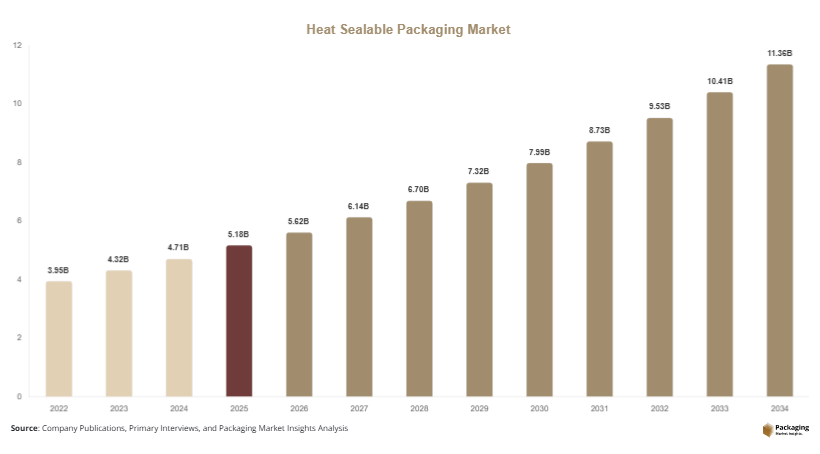
The global heat sealable packaging market size is estimated at approximately USD 5.18 billion in 2025, while in 2026 it is projected to reach around USD 5.62 billion, driven by rising consumption of packaged food and expanding pharmaceutical distribution networks. By 2034, the market is expected to reach nearly USD 11.25 billion, expanding at a CAGR of 9.2% (2025–2034). The heat sealable packaging market is experiencing steady growth driven by rising demand for secure, tamper-evident, and efficient packaging solutions across food & beverage, pharmaceuticals, personal care, and industrial goods sectors. Heat sealable packaging materials are widely used due to their ability to provide airtight sealing, extended shelf life, and improved product protection during storage and transportation.
The growth of the heat sealable packaging market is driven by three key factors. First, increasing demand for convenient and ready-to-eat food products is significantly boosting adoption of heat sealable films and pouches. Second, growing pharmaceutical packaging requirements, especially for temperature-sensitive drugs and sterile products, are driving demand for high-performance sealing materials. Third, expansion of e-commerce and organized retail is increasing the need for durable packaging solutions that can withstand transportation stress.
Key Highlights:
- North America dominated the market with a 34.8% share in 2025.
- Europe accounted for a 28.6% share in 2025.
- Asia Pacific is projected to grow at the fastest CAGR of 10.3%.
- Polyethylene-based materials led the material segment with a 45.2% share in 2024.
- Food packaging dominated the application segment with a 52.6% share in 2024.
- Flexible packaging held the largest format share at 48.1% in 2024.
- The US remained the dominant country with a market size of USD 1.84 billion in 2025 and USD 2.01 billion in 2026.
Explore more data points, trends and opportunities Download Free Sample Report
Market Trends
Shift Toward Sustainable Heat Sealable Materials
The heat sealable packaging market is witnessing a strong transition toward eco-friendly and recyclable materials. Manufacturers are increasingly developing bio-based polymers, compostable films, and mono-material structures that maintain sealing efficiency while reducing environmental impact. This trend is largely driven by government regulations restricting single-use plastics and increasing consumer awareness regarding sustainable packaging. Food and beverage companies are adopting recyclable heat sealable films to meet corporate sustainability goals. Additionally, advancements in material science are enabling the development of low-temperature sealable materials, which reduce energy consumption during packaging operations.
Growth of High-Barrier Heat Sealable Packaging
Another key trend is the rising demand for high-barrier heat sealable packaging solutions that offer enhanced protection against moisture, oxygen, and contaminants. This trend is particularly strong in pharmaceuticals and perishable food segments, where product integrity is critical. Manufacturers are incorporating multi-layer barrier films and advanced coating technologies to improve sealing performance. High-barrier packaging is also gaining traction in ready-to-eat meals and frozen food categories, where extended shelf life is essential. The integration of advanced laminates is improving durability and storage efficiency across industries.
Market Drivers
Rising Demand for Packaged and Convenience Foods
The increasing global consumption of packaged and convenience foods is a major driver of the heat sealable packaging market. Urbanization, busy lifestyles, and changing dietary habits are leading to higher demand for ready-to-eat meals and processed foods. Heat sealable packaging provides airtight sealing that preserves freshness, flavor, and nutritional value, making it highly suitable for food applications. The expansion of retail chains and online grocery platforms is further boosting demand for reliable packaging solutions that ensure product safety during transportation and storage.
Expansion of Pharmaceutical Packaging Applications
The pharmaceutical industry is another key driver of market growth. Heat sealable packaging is widely used for blister packs, sterile pouches, and medical device packaging due to its ability to maintain product sterility and prevent contamination. Increasing production of vaccines, biologics, and temperature-sensitive drugs is driving demand for high-performance sealing materials. Regulatory requirements for tamper-evident and child-resistant packaging are also encouraging adoption of heat sealable solutions in the healthcare sector.
Market Restraint
Volatility in Raw Material Prices and Environmental Concerns
A major restraint in the heat sealable packaging market is the fluctuation in raw material prices, particularly for polymers such as polyethylene, polypropylene, and polyester. These materials are derived from petroleum-based sources, making them sensitive to global oil price variations. Sudden price increases can significantly impact manufacturing costs and reduce profit margins for packaging producers.
Additionally, environmental concerns regarding plastic waste and non-biodegradable packaging materials pose challenges for market expansion. Regulatory pressure from governments to reduce plastic usage is forcing companies to invest in alternative materials, which often involve higher production costs. In developing regions, limited recycling infrastructure further complicates waste management issues. These factors collectively restrict market growth, especially for small and mid-sized packaging manufacturers.
Market Opportunities
Development of Bio-Based and Compostable Packaging
The rising demand for sustainable packaging presents a significant opportunity for the heat sealable packaging market. Manufacturers are increasingly investing in bio-based polymers and compostable materials that offer heat sealing capability while reducing environmental impact. These innovations are particularly relevant in Europe and North America, where sustainability regulations are strict. Companies that develop cost-effective eco-friendly heat sealable solutions are expected to gain strong market advantage in the coming years.
Growth in E-Commerce Packaging Demand
The rapid expansion of e-commerce is creating strong growth opportunities for heat sealable packaging solutions. Online retail requires durable, tamper-proof, and lightweight packaging to ensure product safety during shipping. Heat sealable pouches and films are widely used in logistics and distribution channels due to their flexibility and se
Report Scope
| Report Metric | Details |
|---|---|
| Market Size in 2025 | USD 5.18 Billion |
| Market Size in 2026 | USD 5.62 Billion |
| Market Size in 2034 | USD 11.25 Billion |
| CAGR | 9.2% (2026-2034) |
| Base Year for Estimation | 2025 |
| Historical Data | 2022-2024 |
| Forecast Period | 2026-2034 |
| Report Coverage | Revenue Forecast, Competitive Landscape, Supply Chain Disruption, Growth Factors, Environment & Regulatory Landscape and Trends |
| Geographies Covered | North America, Europe, APAC, Middle East and Africa, LATAM |
| Countries Covered | U.S., Canada, U.K., Germany, France, Spain, Italy, Russia, Nordic, Benelux, Rest of Europe, China, South Korea, Japan, India, Australia, Singapore, Taiwan, South East Asia, Rest of Asia-Pacific, UAE, Turky, Saudi Arabia, South Africa, Egypt, Nigeria, Rest of MEA, Brazil, Mexico, Argentina, Chile, Colombia, Rest of LATAM |
Explore more data points, trends and opportunities Download Free Sample Report
Segmental Analysis
By Material Type
The material type segment of the heat sealable packaging market is dominated by polyethylene-based heat sealable materials, accounting for approximately 45.2% share in 2024. Polyethylene is widely used due to its excellent sealing properties, flexibility, cost-effectiveness, and compatibility with a wide range of packaging applications. It is extensively used in food packaging, industrial packaging, and consumer goods due to its ability to provide strong seals at low temperatures while maintaining durability. Its widespread availability and ease of processing make it the most preferred material in the global packaging industry.
The fastest-growing subsegment is bio-based heat sealable materials, projected to grow at a CAGR of 10.5% through 2034, driven by increasing environmental concerns and regulatory pressure to reduce plastic waste. These materials are gaining traction in Europe and North America, where sustainability regulations are strict. Manufacturers are investing in compostable and recyclable heat sealable films that maintain performance while reducing environmental impact. Rising consumer awareness regarding eco-friendly packaging is also accelerating adoption across food and personal care industries.
By Application
The application segment is led by food packaging, accounting for approximately 52.6% share in 2024. Heat sealable packaging is widely used in this segment due to its ability to preserve freshness, prevent contamination, and extend shelf life. It is commonly used for snacks, frozen foods, dairy products, and ready-to-eat meals. The growth of organized retail and increasing demand for packaged food products are major factors driving this segment.
The fastest-growing subsegment is pharmaceutical packaging, projected to grow at a CAGR of 10.2% through 2034, driven by rising demand for sterile, tamper-evident, and contamination-free packaging. Heat sealable materials are essential for packaging medical devices, diagnostic kits, and temperature-sensitive drugs. Increasing global healthcare expenditure and expansion of pharmaceutical manufacturing facilities are further boosting demand in this segment.
By Packaging Format
The packaging format segment is dominated by flexible packaging, accounting for approximately 48.1% share in 2024. Flexible heat sealable packaging is widely preferred due to its lightweight nature, cost efficiency, and ease of transportation. It is extensively used in food, pharmaceutical, and consumer goods packaging. Its ability to reduce material usage while maintaining strong sealing performance makes it highly attractive for manufacturers.
The fastest-growing subsegment is heat sealable pouches, projected to grow at a CAGR of 10.4% through 2034, driven by increasing demand for convenience packaging. Pouches are widely used in snacks, beverages, pet food, and personal care products. Their resealable nature and portability make them highly popular among consumers. Rising e-commerce activity and demand for durable packaging formats are further accelerating growth in this segment.
Heat Sealable Packaging Market Segmentations
By Material Type
- Polyethylene
- Polypropylene
- Polyester
- Bio-based Materials
By Application
- Food Packaging
- Pharmaceutical Packaging
- Personal Care Packaging
- Industrial Packaging
By Packaging Format
- Flexible Packaging
- Rigid Packaging
- Pouches
- Films & Wraps
Regional Analysis
North America
North America dominates the heat sealable packaging market, accounting for approximately 34.8% share in 2025, and is projected to grow at a CAGR of 9.0% during 2025–2034. The region’s strong position is supported by advanced packaging infrastructure, high consumption of packaged food, and strong pharmaceutical manufacturing activity. The United States is the leading country due to its large-scale food processing industry, well-developed retail sector, and increasing demand for convenient and ready-to-eat packaged products. Canada also contributes significantly with rising adoption of sustainable packaging solutions across food and healthcare sectors.
A key growth factor in North America is the rapid shift toward sustainable and recyclable packaging materials. Companies are increasingly replacing conventional multilayer plastics with mono-material heat sealable films to comply with environmental regulations and corporate sustainability goals. Additionally, strong demand from e-commerce and logistics industries is driving adoption of heat sealable pouches and flexible packaging formats that ensure product safety during transit. The pharmaceutical sector is also expanding usage of sterile heat sealable packaging for medical devices, diagnostic kits, and temperature-sensitive drugs.
Europe
Europe holds approximately 28.6% share in 2025, with a projected CAGR of 8.8% through 2034 in the heat sealable packaging market. The region benefits from strong regulatory frameworks, advanced packaging technology adoption, and high environmental awareness. Germany leads the market due to its strong manufacturing base and innovation in packaging machinery and materials. Other major contributors include France, the United Kingdom, Italy, and Spain, where demand for sustainable and high-performance packaging solutions continues to rise.
A major growth factor in Europe is the strict regulatory focus on reducing plastic waste and promoting circular economy practices. This has significantly increased demand for recyclable and bio-based heat sealable packaging materials. Food manufacturers are adopting eco-friendly packaging formats to meet EU sustainability targets and reduce carbon footprint. Additionally, rising demand for packaged organic food and premium consumer goods is supporting market growth. The pharmaceutical industry is also a strong contributor due to strict packaging compliance requirements, especially for sterile and tamper-evident packaging solutions.
Asia Pacific
Asia Pacific accounts for approximately 27.2% share in 2025, and is expected to grow at the fastest CAGR of 10.3% through 2034 in the heat sealable packaging market. The region’s growth is driven by rapid urbanization, expanding manufacturing sector, and increasing consumption of packaged food and beverages. China is the largest market due to its massive food processing industry and strong packaging manufacturing base. India is emerging as a high-growth market due to rising population, increasing disposable income, and expansion of retail and e-commerce sectors. Japan and South Korea also contribute significantly due to advanced packaging technologies.
A key growth driver in Asia Pacific is the rapid expansion of the food delivery and e-commerce sectors. Increasing demand for convenient packaged meals and online grocery deliveries is boosting the use of heat sealable packaging solutions. Additionally, rising foreign direct investment in manufacturing industries is supporting adoption of advanced packaging technologies. Pharmaceutical production is also increasing in the region, especially in India and China, which is driving demand for sterile and tamper-proof packaging solutions.
Middle East & Africa
The Middle East & Africa (MEA) region holds approximately 4.7% share in 2025, with a projected CAGR of 8.4% through 2034 in the heat sealable packaging market. Growth in this region is driven by expanding food import dependency, rising retail sector development, and increasing investments in packaging infrastructure. The United Arab Emirates, Saudi Arabia, South Africa, and Egypt are the key contributors to regional demand. The UAE leads the market due to strong logistics and food distribution networks.
A key growth factor in MEA is the increasing demand for packaged food products due to rapid urbanization and changing consumer lifestyles. The region relies heavily on imported food products, which require durable and protective packaging solutions such as heat sealable materials. Additionally, growing investments in retail modernization and cold chain logistics are further supporting market expansion. However, limited domestic manufacturing capabilities and high import dependency still restrain faster growth in some African countries.
Latin America
Latin America accounts for approximately 4.7% share in 2025, and is projected to grow at a CAGR of 8.6% through 2034 in the heat sealable packaging market. The region is witnessing steady growth due to expanding FMCG sector, increasing packaged food consumption, and rising retail penetration. Brazil is the largest market in the region, followed by Mexico, Argentina, and Chile. These countries are experiencing increased demand for flexible and cost-efficient packaging solutions.
A major growth factor in Latin America is the expansion of organized retail and food processing industries. Growing urban populations and changing dietary habits are increasing demand for packaged and processed food products. Heat sealable packaging is widely used due to its ability to preserve freshness and extend shelf life. Additionally, increasing investments in packaging automation and manufacturing modernization are further supporting market growth across the region.
Competitive Landscape
The heat sealable packaging market is moderately fragmented with strong participation from global packaging manufacturers. Key players include Amcor plc, Sealed Air Corporation, Berry Global Inc., Mondi Group, and Sonoco Products Company. These companies focus on innovation in sustainable materials, high-barrier films, and advanced sealing technologies.
Amcor plc is a leading player in the market due to its extensive sustainable packaging portfolio. Recently, the company launched a new recyclable heat sealable film designed for food packaging applications, improving shelf life while reducing environmental impact.
Key Players List
- Amcor plc
- Sealed Air Corporation
- Berry Global Inc.
- Mondi Group
- Sonoco Products Company
- Huhtamaki Oyj
- Uflex Ltd.
- Constantia Flexibles
- Coveris Holdings
- Winpak Ltd.
- Bemis Company Inc.
- Clondalkin Group
- FlexPak Services
- Glenroy Inc.
- Polyplex Corporation