Market Overview
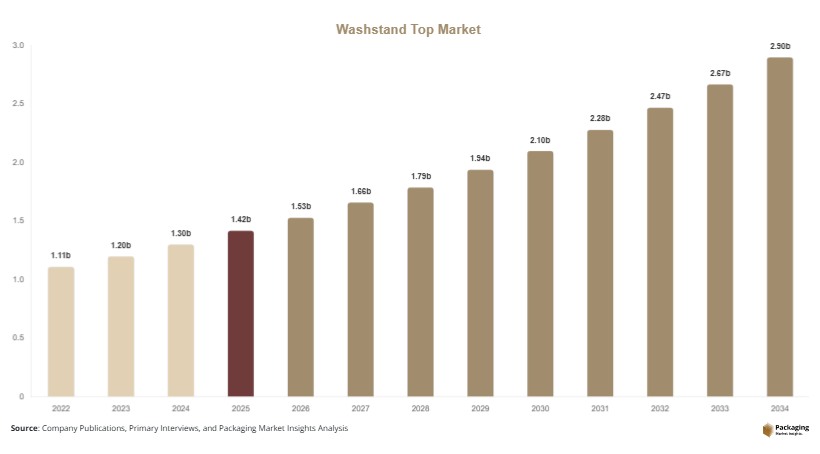
The global washstand top market size was valued at USD 1.42 billion in 2025 and is estimated to reach USD 1.53 billion in 2026. The market is projected to grow from USD 1.53 billion in 2026 to USD 2.89 billion by 2034, expanding at a compound annual growth rate (CAGR) of 8.3% during the forecast period 2025–2034. Washstand tops, widely used across residential and commercial bathroom installations, are witnessing sustained demand as renovation activity, hospitality construction, and premium interior design trends continue to accelerate worldwide.
Market growth is supported by several structural factors. First, rising urbanization and household formation across emerging economies are driving new residential construction, which directly increases demand for bathroom fixtures including washstand tops. Second, growing consumer preference for aesthetically refined and durable bathroom surfaces, such as engineered quartz and natural stone, is prompting manufacturers to expand premium product portfolios. Third, the global hospitality and healthcare construction boom, including hotel refurbishments and hospital modernization projects, is generating consistent institutional demand for washstand tops that combine hygiene, durability, and design appeal.
Key Highlights:
- North America dominated the washstand top market with the largest share of 34.62% in 2025.
- Asia Pacific is expected to be the fastest-growing region in the washstand top market during the forecast period at a CAGR of 10.48%.
- Based on material type, the engineered stone segment dominated the washstand top market with a share of 38.71% in 2025.
- Based on application, the residential segment dominated the market with a share of 58.36% in 2025.
- Based on distribution channel, offline retail stores segment dominated the market with 61.29% in 2025.
- The US washstand top market size was valued at USD 0.41 billion in 2025 and is projected to reach USD 0.45 billion in 2026.
Explore more data points, trends and opportunities Download Free Sample Report
Market Trends
Rising Adoption of Engineered Stone Surfaces
Engineered stone, particularly quartz-based composites, is gaining strong traction across the washstand top market due to its superior stain resistance, non-porous surface, and consistent visual patterns compared with natural stone. Manufacturers are investing in advanced resin-binding technologies that allow engineered slabs to replicate marble and granite aesthetics while reducing maintenance requirements. This trend is particularly visible in mid-to-premium residential renovations, where homeowners seek long-lasting surfaces without the sealing and staining concerns associated with natural stone. As production costs for engineered stone continue to decline through improved manufacturing efficiency, its adoption across both residential and commercial washstand installations is expected to expand steadily through the forecast period.
Integration of Smart and Antimicrobial Surface Technologies
Bathroom fixture manufacturers are increasingly incorporating antimicrobial coatings and easy-clean surface treatments into washstand top products, responding to heightened hygiene awareness following recent global health events. These treatments inhibit bacterial and mold growth on porous or semi-porous surfaces, extending product lifespan and appeal, particularly in healthcare and hospitality settings. Some manufacturers are also exploring integrated sensor technologies, such as touchless faucets paired with washstand top designs, to create cohesive smart-bathroom ecosystems. This convergence of hygiene-focused materials science and connected fixture design is reshaping product development roadmaps across the washstand top industry, influencing purchasing decisions among institutional buyers and design-conscious residential consumers alike.
Market Drivers
Accelerating Residential Renovation and Remodeling Activity
Home renovation spending continues to climb across developed and developing economies, driven by aging housing stock, rising home equity, and lifestyle-driven upgrades. Bathroom remodeling remains one of the most common renovation categories, with washstand tops frequently replaced to modernize outdated fixtures or improve functionality. Homeowners increasingly prioritize durable, visually appealing surfaces that enhance property value, prompting demand for premium materials such as quartz, granite, and solid-surface composites. Financing options, including home improvement loans and retailer credit programs, are further easing the affordability barrier, enabling broader consumer participation in renovation projects and sustaining consistent demand for replacement and upgrade washstand top installations across residential markets globally.
Expansion of Hospitality and Commercial Construction Projects
The global hospitality sector is undergoing significant expansion, with new hotel openings, resort developments, and commercial property upgrades driving bulk procurement of bathroom fixtures. Washstand tops used in hospitality settings must balance aesthetic appeal with high durability to withstand frequent use, making engineered stone and solid-surface materials particularly attractive to developers. Simultaneously, healthcare facility construction, including hospitals and elder-care centers, is generating demand for hygienic, easy-to-clean washstand top solutions that meet stringent sanitation standards. This dual demand from hospitality and healthcare construction pipelines provides manufacturers with stable, large-volume order opportunities, supporting capacity expansion and encouraging continued investment in product innovation across the washstand top industry.
Market Restraint
The washstand top market faces a notable restraint in the form of raw material price volatility, particularly for natural stone and resin-based engineered surfaces. Prices for quarried granite and marble fluctuate based on extraction costs, transportation logistics, and geopolitical factors affecting quarry-rich regions. Similarly, engineered stone production relies on petroleum-derived resins, exposing manufacturers to crude oil price swings that directly impact production costs. These fluctuations create pricing unpredictability for manufacturers and distributors, complicating long-term contract negotiations with construction firms and retailers. For example, a sharp increase in resin costs during a period of supply chain disruption can compress manufacturer margins or force sudden retail price increases, potentially discouraging cost-sensitive residential buyers from proceeding with planned renovations.
This volatility also affects smaller regional manufacturers disproportionately, as they typically lack the purchasing scale or hedging mechanisms available to larger multinational producers. Consequently, smaller players may face inventory management challenges, delayed project timelines, or reduced competitiveness against established brands capable of absorbing short-term cost shocks. Additionally, import tariffs on natural stone in certain regions add further cost pressure, particularly for markets reliant on imported marble and granite slabs. Collectively, these factors introduce a persistent layer of uncertainty into pricing strategies across the washstand top value chain, requiring manufacturers to adopt flexible sourcing strategies, diversified supplier networks, and dynamic pricing models to mitigate the impact of raw material cost fluctuations on overall profitability and market competitiveness.
Market Opportunities
Growing Demand in Emerging Economies
Rapid urbanization across Southeast Asia, Latin America, and parts of Africa is creating substantial opportunities for washstand top manufacturers to establish early market presence. Rising disposable incomes and expanding middle-class populations in these regions are fueling residential construction and home improvement spending, categories historically underserved by premium bathroom fixture brands. Local manufacturers are well positioned to introduce cost-effective engineered stone and ceramic washstand top solutions tailored to regional price sensitivities. International players entering through joint ventures or regional manufacturing partnerships can capture first-mover advantages, particularly as government housing initiatives and infrastructure development programs continue to expand construction activity across these fast-growing emerging markets.
Sustainable and Recycled Material Innovation
Increasing environmental awareness among consumers and regulatory bodies is opening opportunities for manufacturers to develop washstand tops using recycled glass, reclaimed stone composites, and low-emission resin formulations. Green building certifications, such as LEED, are influencing procurement decisions among commercial developers seeking sustainable material credits. Manufacturers investing in eco-friendly production processes and transparent supply chain sourcing can differentiate their offerings in a market increasingly attentive to environmental impact. This shift also aligns with circular economy initiatives promoted across Europe and North America, presenting an opportunity for companies to capture premium pricing while addressing growing regulatory and consumer demand for sustainable bathroom fixture solutions.
Report Scope
| Report Metric | Details |
|---|---|
| Market Size in 2025 | USD 1.42 billion |
| Market Size in 2026 | USD 1.53 billion |
| Market Size in 2034 | USD 2.89 billion |
| CAGR | 8.3% (2026-2034) |
| Base Year for Estimation | 2025 |
| Historical Data | 2022-2024 |
| Forecast Period | 2026-2034 |
| Report Coverage | Revenue Forecast, Competitive Landscape, Supply Chain Disruption, Growth Factors, Environment & Regulatory Landscape and Trends |
| Geographies Covered | North America, Europe, APAC, Middle East and Africa, LATAM |
| Countries Covered | U.S., Canada, U.K., Germany, France, Spain, Italy, Russia, Nordic, Benelux, Rest of Europe, China, South Korea, Japan, India, Australia, Singapore, Taiwan, South East Asia, Rest of Asia-Pacific, UAE, Turky, Saudi Arabia, South Africa, Egypt, Nigeria, Rest of MEA, Brazil, Mexico, Argentina, Chile, Colombia, Rest of LATAM |
Explore more data points, trends and opportunities Download Free Sample Report
Segmental Analysis
By Material
Engineered stone dominated the washstand top market by material type, accounting for a share of 38.71% in 2025. This dominance stems from the material's combination of durability, low maintenance requirements, and design flexibility, allowing manufacturers to produce consistent patterns and color options that appeal to both residential and commercial buyers. Engineered stone's resistance to staining, scratching, and moisture absorption makes it particularly suitable for high-traffic hospitality and healthcare installations. Additionally, advancements in manufacturing technology have reduced production costs over recent years, allowing engineered stone products to compete more directly with traditionally lower-cost ceramic options while offering superior performance characteristics, further reinforcing its leading position within the overall material segment.
Natural granite is projected to be the fastest-growing material subsegment, expanding at a CAGR of 9.2% during the forecast period. This growth is primarily driven by renewed consumer interest in authentic, unique stone patterns that engineered alternatives cannot fully replicate. Granite's natural heat resistance and long-established reputation for durability continue to appeal to premium residential renovation projects, particularly in North America and parts of Europe. Furthermore, improved quarrying and slab-cutting technologies are reducing waste and processing costs, making granite washstand tops more price-competitive than in previous years, thereby broadening their appeal beyond the ultra-premium segment into a wider range of mid-to-high-tier residential and commercial applications.
By Application
The residential segment dominated the washstand top market by application, capturing a share of 58.36% in 2025. This leading position reflects the sheer scale of global housing stock requiring periodic bathroom fixture replacement, combined with sustained consumer spending on home improvement projects. Rising homeownership rates in emerging economies and strong renovation activity in developed markets both contribute to consistent residential demand. Consumers increasingly view bathroom upgrades as a meaningful way to enhance property value and personal comfort, driving continued investment in premium washstand top materials such as engineered stone and granite across single-family homes, apartments, and condominium renovations worldwide throughout the historical and forecast periods.
The commercial segment, encompassing hospitality, healthcare, and office facilities, is expected to be the fastest-growing application category, registering a CAGR of 9.8% through 2034. This accelerated growth is driven by extensive hotel construction pipelines, hospital modernization initiatives, and corporate office renovations across major global markets. Commercial buyers typically procure washstand tops in bulk, favoring standardized, durable materials capable of withstanding heavy daily use while meeting hygiene and design standards specific to their industry. The growing emphasis on guest experience within hospitality and infection control within healthcare settings continues to push commercial demand growth ahead of the broader market average.
By Distribution Channel
Offline retail stores, including specialty showrooms and home improvement chains, dominated the washstand top market by distribution channel, holding a share of 61.29% in 2025. This channel's dominance is attributed to consumers' continued preference for physically inspecting surface textures, colors, and finishes before committing to a purchase, particularly for higher-value natural stone and engineered products. Showrooms also provide value-added services such as design consultation and installation coordination, which strengthen customer confidence and support higher conversion rates for premium washstand top purchases compared with purely online transactions, especially among first-time renovators unfamiliar with material selection processes.
The online distribution channel is projected to be the fastest-growing segment, expanding at a CAGR of 11.4% during the forecast period. Growth is driven by increasing consumer comfort with purchasing home improvement products digitally, supported by virtual visualization tools, augmented reality previews, and expanded return policies that reduce purchase uncertainty. E-commerce platforms are also enabling smaller and regional manufacturers to reach broader audiences without the overhead costs associated with physical showroom networks, intensifying competition and expanding product accessibility for price-sensitive and convenience-driven consumers across both developed and emerging markets.
Washstand Top Market Segmentations
Material
- Engineered Stone
- Natural Granite
- Marble
- Ceramic
- Solid Surface Composites
- Others
Application
- Residential
-
Commercial
- Hospitality
- Healthcare
- Office & Institutional
Distribution Channel
- Offline Retail Stores
- Online Retail
- Direct Sales / B2B Procurement
Regional Analysis
North America
North America held the largest share of the washstand top market at 34.62% in 2025 and is projected to expand at a CAGR of 7.1% through 2034. The region benefits from strong renovation spending, mature housing markets, and a well-established distribution network spanning big-box retailers, specialty showrooms, and online channels. High consumer awareness of premium surface materials continues to support steady replacement demand across both residential and commercial segments throughout the region.
The United States dominates the North American washstand top market, supported by robust home improvement spending and a large existing housing stock requiring periodic bathroom upgrades. A unique growth factor for the region is the widespread adoption of financing programs offered by home improvement retailers, which lower upfront cost barriers and encourage consumers to select premium engineered stone or granite washstand tops over basic alternatives during renovation projects.
Europe
Europe accounted for a significant washstand top market share in 2025 and is expected to grow at a CAGR of 6.8% between 2025 and 2034. The region's mature construction sector, combined with strong design sensibilities and stringent sustainability regulations, continues to shape demand patterns favoring recycled and low-emission surface materials across residential and hospitality applications throughout major European economies.
Germany leads the European washstand top market, supported by its large renovation and remodeling sector and strong manufacturing base for engineered stone products. A unique growth factor for the region is the presence of strict environmental building codes across the European Union, which is prompting manufacturers to accelerate development of sustainable, recyclable washstand top materials to maintain regulatory compliance and market access.
Asia Pacific
Asia Pacific is projected to be the fastest-growing region in the washstand top market, expanding at a CAGR of 10.48% during the forecast period. Rapid urbanization, expanding middle-class populations, and large-scale residential and hospitality construction across China, India, and Southeast Asian nations are driving substantial demand for both premium and value-tier washstand top products throughout the region's diverse markets.
China dominates the Asia Pacific washstand top market, supported by its extensive manufacturing base and large domestic construction sector. A unique growth factor for the region is the rising penetration of e-commerce platforms in home improvement retail, which is enabling manufacturers to reach price-sensitive consumers in tier-two and tier-three cities previously underserved by traditional showroom distribution networks.
Middle East & Africa
The Middle East & Africa washstand top market held a modest but growing share in 2025 and is anticipated to register a CAGR of 8.9% through 2034. Large-scale hospitality and luxury residential development projects across Gulf Cooperation Council countries are driving demand for premium natural stone and engineered surface washstand tops within high-end commercial and residential construction segments.
The United Arab Emirates leads the regional washstand top market, driven by ongoing luxury hotel and residential tower development in Dubai and Abu Dhabi. A unique growth factor for the region is the continued investment in tourism infrastructure, which is generating consistent demand for premium bathroom fixtures that align with the hospitality sector's emphasis on upscale guest experiences and design differentiation.
Latin America
Latin America represented a smaller share of the global washstand top market in 2025 but is expected to grow at a CAGR of 7.6% through 2034. Expanding urban housing development and gradual recovery in construction investment across Brazil and Mexico are supporting steady demand growth for both residential and commercial washstand top installations across the broader region.
Brazil dominates the Latin American washstand top market, supported by its large population base and expanding urban middle class. A unique growth factor for the region is increasing availability of domestically produced engineered stone alternatives, which are reducing reliance on imported natural stone and making premium washstand top designs more accessible to a broader range of consumers.
Competitive Landscape
The washstand top market features a moderately fragmented competitive landscape, comprising established multinational fixture manufacturers alongside regional stone processing companies and specialized surface material producers. Leading companies compete primarily on product durability, design variety, sustainability credentials, and distribution reach. Kohler Co. maintains a leading position within the market, supported by its extensive product portfolio spanning multiple material categories and strong global distribution network across both residential and commercial channels.
In terms of recent development, Kohler Co. expanded its engineered quartz washstand top product line in 2025, introducing new low-emission manufacturing processes aimed at meeting tightening environmental regulations across North American and European markets. Other major players continue to pursue capacity expansion, regional partnerships, and material innovation to strengthen their competitive positioning. Mid-sized regional manufacturers are increasingly focusing on niche differentiation, such as sustainable material sourcing or region-specific design aesthetics, to compete effectively against larger, more resource-intensive multinational competitors within this evolving and increasingly design-conscious global market.
Key Players
- Kohler Co.
- Villeroy & Boch AG
- Duravit AG
- Roca Sanitario S.A.
- TOTO Ltd.
- LIXIL Corporation
- Cosentino Group
- Caesarstone Ltd.
- Hanwha L&C
- Corian Design (DuPont)
- American Standard Brands
- Geberit Group
- Jaquar Group
- RAK Ceramics
- Vitra Bathrooms
- Marmi Bruno Zanet Srl
- Antolini Luigi & C. S.p.A.