Vacuum Shrink Bags Market Size
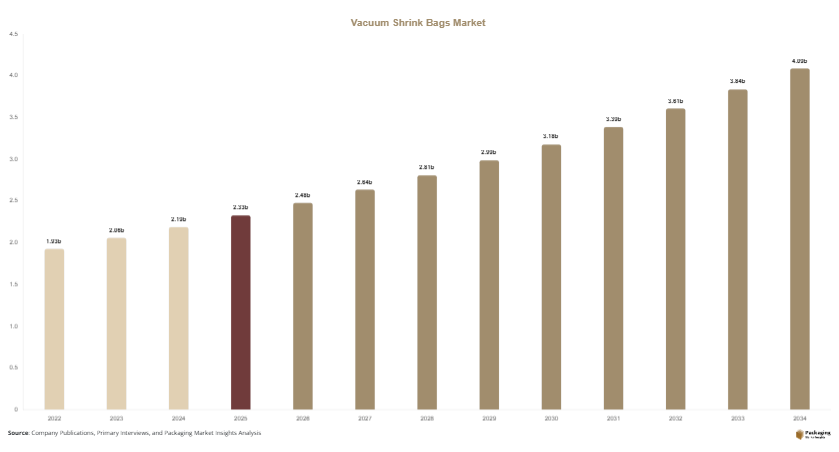
Vacuum Shrink Bags market size is projected at USD 2.48 billion in 2026 and is expected to hit USD 4.09 billion by 2034 with a CAGR of 6.45%. Rising demand for high-barrier food packaging, extended shelf-life solutions, and advanced vacuum packaging technologies continues to support industry expansion. The report provides comprehensive quantitative analysis covering production capacity, pricing trends, segment performance, investment activities, competitive landscape, and regional performance across historical data from 2022–2024, the base year 2025, and forecasts through 2034.
The Vacuum Shrink Bags market consists of multilayer flexible packaging materials designed to remove trapped air and tightly conform around products after heat shrinking, thereby improving product preservation, appearance, and transportation efficiency. Global production exceeded 19.8 billion bags during 2025, while food packaging represented nearly 71% of total consumption. Adoption among meat processors surpassed 78%, seafood applications accounted for approximately 12%, and healthcare and industrial applications collectively contributed over 17% of total demand. Increasing automation in packaging facilities and growing export-oriented food processing continue to strengthen the Vacuum Shrink Bags market.
Explore more data points, trends and opportunities Download Free Sample Report
Vacuum Shrink Bags Market Trends
Rising Adoption of High-Barrier Multilayer Packaging
Manufacturers are increasingly introducing multilayer films incorporating EVOH and polyamide to improve oxygen barriers by over 99%, reducing spoilage while extending shelf life by 30–50%. Global production of multilayer vacuum shrink bags exceeded 13 billion units during 2025, supported by growing investments in automated packaging lines. More than 68% of premium meat processors have transitioned toward high-performance shrink packaging technologies, reinforcing the Vacuum Shrink Bags market.
The integration of recyclable polymers, downgauged films, and high-speed sealing technologies continues to reshape manufacturing operations. Packaging lines operating above 80 bags per minute have increased by nearly 26% over the last three years, while digital quality inspection systems have improved production efficiency by 18%. Food exports requiring vacuum packaging continue to rise across multiple economies, strengthening the Vacuum Shrink Bags market.
Vacuum Shrink Bags Drivers
Growing Demand for Extended Shelf-Life Food Packaging
Expanding global meat, poultry, seafood, and dairy industries remain the primary growth drivers. Vacuum shrink bags reduce oxygen transmission to below 5 cc/m²/day, lower food waste by approximately 25%, and increase storage duration by up to 50%. More than 61% of packaged meat exports now utilize vacuum shrink packaging, while processed food production surpassed 420 million metric tons globally. Continuous investment in food safety regulations and automated packaging technologies continues supporting the Vacuum Shrink Bags market.
Vacuum Shrink Bags Restraints
Volatility in Polymer Raw Material Prices
Fluctuating prices of polyethylene, polyamide, and specialty barrier resins increase production costs across the value chain. Polymer prices experienced fluctuations exceeding 18% during recent years, while transportation costs increased by nearly 12%. Small manufacturers operating with production capacities below 40 million bags annually face margin pressures, limiting investment in advanced technologies and slowing expansion across the Vacuum Shrink Bags market.
Vacuum Shrink Bags Opportunities
Expansion of Sustainable Packaging Technologies
Development of recyclable multilayer films, mono-material structures, and bio-based barrier materials creates substantial opportunities. More than 34% of packaging companies are investing in sustainable flexible packaging, while recycled polymer utilization has increased by approximately 22%. Automated packaging facilities capable of producing over 120 million bags annually continue expanding globally, creating long-term opportunities for the Vacuum Shrink Bags market.
Challenges in Vacuum Shrink Bags
Complex Recycling of Multilayer Structures
Recycling multilayer flexible packaging remains technically challenging because multiple polymer layers require specialized processing infrastructure. Less than 20% of multilayer flexible packaging currently enters advanced recycling streams, while collection rates remain below 35% across several developing markets. Compliance with evolving environmental regulations also increases manufacturing costs by nearly 10%, creating operational challenges for the Vacuum Shrink Bags market.
Report Scope
| Report Metric | Details |
|---|---|
| Market Size in 2025 | USD 2.33 billion |
| Market Size in 2026 | USD 2.48 billion |
| Market Size in 2034 | USD 4.09 billion |
| CAGR | 6.45% (2026-2034) |
| Base Year for Estimation | 2025 |
| Historical Data | 2022-2024 |
| Forecast Period | 2026-2034 |
| Report Coverage | Revenue Forecast, Competitive Landscape, Supply Chain Disruption, Growth Factors, Environment & Regulatory Landscape and Trends |
| Geographies Covered | North America, Europe, APAC, Middle East and Africa, LATAM |
| Countries Covered | U.S., Canada, U.K., Germany, France, Spain, Italy, Russia, Nordic, Benelux, Rest of Europe, China, South Korea, Japan, India, Australia, Singapore, Taiwan, South East Asia, Rest of Asia-Pacific, UAE, Turky, Saudi Arabia, South Africa, Egypt, Nigeria, Rest of MEA, Brazil, Mexico, Argentina, Chile, Colombia, Rest of LATAM |
Explore more data points, trends and opportunities Download Free Sample Report
Vacuum Shrink Bags Market Segmentation
Material innovations and expanding end-use industries continue shaping market performance. Food packaging accounted for approximately 71% of industry revenue during 2025, while polyethylene-based products represented nearly 46% of total production volume.
By Material
Polyethylene
Polyethylene remains the largest material segment with approximately 46% market share due to excellent flexibility, sealing performance, and moisture resistance. Annual production exceeded 9 billion bags, with thickness generally ranging from 40–80 microns. The material offers cost efficiency and compatibility with high-speed packaging equipment.
Polyamide
Polyamide contributes nearly 34% of total consumption because of superior puncture resistance and oxygen barrier properties. Production surpassed 6.4 billion bags, with tensile strength exceeding 70 MPa in many commercial grades. The material is widely utilized for premium meat and seafood applications.
EVOH
EVOH accounts for approximately 20% of production and delivers exceptional oxygen barrier performance below 1 cc/m²/day. More than 3.5 billion bags containing EVOH layers were produced during 2025, supporting premium food preservation and export packaging requirements.
By End-Use Industry
Food Packaging
Food packaging dominates with nearly 71% market share, consuming more than 14 billion bags annually. Usage penetration exceeds 78% among commercial meat processors, while shrink packaging significantly improves storage stability and logistics efficiency.
Healthcare
Healthcare applications contribute approximately 16% of demand, utilizing sterilizable high-barrier vacuum packaging for medical devices and pharmaceutical components. Production exceeded 3 billion bags, supporting contamination prevention and extended storage.
Industrial Packaging
Industrial packaging represents around 13% of total consumption. More than 2.5 billion bags are used for machinery components, electronics, and corrosion-sensitive products requiring moisture and oxygen protection during transportation.
Vacuum Shrink Bags Market Segmentations
Material
- Polyethylene (PE)
- Polyamide (PA)
- Ethylene Vinyl Alcohol (EVOH)
- Others
End-Use Industry
- Food Packaging
- Healthcare
- Industrial Packaging
- Consumer Goods Packaging
Distribution Channel
- Direct Sales
- Packaging Distributors
- Online Sales
- Industrial Suppliers
- Retail Packaging Suppliers
Vacuum Shrink Bags Regional Outlook
North America
North America accounted for approximately 31% of global revenue, supported by highly automated meat processing industries. The United States contributed nearly 81% of regional production, while Canada continued expanding food exports using advanced vacuum packaging technologies. Regional production exceeded 5.8 billion bags during 2025.
Europe
Europe represented around 28% of global demand owing to stringent food safety regulations and sustainable packaging initiatives. Germany, France, Italy, and the United Kingdom collectively generated over 72% of regional consumption. Annual production surpassed 5.2 billion bags, with premium meat packaging driving growth.
Asia-Pacific
Asia-Pacific held nearly 30% market share, led by China, Japan, India, South Korea, and Australia. China alone contributed over 48% of regional manufacturing capacity. Production exceeded 6 billion bags, supported by expanding processed food industries and export activities.
Latin America
Latin America accounted for approximately 6% of global demand, driven by Brazil, Mexico, and Argentina. Meat exports continued increasing, with packaging production surpassing 1.1 billion bags annually across the region.
Middle East & Africa
The Middle East & Africa represented nearly 5% of industry revenue. Saudi Arabia, the UAE, and South Africa remained key markets, while regional production exceeded 900 million bags, supported by increasing cold-chain infrastructure investments.
Top players in Vacuum Shrink Bags
- Sealed Air Corporation
- Winpak Ltd.
- Kureha Corporation
- Flexopack S.A.
- Buergofol GmbH
- Coveris Holdings S.A.
- ALLFO GmbH
- Plastopil Hazorea Company Ltd.
- Orved S.p.A.
- Flavorseal LLC
- Schur Flexibles Group
- M&Q Packaging LLC
Sealed Air Corporation
-
Estimated global market share exceeds 16%.
-
Operates extensive manufacturing facilities serving food, healthcare, and industrial packaging sectors.
-
Produces billions of high-barrier packaging solutions annually with strong investment in recyclable flexible packaging technologies, automation, digital manufacturing, and product innovation. The company maintains a broad international distribution network and continues expanding premium barrier film offerings for meat, poultry, seafood, and cheese packaging applications.
Winpak Ltd.
-
Estimated market share is approximately 9%.
-
Strong presence across North America with advanced multilayer film technologies.
-
Focuses on high-performance barrier packaging, automated converting operations, sustainable product development, and customized solutions for food processors. Continuous investments in manufacturing capacity, multilayer extrusion, and customer-specific packaging innovations strengthen its competitive positioning across global vacuum shrink bag applications.