Barrier Shrink Bags Market Size
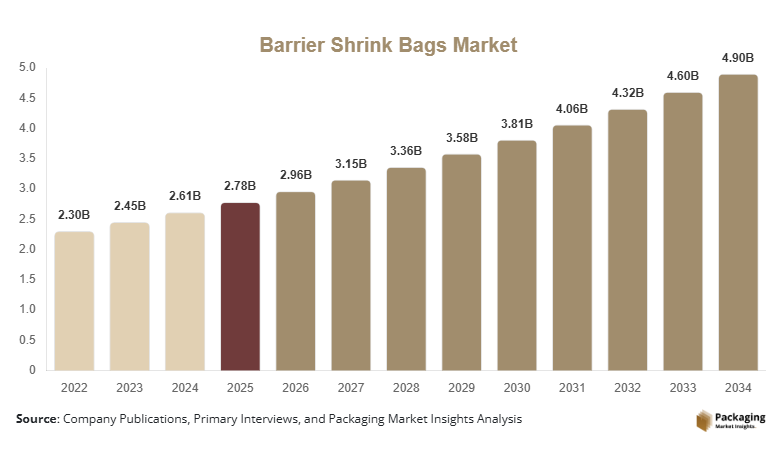
Barrier shrink bags' market size is projected at USD 2.96 billion in 2026 and is expected to hit USD 4.91 billion by 2034 with a CAGR of 6.5%. The market expansion is supported by increasing demand for high-barrier flexible packaging across food, pharmaceutical, and industrial sectors, with annual production exceeding 18.4 billion bags by 2026. The report evaluates quantitative demand patterns, detailed segmentation, competitive benchmarking, supply chain developments, and regional manufacturing capacity to provide a comprehensive assessment of the industry landscape.
Barrier shrink bags are multilayer packaging solutions engineered to provide superior oxygen, moisture, and puncture resistance while extending product shelf life. Global production exceeded 17.6 billion units in 2025, with food packaging accounting for nearly 72% of total consumption, healthcare representing 11%, and industrial applications contributing 17%. Adoption across meat processing facilities surpassed 68%, while vacuum packaging penetration exceeded 61% among processed food manufacturers. High-performance multilayer films with oxygen transmission rates below 10 cc/m²/day continue to improve packaging efficiency, supporting continued barrier shrink bag market expansion.
Explore more data points, trends and opportunities Download Free Sample Report
Barrier Shrink Bags Trends
Rising Adoption of High-Barrier Multilayer Packaging
Manufacturers are increasingly utilizing advanced multilayer co-extrusion technologies incorporating EVOH and polyamide layers to improve barrier performance. Production of multilayer shrink bags surpassed 12.8 billion units in 2025, while automated packaging line compatibility increased by 28% over the previous three years. More than 63% of premium meat processors have shifted toward high-barrier packaging systems to reduce food waste and improve shelf stability, reinforcing the barrier shrink bag market.
Continuous innovation in recyclable film structures, downgauging technologies, and improved sealing properties is reshaping industry requirements. Smart manufacturing has improved production efficiency by 19%, while automated quality inspection systems have reduced defects by 16%. Sustainable packaging materials now represent approximately 24% of newly introduced products, reflecting evolving industry preferences and strengthening the barrier shrink bag market.
Barrier Shrink Bags Market Drivers
Growing Demand for Extended Shelf-Life Packaging
Rising consumption of packaged meat, seafood, cheese, and processed foods continues to drive demand for barrier shrink bags worldwide. Global packaged food production exceeded 1.5 billion tons, while vacuum-packed meat shipments increased by 8.4% during 2025. Food waste reduction initiatives have encouraged packaging upgrades capable of extending shelf life by 30%–50%, resulting in increased adoption across commercial processing facilities. Modern shrink bag production lines now exceed 650 units globally with annual output growth above 7%, supporting sustained industry expansion.
Barrier Shrink Bags Market Restraints
Volatility in Raw Material Prices
Polyethylene, polyamide, and specialty resin prices remain vulnerable to fluctuations in crude oil costs and supply disruptions. Raw materials account for nearly 58% of manufacturing costs, while logistics expenses increased by approximately 11% during recent years. High-performance EVOH resin prices experienced volatility exceeding 14%, affecting profitability for converters producing more than 250 million bags annually and limiting investment across smaller manufacturers.
Barrier Shrink Bags Market Opportunities
Expansion of Sustainable Packaging Solutions
Growing investment in recyclable and downgauged packaging creates substantial opportunities for manufacturers. More than 220 packaging projects focused on recyclable barrier structures were announced globally between 2024 and 2026. Bio-based polymer utilization increased by 18%, while demand for lightweight packaging solutions reduced material consumption by nearly 12% without compromising barrier performance. Emerging economies continue expanding packaged food production, creating significant opportunities for industry participants.
Challenges in Barrier Shrink Bags Market
Balancing Barrier Performance with Recyclability
Manufacturers face challenges in maintaining high oxygen and moisture barrier properties while meeting sustainability targets. Over 42% of converters identify recycling compatibility as a major technical hurdle, while multilayer structures still dominate nearly 74% of premium applications. Compliance with evolving packaging regulations and investment in advanced recycling-compatible materials require significant capital expenditure exceeding USD 150 million annually across leading global producers.
Report Scope
| Report Metric | Details |
|---|---|
| Market Size in 2025 | USD 2.78 Billion |
| Market Size in 2026 | USD 2.96 Billion |
| Market Size in 2034 | USD 4.91 Billion |
| CAGR | 6.5% (2026-2034) |
| Base Year for Estimation | 2025 |
| Historical Data | 2022-2024 |
| Forecast Period | 2026-2034 |
| Report Coverage | Revenue Forecast, Competitive Landscape, Supply Chain Disruption, Growth Factors, Environment & Regulatory Landscape and Trends |
| Geographies Covered | North America, Europe, APAC, Middle East and Africa, LATAM |
| Countries Covered | U.S., Canada, U.K., Germany, France, Spain, Italy, Russia, Nordic, Benelux, Rest of Europe, China, South Korea, Japan, India, Australia, Singapore, Taiwan, South East Asia, Rest of Asia-Pacific, UAE, Turkey, Saudi Arabia, South Africa, Egypt, Nigeria, Rest of MEA, Brazil, Mexico, Argentina, Chile, Colombia, Rest of LATAM |
Explore more data points, trends and opportunities Download Free Sample Report
Barrier Shrink Bags Market Segmentation
Barrier shrink bags are segmented according to material and end-use industries. Polyethylene-based products account for approximately 46% of total demand, while food packaging contributes nearly 72% of industry consumption due to widespread adoption in meat, poultry, seafood, and dairy processing.
By Type
Polyethylene barrier shrink bags represent approximately 46% of global production, exceeding 8.4 billion units annually. Their excellent sealability, flexibility, and moisture resistance make them suitable for high-speed packaging operations operating above 120 packs per minute.
Polyamide variants account for nearly 34% of production, delivering enhanced puncture resistance and oxygen barrier properties. Annual production exceeds 6.1 billion units, with tensile strength improvements of nearly 25% over conventional flexible packaging.
EVOH-based barrier shrink bags contribute roughly 20% of total production. Oxygen transmission rates below 5 cc/m²/day enable extended shelf life for premium food products, supporting production volumes exceeding 3.5 billion units annually.
By Application
Food packaging dominates with approximately 72% market share. Annual utilization exceeds 13 billion bags, while adoption among meat processors surpasses 68%. Superior oxygen barriers significantly reduce spoilage while maintaining product freshness during refrigerated distribution.
Industrial applications account for nearly 17% of demand. Production exceeds 3.1 billion bags, supporting packaging of engineered components, chemicals, and specialty products requiring contamination protection and durable transport performance.
Healthcare packaging contributes approximately 11% of industry demand, with production surpassing 2 billion units annually. High-barrier materials protect sterile medical products while maintaining packaging integrity throughout extended storage periods.
Barrier Shrink Bags Market Segmentations
Material
- Polyethylene
- Polyamide
- EVOH
End Use
- Food Packaging
- Industrial Packaging
- Healthcare Packaging
Barrier Shrink Bags Regional Outlook
North America
North America accounts for nearly 34% of global demand, producing more than 6.2 billion bags annually. The United States contributes approximately 82% of regional production, supported by advanced meat processing and pharmaceutical packaging industries. Canada continues expanding food exports, requiring premium barrier packaging.
Europe
Europe represents approximately 28% of the market with annual production exceeding 5.1 billion units. Germany, France, Italy, and Spain collectively contribute over 71% of regional manufacturing. Sustainability regulations continue accelerating recyclable material adoption throughout the region.
Asia-Pacific
Asia-Pacific holds nearly 31% of global consumption and produces more than 5.8 billion units annually. China contributes around 47% of regional output, followed by Japan, India, and South Korea. Rising packaged food demand and expanding cold-chain infrastructure continue supporting regional manufacturing investments.
Latin America
Latin America contributes approximately 4% of global demand. Brazil and Mexico account for over 69% of regional consumption, driven by expanding meat exports and modern retail packaging requirements.
Middle East & Africa
The Middle East & Africa represents nearly 3% of the global industry. Growing investments in food processing, cold storage, and healthcare packaging are supporting gradual increases in regional production capacity exceeding 500 million units annually.
Top Players In The Barrier Shrink Bags Market
- Sealed Air Corporation
- Winpak Ltd.
- Amcor plc
- CVP Systems Inc.
- Flexopack S.A.,
- Kureha Corporation
- Buergofol GmbH
- Coveris Holdings S.A.
- Schur Flexibles Group
- Allfo GmbH
- Atlantis-Pak
- Viskase Companies Inc.
Sealed Air Corporation Estimated industry share: 15%–17% Strong presence across food packaging and protein processing. Extensive global manufacturing network with advanced multilayer film technologies. Significant investment in recyclable barrier packaging and automation. Broad customer portfolio across North America, Europe, and Asia-Pacific. Amcor plc Estimated industry share: 12%–14% Leading supplier of flexible barrier packaging solutions. Strong innovation in lightweight recyclable shrink bag structures. Extensive production footprint supporting food, healthcare, and industrial applications. Continuous investment in sustainable materials and high-performance barrier films.