Flexible Industrial Packaging Market Size and Growth
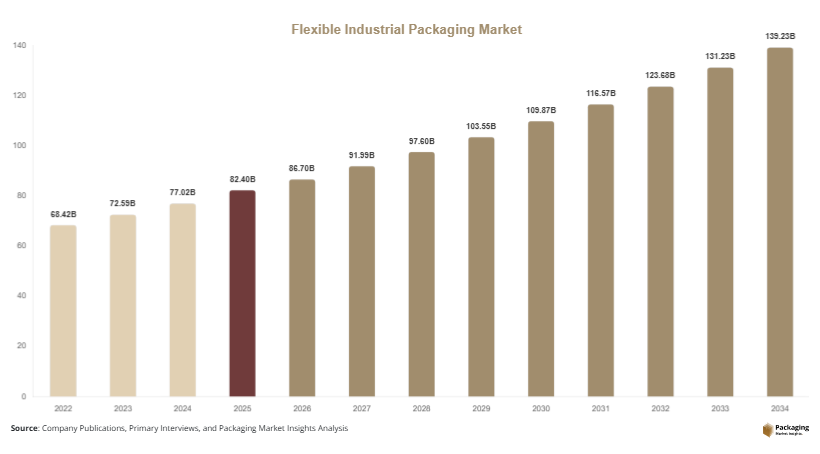
The global flexible industrial packaging market size is estimated to reach USD 82.4 billion in 2025, supported by increased industrial output and the expansion of international supply chains. By 2026, the market size is expected to grow to approximately USD 86.7 billion inn 2026, reflecting rising demand from manufacturing and logistics sectors. Over the forecast period, the market is projected to expand at a compound annual growth rate (CAGR) of 6.1% from 2025 to 2034, reaching around USD 140.3 billion by 2034.
The flexible industrial packaging market is experiencing steady growth as industries seek efficient, lightweight, and cost-effective packaging solutions for bulk materials and intermediate goods. Flexible industrial packaging includes products such as flexible intermediate bulk containers (FIBCs), industrial liners, sacks, and flexible pouches designed to store and transport raw materials across sectors including chemicals, food ingredients, agriculture, construction, and pharmaceuticals.
Key Highlights
- The Flexible Industrial Packaging Market was valued at USD 82.4 billion in 2025 and is projected to reach USD 86.7 billion in 2026, reflecting steady industry expansion.
- The market is expected to grow to USD 140.3 billion by 2034, registering a CAGR of 6.1% during 2025–2034.
- Growth is supported by rapid industrialization, rising sustainability initiatives, and increasing demand for cost-efficient bulk packaging solutions across global supply chains.
Explore more data points, trends and opportunities Download Free Sample Report
Market Trends
Rising Adoption of Sustainable and Recyclable Industrial Packaging
Sustainability has become a major trend shaping the flexible industrial packaging market. Industrial companies are increasingly focusing on reducing packaging waste and improving recyclability across supply chains. Flexible packaging manufacturers are responding by introducing recyclable materials such as mono-material polyethylene films and reusable bulk bags made from durable woven polypropylene.
These sustainable alternatives help reduce material consumption and transportation emissions due to their lighter weight compared to rigid packaging. Several industries, including chemicals and agriculture, are adopting reusable flexible intermediate bulk containers that can be used multiple times before recycling. In addition, regulatory pressure and corporate sustainability commitments are pushing manufacturers to adopt packaging solutions that support circular economy practices. As a result, demand for recyclable industrial packaging products continues to rise globally.
Growth of High-Performance Bulk Packaging Materials
Another notable trend in the flexible industrial packaging market is the increasing use of high-performance materials that enhance product protection and transport efficiency. Industries handling sensitive materials require packaging that offers resistance to moisture, contamination, and mechanical stress. Manufacturers are developing advanced multilayer films and reinforced woven fabrics that provide superior durability and barrier properties.
High-strength flexible packaging products are particularly useful for transporting chemicals, minerals, and construction materials across long distances. These innovations also improve load stability and reduce the risk of product loss during transit. As global trade and industrial logistics continue to expand, demand for high-performance flexible packaging solutions is expected to grow steadily over the coming years.
Market Drivers
Expansion of Global Industrial Supply Chains
The expansion of global industrial supply chains is a major factor supporting the growth of the flexible industrial packaging market. Modern manufacturing relies on efficient movement of raw materials between suppliers, processing facilities, and production plants. Flexible industrial packaging products such as bulk bags and industrial liners offer practical solutions for transporting large volumes of materials across long distances.
Compared with rigid containers, flexible packaging reduces transportation weight and improves space utilization in warehouses and shipping containers. These benefits allow companies to lower logistics costs while maintaining product safety. As industries such as chemicals, food processing, and construction materials expand production networks across different regions, the demand for flexible industrial packaging continues to increase steadily.
Cost Efficiency and Operational Flexibility
Cost efficiency is another key driver supporting market growth. Flexible industrial packaging requires fewer materials and less manufacturing energy compared to rigid packaging options such as drums or metal containers. This advantage makes it a cost-effective solution for industries handling large quantities of powders, granules, and semi-liquid materials.
In addition, flexible packaging products can be folded or compressed when empty, reducing storage and return transportation costs. Many businesses prefer flexible packaging because it supports efficient warehouse operations and simplifies material handling. These operational advantages are encouraging manufacturers and logistics providers to adopt flexible packaging solutions across multiple industrial sectors.
Market Restraint
Volatility in Raw Material Prices
One of the main challenges affecting the flexible industrial packaging market is the volatility in raw material prices, particularly for polymers such as polypropylene and polyethylene. These materials form the primary components of bulk bags, industrial liners, and flexible sacks. Their prices are closely linked to fluctuations in crude oil markets and global petrochemical supply chains.
Price volatility creates uncertainty for packaging manufacturers and end-use industries. Sudden increases in polymer costs can raise production expenses and reduce profit margins for packaging companies. In some cases, higher packaging costs may encourage industrial buyers to delay purchasing decisions or explore alternative packaging formats.
For example, during periods of raw material shortages, manufacturers may face delays in obtaining polymer resins needed to produce bulk packaging products. This situation can disrupt supply chains and limit production capacity. Smaller packaging companies may find it difficult to absorb these cost increases, which can affect their competitiveness in the market.
Despite growing demand for flexible packaging solutions, managing raw material price fluctuations remains a key challenge for the industry. Companies are increasingly exploring strategies such as long-term supplier contracts, material optimization, and recycling initiatives to reduce exposure to raw material cost volatility.
Market Opportunities
Growth of E-Commerce and Industrial Distribution Networks
The rapid growth of e-commerce and industrial distribution networks is creating new opportunities in the flexible industrial packaging market. Many businesses are expanding online procurement platforms for raw materials and intermediate goods. This shift requires packaging solutions that can protect materials during long shipping distances and multiple handling stages.
Flexible packaging products provide strong protection while maintaining lightweight characteristics that reduce transportation costs. Bulk bags and industrial liners are increasingly used in logistics networks for shipping powders, chemicals, and agricultural materials to distribution centers and production facilities. As industrial e-commerce platforms expand globally, the demand for flexible packaging designed for efficient logistics handling is expected to grow significantly.
Increasing Demand from Emerging Economies
Emerging economies present strong growth potential for the flexible industrial packaging market. Countries in Asia, Latin America, and parts of Africa are experiencing steady industrial expansion driven by infrastructure development, manufacturing growth, and agricultural modernization.
These industries require efficient packaging solutions for transporting raw materials and processed goods across domestic and international supply chains. Flexible packaging products are well suited for these markets because they offer lower costs and easy storage compared with rigid packaging alternatives. As industrial output continues to increase in emerging economies, manufacturers of flexible industrial packaging are expected to benefit from expanding demand across multiple sectors.
Report Scope
| Report Metric | Details |
|---|---|
| Market Size in 2025 | USD 82.4 Billion |
| Market Size in 2026 | USD 86.7 Billion |
| Market Size in 2034 | USD 140.3 Billion |
| CAGR | 6.1% (2026-2034) |
| Base Year for Estimation | 2025 |
| Historical Data | 2022-2024 |
| Forecast Period | 2026-2034 |
| Report Coverage | Revenue Forecast, Competitive Landscape, Supply Chain Disruption, Growth Factors, Environment & Regulatory Landscape and Trends |
| Geographies Covered | North America, Europe, APAC, Middle East and Africa, LATAM |
| Countries Covered | U.S., Canada, U.K., Germany, France, Spain, Italy, Russia, Nordic, Benelux, Rest of Europe, China, South Korea, Japan, India, Australia, Singapore, Taiwan, South East Asia, Rest of Asia-Pacific, UAE, Turky, Saudi Arabia, South Africa, Egypt, Nigeria, Rest of MEA, Brazil, Mexico, Argentina, Chile, Colombia, Rest of LATAM |
Explore more data points, trends and opportunities Download Free Sample Report
Segmental Analysis
By Product Type
The Flexible Intermediate Bulk Containers (FIBCs) segment held the largest share of the flexible industrial packaging market in 2024, accounting for approximately 42% of total revenue. These bulk containers are widely used to transport dry and flowable products such as grains, chemicals, and minerals. FIBCs provide high load capacity, durability, and cost efficiency compared with rigid containers. Industries prefer these containers because they support easy handling with forklifts and cranes, reducing manual labor requirements. In addition, FIBCs can be folded when empty, allowing efficient storage and transportation. Their ability to handle large volumes of materials makes them a dominant packaging format in sectors such as agriculture, chemicals, and construction materials.
The industrial flexible liners segment is expected to be the fastest-growing category, projected to expand at a CAGR of 6.8% through 2034. Flexible liners are widely used inside shipping containers and bulk bags to protect materials from moisture and contamination. The growth of international trade and long-distance shipping is increasing the demand for reliable liner solutions that ensure product quality during transportation. Industries such as food ingredients, chemicals, and pharmaceuticals require protective liners to maintain strict safety standards. Manufacturers are also developing multi-layer liners with improved barrier properties, which is further driving adoption in high-value industrial applications.
By Application
The chemical materials application segment held the dominant share of the flexible industrial packaging market in 2024, representing nearly 35% of global demand. Chemical manufacturers rely heavily on flexible packaging products to transport powders, pellets, and intermediate compounds between production facilities and distribution centers. Bulk bags and flexible liners offer safe and efficient solutions for handling these materials while minimizing contamination risks. Chemical producers prefer flexible packaging because it supports large load capacities and can be customized for different product handling requirements. In addition, flexible packaging helps optimize storage space in warehouses and transportation vehicles, improving overall logistics efficiency.
The food ingredients segment is projected to grow at the fastest CAGR of approximately 6.9% during the forecast period. The increasing demand for processed food products is driving the need for bulk transportation of ingredients such as sugar, flour, starch, and dairy powders. Flexible industrial packaging offers strong protection against moisture and contamination while maintaining lightweight characteristics. Food manufacturers are also adopting specialized food-grade packaging materials that meet safety and hygiene standards. The rising expansion of global food supply chains is expected to support steady growth in this application segment.
By End-Use Industry
The agriculture industry accounted for the largest share of the flexible industrial packaging market in 2024, contributing approximately 31% of total revenue. Agriculture requires reliable packaging solutions for transporting fertilizers, seeds, grains, and animal feed across large distribution networks. Flexible packaging products such as bulk bags and sacks provide efficient storage and transportation for these materials. Farmers and agricultural suppliers prefer flexible packaging because it offers high capacity and durability while remaining cost-effective. The seasonal nature of agricultural production also benefits from packaging formats that can be easily stored and reused when needed.
The construction materials segment is expected to grow at the fastest CAGR of around 6.7% through 2034. Rapid infrastructure development and urbanization are increasing the demand for cement, sand additives, and mineral powders. These materials require strong packaging capable of handling heavy loads and rough transportation conditions. Flexible industrial packaging products provide an effective solution due to their strength and cost efficiency. As construction activities continue to expand globally, the demand for packaging used in transporting construction materials is expected to increase significantly.
Flexible Industrial Packaging Market Segmentations
Product Type
- Flexible Intermediate Bulk Containers (FIBCs)
- Industrial Flexible Liners
- Industrial Sacks
- Flexible Pouches
Application
- Chemical Materials
- Food Ingredients
- Pharmaceutical Materials
- Minerals and Construction Materials
End-Use Industry
- Agriculture
- Chemicals
- Food Processing
- Construction
- Pharmaceuticals
Regional Analysis
North America
North America accounted for a significant share of the flexible industrial packaging market in 2025, representing approximately 28% of global revenue. The region is expected to grow at a CAGR of around 5.4% during the forecast period. Growth is supported by advanced logistics infrastructure and strong demand from chemical, food processing, and construction industries. Industrial manufacturers across the region increasingly rely on bulk packaging solutions to improve efficiency in raw material transportation and storage.
The United States dominates the regional market due to its large manufacturing sector and well-developed supply chain networks. A unique growth factor in the country is the adoption of reusable bulk packaging solutions by large industrial companies aiming to reduce waste and meet sustainability targets. The presence of established packaging manufacturers also contributes to continuous innovation in flexible industrial packaging technologies.
Europe
Europe held approximately 24% market share in 2025 and is projected to grow at a CAGR of 5.2% through 2034. The region’s growth is supported by strong regulatory frameworks encouraging sustainable packaging materials. European industries are increasingly adopting recyclable flexible packaging products to reduce environmental impact while maintaining packaging efficiency for industrial goods.
Germany represents the largest market within Europe due to its extensive manufacturing and chemical production sectors. A key growth factor in the country is the integration of advanced packaging technologies into industrial logistics systems. German manufacturers emphasize durable and high-performance flexible packaging products that support efficient export operations and supply chain reliability.
Asia Pacific
Asia Pacific accounted for the largest share of the flexible industrial packaging market in 2025 at about 34% and is projected to register the fastest CAGR of around 7.3% during the forecast period. Rapid industrialization, expanding manufacturing activity, and increasing trade volumes are driving demand for bulk packaging solutions across the region.
China dominates the regional market due to its strong manufacturing base and large export industry. One unique growth factor is the country’s expanding chemical and construction material sectors, which require large volumes of industrial packaging for transporting raw materials. Government initiatives supporting industrial development also contribute to rising demand for flexible packaging solutions.
Middle East & Africa
The Middle East & Africa region represented around 7% of the global market in 2025 and is expected to grow at a CAGR of 5.8% through 2034. Industrial development in sectors such as petrochemicals, construction, and agriculture is supporting the adoption of flexible industrial packaging products across the region.
Saudi Arabia is the leading market due to its strong petrochemical and chemical manufacturing industries. A unique growth factor in the country is the expansion of industrial export operations that require durable packaging for transporting bulk materials to international markets. Flexible packaging products offer practical solutions for these export logistics activities.
Latin America
Latin America held approximately 7% market share in 2025 and is projected to grow at a CAGR of 5.9% during the forecast period. The region’s market growth is supported by expanding agricultural production and increasing industrial activities across several countries.
Brazil leads the regional market due to its large agricultural and food processing industries. A major growth factor in the country is the growing demand for flexible packaging used to transport grains, fertilizers, and agricultural chemicals. These applications require cost-efficient bulk packaging solutions that can support long transportation distances across domestic supply chains.
Competitive Landscape
The flexible industrial packaging market is moderately competitive with a mix of global manufacturers and regional suppliers. Companies compete on product durability, material innovation, sustainability initiatives, and distribution capabilities. Many manufacturers are investing in advanced material technologies to improve load capacity, reduce packaging weight, and enhance barrier properties.
One of the leading companies in the market is Berry Global Group, which maintains a strong position due to its extensive portfolio of flexible packaging solutions and global manufacturing network. The company focuses on developing recyclable industrial packaging products that align with sustainability goals across multiple industries.
Other key participants include Amcor plc, Greif Inc., Mondi Group, and Sonoco Products Company. These companies continue to expand their product offerings and strengthen distribution networks to serve industrial clients worldwide. Market participants are also investing in research and development to introduce improved bulk packaging materials that offer higher strength and enhanced environmental performance.
Recent developments include partnerships with industrial logistics providers and the launch of recyclable bulk bags designed for reuse. These strategies help packaging manufacturers strengthen their presence in global industrial supply chains.
Key Players List
- Berry Global Group
- Amcor plc
- Greif Inc.
- Mondi Group
- Sonoco Products Company
- Sealed Air Corporation
- LC Packaging International BV
- Conitex Sonoco
- BAG Corp
- Global-Pak Inc.
- Intertape Polymer Group
- Flexituff Ventures International
- Rishi FIBC Solutions
- Bulk Lift International
- Plastene India Limited