E Commerce Flexible Packaging Market Size and Growth
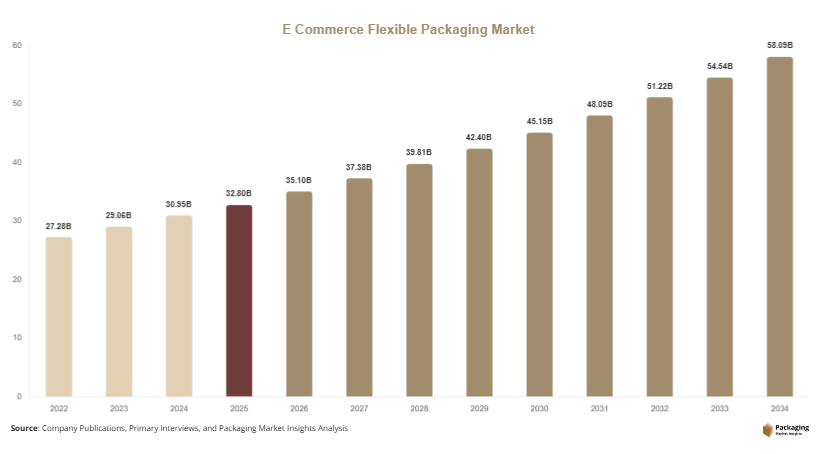
The global E commerce flexible packaging market size is estimated at USD 32.8 billion in 2025 and is projected to reach USD 35.1 billion in 2026. By 2034, the market is forecast to reach USD 61.7 billion, registering a CAGR of 6.5% during 2025–2034. The market is benefiting from rising parcel shipments, expansion of direct-to-consumer brands, and increasing demand for packaging formats that reduce freight cost without compromising product safety. The E commerce flexible packaging market is expanding rapidly as online retail ecosystems increasingly require lightweight, durable, cost-efficient, and sustainable packaging formats that can protect products during long-distance transit while improving fulfillment efficiency.
One of the strongest growth factors is the structural expansion of e-commerce order volumes across categories such as fashion, electronics, beauty, packaged foods, home goods, and pharmaceuticals. Unlike traditional retail packaging, online commerce packaging must withstand shipping stress, compression, environmental exposure, and last-mile handling. Flexible packaging solutions such as mailer bags, padded pouches, stretch films, protective wraps, and resealable poly mailers are increasingly preferred because they reduce package weight while maintaining product protection and improving warehouse handling speed.
Key Highlights:
- Asia Pacific dominated the market with a 39.1% share in 2025.
- Latin America is projected to grow at the fastest CAGR of 7.1%.
- Mailer bags led the type segment with a 31.8% share.
- Plastic-based materials dominated with a 58.6% share.
- Consumer goods applications led the end-use segment with 34.9% share.
- The US remained the dominant country with a market size of USD 6.2 billion in 2025 and USD 6.7 billion in 2026.
Explore more data points, trends and opportunities Download Free Sample Report
Market Trends
Growth of Sustainable Parcel Packaging Formats
Sustainability is becoming a defining trend in the E commerce flexible packaging market, as online retailers and fulfillment companies increasingly prioritize recyclable, compostable, and lightweight shipping materials. Flexible packaging manufacturers are expanding development of curbside-recyclable mailers, paper-padded envelopes, fiber-based protective wraps, and mono-material shipping pouches that improve recovery rates while maintaining protective performance. Fashion brands are increasingly shifting from multilayer plastic mailers toward recycled-content flexible envelopes, while beauty and wellness brands are adopting paper-based padded packaging with printed branding. Over time, broader recycling infrastructure, retailer sustainability commitments, and consumer preference for low-waste packaging will accelerate adoption of environmentally aligned flexible packaging formats across global e-commerce supply chains.
Integration of Smart and Branded Packaging Solutions
Packaging in online retail is evolving from simple shipment protection into a communication and customer engagement platform. Brands increasingly use QR-enabled flexible mailers, digital authentication labels, printed return instructions, personalized inserts, and traceable packaging codes to strengthen post-purchase engagement. Premium direct-to-consumer brands are investing in custom flexible packaging designs that combine lightweight shipping efficiency with premium visual presentation. For example, skincare subscription brands often use matte-finish branded pouches with tamper-evident closures and digital engagement codes. In the coming years, smart flexible packaging integrated with track-and-trace technology, customer analytics tools, and anti-counterfeit labeling is expected to add significant commercial value beyond traditional packaging utility.
Market Drivers
Rising Global Parcel Shipment Volumes
Rapid growth in parcel shipment volumes remains one of the strongest drivers for the E commerce flexible packaging market. Increasing digital purchases across fashion, electronics, food delivery, pharmaceuticals, and specialty consumer goods are creating sustained demand for lightweight shipping solutions that improve operational efficiency. Flexible packaging formats reduce dimensional weight charges, simplify fulfillment automation, and lower transport emissions compared with rigid packaging alternatives. For example, fashion retailers increasingly use recyclable poly mailers rather than corrugated boxes for apparel shipments because they reduce packaging cost and warehouse storage requirements. As same-day delivery, subscription commerce, and cross-border parcel shipping continue expanding, flexible e-commerce packaging demand is expected to strengthen significantly.
Expansion of Direct-to-Consumer Brand Fulfillment
The rapid rise of direct-to-consumer business models is accelerating adoption in the E commerce flexible packaging market. DTC brands prioritize packaging that combines product protection, strong branding, customer experience, and operational efficiency. Flexible packaging enables premium customization through short-run digital printing, lightweight branded mailers, resealable packaging, and personalized fulfillment inserts without significantly increasing shipping cost. Consumer brands in cosmetics, wellness, food kits, and lifestyle retail increasingly rely on custom flexible packaging formats that improve unboxing experience while optimizing shipping economics. As DTC models expand globally, packaging demand will increasingly favor lightweight customizable flexible formats designed specifically for parcel-based retail systems.
Market Restraint
Performance Limitations for High-Value and Fragile Goods
Despite broad adoption, performance limitations remain a restraint for the E commerce flexible packaging market, particularly in shipments involving fragile, high-value, or highly sensitive products. Electronics, luxury goods, glass-packaged items, and precision medical products often require rigid structural packaging, molded cushioning, or reinforced shipping systems that flexible packaging alone cannot provide. While padded flexible mailers and air-cushion protective pouches offer improved shock absorption, they may not always meet high-impact logistics requirements. For example, premium electronics accessories often require hybrid packaging systems combining flexible wraps with rigid inserts for adequate transit protection. Unless protective material engineering continues improving, flexible packaging penetration may remain limited in certain product categories requiring advanced structural protection.
Market Opportunities
Growth in Flexible Cold Chain E-Commerce Packaging
Temperature-sensitive online commerce is creating meaningful opportunity in the E commerce flexible packaging market. Grocery delivery, meal kits, pharmaceuticals, biologics, and wellness products increasingly require flexible insulated packaging, thermal liners, moisture barriers, and lightweight temperature-control pouches that maintain product integrity during delivery. Flexible cold-chain packaging solutions reduce shipping weight compared with rigid insulated containers while improving storage efficiency in fulfillment centers. Food subscription companies and pharmacy delivery platforms are increasingly adopting flexible thermal packaging systems. Future development in phase-change films, recyclable insulation layers, and smart temperature indicators is expected to significantly expand this opportunity.
Expansion of Cross-Border Digital Commerce Packaging
Cross-border online trade is creating new growth avenues for flexible packaging suppliers. International shipments require packaging that balances protection, customs labeling compatibility, weight optimization, and durability across long logistics cycles. Flexible packaging formats are increasingly favored because they lower shipping costs and improve parcel consolidation efficiency. For example, small consumer electronics accessories, beauty products, and specialty wellness goods often use reinforced flexible export mailers with multilingual labeling and tamper-evident sealing systems. As international e-commerce penetration rises in Southeast Asia, Latin America, and Middle Eastern markets, flexible packaging designed for export-ready parcel systems will see strong long-term demand.
Report Scope
| Report Metric | Details |
|---|---|
| Market Size in 2025 | USD 32.8 Billion |
| Market Size in 2026 | USD 35.1 Billion |
| Market Size in 2034 | USD 61.7 Billion |
| CAGR | 6.5% (2026-2034) |
| Base Year for Estimation | 2025 |
| Historical Data | 2022-2024 |
| Forecast Period | 2026-2034 |
| Report Coverage | Revenue Forecast, Competitive Landscape, Supply Chain Disruption, Growth Factors, Environment & Regulatory Landscape and Trends |
| Geographies Covered | North America, Europe, APAC, Middle East and Africa, LATAM |
| Countries Covered | U.S., Canada, U.K., Germany, France, Spain, Italy, Russia, Nordic, Benelux, Rest of Europe, China, South Korea, Japan, India, Australia, Singapore, Taiwan, South East Asia, Rest of Asia-Pacific, UAE, Turky, Saudi Arabia, South Africa, Egypt, Nigeria, Rest of MEA, Brazil, Mexico, Argentina, Chile, Colombia, Rest of LATAM |
Explore more data points, trends and opportunities Download Free Sample Report
Segmental Analysis
By Type
Mailer bags accounted for the largest share of the E commerce flexible packaging market, representing 31.8% of total revenue in 2024. Their dominance is driven by widespread adoption in apparel, books, consumer accessories, cosmetics, small electronics, and personal care product shipping. Mailer bags provide an efficient balance of low packaging weight, durability, weather resistance, and branding flexibility. Retailers increasingly prefer them over corrugated packaging for soft goods because they reduce dimensional freight charges, improve warehouse storage density, and accelerate packaging line throughput. Tamper-evident sealing strips, dual adhesive return closures, recyclable resin structures, and digital print customization have further strengthened commercial adoption. Many fashion and lifestyle brands now use branded flexible mailers as a core part of their fulfillment strategy, combining logistics efficiency with improved customer experience. As parcel shipping volumes continue rising globally, mailer bags are expected to retain their leading market position.
Protective flexible pouches are projected to register the fastest CAGR of 7.3% during 2025–2034, supported by rising shipments of fragile, premium, and higher-value products across digital retail channels. Bubble-lined pouches, air-cushioned envelopes, foam-lined flexible packs, and multilayer protective pouches are increasingly used for electronics accessories, premium skincare, medical devices, collectibles, and specialty goods that require improved shock protection without rigid packaging bulk. Packaging innovation is expanding puncture-resistant films, lightweight cushioning layers, moisture barriers, and smart security sealing systems. E-commerce brands increasingly value these formats because they reduce damage claims while maintaining lower shipping weight compared with rigid protective packaging systems. The growing premiumization of online retail and expansion of cross-border digital commerce are expected to further accelerate demand for advanced protective flexible pouch formats in the coming decade.
By Material
Plastic-based materials dominated the E commerce flexible packaging market, accounting for 58.6% market share in 2024. Polyethylene, polypropylene, co-extruded barrier films, and multilayer flexible laminates remain commercially dominant because they offer strong tear resistance, moisture protection, seal reliability, and lightweight shipping performance. These materials are widely used in courier mailers, padded shipping envelopes, protective wraps, and tamper-evident flexible pouches because they balance cost efficiency with operational durability. Plastic-based packaging also supports automated high-speed bagging systems used in large fulfillment centers, making it highly compatible with modern e-commerce logistics infrastructure. Recycled-content polymers and downgauged film structures are improving environmental performance while maintaining strength characteristics. Large online marketplaces and parcel logistics operators continue using plastic-based flexible packaging extensively because it provides dependable shipping protection across varied climate conditions and long-distance logistics networks.
Paper-based flexible packaging is forecast to grow at a CAGR of 7.0% through 2034, driven by sustainability commitments, regulatory pressure on single-use plastics, and growing consumer preference for recyclable delivery packaging. Paper mailers, padded kraft envelopes, reinforced fiber-based shipping pouches, and recyclable paper cushioning systems are increasingly adopted by apparel, beauty, wellness, and premium gifting brands. Packaging manufacturers are improving tear resistance, water resistance, and seal performance in paper flexible formats through advanced coatings and hybrid barrier engineering. Large retailers are actively piloting curbside-recyclable paper parcel packaging as part of carbon reduction programs. Future growth is expected to accelerate as fiber engineering improves lightweight strength, printable surfaces, and cushioning performance, making paper-based flexible packaging commercially viable across a wider range of e-commerce shipping applications.
By End-Use
Consumer goods represented the largest end-use segment in the E commerce flexible packaging market, accounting for 34.9% of total market revenue in 2024. This segment includes apparel, accessories, home products, personal care, cosmetics, books, electronics accessories, and lifestyle retail shipments. Consumer goods dominate because these categories generate high parcel frequency and often do not require rigid protective packaging structures. Flexible packaging offers lightweight shipment economics, customizable branding, easy storage, and scalable packaging automation compatibility. Fashion retailers increasingly rely on recyclable mailer bags with return-seal functionality, while beauty brands use branded protective pouches that improve customer presentation while maintaining logistics efficiency. Consumer goods brands also value flexible packaging for promotional inserts, QR-enabled engagement, and low-cost seasonal packaging customization. As online consumer spending rises globally, this segment will remain the core volume driver for market expansion.
Healthcare e-commerce packaging is projected to grow at the fastest CAGR of 7.2% during 2025–2034, supported by rapid growth in online pharmacy sales, digital wellness retail, nutraceutical subscriptions, and home healthcare product delivery. Flexible packaging formats are increasingly used for supplement sachets, sterile shipping pouches, insulated medical mailers, tamper-proof pharmacy envelopes, and moisture-resistant healthcare product packaging. Product integrity, security sealing, traceability labeling, and lightweight shipping economics make flexible packaging attractive for expanding healthcare delivery ecosystems. Online pharmacy operators are increasingly adopting secure flexible packaging systems with authentication labels and patient information integration. With rising demand for home diagnostics, wellness subscriptions, and telehealth-linked medicine delivery, healthcare packaging applications are expected to become one of the most commercially attractive segments in the market.
E Commerce Flexible Packaging Market Segmentations
By Type
- Mailer Bags
- Protective Flexible Pouches
- Bubble Mailers
- Stretch and Shrink Films
- Flexible Shipping Wraps
By Material
- Plastic-Based Materials
- Paper-Based Materials
- Recycled Flexible Materials
- Bio-Based Flexible Films
- Hybrid Composite Materials
By End-User
- Consumer Goods
- Food & Beverage E-Commerce
- Healthcare
- Electronics
- Personal Care & Cosmetics
Regional Analysis
North America
North America accounted for 26.4% of the global E commerce flexible packaging market share in 2025 and is projected to grow at a CAGR of 5.9% through 2034. The region’s growth is driven by high online retail penetration, advanced fulfillment infrastructure, rapid parcel movement, and strong demand for lightweight shipping formats that reduce transportation cost. Retailers are increasingly replacing corrugated-heavy packaging systems with flexible parcel mailers, protective wraps, and padded envelopes that improve operational efficiency in warehouse automation environments. Sustainability programs among large retailers are also accelerating adoption of recyclable flexible packaging solutions, especially in apparel, beauty, and small-format consumer goods shipping.
The United States dominates the North American market. A unique growth driver is the rapid expansion of subscription commerce packaging across wellness, fashion, grooming, and curated lifestyle products. These recurring shipment models require branded lightweight packaging that balances customer experience with logistics efficiency. Subscription companies increasingly use digitally printed flexible mailers, protective pouches, and resealable return packaging formats. This combination of high parcel frequency and premium packaging personalization is creating strong long-term demand for advanced e-commerce flexible packaging systems in the U.S.
Europe
Europe represented 21.7% market share in 2025 and is expected to expand at a CAGR of 6.1% during the forecast period. Growth is supported by strong sustainability regulation, rising online retail adoption, and growing investment in recyclable shipping materials. E-commerce brands are increasingly shifting toward paper mailers, recycled-content padded envelopes, and lightweight mono-material flexible shipping formats that align with packaging waste reduction targets. Flexible packaging also helps retailers reduce dimensional shipping cost and improve storage efficiency in urban fulfillment networks. Consumer preference for environmentally responsible delivery packaging continues strengthening market demand across regional retail systems.
Germany remains the dominant country in Europe. A unique growth factor is rapid adoption of return-friendly flexible parcel packaging in fashion and footwear e-commerce. German retailers increasingly use resealable recyclable mailers that support both delivery and product returns within the same packaging system. This dual-function packaging reduces waste, improves customer convenience, and lowers reverse logistics cost. Growth in circular packaging systems and reusable shipping envelope pilots is expected to further strengthen flexible packaging innovation in Germany.
Asia Pacific
Asia Pacific held the leading 39.1% share in 2025 and is forecast to register a CAGR of 6.9% through 2034, supported by massive digital retail volume, strong manufacturing capacity, expanding middle-class spending, and rapid logistics network modernization. The region’s high order density in fashion, electronics accessories, household goods, and packaged wellness products is increasing demand for lightweight parcel packaging solutions. Flexible packaging remains attractive because it reduces freight costs, supports high-volume automated fulfillment, and improves package handling efficiency in fast-moving logistics networks. Regional manufacturers are rapidly expanding recyclable flexible mailer and smart-label shipping pouch production.
China dominates Asia Pacific due to its large e-commerce ecosystem and strong flexible packaging manufacturing base. A unique growth driver is ultra-high parcel density created by rapid same-day and next-day delivery models. Large fulfillment ecosystems require lightweight packaging that minimizes shipping weight while maintaining product integrity across large daily shipment volumes. Custom printed flexible mailers, tamper-evident pouches, and high-speed automated bagging systems are increasingly common in Chinese logistics networks, creating substantial demand for specialized flexible e-commerce packaging.
Middle East & Africa
Middle East & Africa accounted for 5.4% of market share in 2025 and is projected to grow at a CAGR of 6.3% over the forecast period. Growth is supported by expanding online retail, rapid smartphone commerce adoption, and increasing logistics investment in urban delivery networks. Flexible packaging is gaining traction in cosmetics, small electronics, household accessories, and specialty food delivery because lightweight formats reduce transportation cost and simplify parcel handling. Regional packaging suppliers are increasingly offering branded flexible shipping pouches, security-sealed mailers, and recyclable parcel packaging solutions to meet modern e-commerce requirements.
The United Arab Emirates leads the regional market. A unique growth factor is cross-border luxury and premium goods fulfillment, where branded protective flexible packaging is increasingly used for premium accessories, cosmetics, and specialty retail shipments. Packaging that combines security, premium presentation, and reduced freight weight is particularly valued in this segment. As regional digital commerce platforms expand premium product fulfillment, advanced flexible packaging adoption is expected to accelerate.
Latin America
Latin America accounted for 7.4% market share in 2025 and is projected to register the fastest CAGR of 7.1% through 2034, supported by rapid e-commerce expansion, improving parcel logistics, and rising digital consumer participation. Flexible packaging adoption is increasing because retailers seek lower-cost shipping materials that reduce dimensional freight expenses while supporting growing parcel volumes. Demand is particularly strong in fashion, mobile accessories, health products, and small household goods where lightweight packaging offers clear operational benefit. Packaging converters are also increasing recycled-content flexible shipping mailer production to meet sustainability expectations in urban retail markets.
Brazil dominates the Latin American market. A unique growth driver is rapid expansion of marketplace seller fulfillment, where thousands of small and mid-sized digital merchants require affordable branded shipping packaging in flexible formats. Printed mailers, tamper-evident pouches, and lightweight padded envelopes are becoming increasingly common across domestic online retail ecosystems. This merchant-led packaging demand is expected to create sustained long-term growth in Brazil’s flexible e-commerce packaging sector.
Competitive Landscape
The E commerce flexible packaging market is moderately consolidated, with global packaging companies competing through sustainable material innovation, automated fulfillment compatibility, custom digital printing, and expansion of protective flexible shipping formats. Amcor plc remains the leading market participant due to its diversified flexible packaging portfolio, strong global manufacturing network, and active investment in recyclable parcel packaging solutions tailored for online retail logistics. The company recently expanded development of mono-material recyclable shipping mailers and lightweight protective flexible films designed for high-volume fulfillment operations.
Berry Global Inc. continues strengthening its position through recycled-content parcel packaging films, lightweight protective mailers, and sustainable e-commerce packaging systems for apparel and consumer goods brands. Mondi Group is investing heavily in paper-based flexible shipping mailers and hybrid fiber protective packaging solutions aimed at retailers transitioning away from conventional plastic parcel packaging. Sealed Air Corporation remains influential in protective flexible packaging, offering advanced cushioning pouches, air-filled protective systems, and fulfillment packaging designed for damage reduction in parcel delivery. Sonoco Products Company continues expanding customized flexible shipping solutions, especially for branded direct-to-consumer fulfillment, healthcare delivery packaging, and sustainable lightweight parcel packaging.
Competition is increasingly centered around recyclable design, packaging automation efficiency, reduced package weight, and premium branded fulfillment packaging. Companies that successfully combine protective performance, circular packaging innovation, and scalable global production are expected to strengthen long-term market share.
Key Players List
- Amcor plc
- Berry Global Inc.
- Mondi Group
- Sealed Air Corporation
- Sonoco Products Company
- Constantia Flexibles
- Huhtamaki Oyj
- ProAmpac LLC
- Coveris Holdings S.A.
- Winpak Ltd.
- Uflex Ltd.
- DS Smith plc
- Smurfit Westrock
- TC Transcontinental Packaging
- Pregis LLC