Squeeze And Semi Squeeze Tubes Market Size and Growth
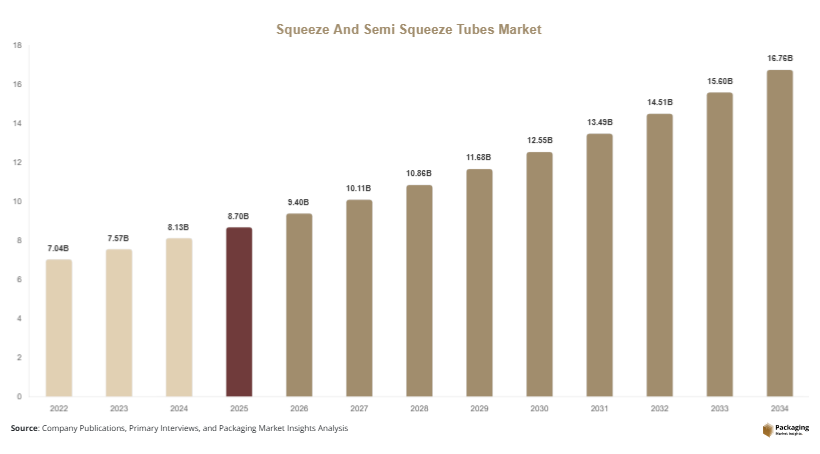
The global squeeze and semi squeeze tubes market size reached approximately USD 8.7 billion in 2025 and is projected to grow to USD 9.4 billion in 2026. With rising adoption across personal care, pharmaceutical, and food sectors, the market is forecast to reach USD 16.8 billion by 2034, expanding at a CAGR of 7.5% during the forecast period (2025–2034). The squeeze and semi squeeze tubes market is witnessing steady expansion due to increasing demand for convenient, hygienic, and cost-effective packaging solutions across multiple industries.
The growth of the market is primarily driven by rising consumer preference for easy-to-use packaging formats. Squeeze and semi squeeze tubes offer controlled dispensing, reduced product wastage, and improved portability, making them highly suitable for creams, gels, pastes, and liquid-based products. These features are encouraging widespread adoption across both developed and emerging markets.
Key Highlights
- Market size reached USD 8.7 billion in 2025 and is projected to reach USD 16.8 billion by 2034, reflecting steady expansion across multiple end-use industries. This growth highlights increasing reliance on tube-based packaging solutions globally.
- The market is expected to grow at a CAGR of 7.5% during the forecast period from 2025 to 2034, driven by consistent demand and innovation. Stable growth indicates strong long-term potential for manufacturers and suppliers.
- Strong demand from personal care, pharmaceutical, and food industries is significantly contributing to market expansion. These sectors require convenient, hygienic, and efficient packaging formats for a wide range of products.
- There is a rising adoption of sustainable and recyclable packaging materials as companies focus on environmental compliance. This shift is encouraging the use of eco-friendly tube solutions and reducing plastic waste.
- Innovation in tube design and dispensing technologies is further supporting market growth. Advanced features such as improved sealing, controlled dispensing, and user-friendly designs are enhancing product appeal.
Explore more data points, trends and opportunities Download Free Sample Report
Market Trends
Increasing Adoption of Sustainable Tube Packaging
Sustainability is emerging as a major trend in the squeeze and semi squeeze tubes market, driven by growing environmental awareness and regulatory pressures. Manufacturers are increasingly shifting toward recyclable and bio-based materials such as polyethylene derived from renewable sources and paper-based laminates. These materials help reduce carbon footprint while maintaining product integrity and functionality.
Brands are also focusing on lightweight packaging designs to minimize material usage and transportation costs. This shift is particularly evident in the cosmetics and personal care industry, where consumers are actively seeking eco-friendly packaging options. Companies are introducing mono-material tubes that are easier to recycle compared to multi-layer structures, further supporting sustainability goals. As a result, sustainable packaging innovations are becoming a key differentiator in the competitive landscape.
Integration of Advanced Dispensing and Smart Packaging Features
Another significant trend is the integration of advanced dispensing technologies and smart packaging features in squeeze and semi squeeze tubes. Innovations such as airless pumps, precision nozzles, and tamper-evident closures are enhancing product usability and safety. These features are particularly important for pharmaceutical and high-value cosmetic products, where controlled dispensing and contamination prevention are critical.
In addition, the adoption of smart packaging technologies, including QR codes and digital tracking features, is gaining traction. These technologies enable brands to provide product information, authentication, and supply chain transparency to consumers. The combination of functional improvements and digital integration is transforming traditional tube packaging into a more interactive and value-added solution.
Market Drivers
Growing Demand from Personal Care and Cosmetics Industry
The expanding personal care and cosmetics industry is a major driver for the squeeze and semi squeeze tubes market. Consumers are increasingly preferring products that offer convenience, hygiene, and portability, which has led to a surge in demand for tube-based packaging. Products such as creams, lotions, gels, and serums are widely packaged in squeeze tubes due to their ease of use and ability to preserve product quality.
Furthermore, the rise of premium and niche cosmetic brands is driving innovation in packaging design. Companies are investing in aesthetically appealing and functional packaging to attract consumers and enhance brand value. The growing influence of e-commerce is also contributing to this trend, as durable and leak-proof packaging is essential for online product delivery.
Expansion of Pharmaceutical and Healthcare Applications
The pharmaceutical and healthcare sectors are significantly contributing to the growth of the squeeze and semi squeeze tubes market. These tubes are widely used for packaging topical medications, ointments, and gels due to their hygienic and user-friendly nature. The ability to dispense precise quantities without contamination makes them suitable for medical applications.
The increasing prevalence of chronic diseases and the growing demand for over-the-counter products are further driving market growth. Additionally, advancements in pharmaceutical formulations are creating new opportunities for tube packaging. The need for safe and reliable packaging solutions in healthcare is expected to continue supporting market expansion over the forecast period.
Market Restraint
Environmental Concerns Related to Plastic Waste
One of the major restraints in the squeeze and semi squeeze tubes market is the environmental impact associated with plastic packaging. Traditional squeeze tubes are often made from multi-layer plastic materials that are difficult to recycle, leading to increased waste generation. This has raised concerns among regulators and environmentally conscious consumers.
Governments across various regions are implementing strict regulations to reduce plastic waste, which is creating challenges for manufacturers. For example, bans on single-use plastics and requirements for recyclable packaging are forcing companies to redesign their products and invest in sustainable materials. While these initiatives promote environmental sustainability, they also increase production costs and complexity.
Moreover, the transition to eco-friendly materials may affect the performance and durability of packaging, especially in applications requiring high barrier properties. As a result, manufacturers need to balance sustainability with functionality, which remains a key challenge in the market.
Market Opportunities
Growth in Emerging Markets
Emerging markets present significant growth opportunities for the squeeze and semi squeeze tubes market. Rapid urbanization, rising disposable incomes, and increasing consumer awareness are driving demand for packaged products in regions such as Asia Pacific and Latin America. The expanding middle-class population is contributing to higher consumption of personal care and healthcare products.
Additionally, the growth of retail and e-commerce channels in these regions is supporting the adoption of tube packaging. Manufacturers are focusing on cost-effective solutions to cater to price-sensitive consumers while maintaining product quality. The increasing penetration of global brands in emerging markets is further boosting demand for innovative packaging solutions.
Development of Bio-Based and Recyclable Materials
The development of bio-based and recyclable materials offers a promising opportunity for market growth. Companies are investing in research and development to create sustainable packaging solutions that meet regulatory requirements and consumer expectations. Materials such as biodegradable plastics and paper-based laminates are gaining popularity.
These innovations not only reduce environmental impact but also enhance brand image and consumer trust. The adoption of circular economy practices, including recycling and reuse, is expected to drive long-term growth in the market. As sustainability becomes a key focus area, manufacturers that prioritize eco-friendly solutions are likely to gain a competitive advantage.
Report Scope
| Report Metric | Details |
|---|---|
| Market Size in 2025 | USD 8.7 Billion |
| Market Size in 2026 | USD 9.4 Billion |
| Market Size in 2034 | USD 16.8 Billion |
| CAGR | 7.5% (2026-2034) |
| Base Year for Estimation | 2025 |
| Historical Data | 2022-2024 |
| Forecast Period | 2026-2034 |
| Report Coverage | Revenue Forecast, Competitive Landscape, Supply Chain Disruption, Growth Factors, Environment & Regulatory Landscape and Trends |
| Geographies Covered | North America, Europe, APAC, Middle East and Africa, LATAM |
| Countries Covered | U.S., Canada, U.K., Germany, France, Spain, Italy, Russia, Nordic, Benelux, Rest of Europe, China, South Korea, Japan, India, Australia, Singapore, Taiwan, South East Asia, Rest of Asia-Pacific, UAE, Turky, Saudi Arabia, South Africa, Egypt, Nigeria, Rest of MEA, Brazil, Mexico, Argentina, Chile, Colombia, Rest of LATAM |
Explore more data points, trends and opportunities Download Free Sample Report
Segmental Analysis
By Material Type
Plastic tubes dominated the Squeeze And Semi Squeeze Tubes Market in 2024, accounting for approximately 62.5% of the total market share. Their dominance is attributed to their lightweight nature, cost-effectiveness, and high flexibility, making them suitable for a wide range of applications including cosmetics, pharmaceuticals, and food products. Plastic materials such as polyethylene and polypropylene offer excellent barrier properties and ease of customization, which enhances their adoption among manufacturers. Additionally, advancements in recyclable and bio-based plastics are further supporting the continued growth of this segment.
Aluminum tubes are projected to be the fastest-growing segment, registering a CAGR of 8.1% during the forecast period. The growth is driven by their superior barrier properties, which protect sensitive products from light, air, and contamination. Aluminum tubes are increasingly used in pharmaceutical and high-end cosmetic applications due to their durability and premium appeal. Moreover, the growing emphasis on sustainability and recyclability is encouraging manufacturers to adopt aluminum packaging solutions, thereby driving segment growth.
By Application
The personal care and cosmetics segment held the largest market share of around 45.3% in 2024, driven by the widespread use of squeeze tubes for products such as creams, lotions, gels, and toothpaste. The segment benefits from the convenience, portability, and controlled dispensing offered by tube packaging. Increasing consumer demand for aesthetically appealing and easy-to-use packaging formats further supports the growth of this segment, especially in premium and organic product categories.
The pharmaceutical segment is expected to grow at the fastest CAGR of 8.3% from 2025 to 2034. This growth is driven by the increasing demand for hygienic and precise dispensing packaging for ointments, gels, and topical medications. Rising healthcare awareness and the expansion of the pharmaceutical industry globally are key factors contributing to segment growth. Additionally, advancements in tamper-evident and sterile packaging solutions further enhance the adoption of squeeze and semi squeeze tubes in this sector.
By End-Use Industry
The consumer goods industry dominated the market in 2024, accounting for approximately 51.7% of the total share. This dominance is driven by the extensive use of squeeze and semi squeeze tubes in packaging everyday products such as personal care items, food condiments, and household products. The demand for convenient, portable, and easy-to-use packaging solutions is a major factor supporting the growth of this segment. Additionally, increasing product differentiation and branding efforts by manufacturers further boost demand.
The healthcare and pharmaceutical industry is projected to be the fastest-growing segment, with a CAGR of 8.5% during the forecast period. The growth is attributed to the increasing need for safe, hygienic, and precise packaging solutions for medical products. The rising prevalence of chronic diseases and the growing demand for topical treatments contribute to the expansion of this segment. Furthermore, advancements in packaging technologies, including anti-contamination features and improved barrier properties, support the increasing adoption of squeeze and semi squeeze tubes in healthcare applications.
Squeeze And Semi Squeeze Tubes Market Segmentations
Material Type
- Plastic Tubes
- Aluminum Tubes
- Laminated Tubes
- Bio-based Tubes
Application
- Personal Care and Cosmetics
- Pharmaceuticals
- Food Products
- Household Products
End-Use Industry
- Consumer Goods
- Healthcare and Pharmaceuticals
- Food and Beverage
- Industrial Applications
Regional Analysis
North America
North America accounted for a significant share of approximately 34.2% of the global Squeeze And Semi Squeeze Tubes Market in 2025, supported by strong demand from personal care, pharmaceutical, and food packaging industries. The region is projected to expand at a CAGR of around 7.2% from 2025 to 2034, driven by continuous innovation in packaging materials and growing preference for convenient dispensing solutions. Increasing investments in sustainable packaging technologies and the adoption of recyclable tube materials further strengthen market growth.
The United States dominates the North American market due to its well-established cosmetic and healthcare industries. A key growth factor is the rising demand for premium and travel-friendly packaging formats, particularly in skincare and pharmaceutical ointments. Brands are increasingly focusing on user-friendly dispensing and hygienic packaging, which boosts the adoption of squeeze and semi squeeze tubes across multiple applications.
Europe
Europe held an estimated 27.6% share of the Squeeze And Semi Squeeze Tubes Market in 2025 and is expected to grow at a CAGR of 6.9% during the forecast period. Growth is supported by strict regulatory frameworks promoting sustainable and recyclable packaging materials. The presence of major packaging manufacturers and increasing demand from the cosmetics and pharmaceutical sectors contribute to steady market expansion across the region.
Germany leads the European market owing to its strong manufacturing base and emphasis on sustainable packaging innovations. A unique growth factor is the rapid shift toward bio-based and recyclable tube materials driven by environmental regulations and consumer awareness. This trend encourages manufacturers to invest in eco-friendly solutions, thereby boosting the adoption of advanced tube packaging formats.
Asia Pacific
Asia Pacific accounted for the largest share of approximately 36.8% in 2025 and is projected to grow at the fastest CAGR of 8.4% through 2034. The region’s growth is driven by rising population, increasing urbanization, and expanding consumer goods industries. Growing demand for affordable and convenient packaging solutions in emerging economies significantly supports market expansion.
China dominates the Asia Pacific market due to its large-scale manufacturing capabilities and strong demand from cosmetics and food industries. A key growth factor is the rapid expansion of e-commerce and retail sectors, which require durable and lightweight packaging formats. This drives the demand for squeeze and semi squeeze tubes, especially for personal care and packaged food products.
Middle East & Africa
The Middle East & Africa region held a smaller share of around 5.8% in 2025 but is expected to grow at a CAGR of 7.0% during the forecast period. Growth is supported by increasing demand for packaged consumer goods and improving retail infrastructure. Rising awareness of hygiene and product safety also contributes to the adoption of tube-based packaging solutions.
Saudi Arabia leads the regional market due to its growing cosmetics and healthcare industries. A unique growth factor is the rising demand for premium packaging solutions in personal care products, supported by increasing disposable income and changing consumer preferences. This trend encourages manufacturers to introduce innovative and visually appealing tube packaging formats.
Latin America
Latin America accounted for approximately 5.6% of the global market share in 2025 and is projected to grow at a CAGR of 7.1% through 2034. The region’s growth is driven by increasing demand for packaged food and personal care products, along with expanding retail networks. Economic development and urbanization further contribute to market expansion.
Brazil dominates the Latin American market due to its strong cosmetics and personal care industry. A key growth factor is the increasing demand for cost-effective and flexible packaging solutions that offer convenience and durability. This drives the adoption of squeeze and semi squeeze tubes, particularly in mass-market consumer products.
Competitive Landscape
The squeeze and semi squeeze tubes market is characterized by the presence of several global and regional players focusing on product innovation and sustainability. Leading companies are investing in research and development to introduce advanced packaging solutions and improve product performance.
Amcor plc is one of the leading players in the market, known for its extensive product portfolio and global presence. The company recently introduced recyclable tube packaging solutions to meet sustainability goals. Other key players are focusing on expanding their production capacities and entering new markets to strengthen their competitive position.
Key Players List
- Amcor plc
- Berry Global Inc.
- Essel Propack Limited
- Albéa Group
- Huhtamaki Oyj
- Sonoco Products Company
- CCL Industries Inc.
- Montebello Packaging
- Linhardt GmbH & Co. KG
- Unette Corporation
- Tuboplast Group
- Intrapac International Corporation
- Alltub Group
- Hoffmann Neopac AG
- Pirlo GmbH