Cosmetic Tubes Market Size and Growth
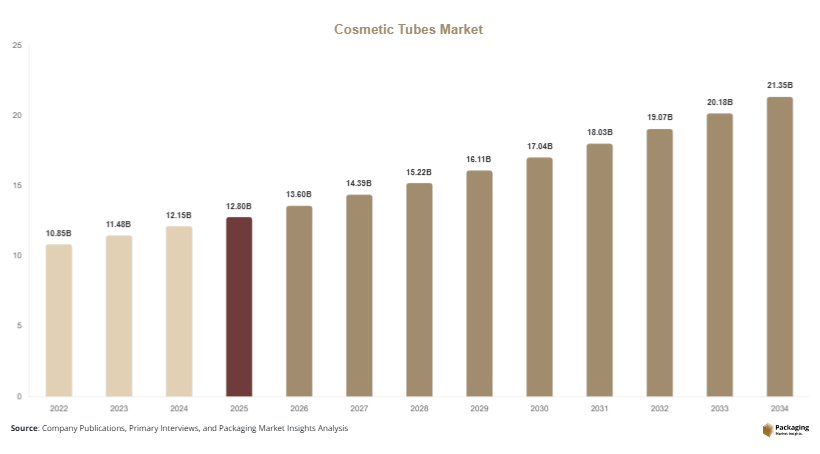
The global cosmetic tubes markett size was valued at USD 12.8 billion in 2025 and is projected to reach USD 13.6 billion in 2026. Over the forecast period from 2025 to 2034, the market is expected to grow at a CAGR of 5.8%, reaching approximately USD 22.9 billion by 2034. This growth reflects the increasing consumption of skincare, haircare, and personal grooming products across both developed and emerging markets. The cosmetic tubes market is experiencing steady growth due to the rising demand for convenient, hygienic, and visually appealing packaging solutions in the personal care and beauty industry.
One of the primary growth factors driving the cosmetic tubes market is the expansion of the global beauty and personal care industry. Rising disposable incomes, urbanization, and changing consumer lifestyles are contributing to higher spending on cosmetic products. Another significant factor is the growing preference for convenient and portable packaging formats. Cosmetic tubes offer ease of use, controlled dispensing, and product protection, making them suitable for a wide range of applications. Additionally, the increasing focus on sustainability is influencing manufacturers to develop recyclable and eco-friendly tube materials, further supporting market growth.
Key Highlights
- Asia Pacific dominated the market with a 38.9% share in 2025, while Latin America is projected to grow at the fastest CAGR of 6.7%.
- Squeeze tubes led the type segment with a 41.5% share, while airless tubes are expected to grow at a CAGR of 6.3%.
- Plastic materials dominated with a 62.4% share, while bio-based materials are forecasted to grow at a CAGR of 6.1%.
- Skincare applications led the segment with 46.8% share, while haircare applications are expected to grow at a CAGR of 5.9%.
- China remained the dominant country with a market size of USD 3.4 billion in 2025 and USD 3.7 billion in 2026.
Explore more data points, trends and opportunities Download Free Sample Report
Market Trends
Increasing demand for sustainable and recyclable packaging solutions
The cosmetic tubes market is increasingly influenced by the growing demand for sustainable packaging solutions. Consumers are becoming more aware of environmental issues, prompting brands to adopt eco-friendly materials such as recyclable plastics, biodegradable polymers, and paper-based laminates. Manufacturers are focusing on reducing the environmental impact of packaging by developing tubes with lower carbon footprints and improved recyclability. This trend is also supported by regulatory initiatives aimed at reducing plastic waste. As sustainability becomes a key purchasing factor, the demand for environmentally responsible cosmetic tubes is expected to rise across global markets.
Rising preference for premium and customized packaging designs
The demand for premium and customized packaging is gaining momentum in the cosmetic tubes market. Brands are investing in innovative designs, advanced printing techniques, and unique finishes to differentiate their products in a competitive landscape. Cosmetic tubes are being designed with features such as metallic coatings, matte finishes, and embossing to enhance visual appeal. Customization allows brands to align packaging with their identity and target audience. This trend is particularly prominent in luxury and niche cosmetic segments, where packaging plays a crucial role in influencing consumer perception and purchasing decisions.
Market Drivers
Growth of the global beauty and personal care industry
The expansion of the beauty and personal care industry is a major factor driving the cosmetic tubes market. Increasing consumer spending on skincare, haircare, and grooming products is creating demand for efficient and attractive packaging solutions. The rise of social media and influencer marketing is also contributing to the popularity of cosmetic products, further boosting market growth. Cosmetic tubes provide convenience, portability, and protection, making them a preferred choice for packaging various personal care products. As the beauty industry continues to grow, the demand for cosmetic tubes is expected to increase.
Increasing demand for convenient and portable packaging formats
Convenience is a key factor influencing consumer preferences in the cosmetic tubes market. Cosmetic tubes are lightweight, easy to use, and suitable for on-the-go applications, making them ideal for modern lifestyles. The ability to control product dispensing and minimize wastage is another advantage that drives their adoption. Additionally, the growth of travel-sized and sample packaging formats is supporting the demand for cosmetic tubes. As consumers seek practical and user-friendly packaging solutions, the market for cosmetic tubes is expected to expand.
Market Restraint
Environmental concerns related to plastic-based packaging materials
One of the primary challenges in the cosmetic tubes market is the environmental impact associated with plastic-based packaging materials. While plastic tubes offer durability and cost-effectiveness, they contribute to plastic waste, which is a growing global concern. Regulatory restrictions and increasing consumer awareness are putting pressure on manufacturers to adopt sustainable alternatives. For example, brands that rely heavily on plastic packaging may face criticism and reduced consumer trust. Transitioning to eco-friendly materials can involve higher costs and technical challenges, which may impact profitability. These factors can restrain market growth and require continuous innovation to address sustainability concerns.
Market Opportunities
Development of bio-based and recyclable tube materials
The development of bio-based and recyclable materials presents significant opportunities for the cosmetic tubes market. Manufacturers are investing in research and development to create packaging solutions that reduce environmental impact while maintaining performance. Materials such as biodegradable plastics and paper-based laminates are gaining popularity as sustainable alternatives. These innovations are enabling brands to meet regulatory requirements and consumer expectations for eco-friendly packaging. As sustainability continues to drive industry trends, the adoption of advanced materials is expected to create new growth opportunities.
Expansion of e-commerce and direct-to-consumer channels
The growth of e-commerce and direct-to-consumer channels is creating new opportunities for the cosmetic tubes market. Online retail requires packaging solutions that are durable, lightweight, and visually appealing. Cosmetic tubes meet these requirements, making them suitable for shipping and storage. Additionally, brands are leveraging digital platforms to reach a wider audience, increasing the demand for innovative packaging designs. The ability to customize packaging for online sales is also supporting market growth. As e-commerce continues to expand, the demand for cosmetic tubes is expected to rise.
Report Scope
| Report Metric | Details |
|---|---|
| Market Size in 2025 | USD 12.8 Billion |
| Market Size in 2026 | USD 13.6 Billion |
| Market Size in 2034 | USD 22.9 Billion |
| CAGR | 5.8% (2026-2034) |
| Base Year for Estimation | 2025 |
| Historical Data | 2022-2024 |
| Forecast Period | 2026-2034 |
| Report Coverage | Revenue Forecast, Competitive Landscape, Supply Chain Disruption, Growth Factors, Environment & Regulatory Landscape and Trends |
| Geographies Covered | North America, Europe, APAC, Middle East and Africa, LATAM |
| Countries Covered | U.S., Canada, U.K., Germany, France, Spain, Italy, Russia, Nordic, Benelux, Rest of Europe, China, South Korea, Japan, India, Australia, Singapore, Taiwan, South East Asia, Rest of Asia-Pacific, UAE, Turky, Saudi Arabia, South Africa, Egypt, Nigeria, Rest of MEA, Brazil, Mexico, Argentina, Chile, Colombia, Rest of LATAM |
Explore more data points, trends and opportunities Download Free Sample Report
Segmental Analysis
By Type
Squeeze tubes dominated the market in 2024, accounting for approximately 41.5% of the total share. These tubes are widely used due to their convenience, ease of use, and cost-effectiveness. Squeeze tubes are suitable for a wide range of cosmetic products, including creams, gels, and lotions. The growing demand for user-friendly packaging solutions is supporting the growth of this segment.
Airless tubes are expected to grow at the fastest CAGR of 6.3% during the forecast period. These tubes offer advantages such as improved product protection and extended shelf life. The increasing demand for premium cosmetic products is driving the adoption of airless tubes.
By Material
Plastic materials accounted for the largest share of 62.4% in 2024, driven by their durability and cost-effectiveness. Plastic tubes are widely used in the cosmetic industry due to their versatility and ease of manufacturing. The demand for plastic tubes is supported by their ability to provide effective barrier properties.
Bio-based materials are expected to grow at a CAGR of 6.1% during the forecast period. This growth is driven by increasing demand for sustainable packaging solutions. Manufacturers are investing in eco-friendly materials to meet regulatory requirements and consumer preferences.
By Application
Skincare applications held the largest share of 46.8% in 2024, driven by the increasing demand for skincare products. Cosmetic tubes are widely used for packaging creams, lotions, and serums. The growth of the skincare industry is supporting the demand for cosmetic tubes.
Haircare applications are expected to grow at the fastest CAGR of 5.9% during the forecast period. This growth is driven by the increasing demand for haircare products. The need for convenient and portable packaging solutions is supporting the growth of this segment.
Cosmetic Tubes Market Segmentations
By Product Type
- Squeeze Tubes
- Airless Tubes
- Twist Tubes
- Cartridge Tubes
By Application
- Skincare
- Haircare
- Oral Care
- Makeup Products
By Material
- Plastic
- Aluminum
- Bio-Based Materials
Regional Analysis
North America
North America accounted for 22.7% of the cosmetic tubes market share in 2025 and is projected to grow at a CAGR of 5.4% during the forecast period. The region benefits from a well-established beauty and personal care industry and high consumer spending on premium products. Increasing awareness of sustainable packaging solutions is encouraging manufacturers to adopt eco-friendly materials. The presence of major cosmetic brands is also supporting market growth.
The United States is the dominant country in North America, supported by its large consumer base and strong retail infrastructure. A key growth factor is the increasing demand for premium and organic cosmetic products, which require high-quality packaging solutions. This trend is driving the adoption of cosmetic tubes in the region.
Europe
Europe held a market share of 21.3% in 2025 and is expected to grow at a CAGR of 5.2% through 2034. The region is characterized by strict environmental regulations and a strong focus on sustainability. Packaging manufacturers are adopting recyclable and biodegradable materials to comply with regulatory requirements. The demand for cosmetic tubes is also supported by the growth of the beauty industry.
Germany leads the European market due to its advanced manufacturing capabilities and strong consumer demand. A unique growth factor is the increasing adoption of sustainable packaging solutions, which is driving the demand for eco-friendly cosmetic tubes.
Asia Pacific
Asia Pacific dominated the cosmetic tubes market with a 38.9% share in 2025 and is projected to grow at a CAGR of 6.1%. The region benefits from a rapidly expanding beauty and personal care industry and increasing disposable incomes. The demand for cosmetic tubes is driven by the growing popularity of skincare and grooming products.
China is the leading country in the region, supported by its large population and strong manufacturing base. A key growth factor is the increasing demand for affordable and innovative cosmetic products, which is driving the adoption of cosmetic tubes.
Middle East & Africa
The Middle East & Africa accounted for 7.6% of the market share in 2025 and is expected to grow at a CAGR of 5.9%. The region is witnessing growth in the beauty and personal care sector, supported by increasing urbanization and changing lifestyles. The demand for cosmetic tubes is also driven by the growth of retail channels.
The United Arab Emirates is a key market in the region, driven by its focus on luxury and premium products. A unique growth factor is the increasing demand for high-end cosmetic packaging solutions, which is supporting market growth.
Latin America
Latin America held a market share of 9.5% in 2025 and is projected to grow at the fastest CAGR of 6.7%. The region is experiencing growth in the beauty industry, driven by increasing consumer awareness and demand for personal care products. The adoption of cosmetic tubes is supported by the need for convenient packaging solutions.
Brazil is the dominant country in Latin America, supported by its large consumer base. A key growth factor is the increasing demand for affordable cosmetic products, which is driving the adoption of cosmetic tubes.
Competitive Landscape
The cosmetic tubes market is characterized by the presence of several global and regional players focusing on innovation and sustainability. Companies are investing in research and development to improve packaging materials and designs. Albea Group is considered a leading player due to its strong product portfolio and global presence. The company has recently introduced recyclable cosmetic tubes to meet sustainability goals.
Other key players are focusing on strategic partnerships and product innovation to strengthen their market position. Companies are also expanding their production capacities to meet growing demand. The competitive landscape is expected to remain dynamic, with sustainability and innovation driving competition.
Key Players List
- Albea Group
- Amcor plc
- Berry Global Inc.
- Huhtamaki Oyj
- Essel Propack Limited
- Sonoco Products Company
- Montebello Packaging
- CCL Industries Inc.
- EPL Limited
- Tubex GmbH
- Linhardt GmbH & Co. KG
- IntraPac International Corporation
- Unette Corporation
- World Wide Packaging LLC
- Hoffmann Neopac AG