Collapsible Tubes Packaging Market Size and Growth
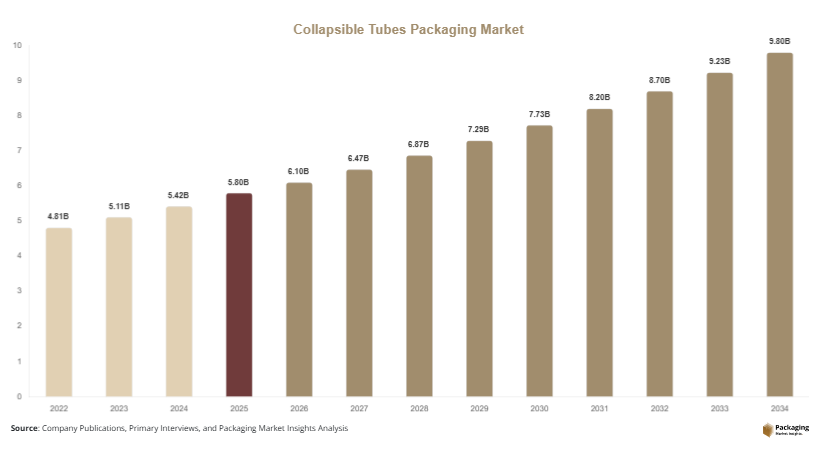
The global collapsible tubes packaging market size is estimated at USD 5.8 billion in 2025, increasing to approximately USD 6.1 billion in 2026. By 2034, the market is projected to reach nearly USD 10.4 billion, registering a CAGR of 6.1% during 2025–2034. The collapsible tubes packaging market is witnessing consistent growth due to rising demand for convenient, hygienic, and lightweight packaging solutions across personal care, pharmaceuticals, food, and industrial applications. Collapsible tubes are widely used for products such as toothpaste, ointments, cosmetics, creams, gels, adhesives, and food condiments because they provide controlled dispensing, product protection, and extended shelf life. Manufacturers are increasingly focusing on sustainable tube materials, advanced barrier technologies, and attractive printing solutions to improve functionality and consumer appeal.
One of the major growth factors driving the market is the increasing consumption of personal care and cosmetic products worldwide. Skincare creams, lotions, hair care products, and beauty formulations increasingly use collapsible tube packaging due to its convenience and branding flexibility. Another significant growth factor is the rising pharmaceutical industry demand for hygienic and tamper-resistant packaging solutions for ointments, medicinal creams, and topical products. Additionally, expanding urban populations and changing consumer lifestyles are supporting demand for portable and easy-to-use packaging formats in food and healthcare applications.
Key Highlights:
- Asia Pacific dominated the market with a 39.4% share in 2025.
- Latin America is projected to grow at the fastest CAGR of 6.7%.
- Plastic collapsible tubes led the type segment with a 46.8% share.
- Plastic materials dominated with a 52.7% share.
- Personal care & cosmetics applications led the market with 44.2% share.
- The US remained the dominant country with a market size of USD 1.2 billion in 2025 and USD 1.3 billion in 2026.
Explore more data points, trends and opportunities Download Free Sample Report
Market Trends
Increasing Adoption of Sustainable and Recyclable Tube Packaging
Sustainability is becoming a major trend in the collapsible tubes packaging market as brands and consumers increasingly prioritize environmentally responsible packaging solutions. Manufacturers are developing recyclable mono-material plastic tubes, bio-based polymers, and lightweight aluminum tubes to reduce packaging waste and improve recyclability. Several cosmetics and personal care companies are replacing conventional multilayer plastic tubes with recyclable laminate alternatives that comply with environmental regulations. For example, skincare brands are launching toothpaste-style recyclable tubes made from post-consumer recycled plastics. This trend is expected to strengthen further as governments introduce stricter packaging sustainability policies and consumers increasingly prefer eco-friendly personal care and healthcare products across global markets.
Growth of Premium Decorative Tube Packaging
The market is witnessing rising demand for premium decorative collapsible tubes designed to improve brand differentiation and product appeal. Packaging companies are increasingly using digital printing, metallic finishes, matte coatings, and customized cap designs to create visually attractive tube packaging for cosmetics and luxury skincare products. For example, premium beauty brands are introducing high-gloss laminated tubes with embossed branding and tamper-evident closures for serums and creams. Pharmaceutical companies are also adopting high-quality printed tubes to improve product identification and consumer trust. In the future, increasing consumer preference for premium packaging experiences and luxury beauty products is expected to drive strong growth in decorative collapsible tube packaging technologies.
Market Drivers
Rising Demand for Personal Care and Cosmetic Products
The growing consumption of personal care and cosmetic products is a major driver supporting the collapsible tubes packaging market. Consumers increasingly purchase skincare creams, lotions, sunscreens, hair gels, and beauty products packaged in collapsible tubes because of their convenience and portability. Cosmetic brands prefer tube packaging because it supports attractive printing, controlled dispensing, and product protection against contamination. For example, global skincare manufacturers are expanding their use of laminated tubes for premium facial care and anti-aging products. The rapid growth of beauty and grooming industries in Asia Pacific, North America, and Europe continues to increase demand for innovative and sustainable collapsible tube packaging solutions.
Expansion of Pharmaceutical and Healthcare Applications
The pharmaceutical industry is also driving strong demand for collapsible tube packaging solutions used for ointments, medicinal creams, gels, and topical treatments. Collapsible tubes provide hygienic dispensing and protect pharmaceutical formulations from contamination and moisture exposure. Healthcare manufacturers increasingly prefer aluminum and multilayer laminate tubes for sensitive medicinal products requiring extended shelf life. For instance, dermatology product manufacturers are using tamper-evident collapsible tubes for prescription creams and antiseptic gels. Growing healthcare spending, aging populations, and rising demand for topical pharmaceutical products are expected to continue supporting market growth across both developed and emerging economies.
Market Restraint
Complex Recycling Challenges for Multilayer Tube Packaging
One of the major restraints affecting the collapsible tubes packaging market is the difficulty associated with recycling multilayer laminate tubes. Many collapsible tubes combine plastic, aluminum, and barrier materials to improve product protection, but these mixed-material structures are difficult to separate during recycling processes. As governments strengthen packaging waste regulations, manufacturers face increasing pressure to redesign products using recyclable materials. For example, personal care companies using multilayer toothpaste tubes may encounter challenges in meeting recyclable packaging targets due to infrastructure limitations in waste management systems. Additionally, sustainable tube materials often involve higher production costs compared to traditional packaging formats. Small and medium-sized packaging companies may struggle to invest in advanced recycling-compatible technologies, limiting market growth in cost-sensitive regions where conventional plastic packaging remains dominant.
Market Opportunities
Growth of Pharmaceutical Tube Packaging Demand
The increasing use of topical medicines, dermatology creams, and healthcare ointments presents significant opportunities for the collapsible tubes packaging market. Pharmaceutical companies require hygienic, tamper-resistant, and high-barrier packaging solutions capable of protecting sensitive medicinal formulations. Aluminum and multilayer laminate tubes are increasingly used for prescription creams, antiseptic products, and medicated gels. For example, pharmaceutical manufacturers are investing in precision dispensing tube designs that improve dosage control and reduce contamination risks. Future growth in healthcare infrastructure, rising demand for over-the-counter treatments, and expansion of dermatology product categories are expected to create substantial opportunities for collapsible tube packaging manufacturers globally.
Expansion of E-Commerce Beauty and Personal Care Sales
The rapid growth of e-commerce sales for beauty, skincare, and wellness products is creating new opportunities for collapsible tube packaging manufacturers. Online retail channels require lightweight, leak-resistant, and visually attractive packaging formats capable of protecting products during transportation. Cosmetic brands are increasingly investing in durable laminated tube packaging with premium printing and customized branding for online sales. For instance, direct-to-consumer skincare companies are using compact recyclable tube packaging to improve shipping efficiency and consumer experience. As digital beauty commerce continues expanding globally, demand for innovative collapsible tube packaging solutions designed for e-commerce logistics is expected to rise steadily.
Report Scope
| Report Metric | Details |
|---|---|
| Market Size in 2025 | USD 5.8 Billion |
| Market Size in 2026 | USD 6.1 Billion |
| Market Size in 2034 | USD 10.4 Billion |
| CAGR | 6.1% (2026-2034) |
| Base Year for Estimation | 2025 |
| Historical Data | 2022-2024 |
| Forecast Period | 2026-2034 |
| Report Coverage | Revenue Forecast, Competitive Landscape, Supply Chain Disruption, Growth Factors, Environment & Regulatory Landscape and Trends |
| Geographies Covered | North America, Europe, APAC, Middle East and Africa, LATAM |
| Countries Covered | U.S., Canada, U.K., Germany, France, Spain, Italy, Russia, Nordic, Benelux, Rest of Europe, China, South Korea, Japan, India, Australia, Singapore, Taiwan, South East Asia, Rest of Asia-Pacific, UAE, Turky, Saudi Arabia, South Africa, Egypt, Nigeria, Rest of MEA, Brazil, Mexico, Argentina, Chile, Colombia, Rest of LATAM |
Explore more data points, trends and opportunities Download Free Sample Report
Segmental Analysis
By Type
Plastic collapsible tubes dominated the global collapsible tubes packaging market in 2024, accounting for approximately 46.8% of the total market share. Plastic tubes are extensively used across personal care, cosmetics, oral care, and pharmaceutical industries because they are lightweight, flexible, cost-effective, and suitable for high-volume manufacturing. Polyethylene-based tubes remain highly preferred for toothpaste, lotions, facial creams, and hair care products due to their durability and compatibility with decorative printing technologies. Manufacturers also favor plastic collapsible tubes because they support customized closures, attractive branding, and convenient dispensing features. For example, cosmetic brands increasingly use glossy plastic tubes with matte finishes and ergonomic caps for skincare products targeted at younger consumers. In addition, advancements in recyclable mono-material plastics are helping companies align with sustainability targets while maintaining packaging performance. The increasing use of flexible consumer packaging across emerging economies continues to support the dominance of plastic collapsible tubes globally.
Laminated collapsible tubes are projected to be the fastest-growing type segment, expanding at a CAGR of 6.9% during the forecast period. Laminated tubes combine multiple material layers to provide superior barrier protection against moisture, oxygen, light, and contamination. These packaging solutions are increasingly used for pharmaceutical ointments, premium cosmetics, toothpaste, and healthcare creams that require extended shelf life and enhanced product stability. Companies are adopting laminated tubes because they support high-quality printing, metallic finishes, and premium decorative effects. For instance, luxury skincare brands are introducing multilayer laminate tubes with holographic printing and tamper-evident features to improve product presentation and consumer trust. Future growth in high-performance personal care products and medicated formulations is expected to strengthen demand for laminated tube packaging. Additionally, the development of recyclable laminate structures is likely to create new opportunities for sustainable packaging adoption during the forecast period.
By Material
Plastic materials dominated the collapsible tubes packaging market in 2024 with a market share of approximately 52.7%. Plastic remains the preferred material because of its low production cost, lightweight structure, flexibility, and compatibility with various product formulations. Polyethylene and polypropylene materials are widely used for manufacturing tubes for cosmetics, oral care, pharmaceuticals, and food products. Plastic materials also support attractive printing and branding solutions that improve shelf visibility in retail environments. For example, toothpaste manufacturers increasingly use squeezable plastic tubes with flip-top caps to improve convenience and product dispensing efficiency. In addition, advancements in recyclable and post-consumer recycled plastics are encouraging manufacturers to transition toward more sustainable plastic packaging formats. The availability of advanced extrusion and molding technologies is also supporting high-volume tube production across global markets. Rising demand for affordable and portable packaging solutions continues driving the dominance of plastic materials in the market.
Aluminum materials are expected to register the fastest CAGR of 6.5% during the forecast period. Aluminum collapsible tubes offer excellent barrier protection against air, light, and moisture, making them suitable for pharmaceutical, industrial adhesive, and specialty cosmetic applications. Pharmaceutical companies increasingly prefer aluminum tubes for medicinal creams and topical ointments that require long-term product stability. For example, dermatology treatment manufacturers use aluminum tube packaging to prevent contamination and preserve sensitive medicinal ingredients. Growing environmental awareness is also contributing to segment growth because aluminum is widely recyclable and supports circular economy initiatives. In addition, luxury cosmetic and premium skincare brands are adopting aluminum packaging for its metallic appearance and premium consumer appeal. Future investments in lightweight aluminum manufacturing and sustainable packaging technologies are expected to accelerate adoption across healthcare and high-end beauty product categories.
By End-Use
Personal care and cosmetics dominated the collapsible tubes packaging market in 2024, accounting for approximately 44.2% of the total market share. The segment benefits from increasing global demand for skincare creams, facial cleansers, sunscreens, lotions, hair gels, and beauty formulations packaged in convenient and visually attractive tubes. Cosmetic brands prefer collapsible tube packaging because it provides portability, hygienic dispensing, and strong branding opportunities through advanced decorative printing technologies. For instance, premium skincare companies increasingly use laminated collapsible tubes with metallic finishes and embossed graphics to improve shelf appeal and enhance brand positioning. Rising disposable incomes and growing consumer awareness regarding personal grooming products are also supporting segment growth. Additionally, expansion of e-commerce beauty retail platforms has increased demand for durable and leak-resistant packaging solutions capable of protecting products during transportation. The rapid growth of global beauty and wellness industries continues strengthening demand for collapsible tube packaging across this segment.
Pharmaceutical applications are projected to witness the fastest CAGR of 6.8% during the forecast period. The increasing use of topical treatments, dermatology creams, medicated gels, and healthcare ointments is driving strong demand for hygienic and tamper-resistant tube packaging solutions. Pharmaceutical manufacturers are adopting multilayer laminate and aluminum tube structures that provide enhanced protection against contamination, oxygen exposure, and moisture penetration. For example, healthcare companies are introducing precision dispensing collapsible tubes for prescription dermatology products and antiseptic creams. Growing healthcare expenditures, aging populations, and increasing prevalence of skin-related medical conditions are expected to support future segment expansion. Furthermore, pharmaceutical packaging regulations requiring improved safety, traceability, and product integrity are encouraging investments in advanced collapsible tube technologies across global healthcare markets.
Collapsible Tubes Packaging Market Segmentations
By Type
- Plastic Collapsible Tubes
- Laminated Collapsible Tubes
- Aluminum Collapsible Tubes
- Squeeze Tubes
- Twist Tubes
By Material
- Plastic
- Aluminum
- Laminates
- Bio-Based Materials
By End-User
- Personal Care & Cosmetics
- Pharmaceuticals
- Oral Care
- Food Products
- Industrial Applications
Regional Analysis
North America
North America accounted for approximately 27.8% of the global collapsible tubes packaging market share in 2025 and is projected to expand at a CAGR of 5.9% during the forecast period. The region benefits from strong demand for personal care products, pharmaceutical creams, and premium cosmetic packaging solutions. Consumers in the United States and Canada increasingly prefer portable and hygienic packaging formats for skincare, oral care, and healthcare products. Sustainability regulations and growing environmental awareness are also encouraging packaging manufacturers to adopt recyclable and lightweight tube materials. In addition, rapid growth in e-commerce beauty sales is increasing demand for durable and leak-resistant collapsible packaging solutions across the region.
The United States dominates the North American collapsible tubes packaging market due to its large cosmetics and healthcare industries. One unique growth driver is the rising popularity of premium skincare and dermatology products requiring customized decorative tube packaging. Beauty brands in the country are increasingly investing in recyclable laminated tubes with advanced printing technologies to improve shelf visibility and strengthen brand identity. Pharmaceutical companies are also adopting tamper-evident tube packaging for medicated creams and topical healthcare products. Growing direct-to-consumer beauty sales and increasing investments in sustainable packaging innovation continue supporting long-term market expansion in the United States.
Europe
Europe held approximately 24.6% of the global collapsible tubes packaging market share in 2025 and is forecast to grow at a CAGR of 5.8% during the forecast period. The regional market is strongly influenced by strict sustainability regulations and increasing demand for recyclable packaging solutions. Cosmetics, oral care, and pharmaceutical manufacturers across Europe are shifting toward mono-material recyclable tubes and lightweight aluminum packaging formats to reduce environmental impact. Growth in premium skincare products and natural cosmetics is also increasing demand for decorative and sustainable tube packaging. Furthermore, rising investments in advanced tube printing technologies and eco-friendly packaging materials continue supporting market development across major European countries.
Germany remains the dominant country in the European collapsible tubes packaging market because of its strong pharmaceutical manufacturing and cosmetic packaging industries. A unique growth factor in Germany is the increasing adoption of high-barrier aluminum tubes for pharmaceutical and healthcare applications. Healthcare manufacturers are investing in durable tube packaging that improves product shelf life and protects sensitive medicinal formulations. In addition, premium cosmetic brands in Germany are using digitally printed laminated tubes with metallic finishes to improve retail presentation and consumer appeal. Government support for recyclable packaging innovation continues strengthening long-term market growth across the country.
Asia Pacific
Asia Pacific dominated the global collapsible tubes packaging market with a 39.4% share in 2025 and is expected to register a CAGR of 6.6% during the forecast period. The region benefits from rapid growth in cosmetics manufacturing, pharmaceutical production, and packaged consumer goods demand. Countries such as China, India, Japan, and South Korea are witnessing increasing consumption of skincare products, toothpaste, medicated creams, and beauty formulations packaged in collapsible tubes. Rising disposable incomes and expanding urban populations are also supporting personal care product sales across emerging economies. Furthermore, growing investments in sustainable tube manufacturing and flexible packaging infrastructure continue strengthening regional market expansion.
China dominates the Asia Pacific collapsible tubes packaging market because of its extensive personal care manufacturing base and rapidly growing beauty industry. One unique growth driver is the strong expansion of domestic skincare and cosmetic brands targeting premium consumer segments. Cosmetic companies in China are increasingly adopting decorative laminated tube packaging with high-quality printing and sustainable materials to improve brand differentiation. In addition, the country’s growing pharmaceutical industry is supporting rising demand for aluminum and multilayer medicinal tube packaging. Rapid expansion of e-commerce beauty retail channels continues accelerating packaging demand across the Chinese market.
Middle East & Africa
The Middle East & Africa region accounted for approximately 4.2% of the global collapsible tubes packaging market in 2025 and is expected to grow at a CAGR of 6.1% during the forecast period. Rising urbanization, increasing healthcare spending, and expanding personal grooming trends are supporting market growth across the region. Demand for toothpaste, skincare creams, pharmaceutical ointments, and cosmetic products is increasing steadily in Gulf countries and developing African economies. Packaging manufacturers are also investing in lightweight and durable tube packaging suitable for high-temperature climatic conditions. Additionally, growth in retail beauty chains and pharmacy distribution networks is contributing to rising demand for collapsible tube packaging solutions.
The United Arab Emirates dominates the Middle East & Africa collapsible tubes packaging market due to its expanding cosmetics retail sector and premium personal care product demand. One unique growth factor is the increasing popularity of luxury skincare and imported beauty products packaged in decorative laminated tubes. Cosmetic retailers in the UAE are focusing on visually attractive packaging designs with metallic finishes and premium dispensing caps to appeal to high-income consumers. In addition, rising healthcare infrastructure investments and pharmaceutical product demand continue supporting the use of hygienic collapsible tube packaging across the country.
Latin America
Latin America represented approximately 4.0% of the global collapsible tubes packaging market share in 2025 and is projected to expand at a CAGR of 6.7% during the forecast period. The regional market is benefiting from rising beauty product consumption, expanding oral care demand, and increasing pharmaceutical product sales. Countries across Latin America are witnessing growing consumer preference for convenient and portable packaging formats for personal care and healthcare applications. Packaging manufacturers are also increasing investments in cost-efficient laminated tube production for regional cosmetic brands. Furthermore, expansion of retail pharmacy chains and online beauty platforms is supporting demand for collapsible tube packaging solutions across urban markets.
Brazil dominates the Latin American collapsible tubes packaging market because of its large cosmetics industry and strong personal care product consumption. One unique growth factor is the increasing demand for herbal and natural beauty products packaged in eco-friendly collapsible tubes. Brazilian cosmetic brands are investing in recyclable tube materials and sustainable decorative packaging to strengthen environmental branding strategies. In addition, growth in toothpaste consumption and topical healthcare products continues driving demand for laminated and aluminum tube packaging formats. Rising local manufacturing activities are expected to support future market expansion across Brazil.
Competitive Landscape
The global collapsible tubes packaging market is moderately fragmented, with leading companies focusing on sustainable packaging innovation, lightweight materials, and advanced decorative printing technologies to strengthen their competitive positions. Major packaging manufacturers are investing in recyclable laminate structures, mono-material plastic tubes, and aluminum tube production capabilities to meet rising environmental standards and consumer demand for sustainable packaging. Companies are also expanding their pharmaceutical and cosmetic packaging portfolios through strategic partnerships and capacity expansions. Increased investments in digital printing and high-barrier tube technologies are further intensifying competition across regional and international markets.
Essel Propack Ltd. remains one of the leading companies in the collapsible tubes packaging market due to its extensive global manufacturing network and strong product portfolio across personal care, oral care, and pharmaceutical applications. The company recently launched recyclable multilayer laminate tubes designed for premium cosmetic and toothpaste packaging applications. Other major players including Albéa Group, Montebello Packaging, Hoffmann Neopac AG, and Berry Global Inc. are also focusing on sustainable packaging development and expansion into emerging markets. Several manufacturers are increasing production capacity for pharmaceutical-grade tube packaging to support growing healthcare demand. Strategic acquisitions, eco-friendly product launches, and advanced printing technologies are expected to remain key competitive strategies throughout the forecast period.
Key Players List
- Essel Propack Ltd.
- Albéa Group
- Hoffmann Neopac AG
- Montebello Packaging
- Berry Global Inc.
- Amcor Plc
- CCL Industries Inc.
- Huhtamaki Oyj
- Linhardt GmbH & Co. KG
- Pirlo GmbH
- Intrapac International Corporation
- CTL Packaging USA
- Alltub Group
- Tubex GmbH
- Unette Corporation