Lipstick Packaging Market Size and Growth
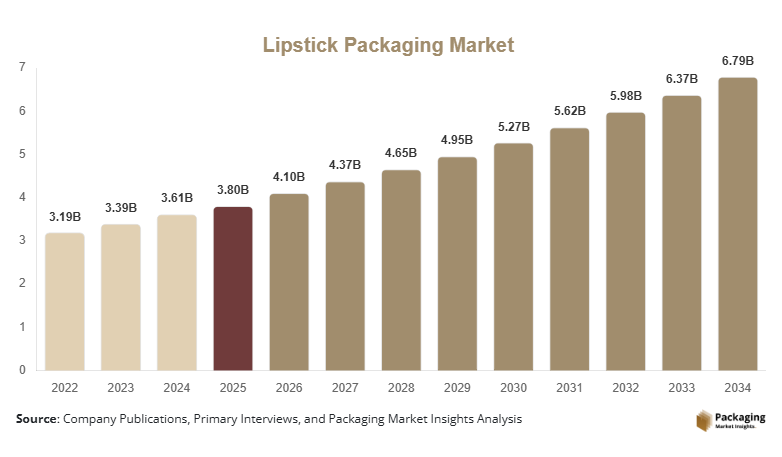
The global lipstick packaging market was valued at approximately USD 3.8 billion in 2025 and is expected to reach USD 4.1 billion in 2026. By 2034, the market is forecasted to attain nearly USD 7.2 billion, expanding at a CAGR of 6.5% during 2025–2034. Lipstick packaging includes containers, tubes, caps, refill systems, applicators, and decorative packaging components designed to improve functionality, product protection, and visual appeal in cosmetic products. The lipstick packaging market is witnessing stable expansion due to increasing cosmetic consumption, rising premium beauty product demand, and growing investments in sustainable packaging technologies.
The increasing popularity of premium and luxury cosmetics is one of the major growth factors driving the market. Cosmetic manufacturers are investing in aesthetically appealing and customized lipstick packaging to strengthen brand differentiation and consumer engagement. Packaging design has become an essential marketing tool in the beauty industry, particularly across social media-driven cosmetic brands. Another major growth factor is the rapid expansion of e-commerce beauty retail channels. Online cosmetic purchases require durable and visually attractive packaging that can protect products during transportation while maintaining premium shelf appeal. Additionally, the growing focus on sustainability is encouraging manufacturers to develop recyclable, refillable, and biodegradable lipstick packaging solutions.
Key Highlights
- Asia Pacific dominated the market with a 40.3% share in 2025.
- Latin America is projected to grow at the fastest CAGR of 7.0%.
- Plastic lipstick tubes led the material segment with a 46.8% share.
- Twist-up packaging dominated the product type segment with a 52.4% share.
- Luxury cosmetic applications led the segment with 44.1% share.
- The US remained the dominant country with a market size of USD 820 million in 2025 and USD 875 million in 2026.
Explore more data points, trends and opportunities Download Free Sample Report
Market Trends
Growing Adoption of Refillable Lipstick Packaging
Refillable lipstick packaging is becoming an important trend in the lipstick packaging market as cosmetic companies focus on sustainability and premium consumer experiences. Beauty brands are introducing reusable outer cases combined with replaceable lipstick cartridges to reduce packaging waste and improve customer retention. Consumers are increasingly willing to pay for environmentally responsible beauty products that offer long-term usability. Luxury cosmetic manufacturers are also using refillable systems as part of their premium branding strategies. In addition, refillable lipstick packaging supports circular economy initiatives by lowering material consumption and reducing disposal rates. This trend is encouraging packaging suppliers to develop durable, lightweight, and aesthetically attractive refill systems.
Increased Demand for Premium Decorative Packaging
The rising influence of social media and digital beauty marketing is increasing demand for premium decorative lipstick packaging solutions. Cosmetic brands are focusing on metallic finishes, embossed logos, magnetic closures, customized textures, and unique shapes to attract consumers and strengthen shelf visibility. Packaging aesthetics have become a critical purchasing factor, especially among younger consumers influenced by beauty influencers and online product reviews. Companies are investing in advanced printing and molding technologies to create visually appealing packaging designs. This trend is particularly strong in luxury cosmetics and limited-edition product launches, where packaging plays a major role in product differentiation and brand storytelling.
Market Drivers
Expansion of Global Cosmetic Industry
The steady expansion of the global cosmetic industry is a primary driver supporting the lipstick packaging market. Increasing beauty product consumption among urban populations and rising disposable incomes are driving demand for lipsticks across both developed and emerging economies. Cosmetic brands are launching new product lines with customized packaging designs to attract consumers and improve market visibility. The growth of online beauty platforms and influencer-driven marketing has also increased lipstick sales globally. As competition intensifies among cosmetic manufacturers, packaging innovation has become essential for product differentiation, directly contributing to increased demand for advanced lipstick packaging solutions.
Rising Consumer Preference for Sustainable Packaging
Growing environmental awareness among consumers is significantly driving demand for sustainable lipstick packaging materials. Cosmetic companies are replacing traditional single-use plastic packaging with recyclable metals, biodegradable materials, and refillable containers to align with sustainability goals. Consumers increasingly prefer eco-friendly cosmetic brands that demonstrate environmental responsibility. Governments and environmental organizations are also encouraging manufacturers to reduce plastic waste within the beauty industry. As a result, packaging suppliers are investing in sustainable material innovation and lightweight designs to reduce carbon footprints. This transition is expected to continue supporting long-term market growth.
Market Restraint
High Production Costs for Premium and Sustainable Packaging
One of the key restraints affecting the lipstick packaging market is the high production cost associated with premium decorative packaging and sustainable materials. Advanced packaging designs involving magnetic closures, metallic finishes, refillable systems, and customized molding processes require significant manufacturing investment. Sustainable materials such as aluminum, biodegradable plastics, and recycled polymers often involve higher processing costs compared to conventional plastic packaging. These cost challenges can impact smaller cosmetic brands with limited budgets and reduce profit margins for manufacturers. For example, independent beauty companies may struggle to adopt refillable lipstick packaging because of tooling expenses and low production volumes. Additionally, fluctuations in raw material prices can further increase operational costs across packaging supply chains. The high cost of sustainable packaging may also lead some mass-market cosmetic brands to continue relying on lower-cost plastic alternatives, slowing the overall transition toward environmentally friendly packaging solutions within the industry.
Market Opportunities
Growth of Organic and Vegan Cosmetic Brands
The rapid expansion of organic and vegan cosmetic brands presents significant opportunities for the lipstick packaging market. Consumers are increasingly choosing beauty products that use natural ingredients and environmentally responsible packaging materials. This trend is encouraging cosmetic manufacturers to adopt biodegradable, recyclable, and refillable lipstick packaging solutions that align with eco-conscious brand identities. Vegan cosmetic brands are particularly focused on minimizing environmental impact throughout product life cycles. Packaging suppliers have opportunities to develop innovative fiber-based tubes, recycled plastic containers, and lightweight metal packaging systems to support this growing segment.
Increasing Demand for Personalized Cosmetic Packaging
Personalized cosmetic packaging is creating new opportunities for packaging manufacturers and beauty brands. Consumers increasingly seek unique products that reflect individual preferences, encouraging brands to offer customized lipstick cases, engraved packaging, and limited-edition designs. Advances in digital printing and smart manufacturing technologies are enabling cost-effective short-run production of personalized packaging solutions. Social media marketing and influencer collaborations are also accelerating demand for visually distinctive packaging. This opportunity is expected to support innovation in decorative finishes, color customization, and interactive packaging designs across the global market.
Report Scope
| Report Metric | Details |
|---|---|
| Market Size in 2025 | USD 3.8 Billion |
| Market Size in 2026 | USD 4.1 Billion |
| Market Size in 2034 | USD 7.2 Billion |
| CAGR | 6.5% (2026-2034) |
| Base Year for Estimation | 2025 |
| Historical Data | 2022-2024 |
| Forecast Period | 2026-2034 |
| Report Coverage | Revenue Forecast, Competitive Landscape, Supply Chain Disruption, Growth Factors, Environment & Regulatory Landscape and Trends |
| Geographies Covered | North America, Europe, APAC, Middle East and Africa, LATAM |
| Countries Covered | U.S., Canada, U.K., Germany, France, Spain, Italy, Russia, Nordic, Benelux, Rest of Europe, China, South Korea, Japan, India, Australia, Singapore, Taiwan, South East Asia, Rest of Asia-Pacific, UAE, Turky, Saudi Arabia, South Africa, Egypt, Nigeria, Rest of MEA, Brazil, Mexico, Argentina, Chile, Colombia, Rest of LATAM |
Explore more data points, trends and opportunities Download Free Sample Report
Segmental Analysis
By Material
Plastic lipstick tubes dominated the lipstick packaging market in 2024 and accounted for approximately 46.8% of the global market share. Plastic remains widely used because of its lightweight structure, design flexibility, and low manufacturing costs. Cosmetic brands extensively use polypropylene and ABS plastics to create lipstick containers with various decorative finishes and customized shapes. Plastic packaging also supports mass production and efficient transportation across global supply chains. The segment benefits from strong demand among affordable and mid-range cosmetic brands that prioritize cost-effective packaging solutions while maintaining attractive product designs. Additionally, advancements in recycled plastic materials are helping manufacturers improve sustainability performance within the segment.
Aluminum packaging is projected to be the fastest-growing subsegment, registering a CAGR of 7.3% during the forecast period. Aluminum lipstick tubes are increasingly adopted because they provide durability, premium appearance, and recyclability advantages compared to conventional plastic packaging. Luxury cosmetic brands are particularly investing in aluminum packaging to improve product aesthetics and align with sustainability initiatives. The growing consumer preference for refillable lipstick systems is also supporting segment growth, as aluminum materials offer long-term usability and structural strength. In addition, aluminum packaging supports advanced decorative finishes such as metallic coatings and engraving, making it attractive for premium beauty product applications globally.
By Product Type
Twist-up lipstick packaging dominated the market in 2024 with a share of approximately 52.4%. Twist-up tubes remain the most commonly used packaging format because of their convenience, ease of use, and compatibility with traditional lipstick formulations. Cosmetic manufacturers prefer twist-up mechanisms due to their reliable dispensing systems and cost-efficient production capabilities. The segment benefits from widespread adoption across mass-market, premium, and luxury lipstick brands. Additionally, twist-up packaging allows extensive customization in shape, color, finish, and branding, making it suitable for diverse consumer preferences. Growing global lipstick consumption continues to support strong demand for this packaging format across retail and online distribution channels.
Refillable lipstick packaging is anticipated to witness the fastest growth, expanding at a CAGR of 7.6% during the forecast period. The increasing focus on sustainability and waste reduction is encouraging cosmetic brands to introduce reusable lipstick cases combined with replaceable refill cartridges. Luxury beauty brands are leading adoption of refillable packaging systems to strengthen customer loyalty and improve environmental performance. Consumers are increasingly attracted to refillable cosmetic products because they reduce packaging waste while offering premium aesthetics and long-term value. Technological improvements in refill mechanisms and durable materials are also supporting wider market adoption across global beauty product categories.
By Application
Luxury cosmetics represented the dominant application segment in 2024 and captured approximately 44.1% of the total market share. Premium cosmetic brands heavily invest in visually appealing lipstick packaging to enhance product differentiation and strengthen consumer engagement. Luxury lipstick packaging often includes metallic finishes, embossed branding, magnetic closures, and customized decorative elements designed to improve perceived product value. The growing influence of social media beauty marketing has further increased the importance of packaging aesthetics in the luxury cosmetics industry. Additionally, rising disposable incomes and premium beauty product consumption across emerging markets continue to support demand for sophisticated lipstick packaging solutions.
Organic cosmetic brands are expected to grow at the fastest CAGR of 7.2% during the forecast period. Consumers are increasingly seeking natural and environmentally responsible beauty products, encouraging organic cosmetic companies to adopt sustainable lipstick packaging materials. These brands commonly use recyclable aluminum, biodegradable plastics, and refillable containers to align with environmentally conscious consumer preferences. Regulatory pressure regarding plastic reduction and sustainability reporting is also supporting segment growth. Furthermore, the expansion of clean beauty product categories across online retail platforms is creating new opportunities for eco-friendly lipstick packaging manufacturers worldwide.
Lipstick Packaging Market Segmentations
By Material
- Plastic
- Aluminum
- Glass
- Paper-Based Materials
By Product Type
- Twist-Up Packaging
- Click Mechanism Packaging
- Refillable Packaging
- Magnetic Closure Packaging
By Application
- Luxury Cosmetics
- Mass-Market Cosmetics
- Organic Cosmetics
- Professional Makeup Products
Regional Analysis
North America
North America accounted for approximately 26.8% of the global lipstick packaging market share in 2025 and is expected to expand at a CAGR of 5.9% during the forecast period. The region benefits from strong cosmetic consumption, advanced packaging technologies, and high demand for premium beauty products. Cosmetic manufacturers in the United States and Canada are increasingly investing in refillable and sustainable lipstick packaging solutions to align with environmental trends. The presence of established luxury beauty brands also supports continuous product innovation within the market.
The United States dominates the North American market due to its large beauty and personal care industry. One unique growth factor is the rising popularity of celebrity-owned cosmetic brands that prioritize visually distinctive and premium lipstick packaging designs. These brands frequently launch limited-edition packaging collections to strengthen social media engagement and attract younger consumers. This trend is contributing to increasing investments in decorative packaging technologies across the country.
Europe
Europe represented approximately 24.1% of the market share in 2025 and is projected to grow at a CAGR of 5.7% during the forecast period. The region is witnessing increasing demand for sustainable cosmetic packaging due to strict environmental regulations and high consumer awareness regarding plastic waste reduction. Cosmetic companies are increasingly adopting recyclable aluminum packaging and refillable lipstick systems to meet sustainability goals. In addition, premium beauty brands across Europe continue to invest in luxury packaging aesthetics to strengthen brand positioning.
France remains the dominant country within the European market because of its strong cosmetics manufacturing industry and global luxury beauty brands. One unique growth factor is the increasing integration of refillable cosmetic packaging within luxury retail stores. French cosmetic brands are promoting refill systems through in-store refill stations and reusable packaging initiatives. This approach is supporting sustainable consumption while encouraging repeat customer purchases across the beauty sector.
Asia Pacific
Asia Pacific dominated the global market with a 40.3% share in 2025 and is expected to register a CAGR of 7.1% during the forecast period. Rapid urbanization, rising disposable incomes, and growing beauty consciousness among younger populations are major growth drivers in the region. The expansion of e-commerce beauty platforms and social media-driven cosmetic trends is further increasing lipstick sales. Additionally, local cosmetic manufacturers are investing in innovative packaging solutions to compete with international beauty brands across emerging economies.
China leads the Asia Pacific market due to its extensive cosmetic manufacturing capabilities and large consumer base. One unique growth factor is the rapid growth of livestream beauty commerce platforms, which heavily emphasize attractive and visually appealing product packaging. Cosmetic companies are investing in premium lipstick packaging designs to improve online product presentation and increase consumer engagement. This trend continues to strengthen demand for decorative and customized lipstick packaging solutions in the country.
Middle East & Africa
The Middle East & Africa region accounted for approximately 4.9% of the global market share in 2025 and is projected to grow at a CAGR of 6.0% during the forecast period. Rising beauty product consumption and increasing urbanization are supporting market growth across the region. Luxury cosmetic demand remains particularly strong in Gulf countries, where premium packaging aesthetics significantly influence consumer purchasing decisions. International beauty brands are expanding their presence in regional retail markets, contributing to increased demand for high-quality lipstick packaging solutions.
The United Arab Emirates dominates the regional market due to its expanding luxury retail and beauty sectors. One unique growth factor is the increasing popularity of premium halal cosmetic brands that focus on elegant and sustainable packaging designs. Cosmetic companies are introducing customized metallic lipstick tubes and decorative packaging collections to appeal to high-income consumers. This trend is encouraging packaging innovation within the regional beauty industry.
Latin America
Latin America held approximately 3.9% of the global market share in 2025 and is expected to grow at the fastest CAGR of 7.0% during the forecast period. Growing middle-class populations and rising beauty product consumption are supporting market expansion across the region. Cosmetic companies are increasingly introducing affordable premium lipstick products with improved packaging aesthetics to attract younger consumers. The expansion of online beauty retail channels is also contributing to higher demand for durable and visually attractive lipstick packaging solutions.
Brazil dominates the Latin American market due to its large cosmetics industry and strong beauty culture. One unique growth factor is the increasing popularity of locally manufactured vegan cosmetic products that utilize recyclable packaging materials. Domestic beauty brands are adopting environmentally responsible lipstick packaging strategies to strengthen market competitiveness and appeal to environmentally conscious consumers. This trend is expected to support long-term market growth within the country.
Competitive Landscape
The lipstick packaging market is moderately competitive, with global and regional manufacturers focusing on sustainable material innovation, premium aesthetics, and customized packaging solutions. Companies are investing in advanced molding technologies, refillable systems, and lightweight materials to strengthen their competitive positions. Strategic collaborations between cosmetic brands and packaging suppliers are increasing as companies seek differentiated packaging designs that enhance consumer engagement and brand visibility.
AptarGroup Inc. remains one of the leading players in the market because of its broad cosmetic packaging portfolio and strong global manufacturing presence. In 2024, the company introduced a new recyclable lipstick packaging solution designed to reduce plastic usage within luxury cosmetic applications. Other major companies operating in the market include HCP Packaging, Albéa Group, Quadpack Industries, and LIBO Cosmetics Company Ltd. These companies are actively expanding production capacities and investing in decorative packaging technologies to meet rising demand from premium and sustainable beauty product segments.
Key Players List
- AptarGroup Inc.
- HCP Packaging
- Albéa Group
- Quadpack Industries
- LIBO Cosmetics Company Ltd.
- RPC Bramlage GmbH
- Silgan Dispensing Systems
- Frapak Packaging
- Fusion Packaging
- Baralan International
- Cosmopak USA LLC
- Geka GmbH
- Yonwoo Co. Ltd.
- CTK Cosmetics
- Berlin Packaging
- Axilone Group
- Lumson S.p.A.