Seed Packaging Market Size and Growth
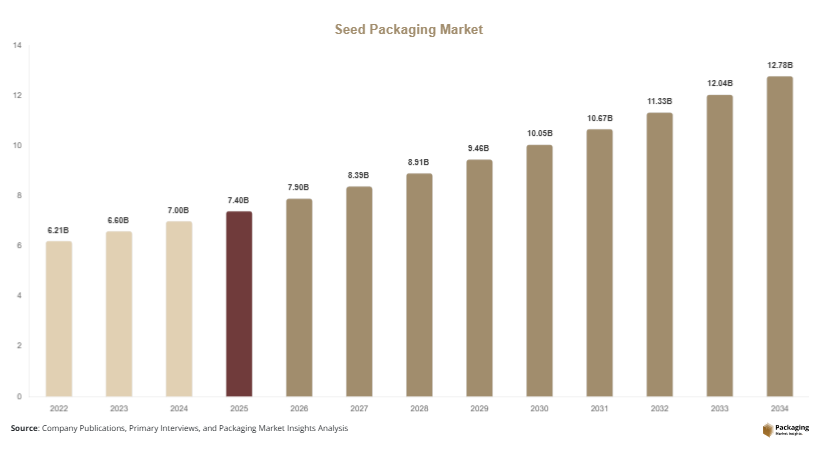
The global seed packaging market size is estimated at USD 7.4 billion in 2025, increasing to nearly USD 7.9 billion in 2026. By 2034, the market is projected to reach approximately USD 13.6 billion, expanding at a CAGR of 6.2% during 2025–2034. The Seed Packaging Market is witnessing steady growth due to rising agricultural productivity requirements, increasing adoption of hybrid and genetically modified seeds, and growing demand for durable and sustainable agricultural packaging solutions. Seed packaging plays a critical role in protecting seeds from moisture, contamination, ultraviolet exposure, and mechanical damage during storage, transportation, and retail distribution. Packaging solutions such as woven sacks, pouches, bags, containers, and bulk packaging formats are widely used across commercial farming, horticulture, and agricultural retail sectors.
One of the major growth factors driving the market is the increasing demand for high-quality hybrid seeds in commercial agriculture. Farmers are increasingly investing in premium seeds with higher productivity and disease resistance, creating demand for advanced protective packaging materials. Another important growth factor is the expansion of global agricultural trade, which requires durable and moisture-resistant seed packaging solutions capable of supporting long-distance transportation and extended storage periods. Additionally, growing awareness regarding sustainable agricultural practices is encouraging manufacturers to develop recyclable and biodegradable seed packaging products.
Key Highlights
- Asia Pacific dominated the market with a 39.6% share in 2025.
- Latin America is projected to grow at the fastest CAGR of 6.8%.
- Flexible packaging led the type segment with a 56.1% share.
- Plastic materials dominated with a 51.8% share.
- Commercial agriculture applications led the market with 47.2% share.
- The US remained the dominant country with a market size of USD 1.4 billion in 2025 and USD 1.5 billion in 2026.
Explore more data points, trends and opportunities Download Free Sample Report
Market Trends
Growing Adoption of Sustainable and Biodegradable Seed Packaging
Sustainability is becoming a significant trend in the seed packaging market as agricultural companies increasingly focus on reducing plastic waste and improving environmental compliance. Manufacturers are developing biodegradable seed bags, recyclable pouches, and compostable packaging films made from paper, starch blends, and bio-based polymers. Agricultural cooperatives and seed distributors are also adopting eco-friendly packaging to align with sustainable farming initiatives and retailer sustainability requirements. For example, several European agricultural packaging suppliers have introduced biodegradable seed bags for vegetable and organic crop seeds. The future impact of this trend is expected to include broader adoption of renewable packaging materials, lower environmental impact, and stronger regulatory compliance across global agricultural supply chains.
Integration of Smart Labeling and Traceability Technologies
The integration of smart labeling technologies and digital traceability systems is transforming the seed packaging market. Manufacturers are incorporating QR codes, RFID tags, tamper-evident seals, and digital authentication systems into seed packaging to improve supply chain visibility and product verification. These technologies help farmers identify certified seed varieties, monitor storage conditions, and verify seed origin before purchase. For instance, seed companies in North America are using QR-enabled packaging to provide crop performance information and planting recommendations directly to farmers through mobile applications. The future impact of this trend includes improved transparency, stronger counterfeit prevention, and better seed inventory management across agricultural distribution networks.
Market Drivers
Rising Demand for Certified and Hybrid Seeds
The increasing use of certified and hybrid seeds is a major driver supporting growth in the seed packaging market. Farmers are adopting premium seeds with improved disease resistance, higher yield potential, and better adaptability to changing climate conditions. These seeds require protective packaging solutions capable of preserving seed quality during transportation and storage. For example, hybrid corn and vegetable seed producers are increasingly using multilayer moisture-resistant packaging to maintain seed viability and germination rates. The growth of commercial farming operations and precision agriculture practices is further increasing demand for advanced seed packaging systems. As global food demand continues rising, certified seed adoption is expected to support long-term market growth.
Expansion of Agricultural Trade and Distribution Networks
Global expansion of agricultural trade and seed distribution activities is another important driver for the market. International seed exports require durable packaging capable of protecting products from moisture, contamination, and physical damage during long-distance transportation. Agricultural distributors and seed producers are increasingly investing in high-strength woven sacks, laminated bags, and bulk packaging solutions to improve product handling efficiency. For example, agricultural exporters in Asia Pacific and Latin America are adopting advanced packaging materials to support growing exports of crop and vegetable seeds. Rising investments in agricultural logistics infrastructure and global seed trade are expected to continue strengthening demand for reliable seed packaging solutions.
Market Restraints
Volatility in Raw Material Prices and Environmental Regulations
One of the primary restraints affecting the seed packaging market is the volatility in raw material prices, particularly for plastic-based packaging materials. Polypropylene, polyethylene, and multilayer plastic films are widely used in seed packaging due to their durability and moisture resistance. However, fluctuations in petroleum prices and supply chain disruptions can significantly affect production costs for packaging manufacturers. In addition, governments across Europe and North America are implementing stricter environmental regulations regarding single-use plastics and non-recyclable packaging materials. For example, certain agricultural distributors are facing higher compliance costs as they transition toward recyclable and biodegradable packaging alternatives. These regulatory and cost-related challenges can limit profit margins and slow adoption of advanced packaging technologies, particularly among small-scale packaging manufacturers operating in price-sensitive agricultural markets.
Market Opportunities
Growth of Precision Agriculture and Digital Farming
The expansion of precision agriculture and digital farming technologies presents strong opportunities for the seed packaging market. Modern farming operations increasingly require traceable, well-labeled, and digitally connected packaging systems to improve inventory management and crop planning efficiency. Seed packaging manufacturers are developing smart packaging solutions integrated with QR codes, RFID tracking, and digital crop information systems. For instance, seed distributors are using digital packaging labels to provide farmers with real-time information about planting schedules, crop performance, and soil compatibility. Future adoption of connected agriculture technologies is expected to create long-term demand for intelligent seed packaging solutions across global farming operations.
Increasing Demand for Bulk Seed Packaging Solutions
Rising commercial farming activities and expansion of agricultural cooperatives are creating opportunities for bulk seed packaging solutions. Large-scale farming operations require durable and cost-efficient packaging systems capable of handling significant seed volumes while maintaining product protection during storage and transportation. Manufacturers are introducing high-capacity woven sacks, flexible intermediate bulk containers, and reinforced laminated bags for grain and crop seed applications. For example, agricultural suppliers in South America are increasingly adopting large-capacity bulk packaging systems for soybean and corn seed distribution. Growing mechanization in agriculture and rising industrial farming practices are expected to strengthen demand for bulk seed packaging products over the forecast period.
Report Scope
| Report Metric | Details |
|---|---|
| Market Size in 2025 | USD 7.4 Billion |
| Market Size in 2026 | USD 7.9 Billion |
| Market Size in 2034 | USD 13.6 Billion |
| CAGR | 6.2% (2026-2034) |
| Base Year for Estimation | 2025 |
| Historical Data | 2022-2024 |
| Forecast Period | 2026-2034 |
| Report Coverage | Revenue Forecast, Competitive Landscape, Supply Chain Disruption, Growth Factors, Environment & Regulatory Landscape and Trends |
| Geographies Covered | North America, Europe, APAC, Middle East and Africa, LATAM |
| Countries Covered | U.S., Canada, U.K., Germany, France, Spain, Italy, Russia, Nordic, Benelux, Rest of Europe, China, South Korea, Japan, India, Australia, Singapore, Taiwan, South East Asia, Rest of Asia-Pacific, UAE, Turky, Saudi Arabia, South Africa, Egypt, Nigeria, Rest of MEA, Brazil, Mexico, Argentina, Chile, Colombia, Rest of LATAM |
Explore more data points, trends and opportunities Download Free Sample Report
Segmental Analysis
By Type
Flexible packaging dominated the global seed packaging market in 2024 and accounted for approximately 56.1% of total market revenue. Flexible seed packaging solutions such as pouches, laminated bags, and woven sacks are widely preferred because they offer lightweight handling, moisture resistance, cost efficiency, and strong product protection during transportation and storage. Agricultural distributors and seed manufacturers increasingly use multilayer flexible packaging systems for hybrid crop seeds, vegetable seeds, and horticulture products to maintain seed viability and prevent contamination. For example, commercial seed suppliers across Asia Pacific and North America are using resealable laminated pouches for premium vegetable seed packaging to improve shelf life and handling convenience. Flexible packaging also supports high-quality printing, branding, and digital labeling integration, which enhances product traceability and customer engagement. Growing demand for durable and transport-efficient agricultural packaging solutions continues strengthening the dominance of flexible packaging across global seed distribution networks.
Bulk seed packaging is projected to witness the fastest growth, registering a CAGR of 6.7% during the forecast period. The rapid expansion of commercial farming and large-scale agricultural cooperatives is increasing demand for high-capacity packaging systems capable of handling substantial seed volumes. Bulk packaging formats such as flexible intermediate bulk containers, reinforced woven sacks, and industrial seed totes are gaining popularity because they improve storage efficiency and reduce transportation costs. For instance, soybean and corn seed distributors in Latin America are increasingly adopting large-capacity woven polypropylene packaging systems for export-oriented agricultural operations. In addition, mechanized farming practices and automated seed handling systems are encouraging adoption of industrial-scale packaging solutions. Future growth in commercial agriculture, agricultural logistics modernization, and export-oriented seed distribution activities is expected to create strong opportunities for bulk seed packaging manufacturers globally.
By Material
Plastic materials dominated the global seed packaging market in 2024 with a market share of approximately 51.8%. Plastic packaging materials such as polyethylene, polypropylene, and multilayer laminated films are widely used because they provide strong moisture resistance, durability, flexibility, and cost efficiency. These materials help protect seeds from humidity, contamination, ultraviolet exposure, and physical damage during transportation and storage. Agricultural distributors and seed manufacturers prefer plastic packaging for hybrid crop seeds and bulk agricultural seed distribution because of its lightweight structure and excellent sealing performance. For example, woven polypropylene sacks are extensively used for corn, wheat, and soybean seed packaging across Asia Pacific and Latin America due to their high load-bearing capacity and resistance to harsh transportation conditions. Plastic materials also support advanced printing and traceability features such as QR codes and tamper-evident labeling systems. Growing global seed trade activities and rising demand for durable agricultural packaging continue supporting the dominance of plastic materials in the market.
Biodegradable materials are expected to register the fastest CAGR of 7.1% during the forecast period. Increasing environmental regulations and rising awareness regarding sustainable agricultural practices are driving adoption of eco-friendly seed packaging solutions. Manufacturers are introducing compostable films, paper-based packaging, starch-based polymers, and bio-derived flexible packaging materials designed to reduce environmental impact while maintaining adequate seed protection. For instance, agricultural cooperatives in Europe are increasingly using biodegradable seed pouches for organic vegetable and horticulture seed products to comply with sustainability goals and retailer packaging standards. In addition, growing investments in circular economy initiatives and sustainable farming practices are encouraging research into renewable agricultural packaging materials. Future advancements in biodegradable barrier technologies and moisture-resistant bio-based films are expected to strengthen the long-term outlook for sustainable seed packaging materials across developed and emerging agricultural markets.
By End-Use
Commercial agriculture applications dominated the global seed packaging market in 2024 and accounted for nearly 47.2% of total market revenue. Large-scale farming operations require durable and protective packaging systems capable of preserving seed quality across transportation, storage, and distribution channels. Commercial agricultural producers increasingly rely on advanced packaging materials to ensure high germination rates and maintain crop productivity. Packaging formats such as laminated bags, woven sacks, and bulk seed containers are widely used for grain, cereal, oilseed, and hybrid crop seed distribution. For example, agricultural cooperatives and seed suppliers in North America and Asia Pacific are investing in moisture-resistant multilayer packaging for large-scale hybrid corn and soybean seed distribution. The growing demand for certified seeds and increasing mechanization in commercial farming continue strengthening the importance of reliable seed packaging systems. Expansion of global agricultural exports and precision farming technologies is also supporting long-term growth within the commercial agriculture segment.
Horticulture applications are projected to witness the fastest CAGR of 6.9% during the forecast period. Rising consumer demand for fruits, vegetables, ornamental plants, and greenhouse-grown crops is increasing the need for specialized seed packaging solutions within the horticulture sector. Premium horticulture seeds require protective packaging capable of preserving seed viability, preventing moisture exposure, and supporting retail presentation. For instance, vegetable seed suppliers are increasingly adopting resealable pouches, vacuum-sealed packets, and digitally labeled packaging formats for retail gardening and greenhouse cultivation markets. In addition, urban farming trends and increasing greenhouse agriculture investments are creating new opportunities for compact and visually attractive seed packaging products. The growing popularity of home gardening, hydroponics, and organic horticulture production is expected to further accelerate demand for innovative packaging solutions tailored to horticulture seed applications globally.
Seed Packaging Market Segmentations
By Type
- Flexible Packaging
- Bulk Packaging
- Rigid Containers
- Pouches and Bags
By Material
- Plastic
- Paper and Paperboard
- Biodegradable Materials
- Woven Polypropylene
By End-User
- Commercial Agriculture
- Horticulture
- Retail Gardening
- Seed Export and Distribution
Regional Analysis
North America
North America accounted for approximately 27.8% of the global seed packaging market share in 2025 and is projected to grow at a CAGR of 5.9% during the forecast period. The region benefits from advanced agricultural infrastructure, high adoption of certified seeds, and strong commercial farming operations. Seed producers across the United States and Canada increasingly rely on high-performance packaging materials to preserve seed quality and improve supply chain efficiency. Demand for moisture-resistant and tamper-evident seed packaging is rising due to increasing agricultural exports and stricter quality standards. In addition, growing investments in sustainable farming practices and recyclable agricultural packaging are supporting market growth across the region. Expansion of precision agriculture technologies is also encouraging adoption of digitally integrated packaging solutions.
The United States dominates the North American seed packaging market due to its large-scale agricultural production and strong hybrid seed industry. One unique growth driver in the country is the rapid adoption of precision farming systems requiring traceable and digitally labeled seed packaging. Agricultural suppliers are increasingly integrating QR codes and RFID-based tracking systems into packaging to improve seed identification and crop planning efficiency. For example, major seed distributors are using connected packaging systems to provide planting guidance and seed authentication directly to farmers through mobile applications. Rising investments in agricultural automation and advanced farming technologies continue supporting long-term demand for innovative seed packaging solutions in the United States.
Europe
Europe held nearly 24.6% of the global seed packaging market share in 2025 and is expected to expand at a CAGR of 5.8% during the forecast period. The market is supported by strong environmental regulations, advanced agricultural supply chains, and increasing demand for sustainable packaging materials. European seed manufacturers are actively adopting recyclable paper bags, compostable films, and biodegradable seed packaging products to comply with regional sustainability targets. The expansion of organic farming and certified crop production is also contributing to demand for protective seed packaging solutions. Furthermore, rising investments in agricultural traceability systems and food security initiatives are encouraging packaging innovation across the region. The growing popularity of premium vegetable and horticulture seeds is supporting additional market growth.
Germany remains the dominant country in the European seed packaging market due to its advanced agricultural technology sector and strong packaging manufacturing capabilities. One unique growth driver in Germany is the increasing adoption of biodegradable agricultural packaging materials supported by environmental regulations and circular economy initiatives. Packaging manufacturers are introducing recyclable multilayer paper-based seed bags and compostable flexible packaging for crop and vegetable seeds. For instance, several agricultural cooperatives in Germany have shifted toward eco-friendly seed packaging formats to reduce plastic waste and improve sustainability compliance. The country’s focus on agricultural innovation and environmentally responsible farming practices continues driving demand for advanced seed packaging solutions.
Asia Pacific
Asia Pacific dominated the global seed packaging market with a 39.6% share in 2025 and is forecast to grow at a CAGR of 6.6% during the forecast period. Rapid agricultural modernization, expanding population levels, and increasing demand for high-yield crop production are driving strong market growth across the region. Countries such as China, India, Japan, and Indonesia are witnessing rising adoption of hybrid and genetically improved seeds, increasing the need for protective packaging systems. Demand for flexible seed packaging, woven sacks, and laminated pouches is rising due to expanding agricultural trade activities and growing commercial farming operations. In addition, government initiatives supporting food security and crop productivity improvement are contributing significantly to market expansion across Asia Pacific.
China dominates the Asia Pacific seed packaging market due to its extensive agricultural production base and growing hybrid seed industry. One unique growth factor in the country is the rapid expansion of domestic seed distribution networks supported by e-commerce agricultural platforms. Agricultural suppliers are increasingly using durable and digitally labeled packaging solutions for direct-to-farmer seed deliveries across rural regions. For example, Chinese agricultural retailers are integrating smart QR code packaging systems that allow farmers to verify seed authenticity and access cultivation recommendations online. Rising investments in agricultural logistics infrastructure and modern farming technologies continue strengthening demand for high-quality seed packaging products across China.
Middle East & Africa
The Middle East & Africa region represented approximately 3.5% of the global seed packaging market in 2025 and is projected to grow at a CAGR of 5.7% during the forecast period. Increasing investments in agricultural development, irrigation infrastructure, and food security programs are supporting gradual market growth across the region. Governments in Gulf countries and parts of Africa are encouraging adoption of certified seeds and advanced agricultural inputs to improve crop productivity in arid and semi-arid environments. Demand for moisture-resistant and heat-protective seed packaging materials is increasing due to challenging climatic conditions. In addition, expansion of greenhouse farming and controlled-environment agriculture is supporting demand for premium seed packaging solutions across selected regional markets.
Saudi Arabia dominates the Middle East & Africa seed packaging market because of its expanding controlled-environment agriculture sector and government-led food security initiatives. One unique growth driver in the country is the rapid development of greenhouse farming operations requiring specialized packaging for high-value vegetable and horticulture seeds. Agricultural suppliers are increasingly using multilayer barrier packaging and UV-resistant seed bags to maintain seed quality under harsh climatic conditions. For example, greenhouse vegetable producers in Saudi Arabia are investing in premium imported seeds packaged with advanced moisture-protection systems to improve crop yields. The country’s ongoing agricultural modernization strategy is expected to support further market growth over the forecast period.
Latin America
Latin America accounted for nearly 4.5% of the global seed packaging market share in 2025 and is expected to register the fastest CAGR of 6.8% during the forecast period. The region benefits from strong agricultural export activities, expanding soybean and corn cultivation, and increasing commercial farming investments. Agricultural producers across Brazil, Argentina, and Mexico are adopting high-strength packaging materials to improve seed storage and export logistics efficiency. Demand for bulk packaging solutions and woven polypropylene seed sacks is increasing due to large-scale crop farming operations. In addition, rising investments in agricultural mechanization and export-oriented seed production are supporting packaging innovation across the region. Expansion of precision agriculture practices is also contributing to growing demand for digitally traceable seed packaging systems.
Brazil dominates the Latin American seed packaging market due to its extensive soybean, corn, and sugarcane cultivation activities. One unique growth factor in Brazil is the increasing adoption of export-oriented agricultural packaging systems designed for long-distance transportation and humid climatic conditions. Agricultural exporters are increasingly using reinforced laminated seed bags and moisture-resistant bulk packaging solutions for crop seed distribution across international markets. For example, Brazilian seed suppliers are investing in durable woven packaging formats with advanced sealing systems to reduce contamination risks during export shipments. Strong agricultural trade growth and rising investments in commercial farming infrastructure continue driving long-term demand for seed packaging solutions in Brazil.
Competitive Landscape
The global seed packaging market is moderately fragmented, with manufacturers focusing on sustainable packaging innovation, high-performance barrier materials, and advanced printing technologies to strengthen market competitiveness. Leading companies are expanding production capacities and investing in recyclable and biodegradable agricultural packaging materials to address changing environmental regulations and customer preferences. Packaging suppliers are also integrating smart labeling technologies, tamper-evident systems, and traceability features into seed packaging products to improve product authentication and supply chain transparency.
Amcor plc remains one of the leading companies in the seed packaging market due to its broad flexible packaging portfolio and strong global distribution network. The company is actively developing recyclable agricultural packaging solutions and moisture-resistant multilayer films for commercial seed applications. In a recent development, Amcor introduced recyclable polyethylene-based agricultural packaging designed for seed and fertilizer applications to support sustainable farming initiatives.
Other major participants including Mondi Group, Berry Global Inc., LC Packaging, ProAmpac, and Sonoco Products Company are focusing on product customization, high-strength woven packaging solutions, and advanced barrier technologies. Several companies are collaborating with agricultural cooperatives and seed manufacturers to develop specialized packaging systems tailored for hybrid seeds and export-oriented agricultural operations. Strategic investments in sustainable packaging innovation, agricultural logistics support, and regional manufacturing expansion continue shaping the competitive landscape of the global seed packaging market.