Cut Flower Packaging Market Size and Growth
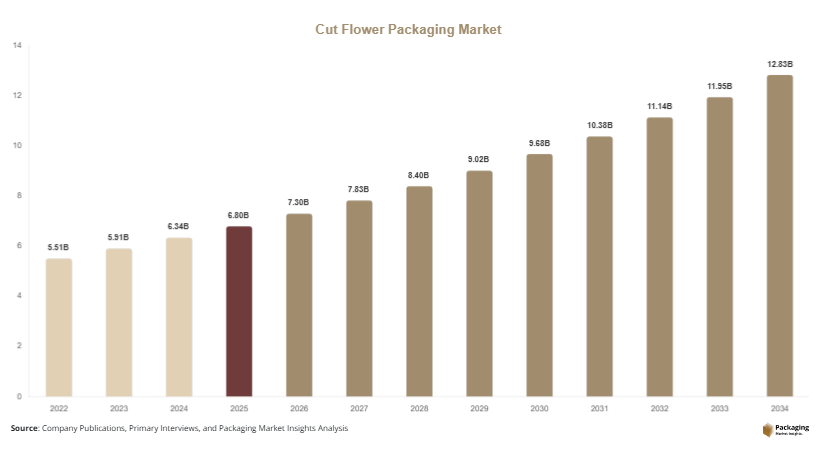
The global cut flower packaging market is estimated at USD 6.8 billion in 2025, and it is projected to reach approximately USD 7.3 billion in 2026. By 2034, the market is forecasted to reach USD 12.9 billion, registering a CAGR of 7.3% during the forecast period (2025–2034). Growth is primarily supported by expanding cross-border flower trade, increasing consumer preference for premium floral gifting, and the rising penetration of e-commerce flower delivery platforms.
Three major growth factors are shaping the market. First, the rapid expansion of online flower retailing is increasing demand for protective and aesthetically appealing packaging solutions. Second, sustainability regulations are encouraging the shift from plastic-based packaging toward recyclable and compostable alternatives. Third, technological improvements in moisture control films and temperature-resistant packaging are enhancing product shelf life during long-distance transportation.
Key Highlights:
- Asia Pacific dominated the market with a 37.4% share in 2025.
- Latin America is projected to grow at the fastest CAGR of 6.2%.
- Antioxidants led the type segment with a 29.6% share.
- Plastic packaging dominated with a 52.3% share.
- Food & beverage applications led the segment with 43.1% share.
- The US remained the dominant country in North America with a market size of USD 9.8 billion in 2025 and USD 10.4 billion in 2026.
Explore more data points, trends and opportunities Download Free Sample Report
Market Trends
Shift Toward Sustainable and Biodegradable Packaging
One of the most significant trends in the cut flower packaging market is the transition from conventional plastic packaging to biodegradable and compostable alternatives. This shift is primarily driven by environmental regulations and consumer awareness regarding plastic waste. Manufacturers are increasingly adopting materials such as plant-based polymers, kraft paper wraps, and recycled cardboard sleeves to reduce environmental impact. For example, flower exporters in the Netherlands have started replacing polyethylene wraps with starch-based films to comply with EU sustainability targets. In addition, retail florists in urban markets are increasingly promoting eco-friendly packaging as part of their brand identity. This trend is expected to significantly reshape procurement strategies across the supply chain, encouraging material innovation and cost optimization over the forecast period.
Integration of Smart and Functional Packaging Solutions
Another emerging trend is the adoption of smart packaging technologies that enhance product traceability and freshness monitoring. QR-coded packaging, humidity indicators, and temperature-sensitive labels are being integrated into floral packaging systems to improve supply chain transparency. For instance, exporters in Kenya are using QR-coded sleeves that allow buyers to trace flower origin, harvest time, and logistics history. This is particularly important for high-value flower exports to Europe and North America, where quality assurance standards are strict. In the future, the integration of IoT-enabled packaging is expected to become more common, enabling real-time monitoring of flower conditions during transit and reducing post-harvest losses.
Market Drivers
Expansion of Global Flower Trade and Export Logistics
The increasing globalization of the flower trade is a major driver of the cut flower packaging market. Countries such as Colombia, Ecuador, Kenya, and the Netherlands are leading exporters of cut flowers, requiring advanced packaging solutions to ensure product integrity during long-distance transportation. As air freight and refrigerated logistics expand, demand for durable, moisture-resistant packaging materials has increased. For example, Colombian rose exporters rely heavily on reinforced corrugated boxes with ventilation systems to maintain flower freshness during transatlantic shipping. This growing reliance on international supply chains is directly increasing demand for high-performance packaging formats that reduce spoilage and improve profitability.
Rising Demand for Premium Floral Gifting and Retail Presentation
Another key driver is the rising demand for premium floral gifting across urban populations. Consumers are increasingly purchasing flowers for weddings, corporate gifting, and lifestyle decoration, which has elevated the importance of packaging aesthetics. Retail florists are investing in visually appealing sleeves, ribbons, and branded wraps to enhance customer experience. For example, luxury florists in Japan and South Korea use minimalist, high-quality packaging to differentiate their offerings in competitive retail markets. This shift from basic protective packaging to premium presentation packaging is significantly expanding market value and encouraging design innovation.
Market Restraint
High Cost of Sustainable Packaging Materials
A major restraint in the cut flower packaging market is the relatively high cost of sustainable and biodegradable packaging materials compared to conventional plastic-based solutions. While environmentally friendly materials are gaining popularity, their production costs remain higher due to limited large-scale manufacturing and raw material constraints. Small and medium floriculture businesses often struggle to adopt these materials without affecting profit margins. For instance, florists in developing regions such as parts of Southeast Asia continue to rely on low-cost polyethylene wraps due to budget limitations. This cost disparity slows down the overall transition toward eco-friendly packaging, particularly in price-sensitive markets.
Market Opportunities
Growth of E-commerce Flower Delivery Platforms
The rapid expansion of e-commerce flower delivery services presents a significant opportunity for the cut flower packaging market. Online platforms require specialized packaging that ensures product protection during last-mile delivery while maintaining aesthetic appeal upon arrival. Companies such as online florists in India and the United States are investing in tamper-proof and water-retaining packaging formats to improve customer satisfaction. This shift is expected to drive demand for compact, lightweight, and durable packaging solutions optimized for logistics efficiency.
Adoption of Customized and Branded Packaging Solutions
Customization in floral packaging is emerging as a strong growth opportunity. Businesses are increasingly using branded packaging to enhance customer engagement and differentiate themselves in competitive markets. Customized sleeves with printed messages, logos, and seasonal themes are becoming common in retail floristry. For example, European florists are offering personalized wedding flower packaging that aligns with event themes. This trend is expected to expand further with digital printing advancements, enabling cost-effective short-run customization.
Report Scope
| Report Metric | Details |
|---|---|
| Market Size in 2025 | USD 6.8 Billion |
| Market Size in 2026 | USD 7.3 Billion |
| Market Size in 2034 | USD 12.9 Billion |
| CAGR | 7.3% (2026-2034) |
| Base Year for Estimation | 2025 |
| Historical Data | 2022-2024 |
| Forecast Period | 2026-2034 |
| Report Coverage | Revenue Forecast, Competitive Landscape, Supply Chain Disruption, Growth Factors, Environment & Regulatory Landscape and Trends |
| Geographies Covered | North America, Europe, APAC, Middle East and Africa, LATAM |
| Countries Covered | U.S., Canada, U.K., Germany, France, Spain, Italy, Russia, Nordic, Benelux, Rest of Europe, China, South Korea, Japan, India, Australia, Singapore, Taiwan, South East Asia, Rest of Asia-Pacific, UAE, Turky, Saudi Arabia, South Africa, Egypt, Nigeria, Rest of MEA, Brazil, Mexico, Argentina, Chile, Colombia, Rest of LATAM |
Explore more data points, trends and opportunities Download Free Sample Report
Segmental Analysis
By Type
The plastic packaging subsegment dominated the market in 2024 with approximately 52.3% share due to its durability, flexibility, and cost-effectiveness. Plastic sleeves and films are widely used in retail floristry and export packaging because they provide moisture retention and protection against physical damage. For example, supermarkets and wholesale flower distributors commonly use polypropylene wraps for roses and mixed bouquets. This dominance is also reinforced by the scalability of plastic production and its adaptability to various flower types and packaging formats. However, environmental concerns are gradually shifting preferences toward alternative materials.
The fastest-growing subsegment is antimicrobial and functional packaging additives, projected to grow at a CAGR of 6.5%. This growth is driven by increasing demand for extended flower shelf life and reduced post-harvest losses. Antimicrobial coatings are being integrated into packaging films to inhibit microbial growth and delay decay. For instance, exporters in Africa are adopting treated packaging to improve the export viability of sensitive flowers during long transit periods. In the future, bio-based antimicrobial solutions are expected to gain traction, improving both sustainability and performance.
By Material
Plastic materials dominated in 2024 with a 50% market share due to their widespread availability and cost efficiency. Plastic-based wraps, films, and sleeves remain essential in both domestic and export markets. Their ability to provide moisture control and structural protection makes them highly suitable for fragile cut flowers. Retail chains and wholesale distributors continue to rely on polyethylene and polypropylene solutions for large-scale operations. Despite environmental concerns, plastic remains dominant due to its performance advantages in logistics.
Paper-based materials are the fastest-growing segment, expected to grow at a CAGR of 5.9%. This growth is driven by sustainability initiatives and consumer preference for eco-friendly packaging. Kraft paper sleeves and recycled cardboard boxes are increasingly used in premium floral arrangements. For example, European florists are replacing plastic wraps with textured paper packaging to enhance aesthetic appeal and environmental compliance. Future growth will be supported by advancements in water-resistant paper coatings and recyclable composite materials.
By End-Use
The retail floristry segment dominated in 2024 with a 43.1% market share, driven by high consumer demand for decorative flowers in urban centers. Florists rely heavily on visually appealing packaging to enhance product presentation and customer satisfaction. Supermarkets, boutique flower shops, and online retailers all contribute to this dominance. For example, retail chains in the United States use branded packaging for seasonal flower promotions.
The healthcare and therapeutic use segment is the fastest-growing, projected to grow at a CAGR of 6.3%. This includes hospital decoration, wellness programs, and therapeutic horticulture initiatives. Flowers are increasingly used in healthcare environments to improve patient well-being, driving demand for hygienic and antimicrobial packaging. For instance, hospitals in Japan are adopting specially packaged floral arrangements to maintain hygiene standards while enhancing interior aesthetics. This segment is expected to expand significantly with rising awareness of therapeutic benefits.
Cut Flower Packaging Market Segmentations
By Type
- Plastic Packaging
- Paper-Based Packaging
- Biodegradable Packaging
- Functional Additive Packaging
By Material
- Plastic
- Paper & Paperboard
- Bioplastics
- Composite Materials
By End-Use
- Retail Floristry
- Online Flower Delivery
- Export & Wholesale Trade
- Hospitality & Events
- Healthcare & Therapeutic Use
Regional Analysis
North America
North America accounted for approximately 24.1% of the cut flower packaging market share in 2025, with a projected CAGR of 6.8% through 2034. The region benefits from high consumer spending on floral gifting, strong retail distribution networks, and advanced cold chain logistics. The United States dominates the regional market due to high demand from supermarkets, online flower retailers, and event management companies. Growth is also supported by increasing adoption of sustainable packaging materials in response to environmental regulations. Additionally, corporate gifting culture in the U.S. and Canada significantly contributes to consistent packaging demand across seasonal peaks such as Valentine’s Day and Mother’s Day.
The United States remains the dominant country in the region, driven by strong e-commerce penetration in floral retailing. A key growth driver is the increasing use of subscription-based flower delivery services, where packaging plays a crucial role in maintaining freshness over recurring deliveries. For example, companies offering weekly floral subscriptions use insulated and water-retaining packaging systems to ensure product quality. This subscription model is reshaping packaging innovation and increasing demand for standardized, scalable solutions.
Europe
Europe held a 28.3% share in 2025 and is expected to grow at a CAGR of 6.5%. The region is characterized by a well-established floriculture industry, particularly in the Netherlands, which serves as a global flower trading hub. Demand for sustainable packaging is especially strong due to strict EU environmental regulations. Growth is also supported by high flower consumption in countries such as Germany, France, and Italy.
The Netherlands is the dominant country in the region, driven by its large-scale flower auction systems and export-oriented floriculture industry. A unique growth driver is the integration of advanced packaging automation in flower auctions, where flowers are rapidly sorted, packed, and distributed globally. For example, Royal FloraHolland utilizes automated packaging systems to handle millions of flowers daily, ensuring efficiency and consistency in export quality.
Asia Pacific
Asia Pacific dominated the market with a 37.4% share in 2025 and is projected to grow at the highest CAGR of 7.9%. The region benefits from large-scale flower production in countries such as China, India, and Thailand. Rising disposable income, expanding urbanization, and cultural importance of flowers in festivals and ceremonies are key growth drivers. The region is also witnessing rapid expansion of online flower delivery platforms.
China leads the regional market due to its massive domestic consumption and strong export capabilities. A key growth driver is the increasing adoption of greenhouse cultivation, which ensures year-round flower supply and boosts packaging demand consistency. For example, Chinese floriculture hubs in Yunnan province are expanding export-oriented packaging facilities to support international shipments.
Middle East & Africa
The Middle East & Africa accounted for 7.6% of the market in 2025, growing at a CAGR of 6.4%. Growth is supported by increasing demand for luxury floral arrangements in Gulf countries and rising flower exports from African nations such as Kenya and Ethiopia. The region is also investing in cold chain logistics infrastructure to support international flower trade.
Kenya is the dominant country due to its strong rose export industry. A key growth driver is the expansion of air freight logistics connecting Nairobi to European markets. For example, Kenyan exporters rely on high-strength ventilated packaging to maintain flower quality during long-haul flights to Amsterdam.
Latin America
Latin America held a 10% market share in 2025 and is expected to grow at a CAGR of 6.2%, making it the fastest-growing region. Colombia and Ecuador dominate flower exports, particularly roses and carnations. Growth is supported by favorable climate conditions and expanding export infrastructure.
Colombia is the leading country in the region, driven by its strong export-oriented floriculture sector. A key growth driver is the increasing adoption of standardized export packaging systems that comply with European quality standards. For example, Colombian exporters use moisture-controlled corrugated boxes designed specifically for long-distance air freight shipments.
Competitive Landscape
The cut flower packaging market is moderately fragmented, with key players focusing on material innovation, sustainability, and supply chain integration. Leading companies include Amcor plc, Mondi Group, Smurfit Kappa, DS Smith, and International Paper. Among these, Amcor plc is considered a leading player due to its strong global presence and advanced flexible packaging solutions tailored for perishable goods.
Companies are increasingly investing in biodegradable packaging technologies, digital printing capabilities, and lightweight structural designs. Strategic collaborations with floriculture exporters and retail chains are becoming common to develop customized packaging solutions. For example, Smurfit Kappa has expanded its sustainable packaging portfolio targeting the floral export industry in Europe and Latin America.
Recent developments include expansion of production facilities in emerging markets, investment in recyclable material research, and integration of smart labeling systems. Companies are also focusing on reducing packaging waste and improving logistics efficiency through design optimization.
Key Players List
- Amcor plc
- Mondi Group
- Smurfit Kappa Group
- DS Smith Plc
- International Paper Company
- WestRock Company
- Berry Global Inc.
- Huhtamaki Oyj
- Stora Enso Oyj
- Uflex Ltd
- Sealed Air Corporation
- Reynolds Group Holdings
- Coveris Holdings
- Transcontinental Inc.
- Sonoco Products Company