Fresh Food Packaging Market Size and Growth
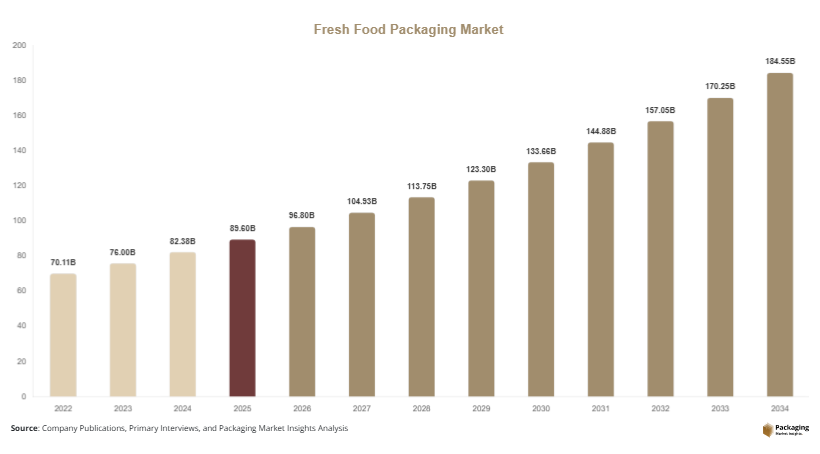
The global Fresh Food Packaging Market size was valued at USD 89.6 billion in 2025 and is projected to reach USD 96.8 billion in 2026, further expanding to USD 185.4 billion by 2034, registering a CAGR of 8.4% during 2025–2034. Increasing consumption of fresh and minimally processed food products is driving the demand for efficient packaging solutions that preserve quality and freshness. The fresh food packaging market is witnessing steady expansion due to rising demand for safe, hygienic, and extended shelf-life packaging solutions across the global food supply chain.
One of the key growth factors is the rising consumer preference for fresh fruits, vegetables, meat, and dairy products, which require specialized packaging to maintain product integrity. Packaging solutions such as modified atmosphere packaging (MAP), vacuum packaging, and breathable films are increasingly being adopted to extend shelf life and reduce food waste. Additionally, the rapid expansion of organized retail and e-commerce grocery platforms is boosting the demand for robust packaging systems that ensure safe transportation and storage.
Key Highlights:
- Market size is projected to reach USD 185.4 billion by 2034, reflecting steady expansion across global markets. This growth highlights increasing investments in packaging innovation and infrastructure to support fresh food distribution.
- The market is expected to grow at a CAGR of 8.4% during 2025–2034, driven by evolving consumer preferences and industry advancements. Consistent demand across developed and emerging economies supports this growth trajectory.
- Rising demand for fresh and minimally processed food products is significantly contributing to market expansion. Consumers are increasingly prioritizing health, nutrition, and convenience in their food choices.
- Increasing adoption of advanced packaging technologies, such as modified atmosphere packaging and smart labeling, is enhancing product shelf life. These innovations help maintain freshness and improve supply chain efficiency.
- Growing focus on sustainability and food safety is encouraging the use of eco-friendly and compliant packaging materials. Regulatory pressure and consumer awareness are accelerating the shift toward recyclable and biodegradable solutions.
Explore more data points, trends and opportunities Download Free Sample Report
Market Trends
Increasing Adoption of Modified Atmosphere Packaging (MAP)
Modified atmosphere packaging is gaining significant traction in the fresh food packaging market due to its ability to extend shelf life and maintain product quality. This technology involves altering the composition of gases within the packaging to slow down the growth of microorganisms and oxidation processes. MAP is widely used for packaging fresh produce, meat, and seafood, where maintaining freshness is critical. The growing demand for longer shelf life and reduced food waste is encouraging the adoption of this technology across the food industry.
In addition, advancements in gas barrier films and packaging equipment are improving the efficiency and reliability of MAP solutions. Companies are investing in research and development to enhance the performance of these systems, making them more cost-effective and accessible. As consumers continue to seek fresh and high-quality food products, the adoption of MAP is expected to increase steadily.
Growing Focus on Sustainable Packaging Materials
Sustainability is becoming a key trend in the fresh food packaging market, with increasing emphasis on reducing environmental impact. Manufacturers are adopting biodegradable, recyclable, and compostable materials to meet regulatory requirements and consumer preferences. Packaging solutions made from paper, bioplastics, and other renewable materials are gaining popularity as alternatives to conventional plastic packaging.
Moreover, companies are exploring innovative approaches such as lightweight packaging and material reduction to minimize waste. The integration of sustainability into packaging design is not only helping companies comply with regulations but also enhancing brand reputation. As environmental concerns continue to rise, the demand for sustainable fresh food packaging solutions is expected to grow significantly.
Market Drivers
Rising Demand for Fresh and Convenient Food Products
The increasing demand for fresh and convenient food products is a major driver for the fresh food packaging market. Consumers are seeking ready-to-eat and easy-to-handle food options that maintain freshness and nutritional value. Packaging plays a critical role in ensuring the safety and quality of these products throughout the supply chain. As a result, manufacturers are adopting advanced packaging solutions that provide protection, convenience, and extended shelf life.
Additionally, the growth of urbanization and changing lifestyles are influencing consumer behavior, leading to higher consumption of packaged fresh foods. The expansion of supermarkets, hypermarkets, and online grocery platforms is further supporting market growth. These factors are driving the demand for innovative packaging solutions that cater to evolving consumer needs.
Expansion of Cold Chain and Logistics Infrastructure
The development of cold chain and logistics infrastructure is significantly contributing to the growth of the fresh food packaging market. Efficient cold chain systems are essential for maintaining the quality and safety of perishable food products during transportation and storage. Packaging solutions that are compatible with these systems are in high demand.
Furthermore, investments in refrigeration, transportation, and storage facilities are enabling the distribution of fresh food products over longer distances. This is increasing the need for packaging solutions that provide insulation, durability, and protection. As the global food supply chain becomes more complex, the demand for reliable fresh food packaging is expected to rise.
Market Restraint
Environmental Concerns Related to Plastic Packaging
One of the major restraints in the fresh food packaging market is the environmental impact of plastic packaging materials. Traditional plastic packaging is widely used due to its durability and cost-effectiveness, but it contributes significantly to environmental pollution. Increasing awareness about plastic waste and its impact on ecosystems is leading to stricter regulations and consumer pressure to reduce plastic usage.
For example, several countries have implemented bans or restrictions on single-use plastics, affecting the availability and usage of conventional packaging materials. This is creating challenges for manufacturers who rely on plastic packaging for its performance and cost advantages. Transitioning to sustainable alternatives often involves higher costs and technical complexities, which can hinder market growth.
Despite these challenges, companies are actively exploring innovative solutions such as biodegradable plastics and recyclable materials. However, achieving the same level of performance as traditional plastics remains a key challenge, limiting the widespread adoption of alternative materials in the short term.
Market Opportunities
Development of Smart Packaging Solutions
The integration of smart technologies into fresh food packaging presents significant growth opportunities. Smart packaging solutions, such as temperature indicators, freshness sensors, and QR codes, provide real-time information about product conditions. These technologies enhance transparency and enable better monitoring of food quality throughout the supply chain.
Moreover, smart packaging can help reduce food waste by providing accurate information about product freshness. Retailers and consumers can make informed decisions, improving efficiency and sustainability. As technology continues to advance, the adoption of smart packaging solutions is expected to increase, creating new opportunities for market players.
Growth in Emerging Markets
Emerging markets offer substantial opportunities for the fresh food packaging market due to rapid urbanization, rising incomes, and changing consumer preferences. Countries in Asia Pacific, Latin America, and Africa are experiencing increased demand for packaged fresh food products. This is driving the need for efficient and affordable packaging solutions.
Additionally, the expansion of retail infrastructure and e-commerce platforms in these regions is supporting market growth. Companies can leverage these opportunities by introducing cost-effective and innovative packaging solutions tailored to local needs. As emerging markets continue to develop, they are expected to contribute significantly to the growth of the fresh food packaging market.
Report Scope
| Report Metric | Details |
|---|---|
| Market Size in 2025 | USD 89.6 Billion |
| Market Size in 2026 | USD 96.8 Billion |
| Market Size in 2034 | USD 185.4 Billion |
| CAGR | 8.4% (2026-2034) |
| Base Year for Estimation | 2025 |
| Historical Data | 2022-2024 |
| Forecast Period | 2026-2034 |
| Report Coverage | Revenue Forecast, Competitive Landscape, Supply Chain Disruption, Growth Factors, Environment & Regulatory Landscape and Trends |
| Geographies Covered | North America, Europe, APAC, Middle East and Africa, LATAM |
| Countries Covered | U.S., Canada, U.K., Germany, France, Spain, Italy, Russia, Nordic, Benelux, Rest of Europe, China, South Korea, Japan, India, Australia, Singapore, Taiwan, South East Asia, Rest of Asia-Pacific, UAE, Turky, Saudi Arabia, South Africa, Egypt, Nigeria, Rest of MEA, Brazil, Mexico, Argentina, Chile, Colombia, Rest of LATAM |
Explore more data points, trends and opportunities Download Free Sample Report
Segmental Analysis
By Packaging Type
The flexible packaging segment dominated the Fresh Food Packaging Market in 2024, accounting for approximately 46.3% of the total market share. Flexible packaging solutions, such as pouches, films, and wraps, are widely used due to their cost-effectiveness, lightweight nature, and ability to extend shelf life. These packaging formats provide excellent barrier properties against moisture, oxygen, and contaminants, making them suitable for fresh food applications. Additionally, the growing demand for convenient and portable packaging formats is further driving the adoption of flexible packaging in the market.
The rigid packaging segment is expected to be the fastest-growing segment, registering a CAGR of 7.1% during the forecast period. This growth is driven by increasing demand for durable and protective packaging solutions for fresh food products. Rigid packaging formats, such as trays, containers, and clamshells, offer enhanced structural integrity and protection during transportation. The rising use of recyclable and reusable rigid materials is also contributing to the growth of this segment.
By Material
Plastic materials dominated the Fresh Food Packaging Market in 2024, holding a market share of around 52.7%. Plastics are widely used due to their versatility, durability, and cost-effectiveness. They provide excellent barrier properties and can be easily molded into various shapes and sizes, making them suitable for different packaging requirements. Additionally, advancements in plastic technologies, such as high-performance polymers, are enhancing the functionality of packaging solutions.
Biodegradable materials are projected to be the fastest-growing segment, with a CAGR of 8.2% during the forecast period. The increasing focus on sustainability and environmental concerns is driving the adoption of biodegradable packaging materials. Governments and regulatory bodies are encouraging the use of eco-friendly alternatives to reduce plastic waste. As a result, manufacturers are investing in the development of innovative biodegradable materials that offer similar performance to traditional plastics.
By Application
The fruits and vegetables segment held the largest share of the Fresh Food Packaging Market in 2024, accounting for approximately 38.9% of the total market. The high consumption of fresh produce and the need to maintain its freshness and quality during transportation are driving demand for packaging solutions in this segment. Packaging solutions for fruits and vegetables often include breathable films and modified atmosphere packaging, which help extend shelf life.
The ready-to-eat foods segment is expected to be the fastest-growing segment, with a CAGR of 7.6% during the forecast period. The increasing demand for convenience foods and busy lifestyles are driving the growth of this segment. Ready-to-eat food products require packaging solutions that ensure product safety, freshness, and ease of use. Innovations in packaging technologies, such as microwaveable and resealable packaging, are further supporting the growth of this segment.
Fresh Food Packaging Market Segmentations
By Type
- Rigid Packaging
- Flexible Packaging
By Application
- Fruits & Vegetables
- Meat & Seafood
- Dairy Products
By Material
- Plastic
- Paper & Paperboard
- Biodegradable Materials
Regional Analysis
North America
North America accounted for a significant share of the Fresh Food Packaging Market in 2025, contributing approximately 32.5% of the global market revenue. The region is projected to grow at a CAGR of 6.5% during the forecast period, driven by strong demand for packaged fresh food and advanced retail infrastructure. The presence of large supermarket chains and increasing consumer preference for convenience foods continue to support market growth. Moreover, technological advancements in packaging materials and cold chain logistics enhance product shelf life and quality.
The United States dominates the North American market due to its well-established food processing and packaging industry. A key growth factor in the country is the rising adoption of modified atmosphere packaging (MAP) and vacuum packaging technologies, which help maintain food freshness. Additionally, growing awareness regarding food safety and hygiene standards among consumers and regulatory authorities is further accelerating demand for innovative fresh food packaging solutions.
Europe
Europe holds a considerable share of the Fresh Food Packaging Market, accounting for around 27.8% in 2025, and is expected to grow at a CAGR of 6.2% during the forecast period. The region’s growth is supported by stringent food safety regulations and increasing consumer demand for sustainable packaging solutions. European countries are actively promoting eco-friendly materials, which is encouraging manufacturers to invest in recyclable and biodegradable packaging formats.
Germany is the leading market in Europe, supported by its strong manufacturing base and advanced packaging technologies. A unique growth factor in the region is the strict regulatory framework focusing on reducing plastic waste and encouraging circular economy practices. This has led to increased adoption of paper-based and compostable packaging solutions for fresh food products, boosting market growth significantly.
Asia Pacific
Asia Pacific is the fastest-growing region in the Fresh Food Packaging Market, with a market share of approximately 24.6% in 2025 and a projected CAGR of 7.8% through 2034. Rapid urbanization, increasing disposable incomes, and changing dietary habits are key factors driving demand for fresh food packaging. The expansion of organized retail and e-commerce platforms is also contributing to the growth of packaging solutions that ensure product freshness and safety during transportation.
China dominates the Asia Pacific market due to its large population and growing food consumption patterns. A major growth factor is the rapid expansion of cold chain logistics infrastructure, which supports the distribution of perishable food products. Additionally, increasing investments in food processing industries and rising awareness of food safety standards are further driving demand for innovative packaging solutions.
Middle East & Africa
The Middle East & Africa region is witnessing steady growth in the Fresh Food Packaging Market, holding a share of around 7.2% in 2025 and expected to grow at a CAGR of 6.7%. The growth is driven by increasing urbanization and the expansion of modern retail channels. Rising demand for packaged fresh food products in urban areas is contributing to the adoption of advanced packaging solutions.
Saudi Arabia is a dominant country in this region, supported by its growing food retail sector. A unique growth factor is the increasing reliance on imported food products, which require efficient packaging solutions to maintain freshness during long-distance transportation. This has led to increased demand for high-quality packaging materials and technologies.
Latin America
Latin America accounted for approximately 7.9% of the Fresh Food Packaging Market in 2025 and is projected to grow at a CAGR of 6.4% during the forecast period. The region’s growth is driven by rising demand for packaged food products and improving retail infrastructure. Increasing consumer awareness regarding food safety and quality is also supporting market expansion.
Brazil leads the Latin American market due to its large agricultural sector and growing food processing industry. A key growth factor is the increasing export of fresh produce, which requires reliable packaging solutions to ensure product quality during transportation. Additionally, advancements in packaging technologies and materials are contributing to market growth in the region.
Competitive Landscape
The fresh food packaging market is moderately competitive with key players focusing on innovation, sustainability, and expansion strategies. Amcor plc is a leading player, emphasizing recyclable packaging solutions and advanced technologies. Companies are investing in R&D and partnerships to strengthen their market position and address evolving consumer demands.
Key Players List
- Amcor plc
- Berry Global Inc.
- Sealed Air Corporation
- Sonoco Products Company
- Smurfit Kappa Group
- Mondi Group
- DS Smith plc
- Coveris Holdings S.A.
- UFlex Ltd.
- Winpak Ltd.
- Huhtamaki Oyj
- WestRock Company
- Graphic Packaging International
- Tetra Pak International
- Bemis Company