Reclosable Zipper Market Size and Growth
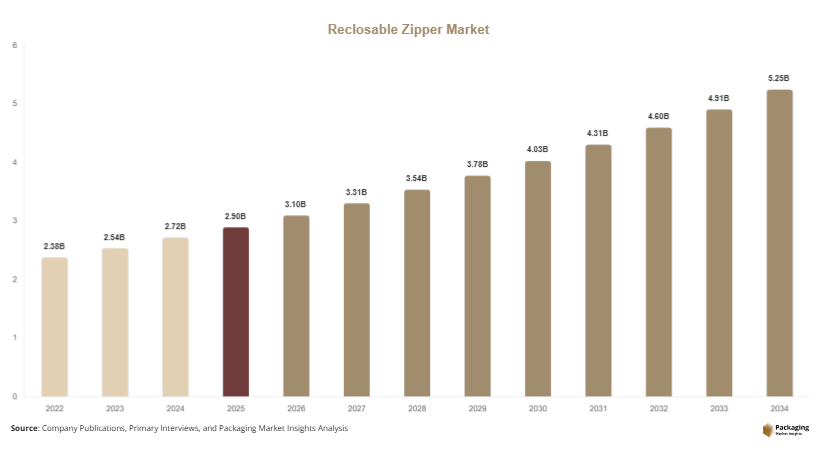
The global reclosable zipper market size is estimated at USD 2.9 billion in 2025, which is projected to reach USD 3.1 billion in 2026. Over the forecast period from 2025 to 2034, the market is expected to reach USD 5.6 billion in 2034, registering a CAGR of 6.8%. The reclosable zipper market is expanding steadily as demand for flexible and convenient packaging solutions increases across industries such as food & beverage, pharmaceuticals, personal care, and household products. Reclosable zippers are widely used in flexible packaging formats, including pouches and bags, to enhance product usability, extend shelf life, and improve consumer convenience.
The increasing demand for convenience-driven packaging is a primary factor driving the growth of the reclosable zipper market. Consumers are seeking packaging that allows easy opening, resealing, and storage, especially for food products. Reclosable zippers meet these needs by maintaining product freshness and reducing waste. The growing popularity of flexible packaging solutions is also contributing to market growth, as they offer cost efficiency, lightweight properties, and ease of transportation.
Key Market Insights:
- Asia Pacific dominated the market with a 39.1% share in 2025.
- Latin America is projected to grow at the fastest CAGR of 7.2%.
- Press-to-close zippers led the type segment with a 44.8% share.
- Plastic materials dominated with a 82.6% share.
- Food & beverage applications led the segment with 52.4% share.
- China remained the dominant country with a market size of USD 0.9 billion in 2025 and USD 1.0 billion in 2026.
Explore more data points, trends and opportunities Download Free Sample Report
Market Trends
Increasing adoption of flexible and convenience-oriented packaging formats
The growing demand for flexible packaging is significantly influencing the reclosable zipper market. Consumers prefer packaging that is easy to use, resealable, and suitable for on-the-go consumption. Reclosable zippers provide convenience by allowing repeated opening and closing without compromising product integrity. For example, snack food manufacturers are increasingly using zipper pouches to enhance usability and extend shelf life.
This trend is expected to strengthen as urbanization and busy lifestyles drive demand for convenient packaging solutions. In the future, innovations in zipper design and integration with flexible packaging formats will further enhance functionality. Companies are likely to focus on user-friendly features to improve consumer satisfaction.
Rising focus on sustainable and recyclable packaging solutions
Sustainability is becoming a key trend in the packaging industry, influencing the adoption of eco-friendly zipper solutions. Manufacturers are developing recyclable and biodegradable materials to reduce environmental impact. For instance, companies are introducing zippers made from mono-material structures that facilitate recycling.
The future impact of this trend includes increased investment in sustainable materials and production processes. Regulatory pressures and consumer awareness are expected to drive the adoption of eco-friendly packaging solutions. This shift will support long-term growth and innovation in the market.
Market Drivers
Expansion of the packaged food industry
The growth of the packaged food industry is a major driver of the reclosable zipper market. Consumers are increasingly purchasing packaged food products that require convenient and resealable packaging. Reclosable zippers help maintain freshness and prevent contamination, making them suitable for food applications.
For example, snack and frozen food manufacturers use zipper pouches to enhance product shelf life and convenience. The increasing demand for packaged food is expected to drive market growth. As consumption patterns evolve, the need for resealable packaging will increase.
Growth of e-commerce and retail distribution channels
The expansion of e-commerce and retail distribution channels is driving demand for durable and user-friendly packaging solutions. Reclosable zippers are widely used in packaging products that require secure sealing and easy access.
For instance, personal care and household product manufacturers use zipper pouches for packaging detergents and cosmetics. The growth of online retail is increasing the need for packaging that protects products during transit. This trend is expected to support market growth.
Market Restraint
Challenges related to recycling and material compatibility
One of the key challenges in the reclosable zipper market is the difficulty in recycling multi-material packaging. Traditional zipper systems are often made from different materials than the packaging film, making recycling complex. This can limit the adoption of reclosable zippers in regions with strict environmental regulations.
For example, flexible packaging with integrated zippers may not be easily recyclable, leading to increased waste. Manufacturers are under pressure to develop compatible materials that support recycling. These challenges can impact market growth and require investment in innovation.
Market Opportunities
Development of mono-material and recyclable zipper solutions
The development of mono-material zipper systems presents significant opportunities in the market. These solutions are designed to be compatible with flexible packaging materials, enabling easier recycling.
For instance, companies are developing polyethylene-based zippers that can be recycled along with packaging films. This innovation is expected to gain traction as sustainability becomes a priority. In the future, advancements in material science will support the development of eco-friendly packaging solutions.
Expansion in emerging markets and new application areas
Emerging markets offer growth opportunities for the reclosable zipper market. Increasing disposable income and urbanization are driving demand for packaged goods. This is creating a need for convenient packaging solutions.
For example, countries in Asia Pacific and Latin America are experiencing growth in the food and beverage industry. The expansion of these industries is expected to drive demand for reclosable zippers. In the future, new applications in pharmaceuticals and personal care products will further support market growth.
Report Scope
| Report Metric | Details |
|---|---|
| Market Size in 2025 | USD 2.9 Billion |
| Market Size in 2026 | USD 3.1 Billion |
| Market Size in 2034 | USD 5.6 Billion |
| CAGR | 6.8% (2026-2034) |
| Base Year for Estimation | 2025 |
| Historical Data | 2022-2024 |
| Forecast Period | 2026-2034 |
| Report Coverage | Revenue Forecast, Competitive Landscape, Supply Chain Disruption, Growth Factors, Environment & Regulatory Landscape and Trends |
| Geographies Covered | North America, Europe, APAC, Middle East and Africa, LATAM |
| Countries Covered | U.S., Canada, U.K., Germany, France, Spain, Italy, Russia, Nordic, Benelux, Rest of Europe, China, South Korea, Japan, India, Australia, Singapore, Taiwan, South East Asia, Rest of Asia-Pacific, UAE, Turky, Saudi Arabia, South Africa, Egypt, Nigeria, Rest of MEA, Brazil, Mexico, Argentina, Chile, Colombia, Rest of LATAM |
Explore more data points, trends and opportunities Download Free Sample Report
Segmental Analysis
By Type
Press-to-close zippers dominated the market in 2024 with a 44.8% share, driven by their cost efficiency and ease of use. These zippers are widely used in food packaging applications, including snacks and frozen products. For example, manufacturers use press-to-close zippers in flexible pouches to enhance convenience.
Slider zippers are the fastest-growing segment, with a projected CAGR of 7.0%. These zippers offer improved functionality and user experience. The growth is driven by increasing demand for premium packaging solutions. Future innovations are expected to enhance performance.
By Material
Plastic materials dominated the market with a 82.6% share in 2024, driven by their durability and flexibility. These materials are widely used in zipper manufacturing due to their cost efficiency and compatibility with flexible packaging.
Biodegradable materials are the fastest-growing segment, with a CAGR of 7.5%. This growth is driven by sustainability concerns. Manufacturers are developing eco-friendly alternatives. Future advancements will support growth.
By End-Use
Food & beverage accounted for the largest share of 52.4% in 2024, driven by the need for convenient packaging. Reclosable zippers are widely used in food packaging to maintain freshness.
Pharmaceuticals is the fastest-growing segment, with a CAGR of 6.9%. The increasing demand for safe and secure packaging is driving growth. Reclosable zippers provide protection and convenience. This trend is expected to support market growth.
Reclosable Zipper Market Segmentations
By Type
- Press-to-Close Zippers
- Slider Zippers
- Velcro Zippers
- Child-Resistant Zippers
By Material
- Polyethylene
- Polypropylene
- Biodegradable Materials
By End-User
- Food & Beverage
- Healthcare
- Personal Care
- Industrial Packaging
Regional Analysis
North America
North America accounted for approximately 25.3% of the global market share in 2025 and is projected to grow at a CAGR of 6.1% through 2034. The region benefits from a well-developed packaging industry, high consumption of packaged foods, and strong presence of leading manufacturers. The increasing demand for convenience packaging and sustainable solutions is driving market growth. The rise of flexible packaging formats in the food and personal care sectors is further supporting demand for reclosable zippers.
The United States dominates the regional market due to its large consumer base and advanced retail infrastructure. A unique growth driver is the increasing adoption of resealable packaging in frozen and ready-to-eat food products. For example, food companies are using zipper pouches to improve product usability. This trend is expected to support market growth.
Europe
Europe held a 22.4% market share in 2025 and is expected to grow at a CAGR of 5.9% during the forecast period. The region’s focus on sustainability and strict environmental regulations is shaping the market. Countries such as Germany, France, and the UK are leading the adoption of recyclable packaging solutions.
Germany is the dominant country in the region, driven by its strong manufacturing base. A unique growth driver is the emphasis on circular economy practices. For instance, companies are adopting mono-material packaging solutions to improve recyclability. This trend is expected to support market growth.
Asia Pacific
Asia Pacific emerged as the largest regional market with a 39.1% share in 2025 and is projected to grow at a CAGR of 7.0%. Rapid urbanization, increasing disposable income, and expanding retail sectors are driving market growth. Countries such as China, India, and Japan are major contributors.
China dominates the region due to its large manufacturing base. A significant growth driver is the expansion of the packaged food industry. For example, local brands are adopting zipper packaging for snacks and ready meals. This trend is expected to support growth.
Middle East & Africa
The Middle East & Africa region accounted for 6.3% of the market share in 2025 and is expected to grow at a CAGR of 6.2%. The region’s growth is driven by increasing investments in retail and food industries.
The UAE is a key market due to its growing retail sector. A unique growth driver is the demand for premium packaging solutions in food and personal care products. This trend is expected to support market growth.
Latin America
Latin America held a 6.9% market share in 2025 and is projected to grow at the fastest CAGR of 7.2%. The region is experiencing growth due to expanding food and beverage industries.
Brazil dominates the market, supported by its large consumer base. A key growth driver is the increasing demand for convenient packaging in packaged foods. This trend is expected to support market growth.
Competitive Landscape
The reclosable zipper market is characterized by the presence of several global and regional players focusing on innovation and sustainability. Companies are investing in research and development to improve product performance and expand application areas.
Amcor Plc is identified as a leading player due to its strong portfolio and focus on sustainable packaging solutions. The company is investing in advanced materials and technologies. Other players are adopting strategies such as partnerships and acquisitions.
Recent developments include innovations in recyclable zipper systems and expansion of production capacities. Companies are focusing on automation and efficiency improvements. These strategies are expected to drive market growth.
Key Players
- Amcor Plc
- Berry Global Inc.
- Sealed Air Corporation
- Mondi Group
- Huhtamaki Oyj
- Coveris Holdings S.A.
- Constantia Flexibles
- Winpak Ltd.
- Glenroy Inc.
- Uflex Ltd.
- Flair Flexible Packaging Corporation
- Schur Flexibles Group
- Clondalkin Group
- ProAmpac LLC
- Dai Nippon Printing Co., Ltd.