Contract Packaging Market Size and Growth
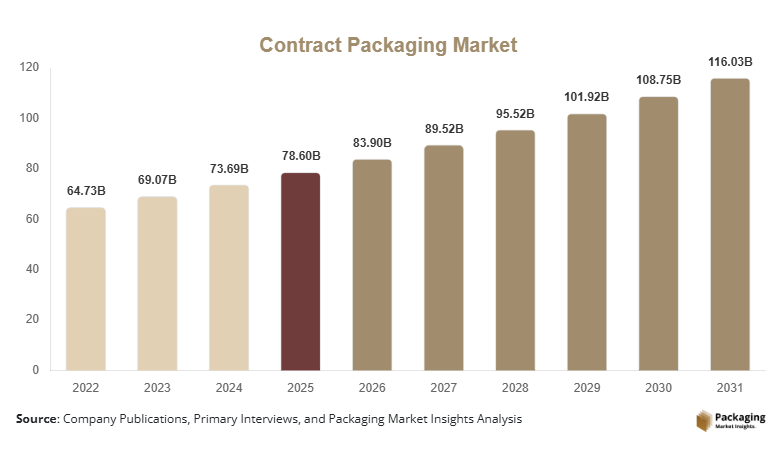
The Contract Packaging Market was valued at USD 78.6 billion in 2025 and is projected to reach USD 109.4 billion by 2030, registering a compound annual growth rate (CAGR) of 6.7% during the forecast period 2025–2031. Contract packaging, also known as co-packing, refers to outsourced packaging services provided by specialized companies that package products for manufacturers across industries such as food & beverages, pharmaceuticals, personal care, and consumer goods. The growing preference among manufacturers to outsource non-core operations has strengthened the demand for contract packaging services globally.
A key global factor supporting the expansion of the Contract Packaging Market is the rapid growth of outsourced manufacturing and supply chain optimization strategies. Companies increasingly rely on third-party packaging providers to reduce capital expenditure on packaging infrastructure, accelerate time-to-market, and maintain operational flexibility. Contract packagers offer services including primary packaging, secondary packaging, labeling, kitting, assembly, and fulfillment, allowing brands to focus on product innovation and marketing.
The Contract Packaging Market has also benefited from rising demand for customized packaging formats and multi-product bundling solutions, particularly within the e-commerce and retail sectors. Service providers have expanded capabilities in automation, flexible packaging, and sustainable packaging solutions to meet evolving customer requirements.
Key Highlights
- North America held the dominant share of 34.2% in 2025, while Asia Pacific is projected to register the fastest growth with a CAGR of 7.9% during the forecast period.
- By service type, primary packaging services accounted for the largest share of 38.6% in 2024, while fulfillment and logistics services are expected to grow at the fastest CAGR of 8.2%.
- By end-use industry, the food & beverage segment dominated with 31.4% share, while the pharmaceutical segment is projected to grow at 8.5% CAGR.
- The United States remained the dominant country market, valued at USD 21.3 billion in 2025 and USD 22.6 billion in 2026.
Explore more data points, trends and opportunities Download Free Sample Report
Market Trends
Integration of Automation and Smart Packaging Technologies
Automation and advanced packaging technologies are reshaping the Contract Packaging Market. Contract packaging providers are increasingly integrating automated packaging lines, robotics, and digital quality control systems to improve operational efficiency and maintain consistent packaging standards. Automation enables faster production cycles, reduced labor dependency, and improved scalability for high-volume packaging projects.
Smart packaging solutions such as QR-coded labels, RFID tags, and traceability systems are also becoming more common. These technologies allow brands to enhance supply chain visibility, improve inventory management, and provide consumers with product authentication and transparency. Contract packagers offering technology-enabled packaging services are gaining strategic importance for manufacturers seeking digital supply chain integration.
Growth of Sustainable and Eco-Friendly Packaging Solutions
Sustainability initiatives are influencing packaging outsourcing decisions. Brands are working with contract packaging providers that offer environmentally responsible packaging solutions, including recyclable materials, biodegradable packaging, and reduced material usage.
Contract packagers are investing in sustainable packaging design capabilities and material optimization processes to align with regulatory requirements and corporate sustainability goals. Lightweight packaging, mono-material flexible packaging, and reusable packaging solutions are increasingly being integrated into contract packaging operations.
As companies adopt circular economy principles, contract packaging providers with sustainability expertise are becoming important partners in reducing environmental impact across packaging supply chains.
Market Drivers
Increasing Outsourcing of Packaging Operations
The growing outsourcing trend among manufacturers is a major factor supporting the expansion of the Contract Packaging Market. Companies across industries are outsourcing packaging processes to reduce operational complexity and avoid heavy investments in packaging equipment, facilities, and labor.
Contract packaging service providers offer specialized infrastructure, experienced workforce, and scalable production capabilities. This allows manufacturers to adapt to fluctuating product demand while maintaining operational efficiency. Outsourcing packaging operations also enables companies to focus resources on core activities such as research, product development, and marketing.
The flexibility offered by contract packaging services makes them particularly attractive for seasonal products, promotional packaging, and new product launches.
Expanding Product Variety in Consumer Markets
The increasing variety of consumer products is driving demand for flexible packaging services. Manufacturers frequently introduce new product variants, limited-edition packaging, and promotional bundles to attract consumers.
Contract packaging providers help companies manage these product variations efficiently by offering specialized services such as kitting, repackaging, labeling, and product assembly. These services enable brands to adapt packaging formats quickly without altering their internal production lines.
The rising number of product SKUs across industries such as food, cosmetics, and pharmaceuticals continues to increase the demand for specialized contract packaging services.
Market Restraint
Quality Control and Compliance Challenges
Quality assurance and regulatory compliance present notable challenges for the Contract Packaging Market. Contract packaging providers must adhere to strict quality standards, especially in regulated industries such as pharmaceuticals, food, and medical devices.
Maintaining consistent packaging quality across outsourced operations can be complex, particularly when multiple packaging processes are involved. Any quality issues or labeling errors may result in product recalls, regulatory penalties, and reputational risks for brand owners.
Contract packaging companies must comply with industry regulations related to product safety, labeling requirements, and traceability. Regulatory frameworks differ across regions, requiring contract packagers to maintain compliance with multiple standards and certification requirements.
Additionally, maintaining standardized quality control systems across high-volume operations can increase operational costs. Companies are therefore investing in advanced inspection systems and quality management processes to mitigate risks associated with outsourced packaging activities.
Market Opportunities
Expansion of E-Commerce Fulfillment Packaging
The continued growth of online retail presents an opportunity for the Contract Packaging Market. E-commerce companies require specialized packaging services such as product bundling, subscription box packaging, and direct-to-consumer fulfillment.
Contract packaging providers are increasingly offering integrated services including packaging, warehousing, labeling, and order fulfillment to support e-commerce logistics operations. These services help online retailers streamline product packaging and distribution.
As direct-to-consumer business models continue to expand, contract packaging providers offering customized fulfillment solutions are expected to experience increased demand.
Rising Demand for Pharmaceutical Packaging Services
Pharmaceutical companies are increasingly partnering with contract packaging providers to manage packaging operations for prescription drugs, over-the-counter products, and medical supplies.
Contract packagers provide specialized capabilities such as sterile packaging, tamper-evident packaging, blister packaging, and serialized labeling systems. These services help pharmaceutical companies comply with regulatory requirements while maintaining operational efficiency.
The rising production of pharmaceutical products and vaccines is expected to create new growth opportunities for contract packaging providers that offer high-compliance packaging services.
Report Scope
| Report Metric | Details |
|---|---|
| Market Size in 2025 | USD 78.6 Billion |
| Market Size in 2026 | USD 83.9 Billion |
| Market Size in 2031 | USD 115.8 Billion |
| CAGR | 6.7% (2026-2031) |
| Base Year for Estimation | 2025 |
| Historical Data | 2022-2024 |
| Forecast Period | 2026-2031 |
| Report Coverage | Revenue Forecast, Competitive Landscape, Supply Chain Disruption, Growth Factors, Environment & Regulatory Landscape and Trends |
| Geographies Covered | North America, Europe, APAC, Middle East and Africa, LATAM |
| Countries Covered | U.S., Canada, U.K., Germany, France, Spain, Italy, Russia, Nordic, Benelux, Rest of Europe, China, South Korea, Japan, India, Australia, Singapore, Taiwan, South East Asia, Rest of Asia-Pacific, UAE, Turky, Saudi Arabia, South Africa, Egypt, Nigeria, Rest of MEA, Brazil, Mexico, Argentina, Chile, Colombia, Rest of LATAM |
Explore more data points, trends and opportunities Download Free Sample Report
Segmental Analysis
By Service Type
The Contract Packaging Market is segmented by service type into primary packaging, secondary packaging, tertiary packaging, and fulfillment & logistics services.
Primary packaging services accounted for the largest share of 38.6% in 2024. This segment includes packaging processes that directly enclose products such as bottle filling, blister packaging, pouch packaging, and sachet packaging. Primary packaging services have historically dominated the market due to their importance in product protection, branding, and regulatory labeling.
Fulfillment and logistics services are projected to grow at the fastest CAGR of 8.2% during the forecast period. This segment will expand as contract packaging providers increasingly integrate packaging operations with warehousing, order processing, and distribution services. The demand for integrated packaging and logistics services will continue to increase as companies seek streamlined supply chain solutions.
By Packaging Format
Based on packaging format, the Contract Packaging Market is segmented into flexible packaging, rigid packaging, and hybrid packaging formats.
Flexible packaging held the dominant share of 41.2% in 2024. Flexible packaging formats include pouches, films, and sachets widely used in food products, personal care items, and pharmaceuticals. These packaging formats have historically been preferred due to lower material consumption and convenient product storage.
Hybrid packaging formats are expected to register the fastest CAGR of 7.8% during the forecast period. Hybrid packaging combines elements of flexible and rigid packaging materials to enhance product protection and visual appeal. Contract packaging providers will increasingly adopt hybrid packaging solutions to support diverse product packaging requirements.
By End-Use Industry
The market is segmented by end-use industry into food & beverages, pharmaceuticals, personal care & cosmetics, household products, and electronics.
The food & beverage industry dominated the Contract Packaging Market with 31.4% share in 2024. The segment has historically relied on contract packaging services for processes such as filling, labeling, repackaging, and promotional packaging.
The pharmaceutical segment is expected to grow at the fastest CAGR of 8.5% during the forecast period. Pharmaceutical packaging requires strict quality control, serialized labeling, and tamper-evident packaging solutions. Contract packaging providers offering specialized pharmaceutical packaging capabilities will experience increasing demand in the coming years.
Contract Packaging Market Segmentations
By Service Type
- Primary Packaging
- Secondary Packaging
- Tertiary Packaging
- Fulfillment & Logistics Services
By Packaging Format
- Flexible Packaging
- Rigid Packaging
- Hybrid Packaging
By End-Use Industry
- Food & Beverages
- Pharmaceuticals
- Personal Care & Cosmetics
- Household Products
- Electronics
Regional Analysis
North America
North America accounted for 34.2% of the global Contract Packaging Market share in 2025, reflecting a strong presence of established contract packaging service providers and advanced packaging infrastructure. The region has historically demonstrated steady demand for outsourced packaging services due to the concentration of consumer goods manufacturers and pharmaceutical companies. During the forecast period, the region will expand at a CAGR of approximately 6.1% between 2025 and 2033.
The United States dominated the regional market due to the large presence of food processing companies, pharmaceutical manufacturers, and personal care brands. The country’s advanced supply chain infrastructure and established contract packaging industry have supported consistent demand for packaging outsourcing services. Additionally, the increasing number of product launches in consumer packaged goods industries continues to sustain demand for specialized packaging solutions.
Europe
Europe represented 26.4% of the global Contract Packaging Market in 2025. The region has historically demonstrated strong adoption of contract packaging services across industries including pharmaceuticals, cosmetics, and food products. The market will grow at a CAGR of around 6.4% during the forecast period.
Germany emerged as the leading country market in Europe. The country’s strong manufacturing sector and well-developed pharmaceutical industry have created consistent demand for outsourced packaging services. German contract packaging providers are known for precision packaging technologies and compliance with strict regulatory standards.
Asia Pacific
Asia Pacific held 23.8% of the global Contract Packaging Market share in 2025. The region has been experiencing increasing demand for packaging services as manufacturing industries continue to expand. The market will register the fastest CAGR of 7.9% through 2033.
China dominated the regional market due to the country’s large-scale manufacturing ecosystem and growing consumer goods industry. The presence of numerous food processing companies, electronics manufacturers, and pharmaceutical firms has increased demand for contract packaging services.
Middle East & Africa
The Middle East & Africa accounted for 7.1% of the global Contract Packaging Market in 2025. The market has gradually developed due to the expansion of retail distribution networks and packaged consumer goods industries. The regional market will grow at a CAGR of approximately 6.5% during the forecast period.
The United Arab Emirates remained the dominant country market due to its position as a regional logistics hub. The country’s modern supply chain infrastructure and expanding consumer goods sector have supported demand for outsourced packaging services.
Latin America
Latin America represented 8.5% of the global Contract Packaging Market share in 2025. The region has experienced steady growth in contract packaging services due to the development of food processing industries and packaged consumer products markets. The regional market will expand at a CAGR of about 6.6% through 2033.
Brazil dominated the Latin American market due to its large consumer base and expanding food & beverage industry. The country’s packaging service providers support domestic manufacturers with flexible packaging, labeling, and product assembly services.
Competitive Landscape
The Contract Packaging Market is characterized by the presence of several global and regional service providers offering packaging, assembly, and fulfillment services. Companies compete based on service capabilities, technological expertise, operational scale, and regulatory compliance.
Jones Healthcare Group is considered one of the leading companies in the market due to its comprehensive pharmaceutical packaging services and advanced packaging technologies. The company continues to expand its packaging facilities and service capabilities to support growing demand from pharmaceutical manufacturers.
Other notable companies such as Sharp Packaging Services, DHL Supply Chain, Stamar Packaging, and Co-Pak Packaging Corporation have strengthened their positions through investments in automation, expansion of packaging service portfolios, and partnerships with consumer goods manufacturers.
Contract packaging providers are increasingly investing in digital packaging technologies, automated production lines, and integrated logistics services to remain competitive in the evolving packaging services industry.
Key Players in the Contract Packaging Market
- Jones Healthcare Group
- DHL Supply Chain
- Sharp Packaging Services
- Stamar Packaging
- Co-Pak Packaging Corporation
- Unicep Packaging
- Aaron Thomas Company
- Green Packaging Asia
- Summit Packaging Solutions
- Reed-Lane Inc.
- Pharma Packaging Solutions
- Assemblies Unlimited
- Multipack Solutions
- AmeriPac Inc.
- Sterling Contract Packaging