Flexitank Market Size and Growth
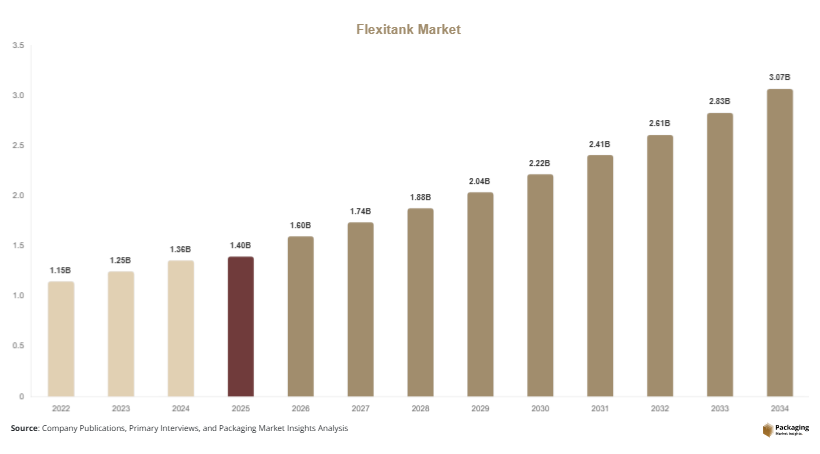
The flexitank market is gaining momentum as industries seek cost-effective, safe, and efficient bulk liquid transportation solutions. Flexitanks are flexible containers made from multiple layers of polyethylene and polypropylene, designed to transport non-hazardous liquids such as food-grade liquids, chemicals, and oils within standard shipping containers. The global market size was valued at approximately USD 1.4 billion in 2025 and is projected to reach USD 1.6 billion in 2026, reflecting increased adoption across international trade routes. By 2034, the market is expected to grow to USD 3.2 billion, registering a CAGR of 8.5% during 2025–2034.
One of the primary growth factors driving the flexitank market is the rising demand for cost-efficient bulk liquid transportation. Compared to traditional methods such as drums and ISO tanks, flexitanks offer higher payload capacity and lower logistics costs. This efficiency is particularly beneficial for industries involved in large-scale liquid transportation, including food and beverage, chemicals, and pharmaceuticals. Another significant growth factor is the expansion of global trade, which is increasing the need for flexible and scalable shipping solutions.
Key Highlights:
- Market size is projected to grow from USD 1.4 billion in 2025 to USD 3.2 billion by 2034, reflecting strong expansion in bulk liquid transportation solutions. This growth is driven by increasing demand for efficient and flexible shipping methods across industries.
- The market is expected to register a CAGR of 8.5% during the forecast period from 2025 to 2034. This indicates steady growth supported by rising global trade and advancements in logistics infrastructure.
- Increasing demand for cost-effective bulk liquid transport solutions is a key growth factor. Flexitanks offer higher payload capacity and lower shipping costs compared to traditional containers.
- Rising global trade and logistics optimization trends are further boosting market demand. Companies are focusing on improving supply chain efficiency, which is increasing the adoption of flexitank solutions.
Explore more data points, trends and opportunities Download Free Sample Report
Market Trends
Growing Adoption of Food-Grade Flexitanks
The increasing demand for food-grade flexitanks is emerging as a key trend in the flexitank market. Industries such as edible oils, wine, fruit juices, and liquid sweeteners are adopting flexitanks for bulk transportation due to their cost efficiency and hygiene standards. Food-grade flexitanks are manufactured using high-quality materials that comply with strict safety regulations, ensuring that the transported liquids remain uncontaminated. Additionally, these flexitanks reduce the need for intermediate packaging, which simplifies logistics and lowers overall costs. As global trade in food products continues to expand, the demand for food-grade flexitanks is expected to increase steadily.
Integration of Advanced Safety and Monitoring Features
The integration of advanced safety and monitoring features in flexitanks is another significant trend shaping the market. Manufacturers are incorporating technologies such as pressure sensors, temperature monitoring systems, and leak detection mechanisms to enhance the safety and reliability of flexitanks. These features help in real-time tracking of cargo conditions, reducing the risk of product loss and contamination. Additionally, improved valve designs and reinforced materials are enhancing the durability of flexitanks. As industries prioritize safety and quality assurance, the adoption of technologically advanced flexitanks is expected to grow.
Market Drivers
Cost Efficiency and Higher Payload Capacity
Cost efficiency is one of the primary drivers of the flexitank market. Flexitanks allow for the transportation of larger volumes of liquid compared to traditional methods such as drums and intermediate bulk containers. This increased capacity reduces the number of shipments required, leading to significant cost savings in logistics and transportation. Additionally, flexitanks eliminate the need for cleaning and return logistics, which further reduces operational expenses. These advantages make flexitanks an attractive option for companies seeking to optimize their supply chains and reduce costs.
Expansion of Global Trade and Liquid Commodity Transport
The expansion of global trade is driving the demand for efficient bulk liquid transportation solutions, boosting the flexitank market. Industries such as chemicals, food and beverages, and pharmaceuticals are increasingly relying on international trade to meet demand. Flexitanks provide a flexible and scalable solution for transporting liquid commodities across long distances. The growth of emerging markets and increasing trade agreements are further supporting market expansion. As global trade continues to grow, the demand for flexitanks is expected to increase.
Market Restraint
Risk of Leakage and Limited Reusability
One of the key restraints in the flexitank market is the risk of leakage and limited reusability of these containers. Although flexitanks are designed to be durable, they are typically single-use products, which can raise concerns regarding environmental impact and cost efficiency for certain applications. Leakage incidents, although rare, can result in significant financial losses and environmental damage. For example, a damaged flexitank during transit can lead to the loss of valuable liquid cargo and contamination of the shipping container. These risks require strict quality control and proper handling procedures, which can increase operational complexity. As a result, some companies may prefer alternative transportation methods, limiting market growth.
Market Opportunities
Increasing Demand from Emerging Economies
Emerging economies present significant growth opportunities for the flexitank market. Rapid industrialization, expanding manufacturing sectors, and increasing trade activities in regions such as Asia Pacific and Latin America are driving demand for bulk liquid transportation solutions. These regions are experiencing growth in industries such as chemicals, food processing, and agriculture, which require efficient logistics solutions. Flexitanks offer a cost-effective and scalable option for transporting liquids, making them suitable for emerging markets. Companies that invest in these regions can benefit from growing demand and expanding trade networks.
Development of Reusable and Eco-Friendly Flexitanks
The development of reusable and eco-friendly flexitanks is creating new opportunities in the market. Manufacturers are focusing on designing flexitanks that can be reused multiple times, reducing environmental impact and improving cost efficiency. Additionally, the use of recyclable materials and sustainable manufacturing processes is gaining traction. These innovations align with global sustainability goals and regulatory requirements, encouraging adoption across industries. As environmental concerns continue to influence business decisions, the demand for eco-friendly flexitank solutions is expected to increase.
Report Scope
| Report Metric | Details |
|---|---|
| Market Size in 2025 | USD 1.4 Billion |
| Market Size in 2026 | USD 1.6 Billion |
| Market Size in 2034 | USD 3.2 Billion |
| CAGR | 8.5% (2026-2034) |
| Base Year for Estimation | 2025 |
| Historical Data | 2022-2024 |
| Forecast Period | 2026-2034 |
| Report Coverage | Revenue Forecast, Competitive Landscape, Supply Chain Disruption, Growth Factors, Environment & Regulatory Landscape and Trends |
| Geographies Covered | North America, Europe, APAC, Middle East and Africa, LATAM |
| Countries Covered | U.S., Canada, U.K., Germany, France, Spain, Italy, Russia, Nordic, Benelux, Rest of Europe, China, South Korea, Japan, India, Australia, Singapore, Taiwan, South East Asia, Rest of Asia-Pacific, UAE, Turky, Saudi Arabia, South Africa, Egypt, Nigeria, Rest of MEA, Brazil, Mexico, Argentina, Chile, Colombia, Rest of LATAM |
Explore more data points, trends and opportunities Download Free Sample Report
Segmental Analysis
By Type
The single-layer flexitanks segment dominated the flexitank market in 2024, accounting for approximately 46% of the market share. These flexitanks are widely used due to their cost-effectiveness and ease of installation. They are suitable for transporting non-hazardous liquids and are commonly used in industries such as food and beverages. The simplicity of design and lower production costs make single-layer flexitanks a preferred choice for many companies.
The multi-layer flexitanks segment is expected to be the fastest-growing, with a CAGR of 9.1% during the forecast period. These flexitanks offer enhanced durability and safety, making them suitable for transporting more sensitive liquids. The increasing demand for high-performance packaging solutions is driving the growth of this segment.
By Application
The food and beverages segment held the largest share of the flexitank market in 2024, accounting for approximately 50% of the market. Flexitanks are widely used for transporting edible oils, wine, and other liquid food products. Their ability to maintain product quality and reduce transportation costs makes them an ideal solution for this segment.
The chemical segment is projected to be the fastest-growing, with a CAGR of 8.9% during the forecast period. The increasing demand for bulk transportation of liquid chemicals is driving the adoption of flexitanks. Additionally, advancements in flexitank technology are improving safety and reliability.
By End-Use
The industrial sector dominated the flexitank market in 2024, accounting for approximately 52% of the market share. Industries such as chemicals and manufacturing rely on flexitanks for efficient bulk liquid transportation. The cost savings and operational efficiency offered by flexitanks are driving their adoption in this segment.
The agriculture sector is expected to be the fastest-growing, with a CAGR of 8.7% during the forecast period. The increasing demand for transporting liquid fertilizers and agricultural products is driving the adoption of flexitanks in this segment.
Flexitank Market Segmentations
By Type
- Single-Layer Flexitanks
- Multi-Layer Flexitanks
By Application
- Food & Beverages
- Chemicals
- Pharmaceuticals
By End-Use
- Industrial
- Agriculture
- Others
Regional Analysis
North America
North America accounted for approximately 29% of the flexitank market share in 2025 and is expected to grow at a CAGR of 7.4% during the forecast period. The region benefits from well-developed logistics infrastructure and strong trade networks. The demand for flexitanks is driven by industries such as chemicals, food and beverages, and pharmaceuticals. Additionally, the adoption of advanced technologies in logistics is supporting market growth.
The United States dominates the North American market due to its large industrial base and extensive export activities. A unique growth factor in the region is the increasing demand for bulk transportation of food-grade liquids, particularly edible oils and beverages. This demand is driving the adoption of flexitanks as a cost-effective and efficient solution.
Europe
Europe held a market share of approximately 25% in 2025 and is projected to grow at a CAGR of 7.1% through 2034. The region’s growth is supported by strong regulatory frameworks and a focus on sustainability. The demand for flexitanks is increasing across industries such as chemicals and food processing.
Germany is a key market in Europe, supported by its advanced manufacturing sector. A unique growth factor in the region is the emphasis on reducing carbon emissions through efficient logistics solutions. This focus is encouraging the adoption of flexitanks as an alternative to traditional transportation methods.
Asia Pacific
Asia Pacific is the fastest-growing region, accounting for approximately 30% of the global market share in 2025 and projected to grow at a CAGR of 9.3%. The region’s growth is driven by rapid industrialization, increasing trade activities, and expanding manufacturing sectors.
China dominates the Asia Pacific market due to its large production capacity and export-oriented economy. A unique growth factor is the increasing demand for bulk transportation of chemicals and food products, which is driving the adoption of flexitanks.
Middle East & Africa
The Middle East & Africa region accounted for approximately 8% of the market share in 2025 and is expected to grow at a CAGR of 8.0%. The market is driven by increasing trade activities and the expansion of the oil and chemical industries.
Saudi Arabia is a leading market in the region, supported by investments in industrial development. A unique growth factor is the growing demand for transporting liquid chemicals and petroleum-based products, which is driving the adoption of flexitanks.
Latin America
Latin America held around 8% of the market share in 2025 and is projected to grow at a CAGR of 8.2% during the forecast period. The region’s growth is driven by expanding agricultural and food processing industries.
Brazil dominates the Latin American market due to its large agricultural sector. A unique growth factor is the increasing export of liquid agricultural products, such as edible oils and beverages, which is driving demand for flexitanks.
Competitive Landscape
The flexitank market is moderately competitive, with several global players focusing on product innovation and strategic partnerships. Companies are investing in research and development to enhance the safety and performance of flexitanks. Additionally, expanding distribution networks is a key strategy adopted by market players.
Braid Logistics is a leading company in the market, known for its extensive product portfolio and global presence. The company recently introduced advanced multi-layer flexitanks designed to improve safety and durability. Other major players are also focusing on developing eco-friendly and reusable solutions to meet evolving market demands.
Key Players List
- Braid Logistics
- Bulk Liquid Solutions
- SIA Flexitanks
- Trans Ocean Bulk Logistics
- Environmental Packaging Technologies
- Qingdao LAF Packaging Co., Ltd.
- Trust Flexitanks
- Rishi FIBC Solutions
- Hengxin Plastic Co., Ltd.
- KriCon Group BV
- Full-Pak
- Flexitank Group
- Mak & Williams Flexitanks
- Qingdao Global Flexitank Logistics
- MY Flexitank