Packaging Tubes Market Size
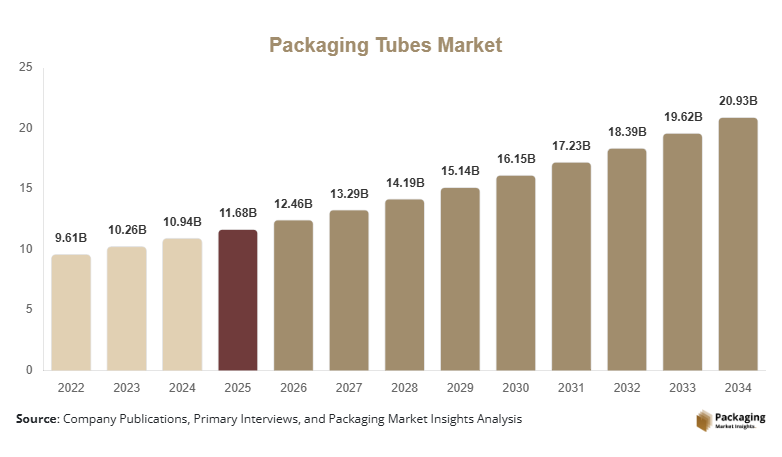
Packaging tubes' market size is projected at USD 12.46 billion in 2026 and is expected to hit USD 20.89 billion by 2034 with a CAGR of 6.7%.
The report provides a comprehensive evaluation of market segmentation, production capacity, technological developments, competitive landscape, and regional performance. Historical analysis from 2022–2024, base year assessment for 2025, and forecasts through 2034 are incorporated to evaluate production trends, consumption patterns, investment opportunities, and manufacturer positioning across the global packaging industry.
Packaging tubes are cylindrical containers designed for dispensing creams, gels, ointments, toothpaste, cosmetics, pharmaceuticals, adhesives, and food products while protecting contents from contamination, moisture, oxygen, and light. Global production exceeds 68 billion packaging tubes annually, with plastic tubes accounting for approximately 54% of total output, laminated tubes contributing 28%, and aluminum tubes representing 18%. Personal care and cosmetics applications contribute over 48% of overall demand, reinforcing the packaging tubes market's expansion.
Explore more data points, trends and opportunities Download Free Sample Report
Packaging Tubes Trends
Growing Adoption of Sustainable Tube Packaging
Packaging manufacturers are increasingly adopting recyclable polymers, post-consumer recycled (PCR) materials, mono-material tube structures, and bio-based resins. More than 37% of newly introduced packaging tubes incorporate recyclable materials, while lightweight tube designs reduce material consumption by nearly 18%–25%. Annual production of sustainable packaging tubes exceeds 20 billion units, supporting circular economy initiatives. These developments continue strengthening packaging tube market trends.
Advanced Dispensing Technologies and Premium Tube Designs
Manufacturers are integrating airless dispensing systems, tamper-evident closures, digital printing, and high-barrier laminated structures into packaging tubes. Premium packaging adoption has increased by more than 30% among cosmetic and pharmaceutical brands. Automated manufacturing lines now produce billions of precision-engineered tubes annually while improving production efficiency by approximately 20%. These innovations continue supporting the packaging tubes market growth.
Packaging Tubes Market Drivers
Expansion of Personal Care and Healthcare Industries
The increasing consumption of cosmetics, skincare products, pharmaceuticals, and nutraceuticals continues driving packaging tube market growth. Personal care applications account for approximately 48% of market demand, while pharmaceutical applications contribute nearly 30%. Annual production exceeds 68 billion units, supported by expanding retail channels, e-commerce sales, and rising consumer preference for hygienic dispensing solutions. These factors continue accelerating the packaging tubes market growth.
Packaging Tubes Market Restraints
Raw Material Price Volatility and Recycling Challenges
Fluctuating prices of polymers, aluminum, and laminate materials continue affecting manufacturing costs. Raw material prices fluctuate between 10% and 22% annually, while multilayer laminated structures remain difficult to recycle compared to mono-material alternatives. Sustainability regulations require increasing recycled content, raising production investments by approximately 15%. These challenges continue influencing the packaging tubes market.
Packaging Tubes Market Opportunities
Increasing Demand for Recyclable and Refillable Packaging
Growing environmental awareness is accelerating demand for recyclable, refillable, and mono-material tube packaging. Adoption of recyclable packaging tubes has increased by over 35%, while refillable cosmetic packaging continues expanding across premium product categories. Manufacturers are investing in advanced extrusion technologies capable of producing billions of sustainable tubes annually. These developments create significant opportunities within the packaging tubes market.
Challenges in Packaging Tubes Market
Balancing Barrier Performance with Sustainability
Manufacturers continue facing challenges in maintaining oxygen barriers, moisture resistance, product compatibility, and recyclability simultaneously. Product failure rates must remain below 2%, while barrier improvements can increase production costs by approximately 12%–18%. Continuous investment in advanced material technologies and quality control remains essential for maintaining competitiveness in the packaging tubes market.
Report Scope
| Report Metric | Details |
|---|---|
| Market Size in 2025 | USD 11.68 Billion |
| Market Size in 2026 | USD 12.46 Billion |
| Market Size in 2034 | USD 20.89 Billion |
| CAGR | 6.7% (2026-2034) |
| Base Year for Estimation | 2025 |
| Historical Data | 2022-2024 |
| Forecast Period | 2026-2034 |
| Report Coverage | Revenue Forecast, Competitive Landscape, Supply Chain Disruption, Growth Factors, Environment & Regulatory Landscape and Trends |
| Geographies Covered | North America, Europe, APAC, Middle East and Africa, LATAM |
| Countries Covered | U.S., Canada, U.K., Germany, France, Spain, Italy, Russia, Nordic, Benelux, Rest of Europe, China, South Korea, Japan, India, Australia, Singapore, Taiwan, South East Asia, Rest of Asia-Pacific, UAE, Turkey, Saudi Arabia, South Africa, Egypt, Nigeria, Rest of MEA, Brazil, Mexico, Argentina, Chile, Colombia, Rest of LATAM |
Explore more data points, trends and opportunities Download Free Sample Report
Packaging Tubes Market Segmentation
The packaging tubes market is segmented by material type and application. Plastic tubes dominate with approximately 54% market share due to lightweight construction and cost efficiency, while personal care and cosmetics account for over 48% of total consumption. Laminated tubes continue expanding rapidly because of their superior barrier performance.
By Material Type
Plastic tubes account for approximately 54% of the packaging tubes market. Annual production exceeds 36 billion units for cosmetics, toothpaste, pharmaceuticals, and food products. HDPE, LDPE, and PP materials provide lightweight construction, flexibility, durability, chemical resistance, and economical manufacturing suitable for high-volume production.
Aluminum tubes represent nearly 18% of market share, with annual production exceeding 12 billion units. These tubes provide excellent oxygen and light barriers, corrosion resistance, and superior product protection. They are widely used for pharmaceutical creams, adhesives, industrial chemicals, and premium cosmetic formulations.
Laminated tubes contribute around 28% of the market, with annual production exceeding 20 billion units. Multi-layer barrier structures improve product shelf life while supporting attractive printing, premium branding, and controlled dispensing. Increasing adoption in oral care and cosmetic products continues supporting demand.
By Application
Personal care and cosmetics dominate the packaging tubes market with approximately a 48% share. More than 32 billion tubes are manufactured annually for creams, lotions, facial cleansers, shampoos, sunscreens, and skincare products. Attractive graphics, hygienic dispensing, and lightweight packaging continue supporting segment expansion.
Pharmaceutical applications account for approximately 30% of market demand. More than 20 billion tubes are produced annually for ointments, gels, creams, antiseptics, and topical medications. High-barrier protection, regulatory compliance, tamper-evident closures, and contamination prevention remain essential technical requirements.
Food product applications contribute nearly 22% of the market. Annual production exceeds 15 billion tubes for sauces, condiments, chocolate spreads, honey, and dessert toppings. Packaging emphasizes freshness preservation, controlled dispensing, leak prevention, and extended shelf life.
Packaging Tubes Market Segmentations
Material Type
- Plastic Tubes
- Aluminum Tubes
- Laminated Tubes
Application
- Personal Care & Cosmetics
- Pharmaceuticals
- Food Products
Distribution Channel
- Direct Sales
- Packaging Distributors
- Online B2B Platforms
- Specialty Packaging Suppliers
Packaging Tubes Market Regional Outlook
North America
North America accounts for approximately 28% of the global packaging tubes market. The United States contributes nearly 72% of regional demand, with annual production exceeding 18 billion units. Cosmetics and pharmaceutical packaging dominate regional consumption, while sustainable tube adoption exceeds 38%.
Europe
Europe represents approximately 29% market share, supported by Germany, France, Italy, and the United Kingdom. Sustainable packaging adoption exceeds 45%, with laminated and recyclable plastic tubes gaining significant market penetration due to environmental regulations.
Asia Pacific
Asia Pacific dominates the packaging tubes market with approximately a 34% share. China, India, Japan, and South Korea contribute more than 76% of regional production, exceeding 23 billion tubes annually. Rapid industrialization, expanding cosmetics manufacturing, and growing pharmaceutical production continue supporting regional demand.
Latin America
Latin America contributes around 6% of global demand, led by Brazil and Mexico. Expanding cosmetics manufacturing, pharmaceutical production, and retail distribution networks continue increasing packaging tube consumption throughout the region.
Middle East & Africa
The Middle East & Africa account for approximately 3% of the market. Growing healthcare investments, increasing cosmetic product consumption, and expanding food processing industries continue generating demand for advanced tube packaging solutions.
Top Players In The Packaging Tubes Market
- Albéa Group
- Berry Global Inc.
- Amcor plc
- Essel Propack Ltd. (EPL Limited)
- Huhtamaki Oyj
- CCL Industries Inc.
- Montebello Packaging Inc.
- Hoffmann Neopac AG
- Tubex Holding GmbH
- Linhardt GmbH & Co. KG
Albéa Group is one of the global leaders in cosmetic and personal care tube packaging with extensive manufacturing operations across Europe, Asia, and the Americas. The company produces billions of packaging tubes annually while serving leading cosmetic, pharmaceutical, and oral care brands. Its product portfolio includes recyclable tubes, laminated tubes, and high-barrier dispensing solutions emphasizing sustainability and premium product appearance. Continuous investment in mono-material tube technologies and circular packaging solutions strengthens Albéa's competitive position within the packaging tubes market. EPL Limited (Essel Propack Ltd.) EPL Limited is among the world's largest specialty tube packaging manufacturers serving oral care, pharmaceutical, food, and cosmetic industries. The company operates multiple production facilities with annual manufacturing capacity reaching billions of laminated and plastic tubes. Strong expertise in barrier laminates, digital decoration technologies, and sustainable packaging innovation supports long-term competitiveness. Ongoing investments in recyclable tube technologies and advanced manufacturing capabilities continue reinforcing its position in the packaging tubes market.