Dip Tube Market Size and Growth
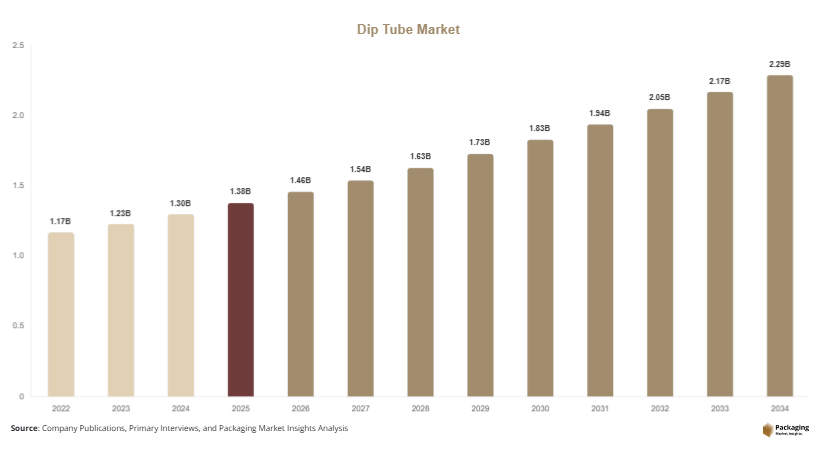
The global dip tube market size was valued at USD 1.38 billion in 2025 and is estimated to reach USD 1.46 billion in 2026. The market is forecasted to grow to approximately USD 2.29 billion by 2034, expanding at a CAGR of 5.8% during 2025–2034. Growth is supported by increasing adoption of aerosol-based packaging in cosmetics and healthcare sectors, rapid urbanization, and rising demand for convenient dispensing solutions in consumer products. Manufacturers are also investing in lightweight and flexible dip tube designs to improve product compatibility and reduce packaging waste.
One of the major growth factors influencing the dip tube market is the rapid expansion of the global personal care and cosmetics industry. Products such as perfumes, deodorants, hair sprays, lotions, and sanitizers rely heavily on dispensing systems that incorporate dip tubes. Another important factor is the growing demand for household cleaning and disinfectant products, particularly in urban markets where hygiene awareness continues to increase. In addition, pharmaceutical companies are increasingly adopting precision dispensing packaging for syrups, topical sprays, and oral care products, creating long-term growth opportunities for dip tube manufacturers.
Key Highlights
- Asia Pacific dominated the market with a 39.1% share in 2025.
- Latin America is projected to grow at the fastest CAGR of 6.4%.
- Polyethylene dip tubes led the material segment with a 34.8% share.
- Personal care applications dominated with a 41.6% share.
- Straight dip tubes accounted for 46.2% of the type segment, while flexible dip tubes are expected to witness strong future demand.
- The US remained the dominant country with a market size of USD 312 million in 2025 and USD 329 million in 2026.
Explore more data points, trends and opportunities Download Free Sample Report
Market Trends
Rising Adoption of Sustainable Packaging Components
Sustainability has emerged as a major trend in the dip tube market as packaging manufacturers and consumer brands seek recyclable and environmentally responsible dispensing solutions. Plastic reduction targets across the cosmetics, household care, and food industries are encouraging the use of recyclable polymers and mono-material dispensing systems. Companies are increasingly replacing conventional multilayer structures with simplified polyethylene and polypropylene-based tubes that improve recycling efficiency. Brands are also reducing tube diameter and material weight to minimize overall packaging consumption.
For example, several cosmetic packaging suppliers in Europe and North America have introduced recyclable spray systems using thinner dip tubes with reduced resin usage. Household cleaning brands are also integrating refillable packaging formats that require reusable dispensing systems. This trend is expected to increase investment in sustainable manufacturing technologies and bio-based plastics. Over the forecast period, sustainable packaging requirements are likely to reshape procurement strategies among consumer goods companies and drive innovation across dip tube production processes.
Growth of Precision Dispensing Technologies
Another important trend shaping the dip tube market is the growing demand for precision dispensing systems in healthcare, beauty, and industrial packaging applications. Consumers increasingly prefer controlled dispensing solutions that improve convenience, reduce product waste, and enhance hygiene. As a result, manufacturers are designing dip tubes optimized for spray accuracy, viscosity management, and compatibility with advanced dispensing pumps.
For instance, pharmaceutical companies are adopting specialized dip tubes for nasal sprays, oral sprays, and medicated dispensing systems where dosage precision is critical. Similarly, premium skincare brands are integrating customized spray and mist dispensing systems to improve product experience. Smart packaging technologies are also influencing market development through sensor-enabled aerosol systems and high-performance dispensing mechanisms. Future advancements in automation and packaging engineering are expected to support further growth in customized dip tube manufacturing and specialized dispensing solutions.
Market Drivers
Expansion of Personal Care and Cosmetics Packaging
The rapid growth of the personal care and cosmetics industry is one of the primary drivers supporting the dip tube market. Products such as deodorants, body sprays, facial mists, perfumes, and hair styling solutions depend on reliable dispensing systems that utilize dip tubes for liquid transfer. Rising disposable incomes, growing beauty awareness, and expanding premium cosmetic consumption are increasing packaging demand globally.
Many multinational beauty companies are introducing travel-sized and portable cosmetic products, which require compact dispensing systems with customized tube designs. The growth of online beauty retail is also encouraging durable and leak-resistant packaging solutions. Asian markets, particularly South Korea, China, and India, are witnessing strong cosmetic product launches that depend heavily on aerosol and spray packaging technologies. This growth directly supports long-term demand for advanced dip tube systems across multiple consumer packaging categories.
Increasing Demand for Household Cleaning Products
Growing hygiene awareness and expanding urban populations are significantly increasing demand for household cleaning products, thereby supporting the dip tube market. Spray bottles used for disinfectants, sanitizers, surface cleaners, and kitchen cleaners require efficient dip tube systems to ensure smooth product dispensing. Rising consumer preference for convenient spray packaging formats is driving product innovation among cleaning product manufacturers.
For example, many global cleaning brands are introducing trigger spray bottles with adjustable dispensing mechanisms and flexible dip tubes for improved product access. Commercial cleaning applications in hotels, offices, and healthcare facilities are also expanding demand for industrial dispensing solutions. The continued focus on sanitation standards in residential and institutional sectors is expected to maintain stable growth for dip tube manufacturers during the forecast period.
Market Restraint
Volatility in Raw Material Prices and Environmental Regulations
One of the key restraints affecting the dip tube market is the fluctuation in raw material prices, particularly for petroleum-based plastics such as polyethylene and polypropylene. Variations in crude oil prices directly impact manufacturing costs and profit margins for packaging component producers. Smaller manufacturers often face operational challenges when resin prices increase rapidly, limiting production scalability and pricing flexibility.
Environmental regulations targeting single-use plastics are also creating challenges for dip tube manufacturers. Governments across Europe and North America are implementing stricter packaging waste reduction policies, forcing companies to redesign traditional dispensing systems. Compliance with recyclability standards and sustainable material requirements often increases manufacturing complexity and capital investment needs.
For example, some cosmetic and household brands are reducing plastic packaging usage by adopting refill pouches and alternative dispensing formats that may reduce long-term dip tube demand. In addition, recycling limitations associated with multi-material packaging components continue to create operational concerns for manufacturers. These factors may restrain market expansion in certain regions over the forecast period.
Market Opportunities
Rising Demand for Pharmaceutical Dispensing Solutions
The growing pharmaceutical and healthcare packaging industry presents substantial opportunities for the dip tube market. Healthcare products increasingly require accurate dispensing systems for nasal sprays, oral care products, topical medications, and disinfectants. Dip tubes play an essential role in ensuring controlled product delivery and maintaining packaging functionality.
Pharmaceutical companies are investing in advanced dispensing systems designed for patient convenience and dosage precision. Aging populations, rising chronic disease prevalence, and increasing healthcare spending are further supporting demand for pharmaceutical packaging solutions globally. Emerging markets in Asia Pacific and Latin America are also witnessing rapid expansion of over-the-counter healthcare products that use spray dispensing formats.
Future opportunities are expected to emerge from sterile packaging technologies and chemically resistant dip tube materials designed for specialized medical formulations. Companies that focus on pharmaceutical-grade dispensing components are likely to gain long-term growth advantages.
Expansion of Refillable and Reusable Packaging Systems
The shift toward refillable and reusable packaging formats is creating new growth opportunities for dip tube manufacturers. Consumer brands are increasingly adopting refill stations and reusable dispensing bottles to reduce packaging waste and improve sustainability performance. Durable dip tube systems designed for long-term usage are gaining traction across beauty, cleaning, and food packaging sectors.
For instance, several household care brands have launched refill concentrate products that use reusable spray bottles equipped with replaceable dispensing systems. Cosmetic companies are also introducing refillable perfume and skincare packaging that relies on high-quality reusable dip tubes. This trend is expected to generate demand for stronger, chemically resistant, and customizable dip tube designs.
Manufacturers investing in recyclable materials, refill-compatible systems, and modular dispensing technologies are likely to benefit from changing consumer preferences and sustainability regulations over the next decade.
Report Scope
| Report Metric | Details |
|---|---|
| Market Size in 2025 | USD 1.38 Billion |
| Market Size in 2026 | USD 1.46 Billion |
| Market Size in 2034 | USD 2.29 Billion |
| CAGR | 5.8% (2026-2034) |
| Base Year for Estimation | 2025 |
| Historical Data | 2022-2024 |
| Forecast Period | 2026-2034 |
| Report Coverage | Revenue Forecast, Competitive Landscape, Supply Chain Disruption, Growth Factors, Environment & Regulatory Landscape and Trends |
| Geographies Covered | North America, Europe, APAC, Middle East and Africa, LATAM |
| Countries Covered | U.S., Canada, U.K., Germany, France, Spain, Italy, Russia, Nordic, Benelux, Rest of Europe, China, South Korea, Japan, India, Australia, Singapore, Taiwan, South East Asia, Rest of Asia-Pacific, UAE, Turky, Saudi Arabia, South Africa, Egypt, Nigeria, Rest of MEA, Brazil, Mexico, Argentina, Chile, Colombia, Rest of LATAM |
Explore more data points, trends and opportunities Download Free Sample Report
Segmental Analysis
By Type
Straight dip tubes dominated the type segment and accounted for approximately 46.2% of the global market share in 2024. These dip tubes are widely used in aerosol cans, spray pumps, trigger sprayers, and cosmetic packaging due to their simple structure, cost efficiency, and compatibility with multiple container formats. Straight dip tubes are commonly integrated into deodorants, room fresheners, disinfectant sprays, and personal care packaging. Manufacturers prefer this design because it supports high-volume production while maintaining dispensing efficiency. The segment also benefits from increasing demand for lightweight packaging systems across household and industrial applications. Large-scale aerosol packaging companies continue to use straight dip tubes because they offer operational consistency and lower manufacturing complexity. Growth in hygiene product demand, especially across Asia Pacific and North America, further supports the dominance of this segment. In addition, straight dip tubes are increasingly being manufactured using recyclable polyethylene materials to comply with sustainability initiatives introduced by global consumer brands.
Flexible dip tubes are projected to register the fastest CAGR of 6.6% during the forecast period. These tubes are gaining popularity because they improve liquid accessibility inside irregularly shaped containers and allow more efficient product dispensing. Flexible dip tubes are increasingly used in premium cosmetic packaging, pharmaceutical sprays, and advanced cleaning products where precise dispensing is important. The rise of refillable and reusable packaging systems is also contributing to segment growth, as flexible tube systems improve usability and reduce residual product waste. Companies are investing in advanced resin materials and flexible polymer technologies to enhance chemical resistance and durability. Several beauty brands are introducing curved packaging designs that require flexible dispensing components to optimize performance. Demand is also increasing in travel-sized packaging products where compact and efficient dispensing systems are necessary. Future growth is expected to be supported by innovations in multi-angle dispensing technologies and customized aerosol packaging solutions designed for consumer convenience and product differentiation.
By Material
Polyethylene (PE) dominated the material segment with a market share of 34.8% in 2024. PE-based dip tubes are widely adopted because they offer flexibility, chemical resistance, lightweight properties, and cost-effective manufacturing capabilities. These materials are commonly used in personal care, pharmaceutical, food, and household cleaning applications due to their compatibility with a broad range of liquid formulations. Packaging manufacturers favor polyethylene because it allows high-speed extrusion and supports large-scale production processes. In addition, PE materials are increasingly used in recyclable dispensing systems as sustainability becomes a major focus across the packaging industry. The household cleaning segment, particularly disinfectants and trigger sprays, relies heavily on polyethylene dip tubes because of their durability and moisture resistance. Growing e-commerce packaging demand is also contributing to material adoption, as brands require reliable dispensing systems that withstand transportation and handling conditions. Several manufacturers are now introducing thinner PE dip tubes to reduce raw material usage and improve sustainability performance while maintaining packaging efficiency.
Recyclable polymer materials are expected to witness the fastest growth, registering a CAGR of 6.7% during 2025–2034. Increasing environmental regulations and consumer demand for sustainable packaging are encouraging companies to adopt recyclable and mono-material dispensing systems. Cosmetic brands, pharmaceutical companies, and household cleaning product manufacturers are actively redesigning packaging components to improve recyclability and reduce plastic waste. Recyclable polymers such as polypropylene and bio-based plastics are gaining traction because they align with circular economy goals and government sustainability initiatives. For example, several European cosmetic companies are launching recyclable spray systems that use simplified polymer structures for easier material recovery. Demand for refillable packaging products is also supporting growth in sustainable dip tube materials. Manufacturers are investing in research to improve chemical resistance, flexibility, and durability of recyclable polymers without compromising dispensing performance. Future growth opportunities are expected to emerge from biodegradable polymer technologies and advanced recycling infrastructure across North America and Europe.
By End-Use
Personal care and cosmetics dominated the end-use segment with a market share of 41.6% in 2024. The segment benefits from widespread usage of dip tubes in deodorants, perfumes, hair sprays, facial mists, body sprays, and skincare products. Rapid expansion of the global beauty industry, combined with rising consumer demand for convenient dispensing systems, continues to support strong market demand. Premium cosmetic packaging increasingly relies on customized dispensing mechanisms to improve user experience and product differentiation. The rise of travel-size beauty products and portable skincare solutions is also increasing demand for compact aerosol and spray packaging systems. Major cosmetic manufacturers are investing in sustainable packaging solutions that integrate recyclable dip tubes and lightweight materials. Asia Pacific remains a major production hub for personal care products, while North America and Europe continue to drive innovation in premium dispensing systems. Growth in online beauty retail and direct-to-consumer cosmetic brands is expected to maintain strong demand for advanced dip tube packaging technologies during the forecast period.
Pharmaceutical applications are expected to register the fastest CAGR of 6.5% through 2034. Increasing demand for nasal sprays, oral sprays, topical medications, disinfectants, and healthcare dispensing systems is supporting market growth within this segment. Pharmaceutical companies require highly accurate and contamination-resistant dispensing components to ensure dosage precision and patient safety. This has encouraged manufacturers to develop specialized dip tubes using medical-grade materials with enhanced chemical compatibility. Aging populations, rising healthcare expenditures, and expanding over-the-counter medication markets are further contributing to segment growth globally. Several pharmaceutical packaging companies are introducing sterile dispensing technologies and advanced spray systems for respiratory care products and oral treatments. Growth in healthcare infrastructure across Asia Pacific and Latin America is also increasing demand for affordable pharmaceutical packaging solutions. Future expansion is expected to be supported by innovations in smart dispensing systems, precision aerosol technologies, and sustainable medical packaging formats designed to meet regulatory standards and improve patient convenience.
Dip Tube Market Segmentations
By Type
- Straight Dip Tubes
- Flexible Dip Tubes
- Curved Dip Tubes
- Custom-Length Dip Tubes
By Material
- Polyethylene (PE)
- Polypropylene (PP)
- Polyvinyl Chloride (PVC)
- Recyclable Polymers
- Bio-Based Plastics
By End-User
- Personal Care & Cosmetics
- Household Cleaning
- Pharmaceuticals
- Food & Beverage
- Industrial Applications
Regional Analysis
North America
North America accounted for 24.8% of the dip tube market share in 2025 and is projected to expand at a CAGR of 5.3% through 2034. The region benefits from strong demand for aerosol packaging, household cleaning products, and premium personal care solutions. The United States and Canada continue to witness rising consumption of spray-based cosmetic and healthcare products. Growth in e-commerce retail is also supporting durable dispensing packaging demand. In addition, increasing investments in sustainable packaging technologies and recyclable dispensing systems are contributing to market expansion. Consumer preference for convenient and portable packaging formats remains a major factor supporting regional growth.
The United States dominated the North American market due to its large consumer goods industry and advanced packaging infrastructure. Rising demand for disinfectants, cosmetic sprays, and pharmaceutical dispensing systems is driving market growth. Several packaging companies are expanding automated production lines to improve manufacturing efficiency and meet sustainability targets. For example, personal care brands in the U.S. are increasingly adopting recyclable aerosol packaging with lightweight dip tube systems. Growth in healthcare packaging and premium beauty product sales is expected to maintain stable market expansion during the forecast period.
Europe
Europe held a 22.6% share of the dip tube market in 2025 and is expected to grow at a CAGR of 5.1% during the forecast period. Strict environmental regulations and increasing focus on recyclable packaging solutions are shaping regional market development. Cosmetic, pharmaceutical, and household cleaning industries remain major end users of dip tube systems across Europe. Demand for mono-material packaging and reduced plastic usage is encouraging packaging innovation among regional manufacturers. Increasing adoption of refillable cosmetic packaging and eco-friendly dispensing systems is also supporting market growth.
Germany remained the leading country within the European market due to its advanced manufacturing sector and strong cosmetics industry. The country is witnessing increasing investments in sustainable aerosol packaging technologies and recyclable polymer materials. Several European packaging suppliers are focusing on lightweight dip tube systems that comply with recycling regulations. In addition, demand for pharmaceutical spray products and precision dispensing packaging is expanding steadily. Growth in premium skincare and fragrance industries across France, Italy, and Germany is expected to support long-term market demand.
Asia Pacific
Asia Pacific dominated the dip tube market with a 39.1% share in 2025 and is projected to register a CAGR of 6.3% through 2034. Rapid urbanization, expanding middle-class populations, and rising demand for consumer goods packaging are driving market growth across the region. Strong production of cosmetics, household cleaners, and pharmaceutical products in China, India, Japan, and South Korea continues to support demand for dispensing components. Expanding e-commerce distribution and increasing manufacturing investments are further strengthening regional market growth.
China remained the dominant country in Asia Pacific due to its large packaging manufacturing industry and strong export capabilities. The country benefits from growing demand for aerosol cosmetics, industrial sprays, and cleaning products. Chinese packaging manufacturers are investing in automated production technologies and recyclable plastic materials to improve competitiveness. India is also emerging as a significant growth market because of increasing pharmaceutical packaging demand and rising personal care consumption. Regional expansion of beauty and hygiene product manufacturing is expected to sustain long-term market development.
Middle East & Africa
The Middle East & Africa accounted for 6.9% of the dip tube market share in 2025 and is anticipated to grow at a CAGR of 5.5% during the forecast period. Rising urban populations, expanding retail sectors, and increasing demand for packaged household products are supporting market growth across the region. Growth in healthcare infrastructure and hygiene awareness is encouraging higher consumption of spray packaging products. Gulf countries are also witnessing increasing investments in consumer goods manufacturing and packaging technologies.
Saudi Arabia emerged as the leading market within the region due to rising demand for personal care products and industrial aerosol packaging. The country is witnessing growth in local cosmetics manufacturing and household cleaning product consumption. Packaging companies are increasingly introducing lightweight dispensing systems to reduce transportation costs and improve product efficiency. South Africa and the United Arab Emirates are also contributing to regional market growth through expanding retail distribution networks and increasing packaged product imports.
Latin America
Latin America represented 6.6% of the dip tube market share in 2025 and is forecasted to grow at the fastest CAGR of 6.4% during 2025–2034. Rising disposable incomes, urbanization, and expanding personal care industries are driving demand for dispensing packaging products across the region. Growth in beauty product consumption and household hygiene awareness is supporting aerosol and spray packaging demand. Increasing local manufacturing activity is also contributing to market expansion.
Brazil remained the dominant country in the Latin American market due to strong cosmetics production and growing household cleaning product demand. The country’s beauty and fragrance industry relies heavily on dispensing packaging solutions that incorporate dip tubes. Regional packaging companies are expanding production capacities to meet rising domestic and export demand. Mexico is also witnessing increased pharmaceutical packaging investments that support growth in specialized dispensing systems. Long-term expansion of consumer goods manufacturing is expected to strengthen regional market opportunities.
Competitive Landscape
The dip tube market is moderately fragmented, with global and regional manufacturers competing through product innovation, sustainability initiatives, strategic partnerships, and production expansion. Leading companies are focusing on lightweight materials, recyclable dispensing systems, and customized tube solutions to strengthen their market position. Technological advancements in aerosol packaging and precision dispensing systems are also shaping competitive strategies across the industry.
AptarGroup Inc. remains one of the leading companies in the market due to its strong global presence, advanced dispensing technologies, and broad product portfolio serving cosmetics, pharmaceuticals, and household applications. The company continues to invest in recyclable dispensing systems and sustainable packaging innovations. Berry Global Inc. is another major participant focusing on lightweight plastic components and high-volume packaging production. Silgan Dispensing Systems has expanded its product offerings through investments in premium cosmetic dispensing technologies and precision spray systems.
Companies such as Coster Group, Precision Valve Corporation, and Mitani Valve are strengthening their market positions by developing advanced aerosol valve systems and customizable dip tube solutions for industrial and consumer applications. Regional manufacturers are also increasing investments in automated extrusion technologies to improve production efficiency and reduce operational costs. Strategic collaborations with cosmetic and healthcare brands are becoming increasingly important as companies seek long-term supply agreements and sustainable packaging solutions.
Growing environmental regulations are encouraging manufacturers to accelerate research into mono-material packaging systems and recyclable polymers. Competitive differentiation is expected to depend heavily on sustainability performance, product compatibility, and dispensing efficiency over the forecast period.
Key Players List
- AptarGroup Inc.
- Berry Global Inc.
- Silgan Dispensing Systems
- Precision Valve Corporation
- Coster Group
- Mitani Valve Co., Ltd.
- LINDAL Group Holding GmbH
- Frapak Packaging
- Raepak Ltd.
- Shenzhen Sunway Packaging
- Albea Group
- Weener Plastics Group
- Summit Packaging Systems
- Yuyao Golden Empire Spray Pumps Co., Ltd.
- Colep Packaging
- SeaCliff Beauty Packaging
- Mold-Rite Plastics
- Shanghai Golden Aerosol Co., Ltd.