Tube Packaging Market Size and Growth
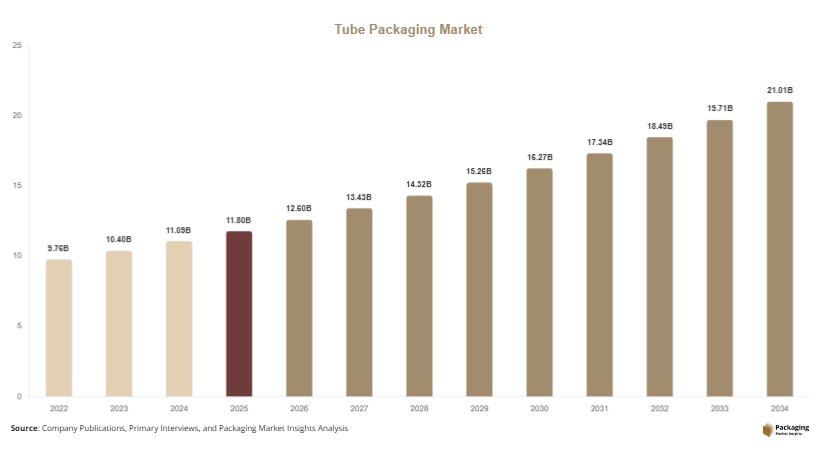
The global tube packaging market size is estimated at USD 11.8 billion in 2025 and is expected to reach USD 12.6 billion in 2026. By 2034, the market is forecasted to reach approximately USD 21.3 billion, growing at a CAGR of 6.6% during the forecast period (2025–2034).
The tube packaging market is an integral segment of the global packaging industry, widely used across cosmetics, pharmaceuticals, food, personal care, and industrial applications. Tube packaging offers advantages such as portability, controlled dispensing, product protection, and extended shelf life, making it a preferred choice for both premium and mass-market brands. Rising consumer demand for hygienic, sustainable, and user-friendly packaging formats continues to reshape the competitive landscape of the industry.
Key Highlights:
- Asia Pacific dominated the market with a 37.4% share in 2025.
- Latin America is projected to grow at the fastest CAGR of 6.2%.
- Antioxidants led the type segment with a 29.6% share.
- Plastic packaging dominated with a 52.3% share.
- Food & beverage applications led the segment with 43.1% share.
- The US remained the dominant country with a market size of USD 11.2 billion in 2025 and USD 11.9 billion in 2026.
Explore more data points, trends and opportunities Download Free Sample Report
Market Trends
Shift Toward Sustainable and Mono-Material Tubes
One of the most significant trends in the tube packaging market is the transition toward sustainable and mono-material tube designs. Manufacturers are increasingly replacing multilayer plastic structures with recyclable polyethylene (PE) and polypropylene (PP) materials to meet environmental regulations and consumer expectations. For example, several European cosmetic brands have introduced fully recyclable toothpaste and skincare tubes made from single-polymer structures. This shift is driven by government bans on non-recyclable plastics and corporate sustainability commitments. In the future, advancements in bio-based polymers and compostable materials are expected to further accelerate adoption, especially in developed markets with strict environmental standards.
Rise of Digital Printing and Customization in Tube Packaging
Another emerging trend is the adoption of digital printing technologies for tube packaging customization. Brands are leveraging high-resolution digital printing to create visually appealing packaging with short production runs, enabling personalized marketing campaigns. Cosmetic companies, for instance, are launching limited-edition packaging designs to target seasonal demand and influencer-driven marketing trends. This approach reduces inventory waste and enhances brand engagement. In the future, integration of AI-driven design tools and on-demand printing systems is expected to transform supply chains, allowing real-time customization and faster product launches.
Market Drivers
Expanding Personal Care and Cosmetic Industry
The rapid growth of the personal care and cosmetics industry is a major driver of the tube packaging market. Consumers are increasingly investing in skincare, haircare, and grooming products, which are predominantly packaged in tubes due to their convenience and hygiene benefits. For instance, global cosmetic brands are expanding their product lines in emerging markets such as India, Indonesia, and Brazil, where rising disposable income is fueling demand. Tube packaging ensures controlled dispensing and product protection, making it ideal for creams, lotions, and gels. As beauty trends continue to evolve, demand for premium and travel-friendly packaging formats is expected to rise further.
Growth in Pharmaceutical and Healthcare Applications
The pharmaceutical industry is another key driver, with tube packaging widely used for ointments, gels, and topical medications. Increasing healthcare awareness and rising prevalence of dermatological conditions have significantly boosted demand for pharmaceutical tube packaging. Hospitals and pharmacies prefer tubes due to their hygienic and contamination-resistant properties. For example, antibiotic creams and antifungal treatments are commonly packaged in aluminum and laminated tubes. The expansion of healthcare infrastructure in developing countries and growing OTC medication consumption are expected to further strengthen market demand.
Market Restraint
High Cost of Sustainable Material Transition
One of the major restraints in the tube packaging market is the high cost associated with transitioning to sustainable materials. While eco-friendly solutions such as bio-based plastics and recyclable laminates are gaining traction, they often involve higher production costs compared to conventional plastic tubes. Small and medium-sized manufacturers face challenges in adopting these materials due to limited capital investment capabilities. Additionally, the lack of standardized recycling infrastructure in many regions further limits the effectiveness of sustainable packaging initiatives. For example, in several developing economies, collection and processing systems for recyclable tubes remain underdeveloped, increasing operational complexity. These cost and infrastructure barriers slow down widespread adoption, particularly in price-sensitive markets.
Market Opportunities
Growth of E-Commerce and Direct-to-Consumer Brands
The rapid expansion of e-commerce and D2C brands presents a significant opportunity for the tube packaging market. Online retail channels require durable, lightweight, and visually appealing packaging that can withstand logistics handling while enhancing unboxing experiences. Tube packaging is increasingly being used for skincare kits, travel-size personal care products, and pharmaceutical samples sold online. For instance, emerging beauty startups are leveraging customized tube packaging to build brand identity and customer loyalty. As digital retail continues to grow globally, demand for innovative and protective tube packaging solutions is expected to rise substantially.
Innovation in Biodegradable and Smart Packaging
Technological advancements in biodegradable materials and smart packaging present another major opportunity. Manufacturers are developing tubes embedded with QR codes, freshness indicators, and anti-counterfeit features to enhance consumer engagement and product safety. Additionally, biodegradable polymers derived from plant-based sources are gaining traction as sustainable alternatives. For example, research into starch-based and PLA-based tube materials is expanding across Europe and North America. In the future, integration of smart packaging with digital supply chain systems is expected to create new value-added applications in pharmaceuticals and premium cosmetics.
Report Scope
| Report Metric | Details |
|---|---|
| Market Size in 2025 | USD 11.8 Billion |
| Market Size in 2026 | USD 12.6 Billion |
| Market Size in 2034 | USD 21.3 Billion |
| CAGR | 6.6% (2026-2034) |
| Base Year for Estimation | 2025 |
| Historical Data | 2022-2024 |
| Forecast Period | 2026-2034 |
| Report Coverage | Revenue Forecast, Competitive Landscape, Supply Chain Disruption, Growth Factors, Environment & Regulatory Landscape and Trends |
| Geographies Covered | North America, Europe, APAC, Middle East and Africa, LATAM |
| Countries Covered | U.S., Canada, U.K., Germany, France, Spain, Italy, Russia, Nordic, Benelux, Rest of Europe, China, South Korea, Japan, India, Australia, Singapore, Taiwan, South East Asia, Rest of Asia-Pacific, UAE, Turky, Saudi Arabia, South Africa, Egypt, Nigeria, Rest of MEA, Brazil, Mexico, Argentina, Chile, Colombia, Rest of LATAM |
Explore more data points, trends and opportunities Download Free Sample Report
Segmental Analysis
By Type
Laminated tubes held approximately 42.6% market share in 2024, driven by their superior barrier properties and aesthetic appeal. These tubes are widely used in cosmetics, pharmaceuticals, and oral care products due to their ability to protect sensitive formulations from contamination and moisture. For example, toothpaste and skincare creams commonly use laminated structures for extended shelf life and premium branding. Their compatibility with high-quality printing further enhances product differentiation in competitive retail environments.
Biodegradable tubes are projected to grow at a CAGR of 7.1%, driven by increasing environmental concerns and regulatory pressure. Manufacturers are investing in plant-based polymers and compostable materials to reduce plastic waste. These tubes are gaining traction in organic skincare and eco-friendly food packaging segments. Future growth will be supported by innovation in bio-resins and improved material durability, making them suitable for broader commercial applications.
By Material
Plastic tubes accounted for 52.3% market share in 2024 due to their low cost, flexibility, and wide applicability. They are extensively used in cosmetics and pharmaceuticals. Brands prefer plastic tubes for their ease of manufacturing and lightweight properties. For example, shampoo, lotion, and gel products predominantly use plastic-based packaging due to mass production efficiency.
Paper-based tubes are expected to grow at a CAGR of 5.9%, driven by sustainability trends. These tubes are increasingly used in premium cosmetics and organic food packaging. Companies are investing in hybrid paper-plastic structures to enhance durability while maintaining eco-friendliness.
By End-Use
Food & beverage accounted for 43.1% share in 2024, driven by sauces, spreads, and edible creams packaged in tubes. Convenience and controlled dispensing are key factors supporting dominance.
Healthcare is expected to grow at a CAGR of 6.3%, driven by increasing demand for topical medications and pharmaceutical gels.
Tube Packaging Market Segmentations
By Type
- Laminated Tubes
- Plastic Tubes
- Aluminum Tubes
- Biodegradable Tubes
By Material
- Plastic
- Aluminum
- Paper-Based
- Hybrid Materials
By End-Use
- Food & Beverage
- Cosmetics & Personal Care
- Pharmaceuticals
- Industrial Applications
Regional Analysis
North America
North America accounted for approximately 28.5% of the tube packaging market share in 2025, with a projected CAGR of 6.1% through 2034. The region is characterized by strong demand from cosmetics, pharmaceuticals, and food industries, supported by high consumer spending and advanced retail infrastructure. Increasing preference for premium skincare products and sustainable packaging formats is driving steady market expansion. Regulatory focus on reducing plastic waste is also encouraging manufacturers to adopt recyclable and mono-material tube solutions.
The United States dominates the regional market due to its large personal care industry and advanced packaging manufacturing capabilities. A key growth driver in the U.S. is the rising demand for premium dermatology and OTC pharmaceutical products packaged in hygienic tubes. For example, major skincare brands are increasingly launching aluminum and biodegradable tube packaging to meet sustainability goals and attract eco-conscious consumers. Canada is also witnessing growth, driven by expanding natural and organic personal care product consumption.
Europe
Europe held around 24.7% market share in 2025, with a CAGR of 6.3% projected through 2034. The region benefits from stringent environmental regulations and strong adoption of recyclable packaging solutions. Demand is particularly high in cosmetics, pharmaceuticals, and food sectors, where sustainability compliance is a key requirement. The European market is heavily influenced by circular economy initiatives and extended producer responsibility policies.
Germany leads the regional market, supported by advanced packaging technology and strong cosmetic manufacturing industries. A unique driver in Germany is the widespread adoption of fully recyclable tube packaging in luxury cosmetics, particularly among premium skincare brands. France also contributes significantly due to its global cosmetic hub status, where companies are investing heavily in sustainable packaging innovation and luxury product differentiation.
Asia Pacific
Asia Pacific dominated the global market with a 37.4% share in 2025 and is expected to grow at a CAGR of 7.2% through 2034. Rapid urbanization, rising disposable income, and expanding retail networks are key growth drivers. The region also benefits from strong manufacturing capabilities and increasing demand for personal care and pharmaceutical products.
China leads the regional market, supported by large-scale cosmetic production and pharmaceutical manufacturing. A key growth factor in China is the expansion of domestic skincare brands targeting younger consumers through digitally marketed tube-packaged products. India is also emerging as a strong growth market due to rising healthcare awareness and increasing consumption of affordable personal care products.
Middle East & Africa
The Middle East & Africa region accounted for 6.8% market share in 2025, with a CAGR of 5.8% projected through 2034. Growth is driven by increasing urbanization, expanding retail infrastructure, and rising demand for packaged consumer goods. The cosmetics and personal care segment is particularly strong in Gulf countries, where premium product consumption is increasing.
The United Arab Emirates leads the regional market due to strong retail expansion and high demand for luxury cosmetic products. A key driver is the growth of high-end beauty retail outlets in Dubai, which promotes imported and premium tube-packaged products. South Africa also shows steady growth supported by expanding pharmaceutical distribution networks.
Latin America
Latin America held 8.0% market share in 2025 and is projected to grow at the fastest CAGR of 6.2% through 2034. The region is witnessing increasing demand for affordable personal care and healthcare products. Economic development and rising consumer awareness are driving packaging innovation.
Brazil dominates the market, supported by a large cosmetics industry and strong domestic manufacturing base. A key driver is the expansion of local beauty brands focusing on sustainable and cost-effective tube packaging formats. Mexico also contributes to growth due to increasing pharmaceutical imports and retail expansion.
Competitive Landscape
The tube packaging market is highly competitive with strong participation from global packaging manufacturers focusing on innovation and sustainability. Key players include Amcor plc, Berry Global Inc., Huhtamaki Oyj, Montebello Packaging, and EPL Limited. Among these, Amcor plc is a leading player due to its extensive global footprint and strong investment in recyclable and lightweight packaging solutions.
Companies are focusing on mergers, sustainable material development, and digital printing technologies to strengthen market position. For instance, several firms are expanding production capacity in Asia to meet rising demand for cosmetic and pharmaceutical packaging.
Key Players
- Amcor plc
- Berry Global Inc.
- Huhtamaki Oyj
- EPL Limited
- Montebello Packaging
- Albea Group
- Constantia Flexibles
- Essel Propack Ltd.
- CTL Packaging
- Auber Packaging
- Lajovic Tuba
- Tubex GmbH
- Hoffmann Neopac AG
- Alltub Group
- Essel Propack Americas