Retail Press Dispenser Pump Market Size and Growth
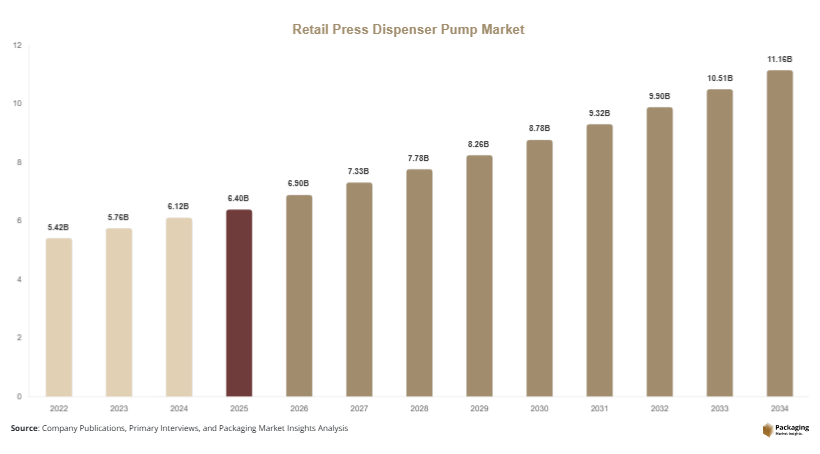
The global retail press dispenser pump market size is estimated at USD 6.4 billion in 2025 and is projected to reach USD 6.9 billion in 2026. With increasing emphasis on user-friendly packaging and product differentiation, the market is forecasted to reach USD 11.8 billion by 2034, registering a CAGR of 6.2% during the forecast period (2025–2034). Retail press dispenser pumps are widely used in liquid soap, lotions, shampoos, sanitizers, and other viscous products, offering controlled dispensing and improved user convenience. The retail press dispenser pump market is experiencing steady growth driven by the expanding demand for convenient and hygienic dispensing solutions across personal care, home care, and food applications.
One of the major growth factors is the increasing demand for hygiene-focused packaging solutions, particularly in the personal care and healthcare sectors. Consumers are prioritizing packaging that minimizes direct contact, thereby driving the adoption of dispenser pumps. Another significant growth factor is the rising consumption of liquid-based products, including hand sanitizers, liquid detergents, and skincare products. These products require efficient dispensing systems that enhance usability and reduce product wastage. Additionally, the rapid expansion of the retail and e-commerce sectors is contributing to market growth, as brands focus on packaging aesthetics and functionality to attract consumers.
Key Highlights:
- Asia Pacific dominated the market with a 38.7% share in 2025, while Latin America is projected to grow at the fastest CAGR of 6.9%.
- Plastic-based pumps led the type segment with a 63.4% share, while metal-based pumps are expected to grow at a CAGR of 5.8%.
- Lotion pumps dominated with a 44.2% share, while foaming pumps are forecasted to grow at a CAGR of 6.7%.
- Personal care applications led the segment with 47.6% share, while healthcare applications are expected to grow at a CAGR of 6.5%.
- China remained the dominant country with a market size of USD 1.6 billion in 2025 and USD 1.8 billion in 2026.
Explore more data points, trends and opportunities Download Free Sample Report
Market Trends
Rising adoption of sustainable and recyclable pump materials
Sustainability is becoming a defining trend in the retail press dispenser pump market. Manufacturers are increasingly focusing on developing pumps made from recyclable and eco-friendly materials to reduce environmental impact. Mono-material pump designs are gaining attention as they simplify recycling processes compared to traditional multi-component pumps. Companies are also exploring bio-based plastics to align with sustainability goals. This trend is supported by regulatory frameworks that encourage the reduction of plastic waste and promote circular economy practices. As consumers become more environmentally conscious, brands are adopting sustainable packaging solutions, including dispenser pumps, to enhance their market positioning.
Increasing demand for innovative and premium packaging designs
The demand for aesthetically appealing and functional packaging is driving innovation in dispenser pump design. Brands are focusing on enhancing the visual appeal of their products through customized pump designs, colors, and finishes. Premium packaging is becoming a key differentiator in the personal care and cosmetics industries, where consumers associate packaging quality with product value. Features such as ergonomic designs, smooth dispensing mechanisms, and tamper-evident closures are being integrated into pump systems. This trend is particularly evident in high-end skincare and cosmetic products, where packaging plays a crucial role in influencing purchasing decisions.
Market Drivers
Growing consumption of liquid-based personal and home care products
The increasing use of liquid-based products is a major driver of the retail press dispenser pump market. Products such as shampoos, conditioners, hand soaps, and liquid detergents require efficient dispensing systems that provide convenience and reduce waste. The shift from solid to liquid formulations in various product categories is further supporting this trend. Consumers prefer packaging that allows controlled dispensing, making press dispenser pumps a preferred choice. The growth of the personal care and home care industries is expected to continue driving demand for these pumps.
Rising focus on hygiene and contactless dispensing solutions
The emphasis on hygiene and cleanliness is significantly influencing the demand for dispenser pumps. Consumers are increasingly seeking packaging solutions that minimize direct contact and reduce the risk of contamination. Press dispenser pumps provide a hygienic way to dispense products, making them suitable for healthcare and personal care applications. The increased use of hand sanitizers and liquid soaps has further boosted demand for these pumps. This driver is expected to remain strong as hygiene awareness continues to shape consumer behavior.
Market Restraint
Complexity in recycling multi-component pump systems
One of the key challenges in the retail press dispenser pump market is the difficulty in recycling multi-component pump systems. Dispenser pumps often consist of multiple materials, including plastic, metal springs, and rubber components, which complicate the recycling process. This complexity can lead to increased waste and environmental concerns. For example, separating different materials during recycling can be time-consuming and costly, reducing the overall efficiency of recycling systems. Regulatory pressures to improve recyclability may require manufacturers to redesign pump systems, which can increase production costs and impact profitability.
Market Opportunities
Development of mono-material and eco-friendly pump designs
The development of mono-material dispenser pumps presents significant opportunities for market growth. These pumps are designed using a single type of material, making them easier to recycle and more environmentally friendly. Manufacturers are investing in research and development to create pumps that maintain performance while improving sustainability. The adoption of such designs can help companies meet regulatory requirements and appeal to environmentally conscious consumers. This opportunity is expected to drive innovation in the market.
Expansion of e-commerce and retail distribution channels
The growth of e-commerce and retail channels is creating new opportunities for the retail press dispenser pump market. Dispenser pumps are widely used in products sold through online platforms due to their convenience and durability. The increasing popularity of online shopping is driving demand for packaging solutions that ensure product safety during transportation. Retailers are also focusing on attractive packaging to enhance product visibility on shelves. This expansion is expected to support market growth in the coming years.
Report Scope
| Report Metric | Details |
|---|---|
| Market Size in 2025 | USD 6.4 Billion |
| Market Size in 2026 | USD 6.9 Billion |
| Market Size in 2034 | USD 11.8 Billion |
| CAGR | 6.2% (2026-2034) |
| Base Year for Estimation | 2025 |
| Historical Data | 2022-2024 |
| Forecast Period | 2026-2034 |
| Report Coverage | Revenue Forecast, Competitive Landscape, Supply Chain Disruption, Growth Factors, Environment & Regulatory Landscape and Trends |
| Geographies Covered | North America, Europe, APAC, Middle East and Africa, LATAM |
| Countries Covered | U.S., Canada, U.K., Germany, France, Spain, Italy, Russia, Nordic, Benelux, Rest of Europe, China, South Korea, Japan, India, Australia, Singapore, Taiwan, South East Asia, Rest of Asia-Pacific, UAE, Turky, Saudi Arabia, South Africa, Egypt, Nigeria, Rest of MEA, Brazil, Mexico, Argentina, Chile, Colombia, Rest of LATAM |
Explore more data points, trends and opportunities Download Free Sample Report
By Material Type
Plastic-based pumps dominated the market in 2024, accounting for 63.4% of the total share. These pumps are widely used due to their lightweight nature, cost-effectiveness, and versatility. Plastic materials provide durability and compatibility with various liquid products, making them suitable for a wide range of applications.
Metal-based pumps are expected to grow at a CAGR of 5.8% during the forecast period. This growth is driven by their use in premium packaging applications, where durability and aesthetics are important. Metal pumps are often used in high-end personal care products, contributing to their increasing demand.
By Product Type
Lotion pumps accounted for the largest share of 44.2% in 2024. These pumps are widely used for dispensing viscous products such as lotions, creams, and shampoos. Their ability to provide controlled dispensing makes them a preferred choice for personal care applications.
Foaming pumps are projected to grow at a CAGR of 6.7%, driven by their ability to dispense products in foam form. These pumps are commonly used in hand soaps and facial cleansers. The increasing demand for convenient and hygienic products is supporting the growth of this segment.
By Application
Personal care products held the largest share of 47.6% in 2024. Dispenser pumps are widely used in packaging products such as shampoos, conditioners, and skincare items. The demand for convenient and hygienic packaging is driving this segment.
Healthcare applications are expected to grow at a CAGR of 6.5% during the forecast period. This growth is driven by the increasing use of liquid sanitizers and disinfectants. Dispenser pumps provide a hygienic way to dispense these products, supporting market growth.
Retail Press Dispenser Pump Market Segmentations
By Material Type
- Plastic-Based Pumps
- Metal-Based Pumps
By Product Type
- Lotion Pumps
- Foaming Pumps
By Application
- Personal Care Products
- Healthcare Products
- Household Products
Regional Analysis
North America
North America accounted for 21.8% of the retail press dispenser pump market share in 2025 and is expected to grow at a CAGR of 5.9% during the forecast period. The region benefits from a well-established personal care and healthcare industry, which drives demand for dispenser pumps. The increasing focus on hygiene and convenience is supporting market growth.
The United States dominates the regional market due to its large consumer base and advanced retail infrastructure. A unique growth factor is the high demand for premium personal care products, which require innovative and aesthetically appealing packaging solutions.
Europe
Europe held a market share of 23.6% in 2025 and is projected to grow at a CAGR of 6.1%. The region is characterized by strict environmental regulations and a strong emphasis on sustainability. The adoption of recyclable pump designs is increasing as companies aim to comply with regulations.
Germany is the dominant country in the European market, driven by its advanced manufacturing sector. A unique growth factor is the implementation of circular economy practices, which encourage the use of sustainable packaging solutions.
Asia Pacific
Asia Pacific dominated the market with a 38.7% share in 2025 and is expected to grow at a CAGR of 6.7%. The region’s growth is driven by rapid urbanization and increasing consumption of personal care products. The expansion of retail and e-commerce sectors is further supporting market growth.
China remains the leading country in the region due to its large manufacturing base. A unique growth factor is the increasing demand for affordable and functional packaging solutions, which is driving the adoption of dispenser pumps.
Middle East & Africa
The Middle East & Africa region accounted for 7.2% of the market share in 2025 and is projected to grow at a CAGR of 6.3%. Growth is supported by increasing urbanization and rising demand for hygiene products. The development of retail infrastructure is also contributing to market expansion.
South Africa is a key market in the region, supported by its growing consumer goods industry. A unique growth factor is the increasing awareness of hygiene and sanitation, which is driving demand for dispenser pumps.
Latin America
Latin America held an 8.7% share in 2025 and is expected to grow at the fastest CAGR of 6.9%. The region’s growth is driven by increasing consumer demand and expanding retail networks. The adoption of modern packaging solutions is also gaining momentum.
Brazil dominates the regional market due to its large population. A unique growth factor is the rising consumption of personal care products, which is increasing the demand for dispenser pumps.
Competitive Landscape
The retail press dispenser pump market is moderately competitive, with several global and regional players focusing on innovation and sustainability. Companies are investing in research and development to improve pump performance and reduce environmental impact. Strategic collaborations and product launches are common strategies to strengthen market presence.
AptarGroup, Inc. is a leading player in the market, known for its innovative dispensing solutions. The company recently introduced recyclable pump designs that align with sustainability goals. Other players are also focusing on expanding their product portfolios and enhancing manufacturing capabilities to meet growing demand.
Key Players List
- AptarGroup, Inc.
- Silgan Holdings Inc.
- Rieke Packaging Systems
- Albea Group
- Berry Global Inc.
- RPC Group Plc
- Frapak Packaging B.V.
- Raepak Ltd.
- Taplast S.r.l.
- Mitani Valve Co., Ltd.
- Yuyao Hongda Sprayer Co., Ltd.
- Coster Group
- Weener Plastics Group
- Guala Dispensing S.p.A.
- LOM Plastics