Package Test Sockets Market Size
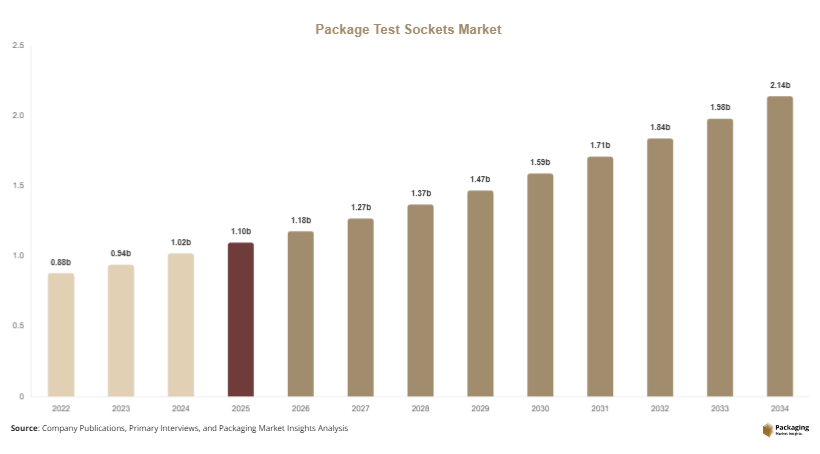
Package Test Sockets market size is projected at USD 1.18 billion in 2026 and is expected to hit USD 2.14 billion by 2034 with a CAGR of 7.7%. Increasing semiconductor production, rising integrated circuit complexity, and higher demand for precision testing continue to strengthen investment across advanced socket technologies. The report evaluates industry segmentation, technology adoption, manufacturing capacity, supply chain developments, pricing trends, and competitive landscape to provide comprehensive market assessment.
The Package Test Sockets market consists of specialized interfaces that electrically connect semiconductor packages to automated test equipment during burn-in, characterization, validation, and production testing. Global semiconductor output exceeded 1.4 trillion chips annually, while advanced package testing penetration surpassed 61% across leading fabrication facilities. Consumer electronics represented nearly 36% of total socket utilization, automotive electronics contributed approximately 24%, and industrial applications accounted for around 18%. Continuous innovation in fine-pitch packages, high-frequency testing above 20 GHz, and increasing wafer-level packaging adoption continue to expand the Package Test Sockets market.
Explore more data points, trends and opportunities Download Free Sample Report
Package Test Sockets Market Trends
Increasing Adoption of High-Performance Semiconductor Testing
Demand for advanced package testing continues to rise as AI processors, high-performance computing chips, and automotive semiconductors require greater testing accuracy. More than 58 million advanced test sockets were manufactured globally during 2025, with over 47% supporting high-pin-count packages exceeding 1,000 contacts. Automated test equipment integration increased by nearly 14%, while production efficiency improved by approximately 18% across leading semiconductor facilities, reinforcing the Package Test Sockets market.
Growing demand for 5G, AI accelerators, and electric vehicle electronics has accelerated the deployment of low-resistance contact materials and high-cycle socket designs. Adoption of precision spring-pin technologies exceeded 54%, while socket replacement cycles shortened by nearly 12% due to increased production volumes. High-frequency testing solutions supporting bandwidths beyond 40 GHz continue to gain traction across semiconductor manufacturing, strengthening the Package Test Sockets market.
Package Test Sockets Drivers
Rapid Expansion of Semiconductor Manufacturing Investments
Worldwide semiconductor fabrication investments exceeded USD 180 billion, with advanced packaging capacity increasing by nearly 16% during 2025. More than 70% of advanced semiconductor packages require high-precision socket testing before shipment, while automotive semiconductor production expanded by approximately 19%. Growing AI server deployment, consumer electronics demand, and industrial automation continue to stimulate the Package Test Sockets market.
Package Test Sockets Restraints
High Manufacturing Costs and Precision Requirements
Manufacturing precision sockets requires micron-level tolerances, specialty alloys, and advanced machining processes, increasing production costs by nearly 22% compared with conventional socket designs. Raw material price fluctuations exceeding 15%, combined with qualification cycles lasting 6–12 months, create barriers for smaller manufacturers. These cost pressures moderately affect the Package Test Sockets market.
Package Test Sockets Opportunities
Expansion of Electric Vehicle and AI Semiconductor Production
Electric vehicle semiconductor demand is projected to increase by more than 60% over the forecast period, while AI accelerator shipments continue recording double-digit annual expansion. Advanced packaging technologies including chiplets and heterogeneous integration are expected to represent nearly 40% of premium semiconductor production by 2034. These developments create significant opportunities for the Package Test Sockets market.
Challenges in Package Test Sockets
Maintaining Performance for Next-Generation Package Architectures
Increasing pin density beyond 2,000 contacts, operating frequencies above 40 GHz, and thermal loads exceeding 300 W require continuous engineering innovation. Manufacturers must simultaneously reduce electrical resistance below 20 milliohms while improving durability beyond 500,000 insertion cycles, presenting ongoing technical challenges for the Package Test Sockets market.
Report Scope
| Report Metric | Details |
|---|---|
| Market Size in 2025 | USD 1.10 billion |
| Market Size in 2026 | USD 1.18 billion |
| Market Size in 2034 | USD 2.14 billion |
| CAGR | 7.7% (2026-2034) |
| Base Year for Estimation | 2025 |
| Historical Data | 2022-2024 |
| Forecast Period | 2026-2034 |
| Report Coverage | Revenue Forecast, Competitive Landscape, Supply Chain Disruption, Growth Factors, Environment & Regulatory Landscape and Trends |
| Geographies Covered | North America, Europe, APAC, Middle East and Africa, LATAM |
| Countries Covered | U.S., Canada, U.K., Germany, France, Spain, Italy, Russia, Nordic, Benelux, Rest of Europe, China, South Korea, Japan, India, Australia, Singapore, Taiwan, South East Asia, Rest of Asia-Pacific, UAE, Turky, Saudi Arabia, South Africa, Egypt, Nigeria, Rest of MEA, Brazil, Mexico, Argentina, Chile, Colombia, Rest of LATAM |
Explore more data points, trends and opportunities Download Free Sample Report
Package Test Sockets Market Segmentation
The market is segmented according to type and application, with IC Test Sockets accounting for approximately 44% of industry revenue, while Semiconductor Manufacturing contributes nearly 58% of overall demand owing to expanding chip fabrication activities.
By Type
Burn-in Test Sockets
Burn-in Test Sockets account for nearly 28% of total demand, supporting long-duration thermal testing at temperatures ranging from -55°C to 150°C. More than 14 million units are supplied annually, with increasing deployment across automotive and industrial semiconductor qualification.
Functional Test Sockets
Functional Test Sockets represent around 28% of the market and are widely used for electrical validation during production testing. Annual shipments exceed 16 million units, supporting frequencies above 20 GHz and high-speed signal integrity requirements.
IC Test Sockets
IC Test Sockets dominate with approximately 44% share due to their extensive utilization in logic ICs, memory devices, RF components, and AI processors. Production surpassed 28 million units annually, supporting fine-pitch semiconductor packages with thousands of electrical contacts.
By Application
Semiconductor Manufacturing
Semiconductor Manufacturing accounts for nearly 58% of total consumption, supported by increasing wafer fabrication, advanced packaging, and automated testing. Socket deployment continues expanding alongside production volumes exceeding 1.4 trillion semiconductor devices annually.
Consumer Electronics
Consumer Electronics contributes approximately 24% of demand through smartphones, laptops, wearables, gaming devices, and networking equipment. More than 9 million package test sockets are utilized annually for high-volume consumer semiconductor production.
Automotive Electronics
Automotive Electronics represents roughly 18% of the market, driven by ADAS, EV power electronics, infotainment, and safety systems. Semiconductor testing penetration exceeds 95% for automotive-grade components due to stringent reliability requirements.
Package Test Sockets Market Segmentations
Type
- Burn-in Test Sockets
- Functional Test Sockets
- IC Test Sockets
Application
- Semiconductor Manufacturing
- Consumer Electronics
- Automotive Electronics
Package Test Sockets Regional Outlook
North America
North America holds approximately 29% of the global market, supported by advanced semiconductor design, AI processor development, and strong automated test equipment deployment. The United States contributes nearly 87% of regional demand, while Canada continues expanding electronics manufacturing capacity.
Europe
Europe accounts for nearly 22% of industry revenue. Germany, France, Italy, and the Netherlands collectively contribute over 78% of regional semiconductor testing demand, supported by automotive electronics and industrial automation investments.
Asia-Pacific
Asia-Pacific dominates with approximately 41% market share. China, Taiwan, South Korea, Japan, and Southeast Asia manufacture the majority of global semiconductor devices, with advanced packaging facilities processing hundreds of billions of chips annually.
Middle East & Africa
The Middle East & Africa contribute around 3% of global demand, supported by expanding electronics assembly, industrial automation, and government investments in technology infrastructure.
South America
South America represents nearly 5% of the market. Brazil leads regional demand with more than 48% share, followed by Argentina and Chile, supported by growing consumer electronics production and industrial semiconductor applications.
Top players in Package Test Sockets
- Yamaichi Electronics
- Cohu Inc.
- Smiths Interconnect
- Ironwood Electronics
- WinWay Technology
- LEENO Industrial Inc.
- Enplas Corporation
- ISC Inc.
- Plastronics Socket Partners
- Johnstech International
- Qualmax Inc.
- Advanced Test Technologies
Yamaichi Electronics
-
Estimated market share of approximately 15–17%.
-
Strong presence in high-frequency semiconductor sockets, burn-in solutions, and advanced package testing.
-
Extensive manufacturing capabilities across Asia and Europe with continuous investment in next-generation socket technologies supporting AI, automotive, and high-performance computing applications.
Cohu Inc.
-
Estimated market share of approximately 13–15%.
-
Global supplier integrating automated test equipment with advanced socket technologies.
-
Broad customer base across semiconductor manufacturers, strong R&D capabilities, and focus on high-density testing solutions for automotive, memory, logic, and RF semiconductor devices.