Active Packaging Market Size and Growth
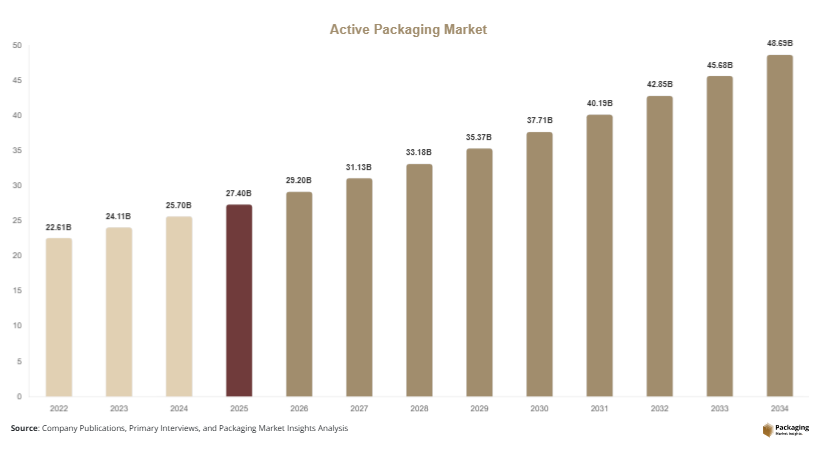
The active packaging market size was valued at USD 27.4 billion in 2025 and is projected to reach USD 48.9 billion by 2034, expanding at a CAGR of 6.6% during the forecast period (2025–2034). Active packaging technologies integrate components that interact with packaged products or the surrounding environment to extend shelf life, maintain quality, and enhance safety. Unlike conventional packaging that functions only as a passive barrier, active packaging systems incorporate oxygen scavengers, moisture regulators, antimicrobial agents, and ethylene absorbers that actively protect food, pharmaceuticals, and consumer goods.
One global factor that supported growth in the active packaging market has been the rising emphasis on reducing food waste across supply chains. Retailers and food manufacturers have increasingly adopted advanced packaging solutions capable of extending freshness and preserving product integrity during storage and distribution. Governments and sustainability initiatives have further encouraged adoption by promoting technologies that improve product shelf life and reduce disposal rates.
Key Highlights
- Dominant Region: North America held 34.1% share in 2025, while Asia Pacific will record the fastest growth at a CAGR of 7.9%.
- Leading Subsegments: Oxygen scavengers led the type segment with 31.6% share in 2025, while antimicrobial packaging will grow fastest at 7.8% CAGR. In materials, plastics dominated with 46.8% share, whereas biodegradable materials will expand fastest at 8.3% CAGR.
- Dominant Country: The United States accounted for USD 8.7 billion in 2025, increasing to USD 9.3 billion in 2026.
Explore more data points, trends and opportunities Download Free Sample Report
Market Trends
Integration of Smart and Active Packaging Technologies
One prominent trend shaping the active packaging market is the convergence of active and intelligent packaging solutions. Manufacturers are increasingly combining active components such as oxygen scavengers or moisture absorbers with smart indicators that monitor product freshness or temperature exposure. This hybrid packaging approach allows retailers and logistics providers to track quality conditions in real time while maintaining product stability.
Advancements in sensor technologies and printable electronics have enabled cost-effective integration of freshness indicators and antimicrobial layers into packaging films and containers. As supply chains become more complex and globalized, the need for packaging that both protects and communicates product conditions has grown significantly. This trend is expected to expand adoption in food distribution, pharmaceuticals, and specialty chemicals.
Growing Adoption of Sustainable Active Materials
Another notable trend in the active packaging market is the shift toward sustainable and biodegradable active materials. Packaging producers are developing plant-based polymers, recyclable multilayer films, and compostable active packaging solutions that maintain functional performance while reducing environmental impact.
This transition is being supported by brand commitments to reduce plastic waste and improve packaging circularity. Bio-based absorbent pads, natural antimicrobial coatings, and recyclable scavenger films are gaining attention among food manufacturers seeking environmentally responsible packaging alternatives. As sustainability becomes a key purchasing criterion for consumers and retailers, demand for eco-friendly active packaging technologies is expected to strengthen across global markets.
Market Drivers
Rising Demand for Extended Shelf-Life Packaging
Increasing consumer demand for fresh and minimally processed food products has driven the need for packaging systems capable of preserving product quality for longer durations. Active packaging technologies such as oxygen scavengers and moisture regulators play a significant role in slowing oxidation and microbial growth, enabling manufacturers to extend shelf life without heavy reliance on chemical preservatives.
Food producers have adopted these technologies to support expanding distribution networks and e-commerce grocery services. Longer shelf life reduces product spoilage during transportation and storage, improving operational efficiency for retailers and food processors. As global food supply chains continue to expand, the importance of protective packaging solutions will remain a key growth factor in the active packaging market.
Growth of Pharmaceutical and Healthcare Packaging
The pharmaceutical sector has increasingly adopted active packaging solutions to ensure drug stability and patient safety. Sensitive formulations such as biologics, vaccines, and moisture-sensitive tablets require controlled environments to maintain efficacy throughout their lifecycle.
Active packaging components such as desiccants, oxygen absorbers, and antimicrobial coatings help maintain optimal storage conditions inside packaging systems. The expansion of pharmaceutical production and the growing need for secure medicine distribution have supported wider adoption of these technologies, contributing to consistent growth in the active packaging market.
Market Restraints
High Cost and Complexity of Active Packaging Systems
One of the primary challenges affecting the active packaging market is the relatively high cost and complexity associated with advanced packaging technologies. Active packaging solutions require specialized materials, chemical components, and manufacturing processes that increase production expenses compared with traditional packaging systems.
These additional costs may limit adoption among small and medium-sized manufacturers that operate with narrow profit margins. Implementing active packaging also requires compatibility testing with specific products to ensure safety and effectiveness, which can increase development timelines and regulatory review processes.
Furthermore, integrating active agents into packaging structures often requires modifications to existing production lines and packaging equipment. These operational adjustments can create barriers for companies that rely on established manufacturing infrastructure.
Although large food and pharmaceutical manufacturers continue to adopt active packaging solutions, cost sensitivity in certain industries may slow widespread penetration. Addressing these cost barriers through scalable production methods and simplified formulations will remain important for expanding the reach of the active packaging market.
Market Opportunities
Expansion of E-Commerce Food Distribution
The rapid expansion of online grocery and meal delivery services presents a significant opportunity for the active packaging market. E-commerce distribution channels often involve longer transportation routes and variable storage conditions compared with traditional retail supply chains.
Active packaging technologies can help maintain product freshness during last-mile delivery and extended logistics cycles. Oxygen control systems, antimicrobial films, and moisture absorbers improve stability for perishable products such as fresh produce, meat, seafood, and dairy. As digital grocery platforms continue to expand globally, packaging solutions capable of protecting products during transit will experience increasing demand.
Development of Natural Antimicrobial Packaging
Growing interest in natural preservatives has opened new avenues for antimicrobial active packaging. Researchers and packaging companies are exploring plant-derived compounds such as essential oils, organic acids, and natural enzymes that can inhibit microbial growth within packaging environments.
These solutions align with consumer preferences for clean-label food products and reduced synthetic additives. Natural antimicrobial packaging technologies offer food manufacturers a method of extending shelf life while maintaining product authenticity. Continued innovation in this area could create new growth segments within the active packaging market.
Report Scope
| Report Metric | Details |
|---|---|
| Market Size in 2025 | USD 27.4 Billion |
| Market Size in 2026 | USD 29.2 Billion |
| Market Size in 2034 | USD 48.9 Billion |
| CAGR | 6.6% (2026-2034) |
| Base Year for Estimation | 2025 |
| Historical Data | 2022-2024 |
| Forecast Period | 2026-2034 |
| Report Coverage | Revenue Forecast, Competitive Landscape, Supply Chain Disruption, Growth Factors, Environment & Regulatory Landscape and Trends |
| Geographies Covered | North America, Europe, APAC, Middle East and Africa, LATAM |
| Countries Covered | U.S., Canada, U.K., Germany, France, Spain, Italy, Russia, Nordic, Benelux, Rest of Europe, China, South Korea, Japan, India, Australia, Singapore, Taiwan, South East Asia, Rest of Asia-Pacific, UAE, Turky, Saudi Arabia, South Africa, Egypt, Nigeria, Rest of MEA, Brazil, Mexico, Argentina, Chile, Colombia, Rest of LATAM |
Explore more data points, trends and opportunities Download Free Sample Report
Segmental Analysis
By Type
Oxygen scavengers represented the dominant subsegment in the active packaging market, accounting for 31.6% share in 2025. These systems are widely used in food packaging to remove residual oxygen from sealed packages, preventing oxidation and maintaining product freshness. Oxygen scavengers are commonly applied in bakery products, ready-to-eat meals, and processed foods where maintaining flavor and color stability is important. Their compatibility with flexible packaging formats has also contributed to strong adoption among food manufacturers.
Antimicrobial packaging will be the fastest-growing subsegment with a projected CAGR of 7.8% through 2034. These packaging systems will incorporate antimicrobial agents that inhibit bacterial and fungal growth within packaged products. Increasing research into antimicrobial films and coatings will enable packaging solutions capable of maintaining hygiene without direct additives in food formulations. The ability of antimicrobial packaging to enhance safety and reduce contamination risks will support rapid growth across food and healthcare applications.
By Material
Plastic materials accounted for the largest share of the active packaging market in 2025, representing 46.8% of total demand. Plastic substrates such as polyethylene, polypropylene, and polyethylene terephthalate provide flexibility, durability, and compatibility with various active agents. Their barrier properties allow integration of oxygen scavengers, moisture regulators, and antimicrobial compounds within packaging structures.
Biodegradable materials will experience the fastest expansion with an anticipated CAGR of 8.3% during the forecast period. Innovations in plant-based polymers and compostable films will allow packaging manufacturers to incorporate active components into environmentally friendly materials. Biodegradable packaging systems will support sustainability objectives while maintaining functionality required for food preservation. Continued development of bio-based materials compatible with active packaging technologies will accelerate this segment’s growth.
By Application
Food and beverage applications dominated the active packaging market in 2025 with a share of 55.4%. Food producers widely use active packaging to regulate oxygen levels, control moisture, and reduce microbial growth within packaged products. Applications include fresh produce, bakery items, dairy products, and processed foods. The ability of active packaging to extend product shelf life while preserving quality has made it an essential component in modern food packaging systems.
Pharmaceutical applications will be the fastest-growing segment with a projected CAGR of 7.2%. Pharmaceutical packaging systems increasingly incorporate desiccants, oxygen absorbers, and antimicrobial layers to maintain stable environments for sensitive medicines. As pharmaceutical formulations become more advanced, packaging solutions capable of controlling environmental conditions will become increasingly important.
By End Use
The food processing industry represented the largest end-use segment in the active packaging market in 2025, accounting for 41.9% share. Food manufacturers rely on packaging technologies that maintain product quality throughout storage and transportation. Active packaging solutions provide controlled internal environments that protect packaged foods from oxidation, moisture fluctuations, and microbial contamination.
Healthcare and pharmaceutical companies will represent the fastest-growing end-use segment, expanding at a CAGR of 7.4% during the forecast period. Increasing production of sensitive drug formulations will require packaging systems capable of maintaining stable internal conditions. Active packaging technologies will enable manufacturers to safeguard product integrity while supporting global pharmaceutical distribution networks.
Active Packaging Market Segmentations
Type
- Oxygen Scavengers
- Moisture Absorbers
- Ethylene Absorbers
- Antimicrobial Packaging
Material
- Plastics
- Paper & Paperboard
- Biodegradable Materials
- Others
Application
- Food & Beverage
- Pharmaceuticals
- Personal Care
- Electronics
End Use
- Food Processing
- Healthcare & Pharmaceuticals
- Consumer Goods
- Industrial Applications
Regional Analysis
North America
North America accounted for 34.1% of the active packaging market in 2025, making it the largest regional contributor. The region has maintained a strong position due to advanced packaging infrastructure and widespread adoption of high-performance materials. Over the forecast period, the regional market will expand at a CAGR of 6.1% from 2025 to 2034.
The United States dominated the regional market in 2025, supported by a large food processing industry and strong innovation in packaging technologies. Food manufacturers in the country increasingly implement packaging systems designed to maintain freshness across long-distance distribution networks. The presence of leading packaging technology developers and material suppliers has also strengthened market growth. Continuous research in barrier films, oxygen absorbers, and antimicrobial coatings has enabled packaging producers to deliver high-performance solutions tailored for diverse consumer goods.
Europe
Europe held 27.3% share of the active packaging market in 2025. The region has long emphasized product quality and advanced packaging technologies, particularly in food safety and pharmaceutical applications. The European market will grow at a CAGR of 5.9% through 2034.
Germany emerged as the dominant country within the region. The country’s strong manufacturing base and leadership in materials engineering have supported the development of innovative packaging systems. German packaging manufacturers focus heavily on high-performance multilayer materials and functional packaging additives that enhance product stability. Strong collaboration between research institutions and industrial packaging producers has also accelerated innovation in active packaging technologies. As demand for high-quality packaged foods and medical products remains stable across Europe, adoption of advanced packaging solutions will continue to expand steadily.
Asia Pacific
Asia Pacific represented 23.8% of the active packaging market in 2025. The region will record the fastest growth with a projected CAGR of 7.9% during the forecast period. Rapid industrial expansion and growing manufacturing capabilities have contributed to the region’s increasing share in global packaging production.
China dominated the regional market in 2025. The country’s large-scale food manufacturing sector and rapidly expanding packaged food consumption have created significant demand for advanced packaging technologies. Domestic packaging companies have also increased investments in functional films and active additives designed to improve product stability. Additionally, the expansion of modern retail infrastructure and cold-chain logistics has increased the need for packaging solutions that maintain product freshness during distribution. These factors will continue to strengthen China’s contribution to the active packaging market in the coming years.
Middle East & Africa
The Middle East & Africa accounted for 7.4% of the active packaging market in 2025. Although the region currently represents a smaller share compared with developed markets, it will grow at a CAGR of 6.8% through 2034.
The United Arab Emirates emerged as the dominant market within the region. The country serves as a key trade hub for packaged food imports and exports across the Middle East. High reliance on imported food products requires packaging technologies capable of maintaining freshness during long shipping periods. Food distributors and retailers in the UAE increasingly adopt active packaging systems that regulate oxygen levels and moisture content inside packaging containers. Continued growth in international trade and modern retail channels will contribute to steady expansion of the active packaging market across the region.
Latin America
Latin America held 7.4% share of the active packaging market in 2025. The regional market will expand at a CAGR of 6.4% during the forecast period as packaging modernization initiatives continue across the region.
Brazil represented the leading country in the regional market. The country’s large agricultural sector and growing processed food industry have created demand for packaging technologies that protect products throughout storage and transportation. Brazilian food exporters rely on packaging systems that preserve freshness during international shipping. Packaging producers in the country have also increased investments in functional packaging films designed to control humidity and oxygen exposure. These developments will support consistent growth of the active packaging market in Latin America over the coming decade.
Competitive Landscape
The active packaging market is characterized by the presence of multinational packaging companies and specialized technology developers. These companies focus on innovation in active materials, barrier films, and packaging integration technologies to enhance product preservation.
Amcor Plc has emerged as a leading player in the market due to its extensive portfolio of flexible and rigid packaging solutions integrated with active components. The company continues to invest in advanced materials designed to improve shelf life while supporting sustainability goals.
Other companies compete through technological development, regional expansion, and partnerships with food and pharmaceutical manufacturers. Strategic collaborations with material science companies and research institutions have enabled packaging producers to develop new active agents and environmentally compatible materials.
Continuous innovation in packaging functionality and material performance will remain a key competitive factor shaping the future of the active packaging market.
Key Players
- Amcor Plc
- Sealed Air Corporation
- Berry Global Inc.
- Mondi Group
- Sonoco Products Company
- BASF SE
- Avery Dennison Corporation
- Huhtamaki Oyj
- Constantia Flexibles
- Clariant AG
- Mitsubishi Chemical Group
- Smurfit Kappa Group
- AptarGroup Inc.
- Multisorb Technologies Inc.
- Coveris Holdings S.A.