Nanotechnology Packaging Market Report Size and Growth
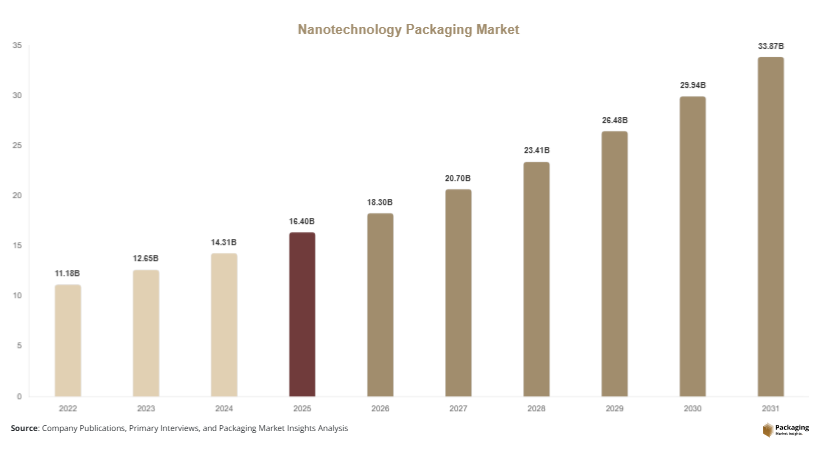
The Nanotechnology Packaging Market was valued at USD 16.4 billion in 2025 and is projected to reach USD 34.7 billion by 2030, expanding at a compound annual growth rate (CAGR) of 13.1% between 2025 and 2031. Nanotechnology packaging integrates nanoscale materials and engineered nanostructures into packaging solutions to enhance barrier properties, durability, antimicrobial protection, and shelf-life extension. These capabilities are gaining relevance across food & beverage, pharmaceuticals, personal care, and electronics packaging industries.
A major global factor supporting the growth of the Nanotechnology Packaging Market is the increasing demand for extended shelf life and food safety. Nanomaterials such as nanoclays, nanosilver, and nanocomposites improve oxygen and moisture barriers, which helps maintain product freshness and reduce food waste. As global food supply chains expand and e-commerce logistics intensify, manufacturers increasingly adopt nanotechnology-enabled packaging to ensure product quality during long-distance transportation.
Additionally, regulatory pressure for sustainable packaging is encouraging companies to incorporate nanotechnology into recyclable and lightweight materials. These materials allow manufacturers to use thinner packaging layers without compromising protection, thereby reducing plastic consumption. Advancements in smart packaging solutions, such as nanosensors that monitor temperature or contamination, further expand market potential.
Key Highlights
- North America accounted for 34.2% of the global Nanotechnology Packaging Market share in 2025, while Asia Pacific is expected to be the fastest-growing region with a CAGR of 15.4% through 2031.
- Within type segmentation, Active Nanotechnology Packaging held the largest share, while Smart Nanotechnology Packaging is expected to register the fastest growth at 16.2% CAGR.
- By application, Food & Beverage Packaging dominated the market, while Pharmaceutical Packaging is projected to grow fastest at 15.7% CAGR.
- The United States led the global market, with a value of USD 4.9 billion in 2025, increasing to USD 5.5 billion in 2026.
Explore more data points, trends and opportunities Download Free Sample Report
Market Trends
Integration of Smart Nanosensors in Packaging
The emergence of smart nanotechnology-enabled packaging represents a notable trend shaping the Nanotechnology Packaging Market. Advanced nanosensors embedded in packaging materials can detect temperature changes, microbial contamination, or gas composition inside packages. These sensors enable real-time monitoring of food freshness and pharmaceutical stability. Manufacturers are increasingly adopting nanosensor-based packaging in cold chain logistics to ensure product integrity during storage and transportation. As digital supply chains expand and consumers demand transparency about product safety, smart nanotechnology packaging solutions are expected to gain wider adoption.
Growing Use of Nanocomposite Barrier Materials
Another key trend influencing the Nanotechnology Packaging Market is the growing use of nanocomposite materials to improve barrier performance. Nanoclays, graphene, and nano-silica are increasingly incorporated into polymer packaging films to enhance resistance to oxygen, moisture, and UV radiation. These materials allow packaging producers to reduce material thickness while maintaining protective properties. This trend aligns with global sustainability initiatives that aim to reduce plastic waste and material consumption. As research advances in biodegradable nanocomposites, the use of nanotechnology in eco-friendly packaging formats is expected to expand further across multiple industries.
Market Drivers
Rising Demand for Food Safety and Shelf-Life Extension
Increasing global food consumption and complex supply chains are driving demand for packaging solutions that maintain freshness and prevent contamination. Nanotechnology packaging provides enhanced antimicrobial properties and improved barrier resistance against oxygen and moisture. These characteristics help extend the shelf life of perishable products, reduce spoilage, and support efficient food distribution. As food retailers and producers prioritize waste reduction and quality preservation, the adoption of nanotechnology packaging is expected to increase across the food and beverage industry.
Advancements in Nanomaterials and Packaging Engineering
Technological progress in nanomaterials is significantly contributing to the expansion of the Nanotechnology Packaging Market. Innovations in nanosilver, nano-titanium dioxide, and graphene-based coatings are enabling packaging manufacturers to design materials with improved strength, flexibility, and antimicrobial protection. These advanced materials offer functional benefits without substantially increasing packaging weight. As research institutions and packaging companies continue to develop scalable nanomaterial production techniques, commercial adoption of nanotechnology-enabled packaging solutions is expected to accelerate.
Market Restraint
Regulatory Uncertainty and Safety Concerns
Despite its technological benefits, the Nanotechnology Packaging Market faces challenges related to regulatory approval and safety concerns. Nanomaterials interact with products at a microscopic level, which raises questions about potential health and environmental impacts. Regulatory authorities in several countries require extensive testing to evaluate the migration of nanoparticles into food or pharmaceutical products. These compliance requirements can increase development costs and delay commercialization. As a result, some manufacturers remain cautious about integrating nanotechnology into packaging materials until clearer regulatory frameworks and safety standards are established.
Market Opportunities
Expansion of Smart Packaging for Supply Chain Monitoring
The development of smart packaging systems incorporating nanosensors and nano-indicators offers significant growth opportunities in the Nanotechnology Packaging Market. These technologies enable monitoring of temperature fluctuations, gas levels, and microbial growth during transportation. With increasing global trade in temperature-sensitive goods such as pharmaceuticals and fresh foods, smart nanotechnology packaging solutions are expected to support supply chain transparency and product safety.
Sustainable Nanomaterial-Based Packaging Solutions
Another emerging opportunity lies in the development of biodegradable nanocomposite packaging materials. Researchers are increasingly exploring plant-based polymers reinforced with nanomaterials to enhance mechanical strength and barrier properties. These materials combine sustainability with high performance, making them suitable alternatives to conventional plastics. As global regulations emphasize environmentally responsible packaging, biodegradable nanotechnology-enabled materials are likely to gain traction across multiple industries.
Report Scope
| Report Metric | Details |
|---|---|
| Market Size in 2025 | USD 16.4 Billion |
| Market Size in 2026 | USD 18.3 Billion |
| Market Size in 2031 | USD 39.2 Billion |
| CAGR | 13.1% (2026-2031) |
| Base Year for Estimation | 2025 |
| Historical Data | 2022-2024 |
| Forecast Period | 2026-2031 |
| Report Coverage | Revenue Forecast, Competitive Landscape, Supply Chain Disruption, Growth Factors, Environment & Regulatory Landscape and Trends |
| Geographies Covered | North America, Europe, APAC, Middle East and Africa, LATAM |
| Countries Covered | U.S., Canada, U.K., Germany, France, Spain, Italy, Russia, Nordic, Benelux, Rest of Europe, China, South Korea, Japan, India, Australia, Singapore, Taiwan, South East Asia, Rest of Asia-Pacific, UAE, Turky, Saudi Arabia, South Africa, Egypt, Nigeria, Rest of MEA, Brazil, Mexico, Argentina, Chile, Colombia, Rest of LATAM |
Explore more data points, trends and opportunities Download Free Sample Report
Segmental Analysis
By Type
Active Nanotechnology Packaging represented the dominant segment and accounted for 46.8% of the Nanotechnology Packaging Market share in 2024. Active packaging technologies incorporate nanomaterials that interact with packaged products to maintain quality. Antimicrobial nanoparticles such as nanosilver and nano-zinc oxide help prevent microbial growth, making these solutions widely used in food and pharmaceutical packaging.
Smart Nanotechnology Packaging is projected to grow at the fastest CAGR of 16.2% through 2031. This segment will expand due to the rising adoption of nanosensors and nano-indicators capable of detecting spoilage, contamination, or temperature fluctuations. These technologies will enable real-time monitoring of product conditions throughout supply chains.
By Material
Polymer-Based Nanomaterials dominated the Nanotechnology Packaging Market and held 52.4% share in 2024. Polymer nanocomposites reinforced with nanoclays and nano-silica enhance packaging strength and barrier resistance. These materials are widely used in flexible packaging formats due to their durability and lightweight characteristics.
Biodegradable Nanomaterials are expected to grow at a CAGR of 15.1% during the forecast period. The segment will gain traction as sustainability initiatives encourage the use of environmentally responsible packaging materials. Biopolymer films combined with nanomaterials will provide improved mechanical strength while maintaining biodegradability.
By Application
Food & Beverage Packaging held the largest share of the Nanotechnology Packaging Market in 2024, accounting for 48.6% of total demand. Nanotechnology packaging improves barrier protection against oxygen and moisture, helping preserve freshness and extend the shelf life of perishable foods.
Pharmaceutical Packaging will register the fastest growth with a CAGR of 15.7% through 2031. Increasing demand for temperature-sensitive drugs and biologics will drive the adoption of nanotechnology-enabled packaging solutions capable of maintaining product stability.
By End-Use Industry
The Food Processing Industry dominated the Nanotechnology Packaging Market in 2024 and accounted for 41.3% of total revenue share. The industry increasingly uses nanocomposite films and antimicrobial coatings to maintain product freshness and improve safety during distribution.
The Healthcare and Pharmaceutical Industry will experience the fastest growth, expanding at a CAGR of 15.9% through 2031. Advanced packaging materials incorporating nanosensors will support pharmaceutical logistics by monitoring environmental conditions and ensuring product stability.
Nanotechnology Packaging Market Segmentations
By Type
- Active Nanotechnology Packaging
- Intelligent/Smart Nanotechnology Packaging
- Controlled Release Packaging
By Material
- Polymer Nanocomposites
- Metal Nanoparticles
- Nanoclays
- Biodegradable Nanomaterials
By Application
- Food & Beverage
- Pharmaceutical
- Personal Care & Cosmetics
- Electronics Packaging
By End-Use Industry
- Food Processing
- Healthcare & Pharmaceuticals
- Consumer Goods
- Industrial Products
Regional Analysis
North America
North America accounted for 34.2% of the global Nanotechnology Packaging Market share in 2025, reflecting strong adoption across food processing, pharmaceutical manufacturing, and consumer goods packaging industries. The region benefits from advanced research infrastructure and strong collaboration between nanotechnology research institutes and packaging manufacturers. The Nanotechnology Packaging Market in North America is projected to expand at a CAGR of 12.4% between 2025 and 2033, supported by continuous investments in smart packaging technologies and food safety innovations.
The United States dominated the regional market due to its well-established packaging industry and high investment in nanotechnology research. Major food producers and pharmaceutical companies increasingly use nanocomposite materials to enhance product protection and extend shelf life. Government funding for nanotechnology research and strong industry collaboration have further accelerated technological advancements in packaging materials.
Europe
Europe held 27.5% of the Nanotechnology Packaging Market share in 2025, driven by strong regulatory focus on sustainable packaging and innovation in material science. The region has a well-developed packaging sector with extensive research initiatives dedicated to nanomaterials and biodegradable packaging solutions. The Nanotechnology Packaging Market in Europe will grow at a CAGR of 12.8% through 2033, supported by sustainability policies and demand for eco-friendly packaging materials.
Germany emerged as the dominant country in the European market due to its advanced chemical and materials manufacturing industries. German packaging companies are actively developing nanocomposite films and antimicrobial coatings that improve packaging performance. The country’s emphasis on sustainable production and circular economy initiatives is encouraging the integration of nanotechnology into recyclable packaging materials.
Asia Pacific
Asia Pacific represented 24.3% of the global Nanotechnology Packaging Market share in 2025. Rapid industrialization, expanding food processing sectors, and growing consumer demand for packaged goods supported market growth across the region. The Nanotechnology Packaging Market in Asia Pacific is expected to expand at a CAGR of 15.4% between 2025 and 2033, making it the fastest-growing regional market.
China dominated the Asia Pacific market due to its large manufacturing base and expanding food export industry. Chinese packaging manufacturers are investing in nanocomposite materials to improve packaging durability and product preservation. The country’s growing pharmaceutical and electronics sectors also contribute to increasing demand for high-performance packaging materials.
Middle East & Africa
The Middle East & Africa accounted for 7.1% of the Nanotechnology Packaging Market share in 2025. The region’s packaging industry has gradually adopted advanced technologies to improve product preservation in extreme climate conditions. The Nanotechnology Packaging Market in this region is projected to grow at a CAGR of 11.2% through 2033, driven by rising food imports and the expansion of pharmaceutical distribution networks.
Saudi Arabia led the regional market due to increasing investments in food processing and logistics infrastructure. The country’s focus on food security initiatives has encouraged the adoption of advanced packaging technologies that help maintain product quality during transportation and storage.
Latin America
Latin America accounted for 6.9% of the Nanotechnology Packaging Market share in 2025, supported by growing packaged food consumption and expanding retail supply chains. The Nanotechnology Packaging Market in the region is expected to grow at a CAGR of 11.6% through 2033, as manufacturers seek packaging solutions that extend product shelf life in tropical climates.
Brazil dominated the regional market due to its large food processing industry and increasing adoption of advanced packaging technologies. Brazilian manufacturers are exploring nanocomposite films to improve packaging strength and barrier performance, supporting longer distribution cycles and export activities
Competitive Landscape
The Nanotechnology Packaging Market features a mix of multinational packaging companies, material science firms, and nanotechnology innovators. These companies focus on developing advanced nanocomposite materials, antimicrobial coatings, and smart packaging technologies.
Amcor Plc remains a prominent market leader due to its extensive research in nanocomposite packaging materials. The company recently expanded its innovation program to develop recyclable packaging solutions incorporating nanoscale barrier technologies.
Other key companies are investing in partnerships with research institutions and nanomaterial developers to strengthen product portfolios and expand global market presence.
Key Players in the Nanotechnology Packaging Market
- Amcor Plc
- BASF SE
- Sealed Air Corporation
- DuPont de Nemours Inc.
- Honeywell International Inc.
- Avery Dennison Corporation
- Mitsubishi Chemical Group
- Tetra Pak International
- Berry Global Inc.
- Mondi Group
- Sonoco Products Company
- Klöckner Pentaplast
- NanoPack Inc.
- Danaflex Group
- Uflex Ltd.
- Coveris Holdings SA