Odor Scavenger Packaging Additives Market Size
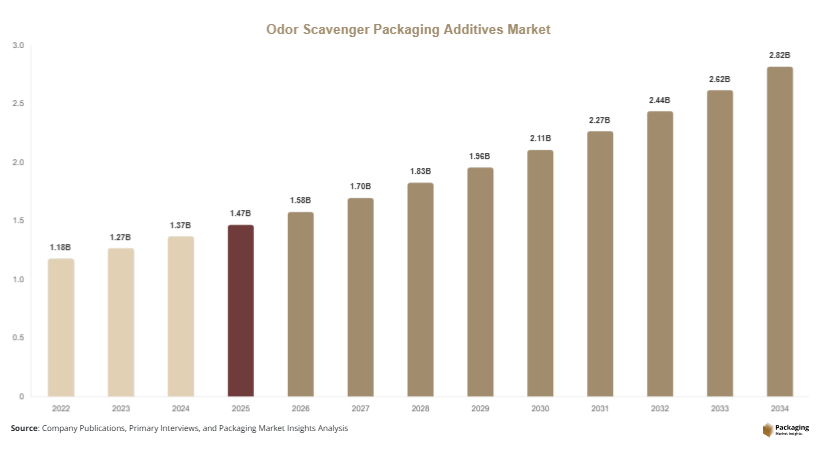
The odor scavenger packaging additives market size is projected at USD 1.58 billion in 2026 and is expected to hit USD 2.82 billion by 2034 with a CAGR of 7.5%. The report evaluates market revenue, production capacity, raw material utilization, technology adoption, and competitive positioning across major manufacturing regions. It also analyzes detailed segmentation, supplier strategies, regulatory developments, and the competitive landscape to provide a comprehensive industry assessment.
Odor scavenger packaging additives are functional compounds incorporated into plastic packaging materials to absorb or neutralize unwanted odors, volatile organic compounds (VOCs), sulfur compounds, and amines, thereby extending product freshness and improving consumer experience. Global production exceeded 325 thousand metric tons in 2025, while industrial utilization rates averaged 79%. Food packaging accounted for approximately 56% of total additive consumption, pharmaceutical packaging represented 24%, and consumer goods packaging contributed nearly 20%. Rising adoption of active packaging technologies continues supporting the odor scavenger packaging additives market.
Explore more data points, trends and opportunities Download Free Sample Report
Odor Scavenger Packaging Additives Market Trends
Increasing Adoption of Active Packaging Technologies
Packaging manufacturers are increasingly integrating odor scavenger additives into multilayer films, rigid containers, and flexible packaging solutions to improve product shelf life. More than 61% of newly developed active packaging materials now incorporate odor-control technologies, while annual additive production surpassed 338 thousand metric tons globally. Adoption of recyclable polymer-compatible additives increased by 29% during the past three years, reinforcing the odor scavenger packaging additives market.
Advancements in nanotechnology, polymer compounding, and controlled-release formulations are improving additive efficiency and compatibility with food-grade packaging materials. Approximately 44% of premium food packaging manufacturers have adopted multifunctional additive technologies that combine odor absorption with antimicrobial protection. Smart packaging integration and sustainable material innovations continue accelerating industrial demand within the odor scavenger packaging additives market.
Odor Scavenger Packaging Additives Market Drivers
Growing Demand for Extended Shelf-Life Packaging
Increasing global consumption of packaged food, ready-to-eat meals, pharmaceuticals, and personal care products is driving demand for odor scavenger additives. Packaged food production exceeded 2.4 billion tons in 2025, while active packaging adoption increased by 16% year-over-year. More than 68% of premium food packaging manufacturers utilize odor-control technologies to improve product quality and customer satisfaction, supporting continued expansion of the odor scavenger packaging additives market.
Odor Scavenger Packaging Additives Market Restraints
Higher Production Costs of Advanced Additives
Advanced odor scavenger formulations require specialized raw materials, precision compounding, and strict regulatory compliance, increasing manufacturing costs. Raw material expenses account for nearly 57% of total production costs, while specialty additive prices increased by approximately 14% during recent supply chain disruptions. Cost sensitivity among small packaging manufacturers continues limiting broader market penetration.
Odor Scavenger Packaging Additives Market Opportunities
Expansion of Sustainable Food Packaging
Demand for recyclable, bio-based, and active packaging materials is creating substantial opportunities for additive manufacturers. Sustainable packaging adoption surpassed 37% across global food packaging applications, while biodegradable packaging production exceeded 9.8 million metric tons during 2025. Investments in recyclable odor scavenger technologies and bio-based additives continue creating long-term commercial opportunities.
Challenges in Odor Scavenger Packaging Additives Market
Regulatory Compliance and Material Compatibility
Manufacturers must ensure compliance with stringent food-contact regulations while maintaining compatibility with multiple polymer systems. Nearly 31% of product development projects require additional formulation testing before commercialization, while regulatory approval timelines can extend beyond 12 months. Continuous investments in product validation and formulation optimization remain essential for market expansion.
Report Scope
| Report Metric | Details |
|---|---|
| Market Size in 2025 | USD 1.47 Billion |
| Market Size in 2026 | USD 1.58 Billion |
| Market Size in 2034 | USD 2.82 Billion |
| CAGR | 7.5% (2026-2034) |
| Base Year for Estimation | 2025 |
| Historical Data | 2022-2024 |
| Forecast Period | 2026-2034 |
| Report Coverage | Revenue Forecast, Competitive Landscape, Supply Chain Disruption, Growth Factors, Environment & Regulatory Landscape and Trends |
| Geographies Covered | North America, Europe, APAC, Middle East and Africa, LATAM |
| Countries Covered | U.S., Canada, U.K., Germany, France, Spain, Italy, Russia, Nordic, Benelux, Rest of Europe, China, South Korea, Japan, India, Australia, Singapore, Taiwan, South East Asia, Rest of Asia-Pacific, UAE, Turky, Saudi Arabia, South Africa, Egypt, Nigeria, Rest of MEA, Brazil, Mexico, Argentina, Chile, Colombia, Rest of LATAM |
Explore more data points, trends and opportunities Download Free Sample Report
Odor Scavenger Packaging Additives Market Segmentation
The market is segmented by type and application. Activated carbon additives account for approximately 43% of global consumption, while food packaging contributes nearly 56% of total demand due to high requirements for freshness preservation and odor control.
By Type
Activated carbon additives account for approximately 43% of global demand, with annual production exceeding 140 thousand metric tons. High adsorption capacity, broad-spectrum odor removal, moisture resistance, and compatibility with polyethylene and polypropylene packaging support extensive use across food and consumer goods packaging.
Zeolite-based additives represent nearly 34% of market demand, with production exceeding 111 thousand metric tons annually. Their crystalline pore structure, selective adsorption capability, thermal stability, and long-lasting odor control make them suitable for pharmaceutical and food packaging applications.
Cyclodextrin-based additives contribute approximately 23% of global consumption, and annual production exceeds 74 thousand metric tons. These additives effectively encapsulate volatile organic compounds, improve sensory performance, support controlled-release formulations, and are increasingly adopted in premium packaging applications.
By Application
Food packaging accounts for approximately 56% of total demand, consuming more than 182 thousand metric tons annually. Applications include meat, seafood, dairy products, bakery products, and ready-to-eat meals, where odor absorption, freshness preservation, and extended shelf life are critical.
Pharmaceutical packaging contributes nearly 24% of market demand. Annual additive consumption exceeded 78 thousand metric tons, while adoption rates surpassed 41% among premium pharmaceutical packaging manufacturers seeking enhanced product stability and contamination control.
Consumer goods packaging represents approximately 20% of global demand with consumption exceeding 65 thousand metric tons annually. Personal care products, household chemicals, pet food, and hygiene products increasingly utilize odor scavenger additives to improve product quality and customer satisfaction.
Odor Scavenger Packaging Additives Market Segmentations
Type
- Activated Carbon Additives
- Zeolite-Based Additives
- Cyclodextrin-Based Additives
Application
- Food Packaging
- Pharmaceutical Packaging
- Consumer Goods Packaging
Odor Scavenger Packaging Additives Market Regional Outlook
North America
North America accounts for approximately 30% of global revenue, supported by advanced food processing, pharmaceutical manufacturing, and active packaging adoption. The United States contributes nearly 83% of regional demand, while annual additive consumption exceeds 97 thousand metric tons.
Europe
Europe represents approximately 29% of the global market, led by Germany, France, Italy, and the United Kingdom. Regional production exceeds 94 thousand metric tons annually, while sustainable active packaging adoption has surpassed 52% among leading food manufacturers.
Asia-Pacific
Asia-Pacific holds nearly 33% of global demand and remains the fastest-growing regional market. China, Japan, India, and South Korea account for more than 78% of regional production. Annual additive production exceeded 107 thousand metric tons, supported by rapid growth in packaged food and pharmaceutical industries.
Latin America
Latin America contributes approximately 5% of global revenue, with Brazil and Mexico serving as major packaging manufacturing centers. Regional additive consumption surpassed 16 thousand metric tons, supported by expanding processed food production.
Middle East & Africa
The Middle East & Africa account for nearly 3% of the market. Growing investments in food processing, healthcare manufacturing, and flexible packaging supported additive consumption exceeding 11 thousand metric tons during 2025.
Top players in the odor scavenger packaging additives market
- Avient Corporation
- Ampacet Corporation
- Clariant AG
- Tosaf Group
- Sukano AG
- PolyOne Corporation
- Cabot Corporation
- ColorMatrix Group
- A. Schulman Inc.
- Techmer PM
- Penn Color Inc.
- Plastiblends India Ltd.
- RTP Company
- BASF SE
- Dow Inc.
Avient Corporation
-
Estimated global market share exceeds 16%, supported by an extensive portfolio of specialty additive masterbatches and active packaging solutions.
-
Avient focuses on advanced polymer formulations, odor scavenger technologies, sustainable additive development, and customized packaging compounds for food, healthcare, and consumer goods industries. Strong investments in research and development, global manufacturing capabilities, and customer-specific formulation expertise enable the company to maintain a competitive position while expanding environmentally responsible packaging solutions across developed and emerging markets.
Ampacet Corporation
-
Ampacet holds an estimated 13% global market share with strong expertise in functional masterbatch technologies.
-
The company emphasizes innovative odor-control additives, food-contact compliant formulations, recyclable polymer compatibility, and advanced compounding technologies. Continuous investment in product innovation, technical support, regulatory compliance, and sustainable packaging solutions has strengthened Ampacet's presence across food packaging, pharmaceutical packaging, and industrial packaging applications worldwide.