Oxygen Scavengers Market Size and Growth
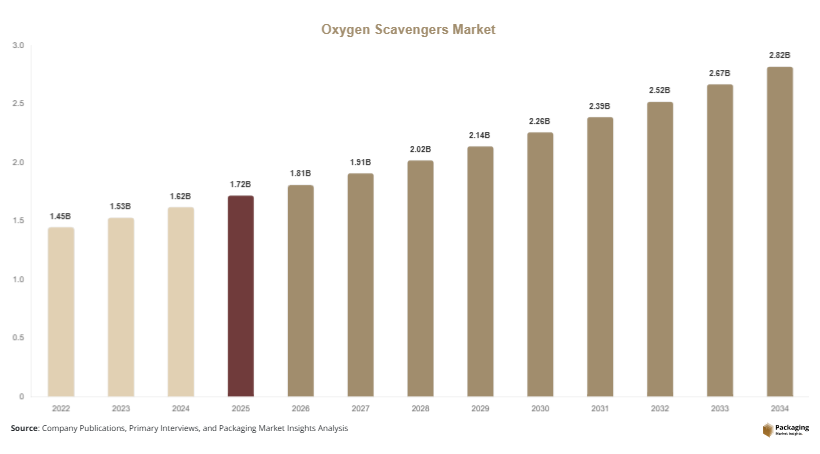
The global oxygen scavengers market size is projected to witness steady growth over the next decade due to increasing industrial adoption and the expanding need for enhanced product shelf life across various end-use industries. The market was valued at approximately USD 1.72 billion in 2025 and is expected to reach around USD 2.85 billion by 2034, growing at a CAGR of 5.7% during the forecast period (2025–2034). Oxygen scavengers, primarily used in packaging, water treatment, and industrial applications, play a pivotal role in maintaining product quality by removing residual oxygen and preventing oxidative degradation.
Three key growth factors are driving the market. Firstly, the rising demand for packaged and processed foods has propelled the integration of oxygen scavengers into food packaging to extend shelf life. Secondly, the pharmaceutical and healthcare sectors increasingly utilize oxygen scavengers to preserve the efficacy of oxygen-sensitive drugs and medical devices. Thirdly, environmental regulations focusing on reducing food waste and minimizing oxidative spoilage have further encouraged manufacturers to adopt advanced oxygen scavenging solutions.
Key Highlights:
- The oxygen scavengers market is valued at USD 1.72 billion in 2025 and is projected to reach USD 2.85 billion by 2034.
- Market growth is primarily driven by rising demand from the food, pharmaceutical, and healthcare industries for improved product preservation.
- Advancements in packaging technologies and increasing regulatory focus on reducing waste and extending product shelf life are further supporting market expansion.
Explore more data points, trends and opportunities Download Free Sample Report
Market Trends
Adoption of Smart Packaging with Oxygen Scavengers
The integration of oxygen scavengers into smart packaging solutions is emerging as a significant trend in the global market. Smart packaging incorporates oxygen-absorbing materials into films, bottles, and sachets, allowing manufacturers to monitor and maintain product quality throughout the supply chain. This trend is particularly prevalent in the food and beverage industry, where oxidative spoilage can lead to flavor degradation, nutrient loss, and microbial growth. The rise of e-commerce and longer supply chains has further accelerated the need for packaging solutions that preserve freshness for extended periods. Manufacturers are increasingly developing multi-layer packaging films with embedded oxygen scavengers to enhance barrier properties. Additionally, the combination of oxygen scavengers with indicators that visually signal oxygen exposure is gaining traction, offering a dual benefit of preservation and real-time quality monitoring.
Shift Towards Eco-Friendly and Biodegradable Scavengers
Sustainability has become a core consideration in the oxygen scavengers market. Companies are innovating biodegradable and environmentally friendly scavengers to reduce ecological impact. Traditional iron-based scavengers, while effective, often contribute to non-recyclable waste, prompting demand for renewable polymer-based or enzymatic oxygen scavengers. This trend aligns with the growing consumer preference for sustainable packaging solutions and regulatory mandates in regions like Europe and North America. Furthermore, biodegradable scavengers offer comparable oxygen absorption performance while supporting circular economy initiatives. Increasing collaborations between packaging material manufacturers and chemical innovators are fostering the development of greener alternatives, ensuring minimal compromise on performance. The adoption of eco-conscious solutions is expected to drive market penetration in the food, beverage, and pharmaceutical sectors, where sustainability is becoming a key purchasing criterion.
Market Drivers
Rising Demand for Packaged Food and Beverages
One of the primary drivers of the oxygen scavengers market is the escalating demand for packaged food and beverages worldwide. Urbanization, changing lifestyles, and the growth of the ready-to-eat food sector have significantly increased the need for extended shelf-life solutions. Oxygen scavengers help prevent oxidation, maintain color, flavor, and nutritional value, and reduce the risk of spoilage. For instance, in the beverage industry, oxygen scavengers are crucial in preventing oxidation of bottled juices, wines, and carbonated drinks, ensuring that products reach consumers in optimal condition. Additionally, the adoption of modified atmosphere packaging (MAP) further relies on oxygen scavengers to maintain an oxygen-free environment, enhancing overall food preservation. As the global food packaging market expands, the integration of oxygen scavengers is becoming standard practice, reinforcing market growth.
Pharmaceutical and Healthcare Applications
The pharmaceutical and healthcare sectors are increasingly driving the adoption of oxygen scavengers due to their role in preserving oxygen-sensitive drugs and medical devices. Certain medications, biologics, and injectable formulations are highly susceptible to oxidative degradation, which can compromise efficacy and safety. Oxygen scavengers, integrated into packaging materials or vials, act as an effective protective barrier, extending product stability. Similarly, medical devices such as diagnostic kits, surgical instruments, and wound care products benefit from oxygen-free environments to maintain sterility and performance. With rising global healthcare expenditure and expanding pharmaceutical production in emerging economies, the demand for oxygen scavengers in this sector is expected to increase steadily. The growing focus on reducing product recalls due to degradation further supports adoption.
Market Restraint
High Cost of Advanced Oxygen Scavenging Solutions
A significant restraint in the global oxygen scavengers market is the high cost associated with advanced oxygen scavenging technologies. While traditional iron-based scavengers remain cost-effective, the latest solutions, including enzymatic, polymer-based, and smart scavengers, require substantial investment in research, development, and manufacturing. These costs often translate into higher prices for packaging materials or medical product protection, which can deter small and medium-sized enterprises (SMEs) from adopting such solutions. For example, biodegradable scavengers with enhanced oxygen absorption efficiency may cost 20–30% more than conventional alternatives. This price disparity can slow market penetration in cost-sensitive regions, especially in developing economies where price competitiveness is crucial. Furthermore, the need for specialized handling and compatibility with different packaging materials may increase operational complexity, further limiting adoption. Despite these challenges, larger manufacturers with access to capital and strong supply chains continue to leverage advanced solutions to ensure product quality and regulatory compliance.
The impact of this restraint is evident in segments where cost pressure is high, such as bulk food packaging or generic pharmaceutical products. Companies must balance performance benefits with affordability to maximize adoption, creating opportunities for mid-range solutions that offer adequate protection without significant cost burdens.
Market Opportunities
Expansion in Emerging Economies
Emerging economies such as India, Brazil, and Southeast Asian nations present significant growth opportunities for the oxygen scavengers market. Rapid urbanization, increased disposable income, and rising demand for packaged food and beverages are driving market expansion in these regions. Many manufacturers are investing in localized production facilities to reduce costs and enhance distribution efficiency. Additionally, regulatory frameworks in these countries are increasingly aligning with international standards for food and pharmaceutical safety, boosting the adoption of oxygen scavenger solutions. Local players are also collaborating with global technology providers to implement cost-effective and efficient solutions tailored to regional requirements. As a result, the market in emerging economies is expected to witness accelerated growth, contributing to the overall global market expansion.
Integration with E-Commerce Logistics
The growth of e-commerce presents another opportunity for oxygen scavenger adoption. With longer supply chains and last-mile delivery challenges, oxygen-sensitive products such as perishable foods, beverages, and pharmaceutical items require advanced packaging solutions to maintain quality. Oxygen scavengers integrated into e-commerce packaging help reduce spoilage and maintain product integrity during transport. Companies are innovating lightweight, flexible, and multi-functional packaging with embedded scavengers to cater specifically to online retail logistics. This trend is expected to become more pronounced as e-commerce continues to expand globally, presenting an opportunity for packaging manufacturers and oxygen scavenger suppliers to collaborate on solutions optimized for digital retail.
Report Scope
| Report Metric | Details |
|---|---|
| Market Size in 2025 | USD 1.72 Billion |
| Market Size in 2026 | USD 1.81 Billion |
| Market Size in 2034 | USD 2.85 Billion |
| CAGR | 5.7% (2026-2034) |
| Base Year for Estimation | 2025 |
| Historical Data | 2022-2024 |
| Forecast Period | 2026-2034 |
| Report Coverage | Revenue Forecast, Competitive Landscape, Supply Chain Disruption, Growth Factors, Environment & Regulatory Landscape and Trends |
| Geographies Covered | North America, Europe, APAC, Middle East and Africa, LATAM |
| Countries Covered | U.S., Canada, U.K., Germany, France, Spain, Italy, Russia, Nordic, Benelux, Rest of Europe, China, South Korea, Japan, India, Australia, Singapore, Taiwan, South East Asia, Rest of Asia-Pacific, UAE, Turky, Saudi Arabia, South Africa, Egypt, Nigeria, Rest of MEA, Brazil, Mexico, Argentina, Chile, Colombia, Rest of LATAM |
Explore more data points, trends and opportunities Download Free Sample Report
Segmental Analysis
Type
Iron-based oxygen scavengers accounted for the dominant subsegment in 2024, representing approximately 45% of the global market share. These scavengers are widely used due to their cost-effectiveness, ease of incorporation into packaging films, and reliable performance in absorbing residual oxygen. Iron-based scavengers are extensively utilized in food and beverage packaging to preserve freshness, prevent spoilage, and extend shelf life. Their compatibility with various packaging forms, including sachets and multilayer films, makes them the preferred choice across diverse applications.
The fastest-growing subsegment is polymer-based oxygen scavengers, projected to grow at a CAGR of 6.5% from 2025 to 2034. Growth is driven by the increasing demand for eco-friendly and recyclable solutions in Europe and North America. These scavengers provide superior barrier properties and can be seamlessly integrated into flexible packaging, enhancing sustainability. Increasing consumer awareness regarding environmental impact is accelerating adoption, particularly in premium food and pharmaceutical applications.
Application
Food and beverage packaging dominated the market application segment in 2024, accounting for roughly 50% of overall market share. Oxygen scavengers in this segment help maintain product quality, color, flavor, and nutritional content while preventing microbial growth. The rising global consumption of ready-to-eat meals, processed beverages, and packaged snacks has further reinforced the importance of oxygen scavengers in food preservation. Additionally, innovations such as multilayer films and sachet integration are enhancing market penetration in this application segment.
The fastest-growing application subsegment is pharmaceuticals and healthcare, with a projected CAGR of 7.0% during the forecast period. Growth is driven by the increasing production of oxygen-sensitive drugs, biologics, and medical devices, which require controlled packaging environments. Enhanced regulatory scrutiny for drug stability and safety is boosting adoption. Companies are investing in oxygen scavenger-integrated vials, blister packs, and diagnostic kit packaging, particularly in North America and Europe.
End-Use Industry
The packaged food industry held the largest market share in 2024, accounting for approximately 52% of the total market. Oxygen scavengers are extensively used to extend shelf life, reduce spoilage, and maintain product quality in processed foods, snacks, and beverages. Rapid urbanization, evolving consumer preferences for convenient foods, and increased international trade have further strengthened the subsegment’s dominance. The integration of oxygen scavengers with modified atmosphere packaging and multilayer films is enhancing efficiency and adoption rates across different markets.
The fastest-growing end-use subsegment is the pharmaceutical and healthcare industry, with an expected CAGR of 6.8% between 2025 and 2034. Growth is driven by the rising need to preserve the stability of oxygen-sensitive biologics, vaccines, and injectable drugs. Technological advancements in packaging solutions and increased regulatory compliance requirements further contribute to the adoption of oxygen scavengers in this sector. The global focus on healthcare infrastructure expansion and medical exports also presents opportunities for long-term growth in this subsegment.
Oxygen Scavengers Market Segmentations
Type
- Iron-based Oxygen Scavengers
- Polymer-based Oxygen Scavengers
- Enzymatic Oxygen Scavengers
- Others
Application
- Food & Beverage Packaging
- Pharmaceuticals & Healthcare
- Water Treatment
- Industrial & Chemical Processing
End-Use Industry
- Packaged Food Industry
- Beverage Industry
- Pharmaceutical & Healthcare Industry
- Industrial Manufacturing
Regional Analysis
North America
The North American oxygen scavengers market accounted for approximately 32% of the global market share in 2025. The region is expected to grow at a CAGR of 4.8% from 2025 to 2034, driven by technological advancements in food and pharmaceutical packaging. The demand for oxygen scavengers in North America is supported by strict regulatory frameworks ensuring product safety and shelf-life optimization. The presence of leading food, beverage, and pharmaceutical companies in the U.S. and Canada fosters high adoption of advanced scavenger technologies. Consumer awareness regarding product freshness and quality is also contributing to sustained market growth in the region.
The United States dominates the North American market due to stringent food safety regulations and the presence of a mature packaged food industry. Unique growth factors include the increasing adoption of modified atmosphere packaging integrated with oxygen scavengers for ready-to-eat meals. The U.S. also leads in R&D investments for smart and biodegradable scavenger solutions, strengthening its position as a regional leader. Canada is gradually contributing to growth with rising packaged food consumption and healthcare product protection initiatives.
Europe
Europe accounted for roughly 28% of the global oxygen scavengers market in 2025, with a projected CAGR of 5.1% during the forecast period. The market is driven by widespread adoption in the pharmaceutical and processed food industries. Regulatory compliance, especially in the EU, mandates effective shelf-life preservation for oxygen-sensitive products, encouraging manufacturers to incorporate oxygen scavengers into their packaging systems. Technological developments, including multilayer films and enzymatic scavengers, further fuel adoption.
Germany is the dominant country in Europe, benefitting from its advanced pharmaceutical and packaging industries. A unique growth factor is the integration of eco-friendly and recyclable oxygen scavenger materials due to strong environmental regulations. France and Italy are also contributing to regional growth through increasing demand for packaged foods and beverages. The emphasis on sustainable packaging solutions ensures ongoing investment in innovative oxygen scavenger technologies.
Asia Pacific
The Asia Pacific region represented approximately 25% of the market share in 2025 and is projected to grow at a CAGR of 6.3%, the highest among all regions. Growth is propelled by rising urbanization, increasing disposable incomes, and expanding packaged food and pharmaceutical sectors. Regional manufacturers are focusing on cost-effective oxygen scavenger solutions to cater to price-sensitive markets, driving rapid adoption. Strategic partnerships between local packaging firms and global technology providers are also supporting market expansion.
China dominates the Asia Pacific market, fueled by massive consumption of packaged food and beverages. A unique growth factor is the government’s focus on reducing food waste and implementing stricter quality standards, which has accelerated the adoption of oxygen scavenger solutions in food logistics. India and Southeast Asian countries are also witnessing increased demand due to urban lifestyle changes and growing e-commerce channels.
Middle East & Africa
The Middle East & Africa accounted for approximately 8% of the global market in 2025, with a forecasted CAGR of 5.0%. Growth is supported by rising food imports, increasing packaged food consumption, and expanding pharmaceutical manufacturing. Technological adoption is moderate compared to North America and Europe; however, investments in advanced packaging solutions are gradually increasing, particularly in GCC countries.
Saudi Arabia dominates the regional market due to its focus on reducing spoilage in imported food products. A unique growth factor is the integration of oxygen scavengers in high-value products such as processed meats and pharmaceuticals to maintain quality during long-distance transport. The UAE is also contributing to regional expansion by promoting sustainable packaging practices and facilitating local production of oxygen scavenger-integrated packaging solutions.
Latin America
Latin America accounted for about 7% of the global market share in 2025 and is projected to grow at a CAGR of 5.2% through 2034. Market expansion is supported by increasing consumption of packaged foods, growing pharmaceutical industries, and the rising adoption of advanced packaging technologies in countries like Brazil and Mexico. Investments in local manufacturing and partnerships with global packaging solution providers are further fueling growth.
Brazil dominates the Latin American market, benefiting from a large packaged food sector and an increasing number of pharmaceutical manufacturers. A unique growth factor is the growing awareness regarding food safety and shelf-life optimization, which is encouraging manufacturers to adopt oxygen scavengers in both domestic and export-oriented products. Mexico and Argentina are also contributing to growth with expanding retail and healthcare packaging demands.
Competitive Landscape
The global oxygen scavengers market is moderately consolidated, with a mix of global chemical giants and regional manufacturers. Key players include Mitsubishi Gas Chemical Company, BASF SE, Clariant AG, OxyChem Solutions, and Nouryon. Mitsubishi Gas Chemical Company is considered a market leader, recently launching an eco-friendly polymer-based oxygen scavenger for sustainable packaging applications. BASF SE has expanded its product portfolio by introducing iron-based scavengers with enhanced absorption efficiency, while Clariant AG is focusing on biodegradable and enzymatic solutions. OxyChem Solutions has strengthened its presence in North America through strategic partnerships with major food packaging companies, and Nouryon is investing in R&D to develop next-generation scavenger technologies.
Competitive strategies include product innovation, mergers, partnerships, and geographic expansion to enhance market reach. Companies are emphasizing environmentally sustainable solutions and multi-functional packaging integration to meet evolving customer and regulatory demands.
Key Players List
- Mitsubishi Gas Chemical Company
- BASF SE
- Clariant AG
- OxyChem Solutions
- Nouryon
- Evonik Industries
- Adeka Corporation
- Showa Denko K.K.
- AkzoNobel N.V.
- Kuraray Co., Ltd.
- Lonza Group
- Arkema S.A.
- Sekisui Chemical Co., Ltd.
- Linde plc
- Wacker Chemie AG