Chitosan Based Aerogel Food Active Packaging Market Size and Growth
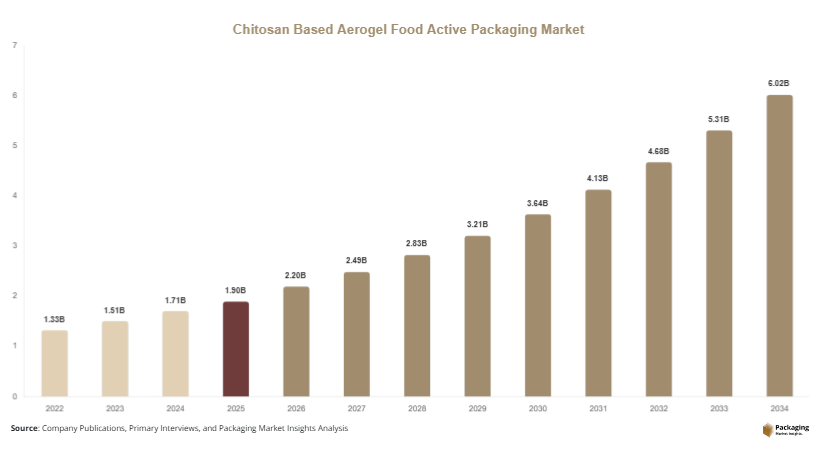
The global chitosan based aerogel food active packaging market size was valued at USD 1.9 billion in 2025 and is projected to reach USD 2.2 billion in 2026. Over the forecast period, the market is expected to expand to approximately USD 6.8 billion by 2034, registering a CAGR of 13.4% from 2025 to 2034. Chitosan-based aerogels are lightweight, porous materials derived from natural biopolymers, offering antimicrobial and moisture-absorbing properties that are suitable for food preservation. The chitosan based aerogel food active packaging market is gaining measurable traction as food manufacturers seek advanced packaging materials that extend shelf life while meeting sustainability goals.
A key growth factor is the increasing demand for active packaging solutions that go beyond passive containment. Chitosan aerogels actively interact with the food environment by controlling moisture and inhibiting microbial growth. This helps maintain product freshness and reduces food waste, which is a growing concern across global supply chains.
Key Highlights:
- Asia Pacific dominated the market with a 36.8% share in 2025, while Latin America is projected to grow at the fastest CAGR of 13.9%.
- Antimicrobial aerogel packaging led the type segment with a 31.2% share, while antioxidant-infused aerogels are expected to grow at a CAGR of 14.2%.
- Biopolymer-based packaging dominated with a 55.4% share, while hybrid bio-nanocomposite packaging is forecasted to grow at a CAGR of 13.7%.
- Food & beverage applications led the segment with 46.5% share, while healthcare packaging is expected to grow at a CAGR of 13.1%.
- China remained the dominant country with a market size of USD 0.6 billion in 2025 and USD 0.7 billion in 2026.
Explore more data points, trends and opportunities Download Free Sample Report
Market Trends
Integration of Active Functional Components in Packaging
The chitosan based aerogel food active packaging market is witnessing a shift toward integrating active functional components such as antimicrobial agents and antioxidants into packaging materials. These additions enhance the protective capabilities of packaging by actively interacting with the food environment. Manufacturers are focusing on embedding natural extracts and bioactive compounds into chitosan aerogels to improve food safety and extend shelf life. This trend is particularly significant in perishable food segments, including meat, dairy, and fresh produce. The integration of active components is also enabling packaging to meet stricter food safety standards and consumer expectations.
Development of Lightweight and High-Absorption Aerogels
Another noticeable trend is the development of lightweight aerogels with high absorption capacity. These materials are designed to manage moisture effectively, reducing the risk of spoilage and contamination. Advances in aerogel structure engineering are allowing for better porosity and surface area, which enhances their functional performance. This trend is driven by the need for efficient packaging solutions that can maintain product quality during transportation and storage. As logistics networks become more complex, the demand for high-performance packaging materials is expected to increase.
Market Drivers
Rising Demand for Food Preservation Technologies
The increasing demand for food preservation technologies is a major driver of the chitosan based aerogel food active packaging market. With growing global food consumption and supply chain complexity, there is a need for packaging solutions that can maintain product quality over extended periods. Chitosan-based aerogels offer antimicrobial and moisture control properties, making them suitable for preserving food freshness. The reduction of food waste is also a key consideration, as it has economic and environmental implications. This driver is expected to continue influencing market growth.
Growing Adoption of Biodegradable Packaging Materials
The shift toward biodegradable packaging materials is another significant driver. Consumers and regulators are increasingly concerned about plastic waste and its environmental impact. Chitosan-based aerogels provide a sustainable alternative to conventional packaging materials, as they are derived from renewable sources and are biodegradable. This aligns with global efforts to reduce plastic pollution and promote circular economy practices. Companies are investing in sustainable packaging solutions to meet regulatory requirements and consumer expectations.
Market Restraint
High Production Costs and Limited Commercial Scalability
The chitosan based aerogel food active packaging market faces challenges related to high production costs and limited scalability. The manufacturing process for aerogels involves complex techniques such as freeze-drying, which can be energy-intensive and costly. This can limit adoption, particularly among small-scale manufacturers. Additionally, the availability of raw materials such as chitosan can be affected by fluctuations in supply, which can impact production efficiency. For example, variations in seafood processing industries can influence the availability of chitosan. These factors can hinder market growth and require ongoing investment in cost optimization and process efficiency.
Market Opportunities
Expansion in Emerging Food Processing Markets
Emerging markets present significant opportunities for the chitosan based aerogel food active packaging market. Rapid urbanization and increasing demand for packaged food products are driving the need for advanced packaging solutions. Governments in these regions are also promoting sustainable practices, creating a favorable environment for biodegradable packaging materials. Companies that invest in these markets can benefit from growing demand and supportive regulatory frameworks. The expansion of retail and e-commerce sectors is further contributing to market growth.
Advancements in Bio-Nanocomposite Technologies
Advancements in bio-nanocomposite technologies offer opportunities for innovation and market expansion. By combining chitosan aerogels with nanomaterials, manufacturers can enhance properties such as strength, barrier performance, and antimicrobial activity. These improvements enable the development of high-performance packaging solutions that meet the requirements of various food applications. Research and development efforts are focused on optimizing these materials for commercial use. As technology continues to evolve, the adoption of bio-nanocomposite packaging is expected to increase.
Report Scope
| Report Metric | Details |
|---|---|
| Market Size in 2025 | USD 1.9 Billion |
| Market Size in 2026 | USD 2.2 Billion |
| Market Size in 2034 | USD 6.8 Billion |
| CAGR | 13.4% (2026-2034) |
| Base Year for Estimation | 2025 |
| Historical Data | 2022-2024 |
| Forecast Period | 2026-2034 |
| Report Coverage | Revenue Forecast, Competitive Landscape, Supply Chain Disruption, Growth Factors, Environment & Regulatory Landscape and Trends |
| Geographies Covered | North America, Europe, APAC, Middle East and Africa, LATAM |
| Countries Covered | U.S., Canada, U.K., Germany, France, Spain, Italy, Russia, Nordic, Benelux, Rest of Europe, China, South Korea, Japan, India, Australia, Singapore, Taiwan, South East Asia, Rest of Asia-Pacific, UAE, Turky, Saudi Arabia, South Africa, Egypt, Nigeria, Rest of MEA, Brazil, Mexico, Argentina, Chile, Colombia, Rest of LATAM |
Explore more data points, trends and opportunities Download Free Sample Report
Segmental Analysis
By Type
Antimicrobial aerogel packaging accounted for the largest share of 31.2% in 2024, driven by its ability to inhibit microbial growth and extend shelf life. These materials are widely used in food packaging applications where safety and freshness are critical. Manufacturers are focusing on enhancing antimicrobial properties through the incorporation of natural extracts and bioactive compounds. The increasing demand for food safety is supporting segment growth.
Antioxidant-infused aerogels are expected to grow at a CAGR of 14.2%, driven by their ability to prevent oxidation and maintain product quality. These materials are particularly useful in packaging applications for products prone to oxidation, such as meat and dairy. The growing demand for high-quality food products is supporting segment growth.
By Application
Food packaging accounted for the largest share of 46.5% in 2024, driven by high demand for active packaging solutions. Chitosan-based aerogels are used to maintain product freshness and extend shelf life. The increasing demand for packaged food products is supporting segment growth.
Healthcare packaging is expected to grow at a CAGR of 13.1%, driven by the need for safe and sustainable packaging solutions. These materials are used in medical packaging applications due to their antimicrobial properties. The increasing demand for healthcare products is supporting segment growth.
By End-Use
Food & beverage end-use accounted for the largest share of 46.5% in 2024, driven by high demand for sustainable packaging solutions. Chitosan-based aerogels are used to ensure product safety and extend shelf life. The increasing demand for packaged food products is supporting segment growth.
Personal care end-use is expected to grow at a CAGR of 13.3%, driven by the demand for sustainable packaging solutions. These materials are used in packaging for cosmetics and personal care products due to their biodegradability.
Chitosan Based Aerogel Food Active Packaging Market Segmentations
By Type
- Antimicrobial Aerogels
- Antioxidant Aerogels
- Moisture Absorbing Aerogels
- Hybrid Bio-Nanocomposite Aerogels
By Application
- Food Packaging
- Healthcare Packaging
- Personal Care Packaging
- Industrial Packaging
By End-Use
- Food & Beverage
- Healthcare
- Personal Care
- Industrial
Regional Analysis
North America
North America accounted for 24.9% of the chitosan based aerogel food active packaging market share in 2025 and is projected to grow at a CAGR of 12.8%. The region benefits from advanced food processing industries and strong regulatory frameworks that promote food safety and sustainability. Increasing consumer awareness regarding food quality and environmental impact is driving demand for active packaging solutions.
The United States dominates the regional market due to its large consumer base and technological advancements. A key growth factor is the increasing adoption of innovative packaging technologies in the food industry, which is driving demand for chitosan-based aerogels.
Europe
Europe held a market share of 23.7% in 2025 and is expected to grow at a CAGR of 13.1%. The region is characterized by strict environmental regulations and a strong focus on sustainability. European countries are promoting the use of biodegradable materials, which is driving demand for chitosan-based packaging.
Germany is the leading country in the European market, supported by its strong industrial base. A unique growth factor is the implementation of circular economy policies, which is encouraging the adoption of sustainable packaging materials.
Asia Pacific
Asia Pacific dominated the market with a 36.8% share in 2025 and is projected to grow at a CAGR of 13.6%. The region’s growth is driven by rapid urbanization and increasing demand for packaged food products. Countries such as China and India are witnessing significant growth in food processing industries.
China is the dominant country in the region, supported by its large manufacturing base. A key growth factor is the expansion of the food packaging industry, which is driving demand for advanced packaging materials.
Middle East & Africa
The Middle East & Africa region accounted for 7.1% of the market share in 2025 and is expected to grow at a CAGR of 13.0%. The region is experiencing growth in consumer markets and increasing awareness of food safety. Governments are implementing policies to improve food security and reduce waste.
The United Arab Emirates is a key market in the region. A unique growth factor is the development of advanced food storage and logistics systems, which is driving demand for active packaging solutions.
Latin America
Latin America held a 7.5% share in 2025 and is projected to grow at a CAGR of 13.9%. The region’s growth is driven by increasing demand for packaged food products and expanding retail sectors. Governments are promoting sustainable practices, which is supporting market growth.
Brazil dominates the regional market due to its large population. A key growth factor is the increasing adoption of sustainable packaging solutions in the food industry.
Competitive Landscape
The chitosan based aerogel food active packaging market is moderately competitive, with key players focusing on innovation and sustainability. Companies are investing in research and development to improve material performance and reduce costs. Strategic collaborations and partnerships are common strategies used to expand market presence.
BASF SE is recognized as a leading player in the market, offering a range of bio-based materials. The company recently introduced advanced biodegradable solutions for packaging applications. Other major players are also focusing on expanding their product portfolios and enhancing their technological capabilities.
Key Players List
- BASF SE
- Arkema S.A.
- UPM-Kymmene Corporation
- Stora Enso Oyj
- NatureWorks LLC
- Toray Industries Inc.
- Mitsubishi Chemical Group Corporation
- Green Dot Bioplastics
- Biome Bioplastics
- Danimer Scientific
- Corbion N.V.
- FKuR Kunststoff GmbH
- Plantic Technologies Limited
- Novamont S.p.A.
- TotalEnergies Corbion