Antimicrobial Packaging Market Size and Growth
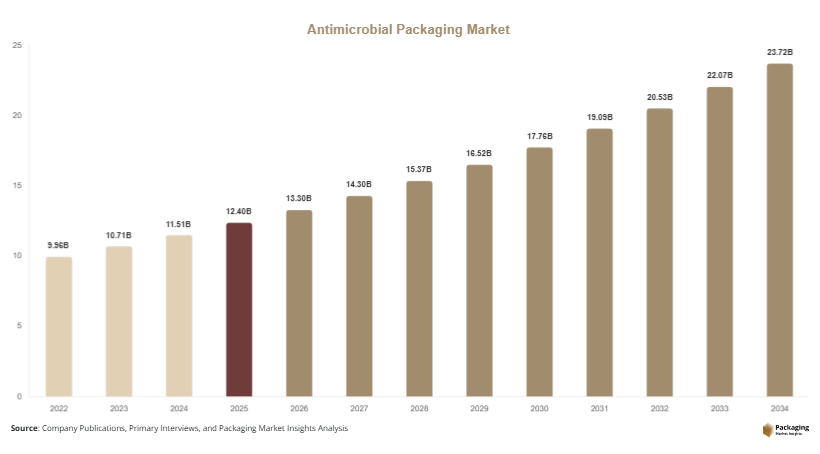
The antimicrobial packaging market size was valued at approximately USD 12.4 billion in 2025 and is projected to reach USD 23.8 billion by 2034, registering a compound annual growth rate (CAGR) of 7.5% during 2025–2034. The market size expansion reflects the growing need for packaging solutions that can actively prevent microbial contamination and extend product shelf life. Antimicrobial packaging incorporates additives or coatings that inhibit the growth of bacteria, fungi, and other microorganisms on packaged goods, particularly food, pharmaceuticals, and healthcare products.
One of the key global factors supporting the growth of the antimicrobial packaging market is the increasing demand for safe and longer-lasting packaged food products. Rising urbanization and busy consumer lifestyles have led to a greater reliance on packaged and ready-to-eat food items. Manufacturers are adopting antimicrobial packaging technologies to minimize contamination risks, reduce spoilage, and maintain product freshness during extended transportation and storage cycles.
Key Highlights
- Dominant region: North America accounted for 34% market share in 2025, while Asia Pacific is projected to grow fastest at a CAGR of 8.8% through 2034.
- Leading segment: Plastic-based antimicrobial packaging dominated the material segment with 46% share, while bio-based materials are expected to grow fastest at a CAGR of 9.4%.
- Top application: Food and beverage packaging held the largest share of 52%, whereas pharmaceutical packaging is forecast to grow fastest at 8.7% CAGR.
- Dominant country: The United States market reached USD 3.7 billion in 2025 and is estimated to grow to USD 4.0 billion in 2026.
Explore more data points, trends and opportunities Download Free Sample Report
Market Trends
Integration of Active and Intelligent Packaging Technologies
A significant trend influencing the antimicrobial packaging market is the integration of active and intelligent packaging systems. These packaging solutions interact with the product environment to reduce microbial growth and maintain product quality. Companies are incorporating antimicrobial agents such as silver ions, organic acids, and essential oils into packaging films and coatings. This development enables packaging to actively inhibit microbial contamination rather than merely acting as a passive barrier.
In addition, the integration of sensors and freshness indicators into antimicrobial packaging formats is gaining traction. These technologies allow manufacturers and retailers to monitor product conditions throughout the supply chain. The convergence of antimicrobial properties with smart packaging technologies is expected to support product safety and improve supply chain transparency.
Adoption of Sustainable Antimicrobial Packaging Materials
Another notable trend in the antimicrobial packaging market is the increasing shift toward sustainable and biodegradable packaging materials. Environmental concerns and regulatory initiatives are encouraging packaging manufacturers to develop eco-friendly antimicrobial solutions. Bio-based polymers combined with natural antimicrobial agents such as chitosan and plant extracts are gaining attention.
Companies are investing in research to produce antimicrobial films derived from renewable resources. This trend aligns with broader sustainability initiatives in the packaging industry while maintaining food safety standards.
Market Drivers
Growing Demand for Food Safety and Shelf-Life Extension
The increasing focus on food safety and quality assurance has become a major driver of the antimicrobial packaging market. Food contamination caused by microorganisms remains a significant concern for manufacturers and consumers. Antimicrobial packaging provides an effective solution by inhibiting microbial growth directly within the packaging environment.
Food producers are increasingly integrating antimicrobial materials into packaging formats to reduce spoilage rates and maintain freshness during distribution. This approach supports compliance with food safety regulations and helps companies minimize product losses.
Expansion of the Pharmaceutical and Healthcare Packaging Sector
The expansion of pharmaceutical manufacturing and healthcare services is contributing to the growth of the antimicrobial packaging market. Medical products, drugs, and diagnostic equipment require packaging solutions that prevent microbial contamination.
Antimicrobial packaging helps maintain product sterility and stability during storage and transportation. Increasing demand for sterile medical devices and pharmaceutical products has encouraged manufacturers to adopt advanced antimicrobial packaging technologies.
Market Restraints
High Cost of Advanced Antimicrobial Packaging Materials
One of the primary restraints affecting the antimicrobial packaging market is the higher cost associated with antimicrobial materials and additives. Incorporating antimicrobial agents such as silver nanoparticles, specialized polymers, or natural extracts into packaging materials increases manufacturing expenses.
Small and medium-sized packaging companies may face challenges in adopting these technologies due to cost constraints. In addition, regulatory approvals and testing requirements for antimicrobial agents can further increase production costs and delay commercialization.
Market Opportunities
Growth of E-commerce Food Distribution
The rapid growth of e-commerce grocery and food delivery platforms presents a promising opportunity for the antimicrobial packaging market. Online food distribution requires packaging that can maintain product safety over extended shipping durations.
Antimicrobial packaging helps reduce microbial contamination risks during transit and storage. As digital retail channels expand globally, the demand for advanced packaging solutions that preserve food quality will likely increase.
Development of Natural Antimicrobial Additives
Another emerging opportunity in the antimicrobial packaging market lies in the development of natural antimicrobial agents. Researchers are exploring plant-derived extracts, enzymes, and biodegradable compounds that can replace synthetic antimicrobial additives.
These solutions address both consumer demand for clean-label products and regulatory requirements related to chemical additives. Natural antimicrobial technologies could support the next generation of sustainable packaging systems.
Report Scope
| Report Metric | Details |
|---|---|
| Market Size in 2025 | USD 12.4 Billion |
| Market Size in 2026 | USD 13.3 Billion |
| Market Size in 2034 | USD 23.8 Billion |
| CAGR | 7.5% (2026-2034) |
| Base Year for Estimation | 2025 |
| Historical Data | 2022-2024 |
| Forecast Period | 2026-2034 |
| Report Coverage | Revenue Forecast, Competitive Landscape, Supply Chain Disruption, Growth Factors, Environment & Regulatory Landscape and Trends |
| Geographies Covered | North America, Europe, APAC, Middle East and Africa, LATAM |
| Countries Covered | U.S., Canada, U.K., Germany, France, Spain, Italy, Russia, Nordic, Benelux, Rest of Europe, China, South Korea, Japan, India, Australia, Singapore, Taiwan, South East Asia, Rest of Asia-Pacific, UAE, Turky, Saudi Arabia, South Africa, Egypt, Nigeria, Rest of MEA, Brazil, Mexico, Argentina, Chile, Colombia, Rest of LATAM |
Explore more data points, trends and opportunities Download Free Sample Report
Segmental Analysis
By Material
Plastic-based antimicrobial packaging dominated the material segment with 46% share in 2025. Plastic materials offer flexibility, durability, and compatibility with antimicrobial additives. Packaging manufacturers widely use polyethylene, polypropylene, and polyethylene terephthalate for antimicrobial films and containers.
Bio-based materials are expected to become the fastest-growing subsegment with a projected CAGR of 9.4% through 2034. Increasing environmental awareness and regulatory pressures are encouraging companies to explore biodegradable packaging solutions. Bio-based polymers integrated with natural antimicrobial agents will support the adoption of sustainable packaging alternatives.
By Packaging Type
Flexible antimicrobial packaging held the largest share of 55% in 2025 due to its extensive use in food packaging applications. Flexible films, pouches, and wraps provide lightweight and cost-efficient packaging formats that can incorporate antimicrobial coatings.
Rigid antimicrobial packaging will likely experience the fastest growth with a CAGR of 8.2% during the forecast period. Rigid containers and trays are increasingly used for pharmaceutical and healthcare packaging. Their structural strength and ability to maintain product integrity make them suitable for sensitive products requiring antimicrobial protection.
By Antimicrobial Agent
Organic acids and natural extracts accounted for 38% share of the antimicrobial packaging market in 2025. These agents are commonly used in food packaging because they effectively inhibit microbial growth without significantly altering product characteristics.
Silver-based antimicrobial agents will likely record the fastest CAGR of 8.9% through 2034. Silver ions possess strong antimicrobial properties and can inhibit a wide range of microorganisms. Advances in nanotechnology will enable more efficient integration of silver particles into packaging materials.
By Application
Food and beverage packaging dominated the antimicrobial packaging market with 52% share in 2025. The use of antimicrobial packaging in processed foods, dairy products, and ready-to-eat meals helps maintain product freshness and safety.
Pharmaceutical packaging is projected to grow fastest with a CAGR of 8.7% during the forecast period. Pharmaceutical products require sterile packaging solutions to maintain efficacy and stability. Increasing global pharmaceutical production will support demand for antimicrobial packaging systems.
Antimicrobial Packaging Market Segmentations
Material
- Plastic
- Paper & Paperboard
- Bio-based Materials
- Others
Packaging Type
- Flexible Packaging
- Rigid Packaging
Antimicrobial Agent
- Organic Acids
- Silver-based Agents
- Enzymes
- Natural Extracts
Application
- Food & Beverage Packaging
- Pharmaceutical Packaging
- Healthcare Packaging
- Personal Care Packaging
Regional Analysis
North America
North America accounted for 34% of the antimicrobial packaging market share in 2025 and is expected to maintain a stable growth trajectory. The region will likely grow at a CAGR of 6.9% between 2025 and 2034 due to strong demand for advanced packaging technologies and strict food safety regulations.
The United States dominated the regional market due to the presence of a large packaged food industry and strong investments in packaging innovation. Food manufacturers in the country are adopting antimicrobial packaging to reduce food waste and improve shelf stability. The growth of pharmaceutical production and medical device manufacturing in the United States also contributes to the adoption of antimicrobial packaging solutions.
Europe
Europe held 27% of the antimicrobial packaging market share in 2025 and is projected to expand at a CAGR of 6.7% through 2034. The region has a mature packaging industry supported by regulatory standards that emphasize food safety and environmental sustainability.
Germany emerged as the dominant country within the European antimicrobial packaging market. The country’s strong packaging technology sector and research institutions have supported the development of antimicrobial coatings and materials. German packaging companies continue to invest in sustainable antimicrobial solutions that align with regional environmental regulations.
Asia Pacific
Asia Pacific represented 25% of the antimicrobial packaging market in 2025 and is anticipated to record the fastest CAGR of 8.8% during the forecast period. Rapid industrialization, rising consumer spending, and expanding packaged food consumption contribute to market growth.
China dominated the regional market due to its large-scale manufacturing sector and expanding food processing industry. Increasing urbanization and changing dietary patterns have increased demand for packaged food products in the country. As a result, packaging manufacturers are incorporating antimicrobial technologies to enhance product safety.
Middle East & Africa
The Middle East & Africa region accounted for 7% of the antimicrobial packaging market share in 2025 and will likely grow at a CAGR of 7.2% through 2034. Rising food imports and the development of modern retail infrastructure are influencing the demand for improved packaging solutions.
Saudi Arabia led the regional market, supported by investments in food processing and pharmaceutical manufacturing. The country’s efforts to enhance food security and supply chain efficiency are encouraging the adoption of antimicrobial packaging technologies.
Latin America
Latin America held 7% of the antimicrobial packaging market in 2025 and is projected to grow at a CAGR of 7.0% between 2025 and 2034. Increasing demand for packaged foods and expanding retail distribution networks are influencing market growth.
Brazil dominated the regional antimicrobial packaging market due to its large food production industry. The country exports various food products globally, which requires packaging solutions capable of maintaining quality during long-distance transportation. Antimicrobial packaging helps manufacturers reduce spoilage and preserve freshness.
Competitive Landscape
The antimicrobial packaging market is characterized by the presence of global packaging manufacturers and specialized materials companies. Market participants focus on product innovation, partnerships, and technological development to expand their portfolios.
BASF SE emerged as a key market leader due to its strong portfolio of antimicrobial additives and packaging materials. The company recently introduced new antimicrobial polymer solutions designed for food packaging applications.
Other major players include packaging manufacturers that develop advanced antimicrobial films, coatings, and containers. Strategic collaborations between packaging companies and antimicrobial technology providers are supporting product innovation in the industry.
Key Players
- BASF SE
- Dow Inc.
- Mondi Group
- Amcor plc
- Berry Global Inc.
- Sealed Air Corporation
- BioCote Limited
- Microban International
- Takex Labo Co., Ltd.
- PolyOne Corporation
- Dunmore Corporation
- Linpac Packaging
- Sanitized AG
- Avient Corporation
- Sonoco Products Company