Returnable Transport Packaging Market Pricing, Production, Consumption & Trade Analysis
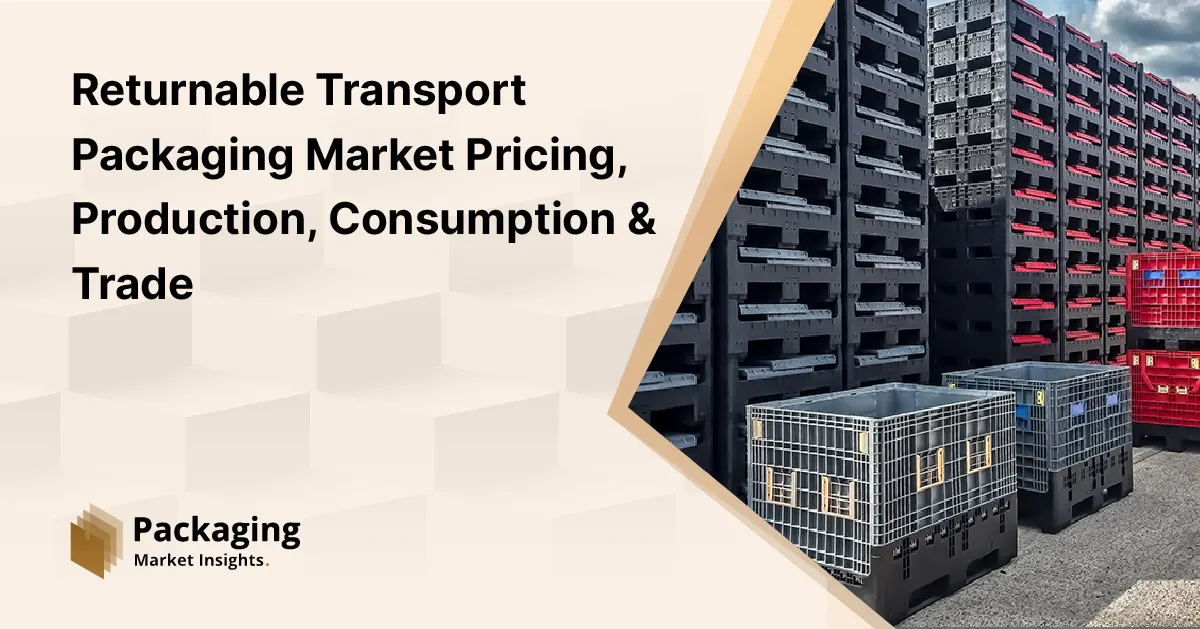
Introduction
The Returnable Transport Packaging Market has gained significant traction due to rising demand for sustainable and cost-efficient logistics solutions across industries such as automotive, food & beverages, and retail. Returnable packaging systems—such as pallets, crates, intermediate bulk containers (IBCs), and dunnage—are increasingly replacing single-use packaging.
Globally, more than 65% of automotive components are now shipped using returnable packaging systems, while reusable plastic containers account for nearly 45 million units in circulation annually across supply chains. These figures highlight the growing operational shift toward long-term packaging reuse and circular logistics models.
Returnable Transport Packaging Market Pricing Analysis
Pricing in the Returnable Transport Packaging Market varies significantly based on material type, product category, durability, and customization.
- Plastic returnable crates are typically priced between $8 and $25 per unit, depending on load capacity and design complexity.
- Industrial-grade pallets, particularly high-density polyethylene (HDPE) pallets, range from $45 to $120 per unit.
- Intermediate Bulk Containers (IBCs), widely used in chemical and food industries, are priced between $120 and $300 per unit.
- Metal racks and customized automotive dunnage systems can cost between $200 and $800 per unit, reflecting higher durability and tailored design.
Material costs play a critical role in pricing. For instance:
- Polypropylene resin prices fluctuate between $1,100 and $1,400 per metric ton, directly influencing plastic packaging costs.
- Steel prices used in metal racks average around $650 to $900 per metric ton, affecting heavy-duty packaging systems.
Bulk procurement and long-term contracts can reduce unit pricing by 10% to 18%, particularly in automotive and FMCG sectors. Additionally, lifecycle cost advantages—where reusable packaging completes 50 to 100 trips per lifecycle—significantly offset initial investments, reducing per-use costs by up to 70% compared to single-use packaging.
Returnable Transport Packaging Market Production Analysis
Production of returnable transport packaging is closely tied to industrial output, especially in manufacturing-heavy economies.
- Global production of plastic returnable containers exceeds 30 million units annually, with Asia-Pacific contributing nearly 40% of total output.
- Europe produces approximately 12 million reusable pallets per year, driven by stringent sustainability regulations.
- North America accounts for over 25 million units of reusable crates and pallets annually, largely supported by retail and food distribution networks.
Material-wise production distribution shows:
- Plastic packaging represents nearly 60% of total production volume due to lightweight and durability advantages.
- Metal-based packaging contributes about 25%, mainly for heavy-duty industrial use.
- Wooden returnable packaging still holds around 15% share, particularly in cost-sensitive markets.
Automation is transforming production efficiency. Advanced injection molding systems now produce up to 500 units per hour, reducing manufacturing costs by approximately 12% to 15%. Additionally, recycled plastic usage in production has increased to 30%–35%, lowering raw material dependency and supporting sustainability goals.
Returnable Transport Packaging Market Consumption Analysis
Consumption patterns in the Returnable Transport Packaging Market vary across industries and regions, reflecting differing logistics requirements.
- The automotive sector consumes nearly 35% of total returnable packaging, driven by just-in-time manufacturing systems.
- The food and beverage industry accounts for approximately 28% consumption, particularly in dairy, beverages, and fresh produce logistics.
- Retail and e-commerce sectors contribute around 20%, with increasing adoption of reusable crates for last-mile delivery.
Regionally:
- Europe leads with nearly 40% of total consumption, supported by circular economy policies.
- North America follows with approximately 30%, driven by large-scale retail chains.
- Asia-Pacific accounts for 25% consumption, with rapid growth in manufacturing and export activities.
On a volume basis, global reuse cycles have improved significantly. A standard reusable crate now completes 70–90 trips per lifecycle, compared to 40–50 trips a decade ago, indicating better asset management and tracking technologies.
Additionally, pooling systems—where packaging assets are shared among multiple users—handle over 20 million pallets globally, improving utilization rates by 25%–30%.
Import & Export Analysis
International trade plays a vital role in balancing supply and demand in the Returnable Transport Packaging Market.
- Global exports of returnable plastic packaging products are valued at approximately $6.5 billion annually.
- Europe dominates exports with nearly 45% share, particularly from Germany, France, and the Netherlands.
- China accounts for over 30% of global exports, supplying cost-effective plastic containers and pallets.
On the import side:
- The United States imports returnable packaging products worth around $2.1 billion annually, primarily from Asia and Europe.
- Southeast Asia imports approximately $1.2 billion, driven by expanding manufacturing sectors.
- Middle Eastern countries collectively import packaging solutions valued at $800 million, largely for logistics and petrochemical industries.
Trade flows are influenced by:
- Tariffs ranging from 5% to 12% on plastic packaging products in various regions.
- Freight costs, which increased by nearly 18% during recent logistics disruptions, impacting overall pricing.
Cross-border pooling systems are also expanding, particularly in Europe, where more than 10 million pallets are circulated across multiple countries, reducing the need for localized production.
Supply Chain Analysis
The supply chain for returnable transport packaging involves multiple stakeholders, including raw material suppliers, manufacturers, pooling service providers, and end-users.
Key Components:
- Raw Materials: Polypropylene, polyethylene, steel, and wood form the backbone of production. Price volatility in these materials directly affects overall costs.
- Manufacturing: Injection molding and metal fabrication units operate at utilization rates of 75% to 85%, ensuring steady supply.
- Pooling & Logistics Providers: Companies offering pooling services manage large fleets of reusable packaging, often exceeding 5 million units per provider.
- Tracking & Management: RFID and IoT-based tracking systems improve asset visibility, reducing loss rates from 8% to below 3%.
Supply chain efficiency is increasingly driven by digitalization. Real-time tracking systems have reduced turnaround times by 20%–25%, while predictive maintenance extends packaging lifespan by 15%.
However, challenges remain:
- Reverse logistics costs can account for 10% to 20% of total operational expenses.
- Packaging loss and damage still result in annual losses exceeding $500 million globally.
Conclusion
The Returnable Transport Packaging Market is evolving as industries prioritize cost efficiency, sustainability, and operational resilience. Pricing remains influenced by raw material fluctuations and customization needs, while production continues to scale through automation and recycled material integration.
Consumption is expanding across automotive, food, and retail sectors, supported by improved lifecycle performance and pooling systems. Meanwhile, global trade dynamics highlight strong export activity from Europe and Asia, alongside rising import demand in North America and emerging markets.
Supply chain optimization, particularly through digital tracking and pooling models, is enhancing efficiency while reducing losses. Despite challenges such as reverse logistics costs and material price volatility, returnable transport packaging systems offer significant long-term economic and environmental advantages, making them a critical component of modern logistics infrastructure.
Author : Shawn M. Hollingsworth
Shawn M. Hollingsworth is a Market Research Analyst with 7+ years of expertise in Sustainable Packaging. His work focuses on biodegradable materials, circular economy practices, and regulatory trends, guiding companies toward environmentally responsible packaging solutions.
