Timber Wrap Films Market Size
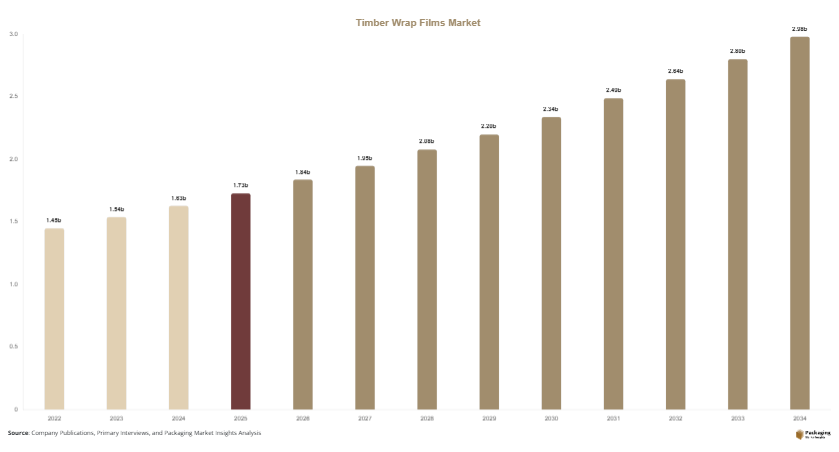
Timber Wrap Films market size is projected at USD 1.84 billion in 2026 and is expected to hit USD 2.98 billion by 2034 with a CAGR of 6.2%. Rising global timber exports, increasing demand for protective packaging, and expansion of the construction sector continue supporting market expansion. The report provides comprehensive analysis of production capacity, market segmentation, competitive landscape, and regional performance to support strategic decision-making across the Timber Wrap Films market.
Timber wrap films are specialized protective packaging materials designed to safeguard lumber, plywood, logs, and engineered wood products against moisture, UV radiation, dust, and mechanical damage during storage and transportation. Global production exceeded 2.9 billion square meters in 2025, with polyethylene films accounting for nearly 58% of output, lumber transportation representing 43% of total consumption, and wood storage contributing approximately 31%. More than 76% of exported timber products are packaged using protective wrap films, reinforcing the Timber Wrap Films market.
Explore more data points, trends and opportunities Download Free Sample Report
Timber Wrap Films Market Trends
Rising Adoption of High-Performance UV-Resistant Films
Manufacturers are increasingly introducing multilayer UV-resistant timber wrap films to improve weather protection and product durability. More than 35% of newly launched products incorporate advanced UV stabilizers, while annual production surpassed 3.1 billion square meters. Growing timber exports and outdoor storage requirements continue increasing demand for premium protective films, strengthening the Timber Wrap Films market.
Automation and multilayer extrusion technologies have improved production efficiency by nearly 19%, while reducing film thickness by 14% without compromising tensile strength. Approximately 57% of manufacturers have adopted high-speed extrusion systems, supporting increased production capacity and improved quality consistency. These technological developments continue driving the Timber Wrap Films market.
Timber Wrap Films Market Drivers
Growing Global Timber Trade and Construction Activities
Expanding residential and commercial construction projects continue increasing timber transportation worldwide. Global timber production exceeded 2.1 billion cubic meters, while international lumber exports increased by approximately 7% annually. More than 72% of exported wood products require moisture-resistant protective packaging, supporting Timber Wrap Films market growth.
Timber Wrap Films Market Restraints
Volatility in Polymer Raw Material Prices
Fluctuating polyethylene and polypropylene resin prices continue affecting production costs. Raw material expenses increased by nearly 16% during recent procurement cycles and account for approximately 63% of total manufacturing costs. Smaller manufacturers producing over 180 million square meters annually face margin pressure, restraining Timber Wrap Films market growth.
Timber Wrap Films Market Opportunities
Expansion of Sustainable and Recyclable Packaging Solutions
Growing environmental regulations and sustainability initiatives create opportunities for recyclable timber wrap films. More than 41% of forestry companies have adopted recyclable packaging programs, while investments exceeding USD 1.8 billion are directed toward sustainable flexible packaging technologies. These developments create significant opportunities across the Timber Wrap Films market.
Challenges in Timber Wrap Films Market
Maintaining Durability Under Extreme Environmental Conditions
Manufacturers continue improving puncture resistance, UV stability, and moisture barriers while reducing film weight. More than 29% of R&D investments focus on multilayer barrier structures capable of maintaining performance for over 12 months of outdoor exposure. Achieving high durability with lower material consumption remains a major challenge for the Timber Wrap Films market.
Report Scope
| Report Metric | Details |
|---|---|
| Market Size in 2025 | USD 1.73 billion |
| Market Size in 2026 | USD 1.84 billion |
| Market Size in 2034 | USD 2.98 billion |
| CAGR | 6.2% (2026-2034) |
| Base Year for Estimation | 2025 |
| Historical Data | 2022-2024 |
| Forecast Period | 2026-2034 |
| Report Coverage | Revenue Forecast, Competitive Landscape, Supply Chain Disruption, Growth Factors, Environment & Regulatory Landscape and Trends |
| Geographies Covered | North America, Europe, APAC, Middle East and Africa, LATAM |
| Countries Covered | U.S., Canada, U.K., Germany, France, Spain, Italy, Russia, Nordic, Benelux, Rest of Europe, China, South Korea, Japan, India, Australia, Singapore, Taiwan, South East Asia, Rest of Asia-Pacific, UAE, Turky, Saudi Arabia, South Africa, Egypt, Nigeria, Rest of MEA, Brazil, Mexico, Argentina, Chile, Colombia, Rest of LATAM |
Explore more data points, trends and opportunities Download Free Sample Report
Timber Wrap Films Market Segmentation
The market is segmented by type and application to evaluate demand across timber processing and logistics industries. Polyethylene wrap films account for approximately 58% of market consumption, while lumber transportation contributes nearly 43% of total demand due to increasing global wood exports.
By Type
Polyethylene Wrap Films
Polyethylene wrap films dominate with approximately 58% market share and annual production exceeding 1.7 billion square meters. These films provide excellent moisture resistance, tear strength, UV protection, and flexibility for long-distance timber transportation.
Polypropylene Wrap Films
Polypropylene wrap films account for nearly 24% of global production, exceeding 700 million square meters annually. They offer improved tensile strength, lightweight construction, and excellent printability for branding and logistics identification.
UV-Resistant Wrap Films
UV-resistant wrap films contribute approximately 18% of market demand. Manufactured with advanced stabilizers, these films extend outdoor protection by more than 40% compared with conventional packaging materials, making them suitable for prolonged storage.
By Application
Sawn Timber
Sawn timber accounts for approximately 26% of market demand. More than 760 million square meters of wrap films are consumed annually to protect processed lumber from moisture, contamination, and weather-related damage.
Lumber Transportation
Lumber transportation dominates with approximately 43% market share. Annual consumption exceeds 1.2 billion square meters, supported by increasing international timber trade, export logistics, and long-distance freight operations.
Wood Storage
Wood storage contributes nearly 31% of total consumption. Protective films reduce moisture absorption by over 85%, minimize UV degradation, and improve long-term storage quality across forestry and construction industries.
Timber Wrap Films Market Segmentations
Type
- Polyethylene Wrap Films
- Polypropylene Wrap Films
- UV-Resistant Wrap Films
Application
- Sawn Timber
- Lumber Transportation
- Wood Storage
Thickness
- Up to 100 Microns
- 101–150 Microns
- 151–200 Microns
- Above 200 Microns
Timber Wrap Films Regional Outlook
North America
North America accounts for approximately 33% of global revenue, producing over 980 million square meters annually. The United States contributes nearly 79% of regional production, supported by extensive forestry operations, lumber exports, and construction activities.
Europe
Europe represents approximately 29% of global consumption. Germany, Sweden, Finland, and Austria collectively contribute more than 73% of regional demand. Production exceeds 840 million square meters, supported by sustainable forestry and advanced packaging technologies.
Asia-Pacific
Asia-Pacific holds approximately 31% of global demand and records the fastest expansion. China, Japan, India, and Indonesia collectively manufacture over 910 million square meters annually, driven by growing construction activities and timber imports.
Middle East & Africa and South America
These regions jointly account for approximately 7% of global consumption. Brazil leads South American production, while South Africa and the UAE continue increasing timber imports. Combined production exceeds 210 million square meters, supported by infrastructure development and expanding logistics operations.
Top players in Timber Wrap Films Market
- Rani Plast Oy
- Trioworld Group
- Berry Global Inc.
- Inteplast Group
- Coveris Holdings S.A.
- POLIFILM Group
- Bischof + Klein SE & Co. KG
- Borealis AG
- Interplast Group
- Scientex Berhad
- Sigma Plastics Group
- Paragon Films Inc.
Rani Plast Oy
-
Holds an estimated 11–13% share of the global timber wrap films market.
-
The company specializes in high-performance timber packaging films with advanced UV protection, moisture resistance, and multilayer extrusion technology. Its manufacturing operations supply forestry, sawmill, and construction industries across Europe and North America. Continuous investment in recyclable film technologies and sustainable packaging solutions strengthens its leadership position within the Timber Wrap Films market.
Trioworld Group
-
Accounts for approximately 9–11% of the global market.
-
The company manufactures premium industrial stretch films, timber wrap films, and agricultural packaging solutions through advanced multilayer extrusion technologies. Its emphasis on recycled polymer integration, lightweight film structures, and sustainable manufacturing supports growing demand across global timber logistics. Strong international distribution and long-term partnerships reinforce its competitive position in the Timber Wrap Films market.