Tire Packaging Film Market Size and Growth
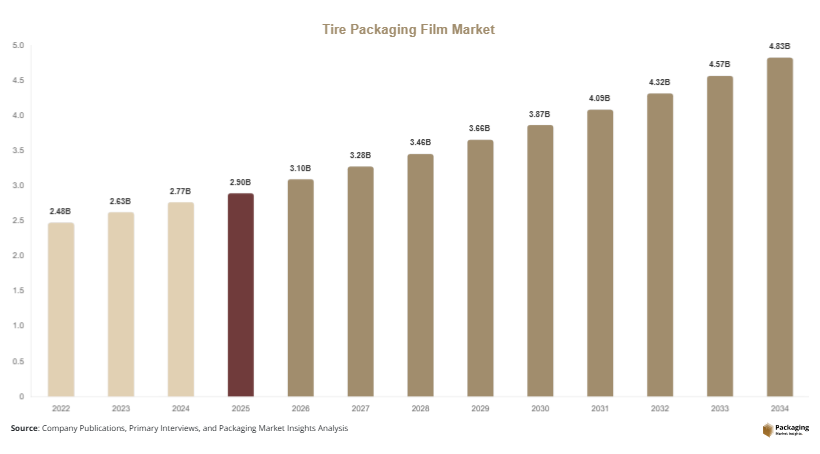
The global tire packaging film market size was valued at approximately USD 2.9 billion in 2025 and is projected to reach USD 3.1 billion in 2026. Over the forecast period from 2025 to 2034, the market is expected to grow at a CAGR of 5.7%, reaching an estimated USD 5.2 billion by 2034. Tire packaging films play a crucial role in protecting tires from environmental factors such as moisture, dust, UV exposure, and physical damage during storage and transportation. The tire packaging film market is expanding steadily as the global automotive and tire manufacturing industries continue to grow.
One of the primary growth factors is the rising production and sales of automobiles globally, which directly increases the demand for tires and associated packaging materials. The growth of the aftermarket tire segment is also contributing to market expansion, as replacement tires require effective packaging for distribution and retail display. Additionally, the increasing focus on logistics efficiency and product protection is driving the adoption of advanced packaging films that offer durability and flexibility.
Key Highlights:
- Asia Pacific dominated the market with a 39.2% share in 2025, while Latin America is projected to grow at the fastest CAGR of 6.1%.
- Polyethylene films led the type segment with a 48.5% share, while biodegradable films are expected to grow at a CAGR of 6.4%.
- Plastic films dominated with a 61.3% share, while recyclable films are forecasted to grow at a CAGR of 6.0%.
- Replacement tire applications led the segment with 46.7% share, while OEM applications are expected to grow at a CAGR of 5.9%.
- China remained the dominant country with a market size of USD 0.7 billion in 2025 and USD 0.8 billion in 2026.
Explore more data points, trends and opportunities Download Free Sample Report
Market Trends
Growing Adoption of Sustainable and Recyclable Film Materials
The tire packaging film market is witnessing a shift toward sustainable packaging solutions as environmental concerns and regulatory pressures increase. Manufacturers are focusing on developing recyclable and biodegradable films to reduce environmental impact. The use of mono-material polyethylene films is gaining traction due to their recyclability and cost efficiency. Companies are also exploring bio-based polymers to create eco-friendly alternatives to conventional plastic films. This trend is driven by the need to comply with environmental regulations and meet the sustainability goals of automotive manufacturers. As a result, innovation in material science is expected to play a crucial role in shaping the future of the market.
Technological Advancements in Multi-Layer Film Structures
Technological advancements in multi-layer film structures are significantly influencing the tire packaging film market. These films offer enhanced mechanical strength, puncture resistance, and barrier properties, making them suitable for heavy-duty applications such as tire packaging. Multi-layer extrusion technology allows manufacturers to combine different materials to achieve desired performance characteristics. Additionally, advanced coatings are being developed to improve UV resistance and durability. These innovations are helping manufacturers meet the evolving demands of the automotive industry, ensuring product protection during storage and transportation.
Market Drivers
Expansion of Global Automotive and Tire Manufacturing Industry
The growth of the global automotive and tire manufacturing industry is a key driver of the tire packaging film market. Increasing vehicle production and sales are driving the demand for tires, which in turn boosts the need for packaging films. The expansion of tire manufacturing facilities in emerging economies is further supporting market growth. Additionally, the rise in electric vehicle adoption is contributing to increased tire demand, as these vehicles require specialized tires. This trend is expected to continue, supporting the growth of the tire packaging film market.
Growth of Aftermarket Tire Sales and Distribution Networks
The increasing demand for replacement tires is another significant driver of the tire packaging film market. Aftermarket tire sales require efficient packaging solutions for storage, transportation, and retail display. Packaging films help protect tires from environmental damage and maintain product quality. The expansion of distribution networks and retail outlets is further driving demand for packaging films. Additionally, the growth of online tire sales is increasing the need for durable packaging solutions that ensure safe delivery.
Market Restraint
Fluctuations in Raw Material Prices and Environmental Regulations
The tire packaging film market faces challenges due to fluctuations in raw material prices and stringent environmental regulations. The cost of raw materials such as polyethylene and polypropylene is influenced by crude oil prices, which can impact production costs. Additionally, regulations aimed at reducing plastic waste are forcing manufacturers to adopt alternative materials, which may be more expensive. For example, transitioning to biodegradable films requires investment in new technologies and infrastructure. These factors can increase production costs and limit market growth, particularly for small and medium-sized manufacturers.
Market Opportunities
Development of High-Performance and Customizable Film Solutions
The development of high-performance and customizable film solutions presents significant opportunities for the tire packaging film market. Manufacturers are focusing on creating films with enhanced properties such as UV resistance, anti-static features, and improved durability. These advanced films can be tailored to meet specific requirements of different tire types, providing better protection and performance. The increasing demand for specialized packaging solutions is expected to drive innovation and create new growth opportunities.
Increasing Demand from Emerging Markets and Infrastructure Development
Emerging markets offer substantial growth opportunities for the tire packaging film market. Rapid urbanization and infrastructure development are driving the demand for vehicles and tires in these regions. The expansion of transportation networks and industrial activities is further supporting market growth. Manufacturers can capitalize on these opportunities by establishing local production facilities and expanding distribution networks. This approach can help companies gain a competitive edge and increase market share in high-growth regions.
Report Scope
| Report Metric | Details |
|---|---|
| Market Size in 2025 | USD 2.9 Billion |
| Market Size in 2026 | USD 3.1 Billion |
| Market Size in 2034 | USD 5.2 Billion |
| CAGR | 5.7% (2026-2034) |
| Base Year for Estimation | 2025 |
| Historical Data | 2022-2024 |
| Forecast Period | 2026-2034 |
| Report Coverage | Revenue Forecast, Competitive Landscape, Supply Chain Disruption, Growth Factors, Environment & Regulatory Landscape and Trends |
| Geographies Covered | North America, Europe, APAC, Middle East and Africa, LATAM |
| Countries Covered | U.S., Canada, U.K., Germany, France, Spain, Italy, Russia, Nordic, Benelux, Rest of Europe, China, South Korea, Japan, India, Australia, Singapore, Taiwan, South East Asia, Rest of Asia-Pacific, UAE, Turky, Saudi Arabia, South Africa, Egypt, Nigeria, Rest of MEA, Brazil, Mexico, Argentina, Chile, Colombia, Rest of LATAM |
Explore more data points, trends and opportunities Download Free Sample Report
Segmental Analysis
By Material Type
Polyethylene films accounted for the largest share of the tire packaging film market in 2024, contributing approximately 48.5% of total revenue. These films are widely used due to their flexibility, durability, and cost efficiency. Polyethylene films provide excellent protection against moisture and dust, making them suitable for tire packaging. Their lightweight nature and recyclability further support their widespread adoption in the market. Manufacturers are continuously improving the performance of polyethylene films to meet evolving industry requirements and enhance product protection.
Biodegradable films are the fastest-growing segment, expected to register a CAGR of 6.4% during the forecast period. The increasing focus on sustainability and environmental regulations is driving the adoption of eco-friendly materials. These films are designed to reduce environmental impact while maintaining performance standards. Innovations in biodegradable materials are improving their strength and durability, making them suitable for tire packaging applications. As awareness of environmental issues continues to grow, the demand for biodegradable films is expected to increase significantly.
By Product Type
Plastic films accounted for the largest share in 2024, contributing 61.3% of the total market. These films offer versatility and cost efficiency, making them suitable for various packaging applications. Plastic films provide excellent protection and durability, ensuring the safe handling and transportation of tires. Their ability to be customized according to specific requirements further supports their widespread adoption. The increasing demand for efficient packaging solutions is driving the growth of this segment.
Recyclable films are expected to grow at the fastest rate, with a CAGR of 6.0% over the forecast period. The shift toward sustainable packaging solutions is driving this segment. Recyclable films offer environmental benefits and help companies comply with regulatory requirements. Manufacturers are investing in research and development to improve the performance and recyclability of these films. This trend is expected to support the growth of the recyclable films segment in the coming years.
By Application
Replacement tire applications accounted for the largest share of the market in 2024, contributing 46.7% of total revenue. The demand for replacement tires is driven by the increasing number of vehicles on the road and the need for regular maintenance. Packaging films play a crucial role in protecting tires during storage and transportation. The expansion of distribution networks and retail outlets is further supporting the growth of this segment.
OEM applications are the fastest-growing segment, with a projected CAGR of 5.9%. The growth of automotive manufacturing is driving demand for packaging solutions in this segment. OEM packaging requires high-quality films that provide protection and efficiency during production and distribution. The increasing adoption of advanced packaging solutions is expected to support the growth of this segment.
Tire Packaging Film Market Segmentations
By Material Type
- Polyethylene Films
- Polypropylene Films
- Biodegradable Films
By Product Type
- Plastic Films
- Recyclable Films
By Application
- Replacement Tires
- OEM Tires
Regional Analysis
North America
North America accounted for approximately 27.6% of the tire packaging film market share in 2025 and is projected to grow at a CAGR of 5.3% during the forecast period. The region benefits from a well-established automotive industry and advanced logistics infrastructure. Increasing demand for high-quality packaging solutions is supporting market growth.
The United States dominates the North American market due to its large automotive sector and strong distribution networks. A key growth factor is the increasing demand for replacement tires, which drives the need for packaging films.
Europe
Europe held around 23.9% of the market share in 2025 and is expected to grow at a CAGR of 5.2% through 2034. The region is characterized by strict environmental regulations and a focus on sustainability. These factors are encouraging the adoption of recyclable packaging materials.
Germany leads the European market, supported by its strong automotive manufacturing base. The emphasis on eco-friendly packaging solutions is a key growth factor in the region.
Asia Pacific
Asia Pacific emerged as the largest regional market, accounting for 39.2% of the global share in 2025. The region is expected to grow at a CAGR of 6.0% during the forecast period. Rapid industrialization and increasing vehicle production are driving market growth.
China dominates the Asia Pacific market due to its large automotive and tire manufacturing industries. The expansion of export activities is a major growth factor, increasing demand for packaging films.
Middle East & Africa
The Middle East & Africa region accounted for approximately 4.8% of the market share in 2025 and is projected to grow at a CAGR of 5.5%. Increasing investments in infrastructure and transportation are driving demand for vehicles and tires.
The United Arab Emirates leads the regional market, supported by growing trade activities. The demand for efficient packaging solutions is a key growth factor.
Latin America
Latin America held a market share of around 3.9% in 2025 and is expected to grow at the fastest CAGR of 6.1% during the forecast period. The region is experiencing growth in automotive and industrial sectors.
Brazil dominates the Latin American market due to its large automotive industry. Increasing demand for replacement tires is driving the adoption of packaging films.
Competitive Landscape
The tire packaging film market is moderately competitive, with several global and regional players focusing on innovation and sustainability. Companies are investing in advanced manufacturing technologies and expanding their product portfolios to meet evolving market demands. Strategic collaborations and partnerships are common strategies used to strengthen market presence and enhance product offerings.
Berry Global Inc. is recognized as a leading player in the market, driven by its focus on high-performance packaging solutions. The company recently introduced advanced multi-layer films designed for tire packaging applications, offering improved durability and protection. Other key players are also investing in research and development to enhance product performance and address environmental concerns. The competitive landscape is expected to remain dynamic, with companies focusing on innovation and sustainability to gain a competitive edge.
Key Players List
- Berry Global Inc.
- Amcor plc
- Sealed Air Corporation
- Coveris Holdings S.A.
- Inteplast Group
- Sigma Plastics Group
- RKW Group
- Trioplast Industrier AB
- Jindal Poly Films Ltd.
- Uflex Ltd.
- Winpak Ltd.
- Novolex Holdings, Inc.
- Cosmo Films Ltd.
- Polyplex Corporation Ltd.
- Plastotecnica S.p.A.