Pallet Wraps Market Size
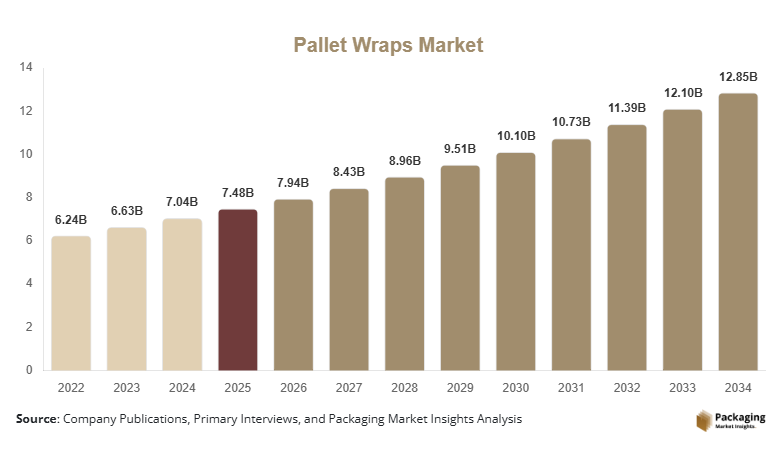
The pallet wrap market size is projected at USD 7.94 billion in 2026 and is expected to hit USD 12.86 billion by 2034 with a CAGR of 6.2%.
The report provides an extensive evaluation of the industry through detailed assessment of material types, application sectors, production capacity, technological advancements, regional demand, and the competitive landscape. It offers comprehensive quantitative analysis of manufacturing trends, supply chain developments, pricing dynamics, and strategic investments supporting informed business decisions.
Pallet wraps are stretchable plastic films designed to secure palletized goods during storage, transportation, and distribution. These films improve load stability, protect products from moisture and contamination, and reduce logistics damage across industrial supply chains. Global production exceeded 9.4 million metric tons in 2025, while machine-grade pallet wraps accounted for approximately 61% of total output. Food and beverage applications represented nearly 36% of demand, industrial manufacturing contributed 31%, and logistics operations accounted for 22%, reinforcing the pallet wrap market.
Explore more data points, trends and opportunities Download Free Sample Report
Pallet Wraps Market Trends
Increasing Adoption of High-Performance Stretch Film Technologies
Manufacturers continue investing in multilayer extrusion technologies, nano-layer films, and downgauged stretch films to improve load retention while reducing material consumption. More than 5.8 million metric tons of high-performance pallet wraps were produced globally during 2025, while automated stretch wrapping installations increased by 16%. Improved puncture resistance and higher stretch efficiency continue strengthening the pallet wrap market.
Growing sustainability initiatives are accelerating the adoption of recyclable and recycled-content stretch films. Approximately 49% of newly introduced pallet wrap products incorporated recycled polymers during 2025, while recycled polyethylene utilization increased by 18%. Logistics providers and manufacturers continue emphasizing lightweight packaging and waste reduction across the pallet wrap market.
Pallet Wraps Market Drivers
Expansion of Global Logistics and Warehouse Operations
Rapid expansion of e-commerce, industrial production, and international trade continues increasing demand for pallet stabilization solutions. Global warehouse capacity expanded by 13% during 2025, while pallet shipments exceeded 8.2 billion units annually. Automated logistics facilities increased by 17%, accelerating adoption across the pallet wrap market.
Pallet Wraps Market Restraints
Fluctuating Polyethylene Resin Prices
Manufacturers continue facing volatility in polyethylene resin pricing and energy costs. Raw material expenses fluctuated between 11% and 18% during 2025, while transportation costs increased by approximately 9%. These cost pressures continue affecting production margins and restraining the pallet wrap market.
Pallet Wraps Market Opportunities
Growing Demand for Sustainable Stretch Films
Increasing environmental regulations and corporate sustainability targets create significant opportunities for recyclable and recycled-content pallet wraps. Recycled polymer demand increased by 19% during 2025, while sustainable industrial packaging investments exceeded USD 2.7 billion globally. Development of ultra-thin high-performance films continues strengthening the pallet wrap market.
Challenges in Pallet Wraps Market
Balancing Film Strength with Material Reduction
Manufacturers continue optimizing downgauged stretch films without compromising load stability and puncture resistance. Film thickness reductions averaged 12%, while quality testing costs increased by 8%. Advanced resin formulations and multilayer extrusion technologies remain essential for maintaining product performance across the pallet wrap market.
Report Scope
| Report Metric | Details |
|---|---|
| Market Size in 2025 | USD 7.48 Billion |
| Market Size in 2026 | USD 7.94 Billion |
| Market Size in 2034 | USD 12.86 Billion |
| CAGR | 6.2% (2026-2034) |
| Base Year for Estimation | 2025 |
| Historical Data | 2022-2024 |
| Forecast Period | 2026-2034 |
| Report Coverage | Revenue Forecast, Competitive Landscape, Supply Chain Disruption, Growth Factors, Environment & Regulatory Landscape and Trends |
| Geographies Covered | North America, Europe, APAC, Middle East and Africa, LATAM |
| Countries Covered | U.S., Canada, U.K., Germany, France, Spain, Italy, Russia, Nordic, Benelux, Rest of Europe, China, South Korea, Japan, India, Australia, Singapore, Taiwan, South East Asia, Rest of Asia-Pacific, UAE, Turkey, Saudi Arabia, South Africa, Egypt, Nigeria, Rest of MEA, Brazil, Mexico, Argentina, Chile, Colombia, Rest of LATAM |
Explore more data points, trends and opportunities Download Free Sample Report
Pallet Wraps Market Segmentation
The market is segmented according to material type and application. Linear low-density polyethylene accounts for approximately 64% of total consumption, while food and beverage applications contribute nearly 36% of overall demand owing to extensive palletized product transportation and warehouse operations.
By Material Type
LLDPE dominates the market with approximately 64% share. Annual production exceeded 6 million metric tons during 2025 because of superior stretchability, puncture resistance, and load retention. Film thickness generally ranges from 12 to 35 microns, making LLDPE suitable for high-performance industrial packaging.
LDPE accounts for nearly 23% of market demand. Production exceeded 2.1 million metric tons, supporting light-duty pallet wrapping and secondary packaging applications. Excellent flexibility and cost efficiency continue driving adoption.
High-performance multi-layer films contribute approximately 13% of total demand. Production surpassed 1.2 million metric tons, featuring enhanced tensile strength, superior cling performance, and improved load containment for automated pallet wrapping systems.
By Application
Food and beverage remains the largest application with approximately 36% market share. More than 3.3 million metric tons of pallet wraps were consumed during 2025 to protect packaged foods, beverages, frozen products, and retail shipments. Hygiene standards and efficient logistics continue supporting demand.
Industrial and manufacturing applications account for approximately 31% of global consumption. Annual demand exceeded 2.9 million metric tons, supporting machinery, chemicals, construction materials, and automotive component transportation. High-load stability remains a critical requirement.
Logistics and warehousing contribute nearly 22% of total market demand. Consumption exceeded 2 million metric tons, driven by expanding fulfillment centers, third-party logistics providers, and automated warehouse operations requiring efficient pallet stabilization.
Pallet Wraps Market Segmentations
Material Type
- Linear Low-Density Polyethylene (LLDPE)
- Low-Density Polyethylene (LDPE)
- High-Performance Multi-Layer Films
Application
- Food & Beverage
- Industrial & Manufacturing
- Logistics & Warehousing
Pallet Wraps Regional Outlook
North America
North America accounts for approximately 28% of global demand. The United States contributes nearly 84% of regional consumption due to advanced logistics infrastructure and widespread warehouse automation. Annual pallet wrap production exceeded 2.3 million metric tons.
Europe
Europe represents approximately 30% of worldwide demand. Germany, France, Italy, and the United Kingdom collectively contribute more than 72% of regional production. Recyclable stretch film adoption exceeded 52%, supported by stringent packaging sustainability regulations.
Asia-Pacific
Asia-Pacific contributes approximately 35% of global demand and remains the fastest-growing regional market. China, India, Japan, and South Korea account for over 79% of regional production. Manufacturing exceeded 3.2 million metric tons, supported by expanding industrial production and export activities.
Latin America
Latin America represents approximately 4% of global demand. Brazil and Mexico remain major regional consumers, with industrial manufacturing accounting for nearly 59% of pallet wrap utilization. Regional logistics investments continue supporting market expansion.
Middle East & Africa
The Middle East & Africa contributes approximately 3% of worldwide demand. Saudi Arabia, the UAE, and South Africa continue investing in warehousing, industrial production, and logistics infrastructure. Regional pallet wrap demand increased by approximately 10% during 2025.
Top Players In The Pallet Wrap Market
- Berry Global Inc.
- Sigma Stretch Film Corp.
- Amcor, PLC,
- Inteplast Group
- Coveris Holdings S.A.,
- Manuli Stretch S.p.A.,
- AEP Industries Inc.,
- Dow Inc.,
- Paragon Films
- Scientex Berhad
- Trioworld Group
- RKW Group
- Bolloré Group
- POLIFILM GmbH
- Novolex Holdings LLC
Berry Global Inc. Estimated market share: 12–14% Leading global manufacturer of stretch films and industrial packaging solutions. Extensive manufacturing footprint across North America, Europe, and Asia. Continuous investment in recyclable stretch films, downgauged packaging materials, multilayer extrusion technologies, and sustainable industrial packaging solutions supports its leadership position in global pallet wrap manufacturing. Sigma Stretch Film Corp. Estimated market share: 10–12% Major supplier of machine-grade and hand-grade stretch films. Strong presence across logistics, food processing, and industrial packaging sectors. Continuous investments in high-performance resin formulations, automated film production, and sustainable packaging innovations enhance operational efficiency and support expanding global demand for pallet stabilization products.