Market Overview
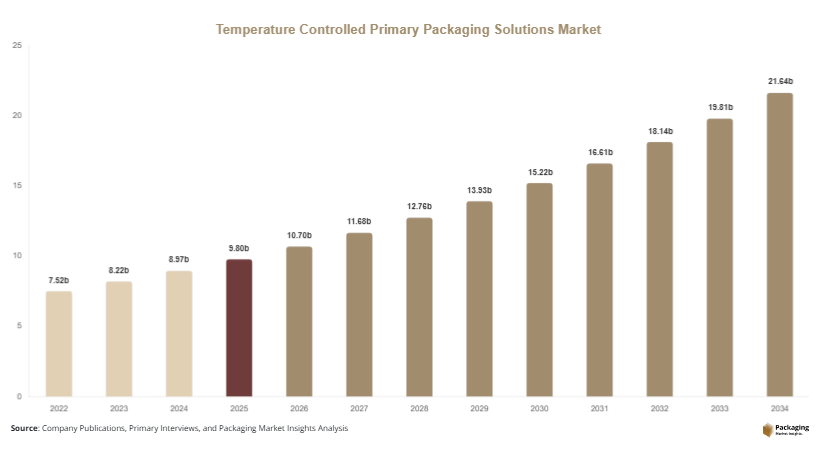
The global market size is estimated at USD 9.8 billion, and it is projected to reach USD 10.7 billion in 2026, driven by rising demand for biologics and global vaccine distribution programs. By 2034, the market is forecasted to reach USD 21.6 billion, registering a compound annual growth rate (CAGR) of 9.2% from 2025 to 2034. This strong growth trajectory reflects the increasing need for reliable cold-chain logistics and regulatory compliance across global healthcare systems.
The Temperature Controlled Primary Packaging Solutions Market is witnessing steady expansion as pharmaceutical, biotechnology, and specialty food industries increasingly rely on advanced cold-chain packaging systems to preserve product integrity during storage and transportation. These solutions include insulated containers, phase change materials (PCM), vacuum insulated panels, and gel-based refrigerants designed to maintain strict temperature ranges for sensitive products such as vaccines, biologics, cell therapies, and high-value perishables.
Key Highlights:
- North America dominated the Temperature Controlled Primary Packaging Solutions Market with the largest share of 38.4% in 2025.
- Asia Pacific is expected to be the fastest-growing region during the forecast period at a CAGR of 10.8%.
- Based on product type, insulated shippers dominated the market with a share of 42.1% in 2025.
- Based on material, vacuum insulated panels accounted for 36.5% share in 2025.
- Based on end-use, pharmaceutical and biotechnology segment dominated with 48.7% share in 2025.
- The US market size was valued at USD 3.1 billion in 2025 and is projected to reach USD 3.4 billion in 2026.
Explore more data points, trends and opportunities Download Free Sample Report
Market Trends
Integration of Smart Temperature Monitoring Systems
One of the most significant trends in the Temperature Controlled Primary Packaging Solutions Market is the integration of smart temperature monitoring technologies. These systems use IoT-enabled sensors, RFID tags, and real-time tracking devices to continuously monitor temperature conditions during transit. Pharmaceutical companies increasingly demand visibility and data-driven assurance for high-value biologics and vaccines. Smart packaging solutions allow logistics providers to detect temperature deviations instantly and take corrective action, reducing product spoilage risks. Furthermore, cloud-based dashboards and predictive analytics are enhancing supply chain transparency. This trend is expected to gain momentum as regulatory authorities encourage digital traceability in cold-chain logistics, especially for global vaccine distribution programs and advanced cell and gene therapies.
Shift Toward Sustainable and Reusable Packaging Systems
Sustainability is becoming a core trend shaping the Temperature Controlled Primary Packaging Solutions Market. Companies are shifting from single-use packaging toward reusable and recyclable materials to reduce environmental impact and operational costs. Innovations in biodegradable insulation materials, reusable vacuum insulated containers, and recyclable gel packs are gaining traction. Pharmaceutical and food logistics companies are increasingly adopting circular packaging models, where packaging is returned, sterilized, and reused multiple times. This shift is driven by global ESG commitments and stricter environmental regulations. Additionally, cost-saving potential over long-term usage is encouraging adoption across large-scale distribution networks. As sustainability becomes a procurement requirement, manufacturers focusing on eco-friendly designs are expected to gain a competitive advantage.
Market Drivers
Rising Demand for Biologics and Temperature-Sensitive Drugs
The rapid expansion of biologics, biosimilars, and advanced therapeutic products is a major driver of the Temperature Controlled Primary Packaging Solutions Market. These products require strict temperature control, often between 2°C and 8°C or even ultra-cold conditions down to -70°C. The increasing prevalence of chronic diseases such as cancer, diabetes, and autoimmune disorders has accelerated demand for biologics globally. Pharmaceutical companies are expanding production pipelines, which increases the need for reliable cold-chain packaging solutions. Additionally, the rise of personalized medicine and cell-based therapies requires highly specialized packaging systems to maintain product stability. This growing complexity in drug formulations is pushing manufacturers to invest in advanced insulation technologies and high-performance packaging systems.
Expansion of Global Vaccine Distribution Networks
Another major driver is the expansion of global vaccine distribution programs, particularly following large-scale immunization initiatives worldwide. Governments and healthcare organizations are strengthening cold-chain infrastructure to ensure vaccine safety and efficacy during transportation. Temperature controlled primary packaging plays a critical role in maintaining stability across long-distance logistics networks. The increasing focus on pandemic preparedness and routine immunization programs is further strengthening demand. Emerging markets are also investing heavily in healthcare infrastructure, increasing adoption of advanced packaging solutions. As vaccine technologies evolve, including mRNA-based formulations requiring ultra-cold storage, demand for high-performance packaging systems continues to grow rapidly.
Market Restraint
High Operational and Material Costs
A key restraint affecting the Temperature Controlled Primary Packaging Solutions Market is the high cost associated with advanced packaging materials and operational processes. Technologies such as vacuum insulated panels, phase change materials, and smart monitoring devices significantly increase production costs. For small and mid-sized pharmaceutical companies, these costs can be prohibitive, limiting widespread adoption. Additionally, logistics expenses increase due to the need for specialized handling, returnable packaging systems, and cold-chain infrastructure maintenance. In developing regions, inadequate infrastructure further amplifies operational inefficiencies and cost burdens. For example, limited availability of temperature-controlled storage facilities in rural supply chains leads to higher wastage rates and increased dependency on expensive packaging solutions. While large pharmaceutical companies can absorb these costs, smaller firms often struggle to implement high-end solutions, thereby restricting overall market penetration. Cost reduction through material innovation and scalable production remains a key challenge for industry participants.
Market Opportunities
Growth in Cell and Gene Therapy Logistics
The increasing commercialization of cell and gene therapies presents a significant opportunity in the Temperature Controlled Primary Packaging Solutions Market. These therapies require ultra-precise temperature control, often involving cryogenic conditions during transportation. As more therapies receive regulatory approval, demand for specialized packaging solutions is rising rapidly. Packaging providers are developing advanced cryogenic containers and phase-stable insulation systems tailored for high-value biological materials. This segment also requires enhanced security and traceability features, creating opportunities for smart packaging integration. Pharmaceutical companies are forming partnerships with packaging manufacturers to develop customized cold-chain solutions, ensuring product integrity from manufacturing facilities to clinical sites.
Expansion in Emerging Economies
Emerging economies in Asia Pacific, Latin America, and parts of Africa represent a major growth opportunity. These regions are experiencing rapid improvements in healthcare infrastructure and pharmaceutical distribution networks. Increasing government investments in vaccination programs and growing pharmaceutical manufacturing activities are boosting demand for temperature controlled packaging systems. Additionally, rising penetration of online pharmacy platforms is increasing the need for last-mile cold-chain logistics. Local manufacturers are entering the market with cost-effective packaging solutions tailored to regional needs. This expansion is expected to significantly contribute to global market growth over the forecast period.
Report Scope
| Report Metric | Details |
|---|---|
| Market Size in 2025 | USD 9.8 billion |
| Market Size in 2026 | USD 10.7 billion |
| Market Size in 2034 | USD 21.6 billion |
| CAGR | 9.2% (2026-2034) |
| Base Year for Estimation | 2025 |
| Historical Data | 2022-2024 |
| Forecast Period | 2026-2034 |
| Report Coverage | Revenue Forecast, Competitive Landscape, Supply Chain Disruption, Growth Factors, Environment & Regulatory Landscape and Trends |
| Geographies Covered | North America, Europe, APAC, Middle East and Africa, LATAM |
| Countries Covered | U.S., Canada, U.K., Germany, France, Spain, Italy, Russia, Nordic, Benelux, Rest of Europe, China, South Korea, Japan, India, Australia, Singapore, Taiwan, South East Asia, Rest of Asia-Pacific, UAE, Turky, Saudi Arabia, South Africa, Egypt, Nigeria, Rest of MEA, Brazil, Mexico, Argentina, Chile, Colombia, Rest of LATAM |
Explore more data points, trends and opportunities Download Free Sample Report
Segmental Analysis
By Product Type
Insulated shippers dominated the Temperature Controlled Primary Packaging Solutions Market with a 2024 share of 42.1%, driven by their widespread use in pharmaceutical logistics and vaccine transportation. These systems provide reliable thermal protection across short and long-haul deliveries, making them essential for maintaining drug stability.
The fastest-growing subsegment is reusable insulated containers, projected to expand at a CAGR of 10.2% due to rising sustainability initiatives and cost-efficiency advantages. Pharmaceutical companies are increasingly adopting reusable models to reduce packaging waste and long-term operational costs.
By Material
Vacuum insulated panels held the dominant share of 36.5% in 2024, owing to their superior thermal performance and lightweight structure. These materials are widely used in high-value pharmaceutical shipments requiring strict temperature control.
Phase change materials are the fastest-growing subsegment with a CAGR of 9.8%, driven by their ability to maintain stable temperature ranges without external energy sources. Their application in biologics and vaccine logistics is expanding rapidly.
By End Use
The pharmaceutical and biotechnology segment dominated with a 48.7% share in 2024, reflecting strong demand for biologics, vaccines, and advanced therapies. This segment heavily relies on precise temperature control during transportation and storage.
The fastest-growing subsegment is the clinical research and diagnostics segment, growing at a CAGR of 10.5%, driven by increasing clinical trials and personalized medicine development globally.
Temperature Controlled Primary Packaging Solutions Market Segmentations
By Product Type
- Insulated Shippers
- Reusable Containers
- Single-Use Thermal Packaging
- Thermal Blankets
By Material
- Vacuum Insulated Panels (VIP)
- Phase Change Materials (PCM)
- Expanded Polystyrene (EPS)
- Polyurethane Foam
By End Use
- Pharmaceutical & Biotechnology
- Food & Beverage Logistics
- Clinical Research & Diagnostics
- Chemical & Industrial Logistics
- Others
Regional Analysis
North America
North America accounted for approximately 38.4% share of the Temperature Controlled Primary Packaging Solutions Market in 2025, supported by advanced healthcare infrastructure and strong pharmaceutical manufacturing capabilities. The region is expected to grow at a CAGR of 9.1% during 2025–2034, driven by continuous innovation in cold-chain logistics and packaging technologies. High adoption of biologics and vaccines further strengthens regional dominance.
The United States remains the leading country due to its strong presence of pharmaceutical giants and biotech firms. A key growth factor is the widespread adoption of personalized medicine and gene therapy, which requires highly controlled packaging environments for product stability and compliance with regulatory standards.
Europe
Europe held around 27.6% market share in 2025, with a projected CAGR of 8.7% through 2034. The region benefits from strict regulatory frameworks and high demand for sustainable packaging solutions in pharmaceutical logistics. Strong emphasis on green packaging is driving innovation.
Germany leads the European market due to its strong pharmaceutical manufacturing base. A major growth factor is the integration of environmentally friendly packaging systems aligned with EU sustainability goals, encouraging reusable and recyclable cold-chain solutions.
Asia Pacific
Asia Pacific accounted for 22.9% share in 2025 and is expected to grow at the fastest CAGR of 10.8%, driven by expanding pharmaceutical production and increasing healthcare investments. Rapid urbanization and rising vaccine demand further boost growth.
China dominates the region due to its large-scale pharmaceutical manufacturing ecosystem. A key growth driver is government investment in healthcare infrastructure and cold-chain logistics expansion in rural and semi-urban areas.
Middle East & Africa
The Middle East & Africa region held a 6.3% share in 2025, with a CAGR of 9.4% expected through 2034. Growth is supported by increasing healthcare modernization and vaccine distribution programs across Gulf countries and parts of Africa.
Saudi Arabia leads the region due to strong healthcare investments. A major growth factor is the expansion of temperature-controlled logistics networks for imported pharmaceuticals and vaccines.
Latin America
Latin America accounted for 4.8% market share in 2025, with a CAGR of 8.9% projected through 2034. Growth is driven by improving pharmaceutical distribution systems and rising demand for biologics.
Brazil is the dominant country due to its large healthcare system and vaccine distribution programs. A key growth driver is increasing investment in cold-chain infrastructure for remote and rural healthcare delivery.
Competitive Landscape
The Temperature Controlled Primary Packaging Solutions Market is moderately consolidated, with key players focusing on innovation, sustainability, and global expansion. Leading companies include Sonoco ThermoSafe, Pelican BioThermal, Cold Chain Technologies, Envirotainer, and Softbox Systems. These companies dominate due to strong product portfolios and global distribution networks.
Sonoco ThermoSafe is a leading player focusing on reusable packaging systems and advanced insulation technologies. A recent development includes the expansion of its reusable shipper portfolio to support biologics distribution across North America and Europe.
Companies are increasingly investing in IoT-enabled packaging solutions and sustainable materials to meet regulatory and environmental requirements. Strategic partnerships with pharmaceutical companies are also common to develop customized cold-chain packaging solutions.
Key Players List
- Sonoco ThermoSafe
- Pelican BioThermal
- Envirotainer
- Cold Chain Technologies
- Softbox Systems
- DS Smith
- Cryopak
- va-Q-tec
- Intelsius
- ACH Foam Technologies
- Snyder Industries
- Marko Foam Products
- Tempack Packaging Solutions
- CoolPac
- Peli BioThermal Solutions