Isothermal Packaging Market Size and Growth
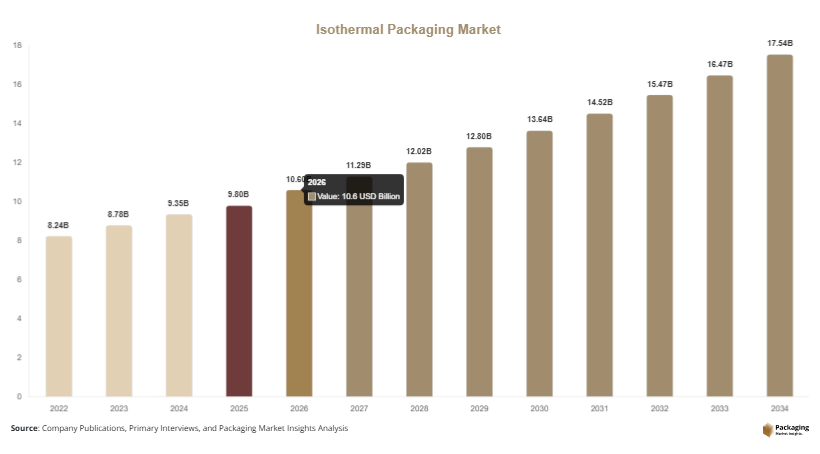
The global isothermal packaging market size is estimated at USD 9.8 billion, and it is projected to reach USD 10.6 billion in 2026. By 2034, the market is forecasted to expand to approximately USD 18.7 billion, registering a compound annual growth rate (CAGR) of 6.5% during 2025–2034. The expansion is driven by the growing need for maintaining product integrity during transit, particularly for vaccines, biologics, and perishable food items. The isothermal packaging market is witnessing steady growth due to increasing demand for temperature-sensitive product transportation across industries such as pharmaceuticals, food & beverages, and biotechnology.
One of the key growth factors includes the rising global pharmaceutical trade, which requires strict temperature control during shipping. Isothermal packaging solutions such as insulated containers and phase change materials help ensure product stability across long distances. Another significant factor is the surge in e-commerce, especially in food delivery and meal kits, which has increased demand for reliable cold chain packaging. Additionally, regulatory compliance for temperature-sensitive goods is pushing manufacturers to adopt advanced packaging technologies that can ensure consistent thermal performance.
Technological advancements are also playing a role in shaping the market. Innovations such as reusable thermal packaging, smart sensors for temperature tracking, and eco-friendly insulation materials are gaining traction. Companies are increasingly focusing on sustainability, leading to the development of recyclable and biodegradable isothermal packaging solutions. Furthermore, the expansion of cold chain infrastructure in emerging economies is creating new opportunities for market players.
The healthcare sector remains a major contributor, especially with increasing vaccine distribution programs and biologics transportation. At the same time, the food industry is adopting isothermal packaging to reduce spoilage and extend shelf life, particularly in cross-border shipments.
Key Highlights:
- Asia Pacific dominated the market with a 38.2% share in 2025, while Latin America is projected to grow at the fastest CAGR of 6.9%.
- Insulated containers led the type segment with a 31.4% share, while phase change materials are expected to grow at a CAGR of 7.1%.
- Plastic-based packaging dominated with a 49.8% share, while biodegradable materials are forecasted to grow at a CAGR of 6.8%.
- Pharmaceutical applications led the segment with 45.6% share, while food delivery services are expected to grow at a CAGR of 7.0%.
- The US remained the dominant country with a market size of USD 2.7 billion in 2025 and USD 2.9 billion in 2026.
Explore more data points, trends and opportunities Download Free Sample Report
Market Trends
Rising Adoption of Sustainable Packaging Solutions
Sustainability is becoming a central trend in the isothermal packaging market as companies seek to reduce environmental impact. Manufacturers are increasingly developing recyclable insulation materials and reusable packaging systems to align with environmental regulations and corporate sustainability goals. The shift away from traditional polystyrene-based insulation toward paper-based and plant-based materials is gaining momentum. Additionally, consumers are demanding eco-friendly packaging, especially in the food delivery and e-commerce sectors. This trend is encouraging companies to invest in circular economy models, where packaging is reused multiple times, thereby reducing waste and overall cost. The focus on sustainability is expected to significantly influence product innovation and purchasing decisions over the forecast period.
Integration of Smart Monitoring Technologies
Another notable trend is the integration of smart technologies into isothermal packaging systems. Temperature sensors, GPS tracking, and IoT-enabled devices are increasingly being incorporated to monitor conditions in real time. These technologies provide valuable data on temperature fluctuations, transit time, and handling conditions, helping companies ensure compliance and reduce product loss. The pharmaceutical industry, in particular, is adopting these smart solutions to maintain strict regulatory standards for drug transportation. Moreover, data analytics derived from these systems can help optimize supply chain operations. This trend is expected to enhance transparency and efficiency across logistics networks.
Market Drivers
Growth in Pharmaceutical and Biologics Transportation
The rapid expansion of the pharmaceutical industry is a major driver of the isothermal packaging market. The transportation of temperature-sensitive drugs, vaccines, and biologics requires precise thermal control to maintain efficacy. Increasing global healthcare demand, along with the rise in clinical trials and vaccine distribution programs, has significantly boosted the need for reliable packaging solutions. Additionally, strict regulatory frameworks mandate the use of validated packaging systems for drug transportation. This has encouraged pharmaceutical companies to invest in advanced isothermal packaging solutions that offer consistent temperature performance over extended durations.
Expansion of E-commerce and Food Delivery Services
The growth of e-commerce platforms and online food delivery services is another key driver. Consumers are increasingly ordering perishable items such as groceries, meal kits, and frozen foods online. This shift has created a strong demand for packaging solutions that can maintain product freshness during transit. Isothermal packaging helps prevent spoilage and ensures food safety, making it an essential component of the supply chain. Moreover, the rise of direct-to-consumer business models has further increased the need for efficient cold chain logistics, thereby driving market growth.
Market Restraint
High Cost of Advanced Packaging Solutions
One of the primary restraints in the isothermal packaging market is the high cost associated with advanced packaging materials and technologies. Solutions such as phase change materials, vacuum-insulated panels, and smart monitoring systems can significantly increase packaging costs. This poses a challenge for small and medium-sized enterprises that may have limited budgets. Additionally, the initial investment required for reusable packaging systems can be substantial. These cost factors may limit adoption, particularly in price-sensitive markets. For example, smaller food delivery companies may opt for cheaper alternatives, even if they offer lower thermal efficiency, thereby restricting overall market penetration.
Market Opportunities
Expansion in Emerging Markets
Emerging economies present significant growth opportunities for the isothermal packaging market. Rapid urbanization, increasing healthcare expenditure, and expanding food delivery services are driving demand in regions such as Asia Pacific, Latin America, and Africa. Governments in these regions are investing in cold chain infrastructure, which is expected to support market growth. Additionally, the rising middle-class population and changing consumption patterns are increasing demand for perishable goods, further boosting the need for temperature-controlled packaging solutions.
Development of Reusable Packaging Systems
The growing focus on sustainability is creating opportunities for reusable isothermal packaging solutions. Companies are developing durable packaging systems that can be used multiple times, reducing waste and overall cost. These systems are particularly beneficial for industries with frequent shipments, such as pharmaceuticals and meal kit delivery services. Reusable packaging also aligns with environmental regulations and corporate sustainability goals. As awareness increases, more companies are expected to adopt these solutions, creating new revenue streams for market players.
Report Scope
| Report Metric | Details |
|---|---|
| Market Size in 2025 | USD 9.8 Billion |
| Market Size in 2026 | USD 10.6 Billion |
| Market Size in 2034 | USD 18.7 Billion |
| CAGR | 6.5% (2026-2034) |
| Base Year for Estimation | 2025 |
| Historical Data | 2022-2024 |
| Forecast Period | 2026-2034 |
| Report Coverage | Revenue Forecast, Competitive Landscape, Supply Chain Disruption, Growth Factors, Environment & Regulatory Landscape and Trends |
| Geographies Covered | North America, Europe, APAC, Middle East and Africa, LATAM |
| Countries Covered | U.S., Canada, U.K., Germany, France, Spain, Italy, Russia, Nordic, Benelux, Rest of Europe, China, South Korea, Japan, India, Australia, Singapore, Taiwan, South East Asia, Rest of Asia-Pacific, UAE, Turky, Saudi Arabia, South Africa, Egypt, Nigeria, Rest of MEA, Brazil, Mexico, Argentina, Chile, Colombia, Rest of LATAM |
Explore more data points, trends and opportunities Download Free Sample Report
Segmental Analysis
By Type
Insulated containers dominated the isothermal packaging market in 2024, accounting for approximately 34.2% of the total share. These containers are widely used due to their ability to maintain stable temperatures for extended periods. They are commonly used in pharmaceutical and food industries for transporting temperature-sensitive products. Their durability and reusability make them a preferred choice for companies looking to reduce long-term costs. Additionally, advancements in insulation materials have improved their performance, further driving their adoption across various industries.
Phase change materials (PCMs) are expected to be the fastest-growing subsegment, with a projected CAGR of 7.1%. PCMs offer precise temperature control by absorbing and releasing thermal energy during phase transitions. This makes them ideal for applications requiring strict temperature ranges, such as vaccine transportation. The growing demand for advanced thermal packaging solutions is driving the adoption of PCMs, particularly in the pharmaceutical sector.
By Application
The pharmaceutical segment dominated the market in 2024, holding a share of 45.6%. The need for temperature-controlled packaging for drugs, vaccines, and biologics is a major factor driving this segment. Regulatory requirements for maintaining product integrity during transportation have further increased demand. Pharmaceutical companies are investing in advanced packaging solutions to ensure compliance and reduce product loss.
The food delivery segment is expected to grow at the fastest CAGR of 7.0%. The increasing popularity of online food ordering and meal kit services is driving demand for reliable packaging solutions. Isothermal packaging helps maintain food freshness and quality during transit, making it essential for this segment. The growth of e-commerce platforms is further supporting this trend.
By Material
Plastic-based packaging dominated the market in 2024, accounting for 49.8% of the share. Plastics are widely used due to their lightweight nature, durability, and cost-effectiveness. They offer good insulation properties and are suitable for a wide range of applications. However, environmental concerns are leading to a gradual shift toward sustainable alternatives.
Biodegradable materials are expected to be the fastest-growing subsegment, with a CAGR of 6.8%. The increasing focus on sustainability and environmental regulations is driving demand for eco-friendly packaging solutions. Companies are developing innovative materials that offer similar performance to traditional plastics while reducing environmental impact.
Isothermal Packaging Market Segmentations
By Packaging Type
- Insulated Containers
- Phase Change Material Packaging
- Vacuum Insulated Panels
- Insulated Shippers & Boxes
- Thermal Blankets & Covers
By nMaterial Type
- Plastic-Based Isothermal Packaging
- Paper & Fiber-Based Packaging
- Metal-Based Thermal Packaging
- Biodegradable & Compostable Materials
- Hybrid Composite Insulation Materials
By End-User Industry
- Pharmaceutical & Biotechnology
- Food & Beverage Distribution
- Chemical Transportation
- E-commerce Grocery Delivery
- Healthcare & Clinical Logistics
Regional Analysis
North America
North America accounted for approximately 29.5% of the global isothermal packaging market share in 2025 and is projected to grow at a CAGR of 5.8% during the forecast period. The region benefits from a well-established cold chain infrastructure and strong demand from the pharmaceutical and food industries. High healthcare spending and stringent regulatory requirements further support market growth. The presence of advanced logistics networks ensures efficient transportation of temperature-sensitive products.
The United States dominates the North American market due to its large pharmaceutical industry and strong e-commerce sector. One unique growth factor is the increasing adoption of biologics and specialty drugs, which require strict temperature control. This has led to higher demand for advanced isothermal packaging solutions that can maintain precise temperature ranges over long distances.
Europe
Europe held a market share of around 24.3% in 2025 and is expected to grow at a CAGR of 5.6%. The region’s growth is driven by strict regulatory standards for pharmaceutical transportation and a strong focus on sustainability. Countries in Europe are actively promoting eco-friendly packaging solutions, which is influencing market trends. The region also has a well-developed logistics network supporting cold chain operations.
Germany is the leading country in the European market, supported by its robust manufacturing and pharmaceutical sectors. A unique growth factor is the increasing emphasis on sustainable packaging practices. Companies in Germany are investing in recyclable and biodegradable materials, which is driving innovation in the isothermal packaging market.
Asia Pacific
Asia Pacific dominated the market with a 38.2% share in 2025 and is projected to grow at a CAGR of 7.1%. Rapid industrialization, urbanization, and increasing healthcare expenditure are key drivers in the region. The expansion of e-commerce and food delivery services is also contributing to market growth. Additionally, improving cold chain infrastructure is supporting the adoption of isothermal packaging solutions.
China is the dominant country in Asia Pacific, driven by its large population and growing pharmaceutical industry. A unique growth factor is the rapid expansion of online grocery platforms, which require efficient temperature-controlled packaging. This has significantly increased demand for isothermal packaging solutions in the region.
Middle East & Africa
The Middle East & Africa region accounted for approximately 4.8% of the market share in 2025 and is expected to grow at a CAGR of 6.0%. Growth in this region is driven by increasing investments in healthcare infrastructure and rising demand for temperature-sensitive products. The development of cold chain logistics is also supporting market expansion.
The United Arab Emirates leads the regional market due to its advanced logistics infrastructure. A unique growth factor is the increasing import of pharmaceutical products, which requires reliable packaging solutions. This has created opportunities for isothermal packaging providers in the region.
Latin America
Latin America held a market share of 3.2% in 2025 and is projected to grow at the fastest CAGR of 6.9%. The region’s growth is supported by rising demand for pharmaceuticals and perishable food products. Improving logistics infrastructure and increasing foreign investments are also contributing to market expansion.
Brazil is the dominant country in Latin America, driven by its large population and growing healthcare sector. A unique growth factor is the expansion of cold chain logistics for agricultural exports. This has increased demand for isothermal packaging solutions to maintain product quality during transportation.
Competitive Landscape
The isothermal packaging market is moderately competitive, with several key players focusing on innovation and sustainability. The leading company in the market is Sonoco Products Company, known for its extensive product portfolio and strong global presence. The company recently introduced a new line of recyclable thermal packaging solutions to meet growing environmental demands.
Other major players include Pelican BioThermal, Cold Chain Technologies, Sofrigam, and Cryopak. These companies are investing in research and development to enhance product performance and expand their market reach. Strategic partnerships and acquisitions are also common strategies used to strengthen market position.
Key Players List
- Sonoco Products Company
- Pelican BioThermal
- Cold Chain Technologies
- Sofrigam
- Cryopak
- Tempack
- Intelsius
- Envirotainer
- Va-Q-Tec AG
- Softbox Systems
- Inmark Packaging
- Snyder Industries
- Insulated Products Corporation
- American Aerogel Corporation
- DGP Intelsius